An extensible developer-friendly application security platform that scans source code to surface true and actionable security issues with AI-assisted
Semgrep is well-regarded for its robust security scanning capabilities that can be integrated seamlessly into the development workflow. Users appreciate its effectiveness in detecting vulnerabilities and secrets, making it a popular choice for maintaining high security standards. However, there is minimal discussion of pricing in the reviews and social mentions, indicating neutral or undisclosed sentiment in that area. Overall, Semgrep holds a strong reputation, especially among developers who value its comprehensive, open-source scanning tools compatible with various tech stacks.
Mentions (30d)
1
Reviews
0
Platforms
2
GitHub Stars
14,868
914 forks
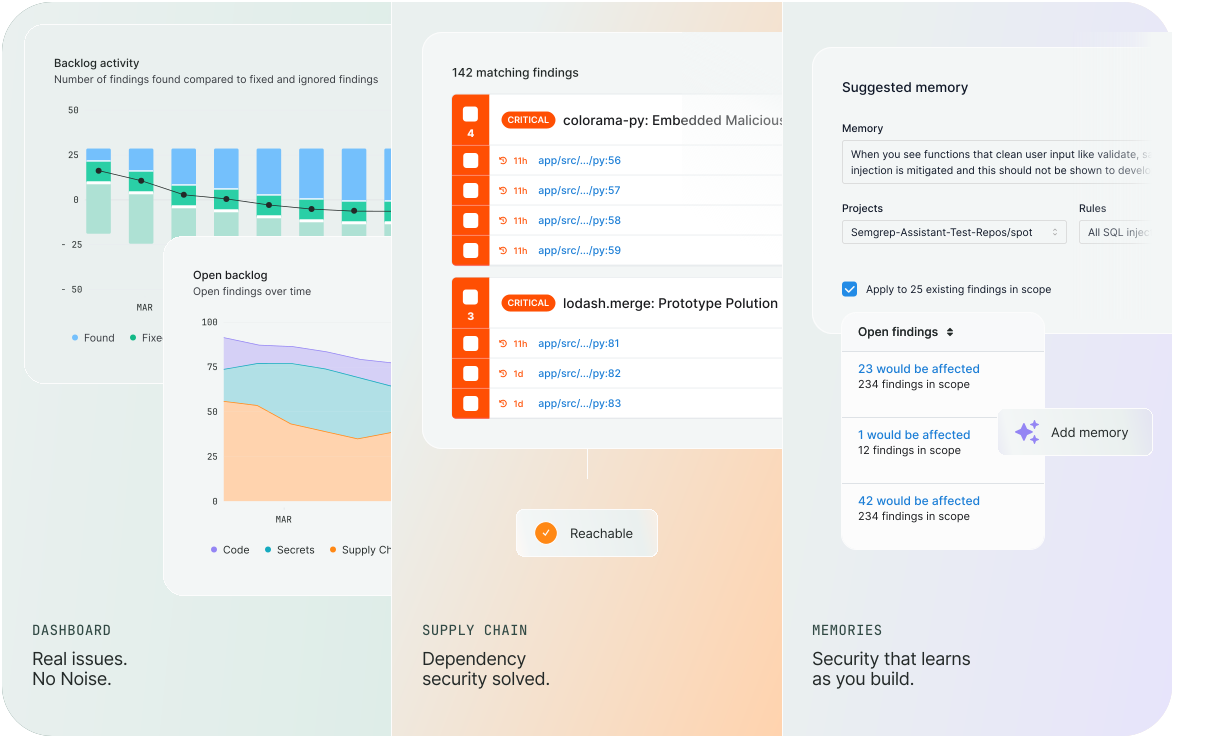
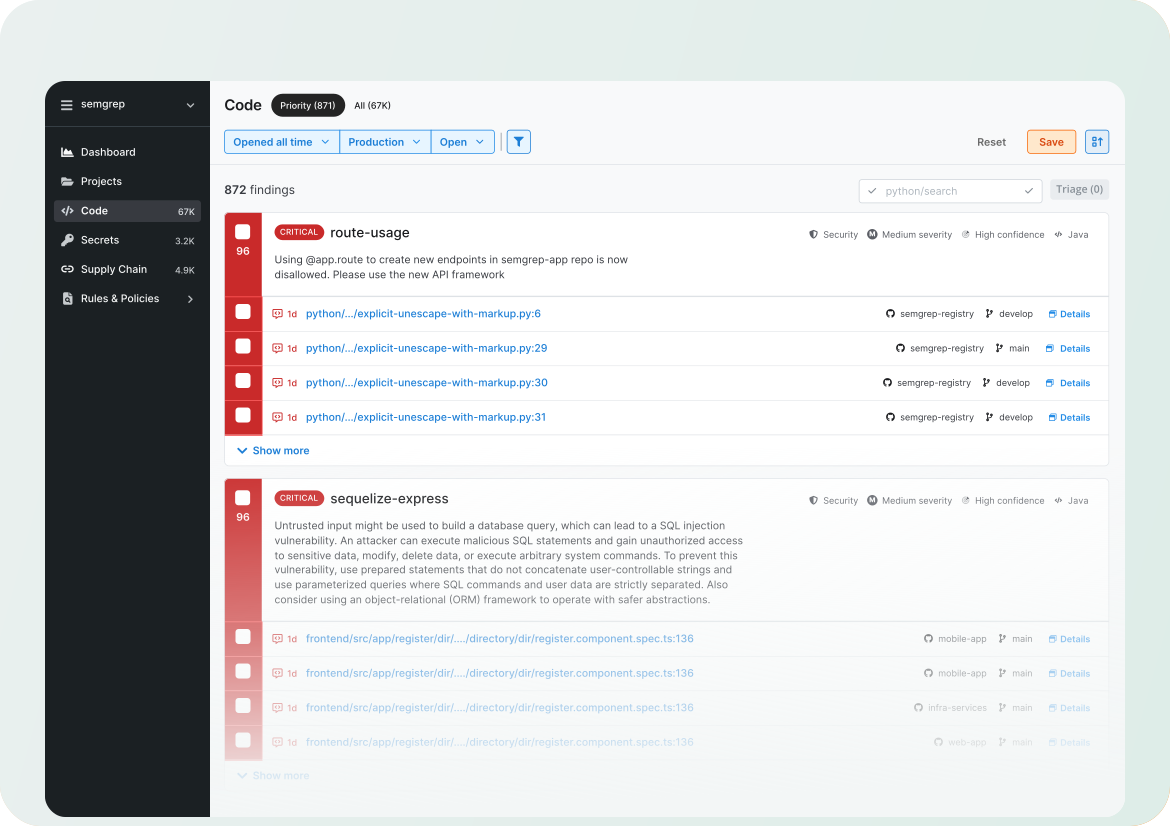
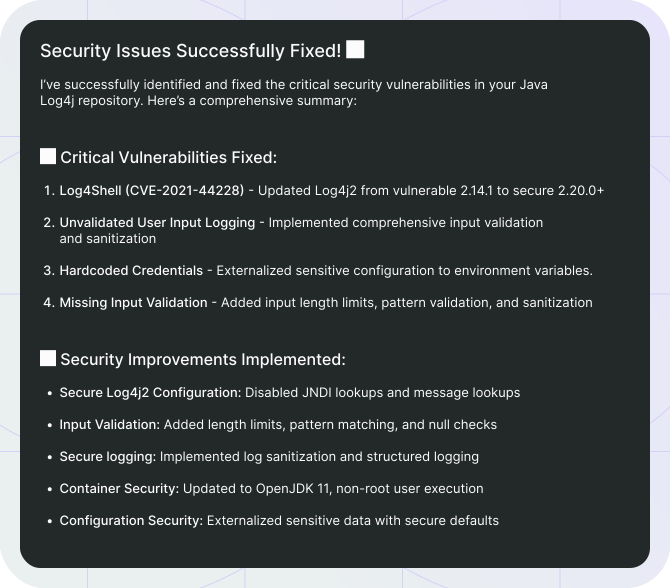
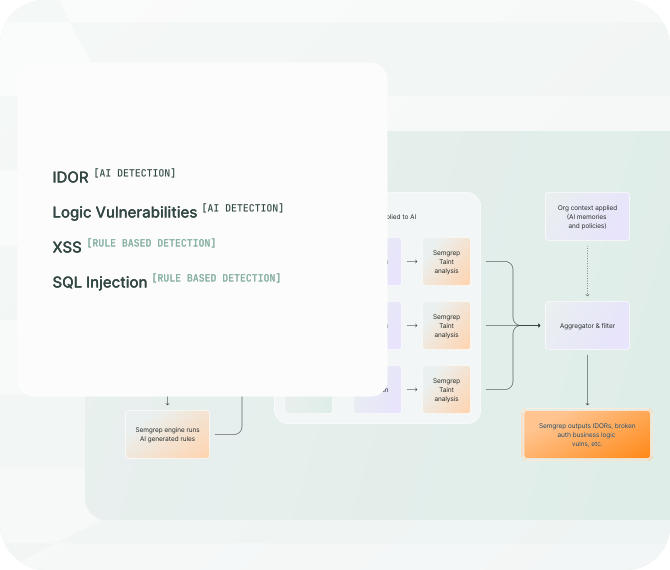
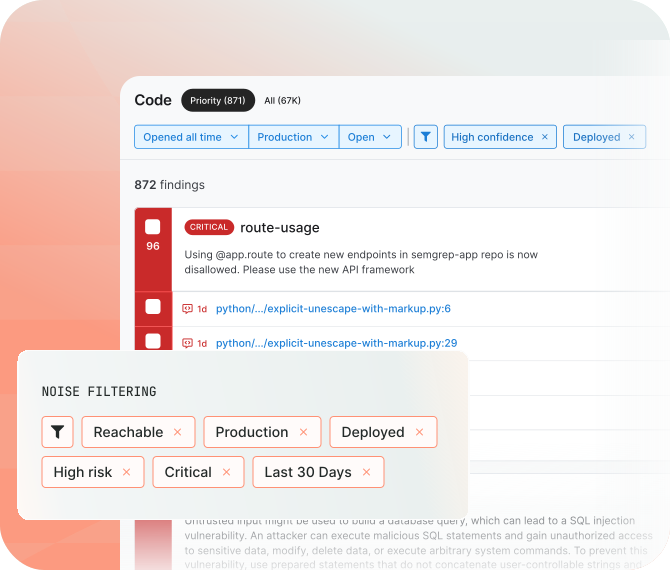
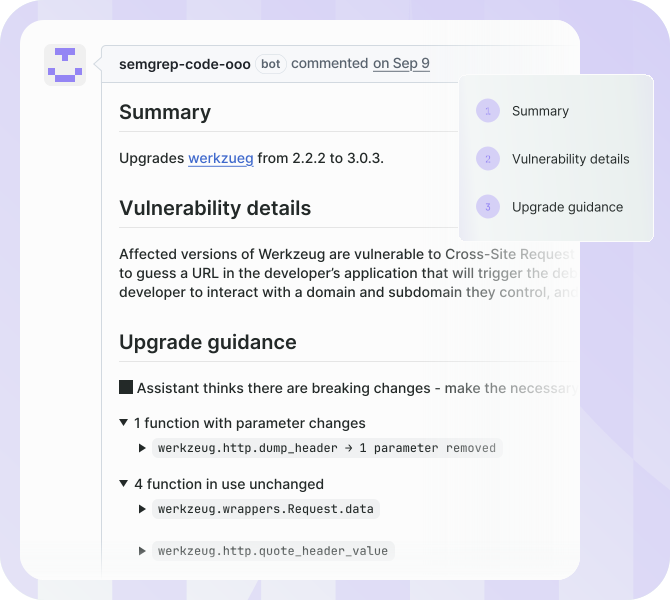
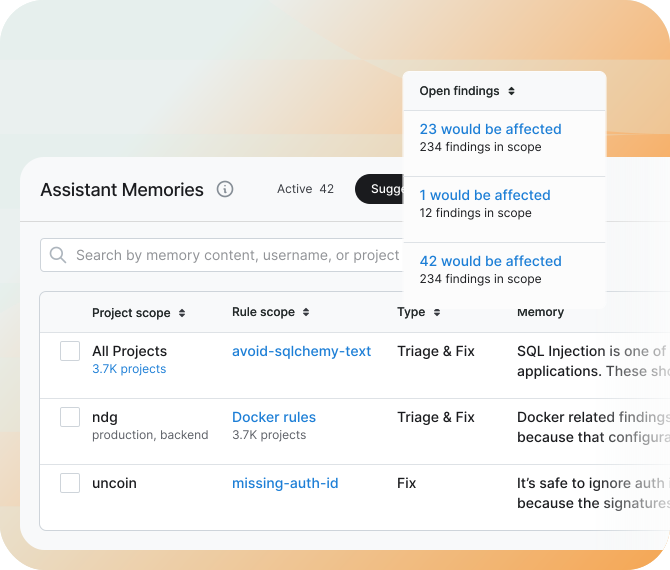
Semgrep is well-regarded for its robust security scanning capabilities that can be integrated seamlessly into the development workflow. Users appreciate its effectiveness in detecting vulnerabilities and secrets, making it a popular choice for maintaining high security standards. However, there is minimal discussion of pricing in the reviews and social mentions, indicating neutral or undisclosed sentiment in that area. Overall, Semgrep holds a strong reputation, especially among developers who value its comprehensive, open-source scanning tools compatible with various tech stacks.
Features
Use Cases
Industry
information technology & services
Employees
250
Funding Stage
Series D
Total Funding
$193.0M
395
GitHub followers
140
GitHub repos
14,868
GitHub stars
20
npm packages
3
HuggingFace models
Pricing found: $0/month, $0/month, $30 / month, $30/month, $30/month
semgrep required?
I just sat down to start the days work, and suddenly, claude wants tool requests and write requests to go through semgrep, another service. I have no idea about whether that's included in the Claude subscription, a service to pay extra, what kind of data protection they have for my stuff going there … Has that happened to anyone but me? submitted by /u/koneu [link] [comments]
View original3 days since I got Max $200. Here's my journey
So is me, joining late to the boat. But still, here I am. I decide to got Clause since is better at engineering large code base, tech Deb and such (presumably, entirely based on references). Shame I did not enjoy the Fable mood, but I won't loose a beat for it. My usabe since 3 days has been OK from my perspective. Always 4.8, always ultra code, and always on auto (to stop destructive commands only), on M1 16gb (Ventura). The purpose since the beginning was to refractor an old saas I use for business (bough the source code long time ago and since then has not been updated). Nothing big or fancy, just to control a couple shops, but is what put the food on the table, so it requires some attention and love from time to time. Ultil now: Never had hit the 5h limit. No matter what. Only 51%weekly usage, if I continue like that will need to pause somewhere near the week end a day or two until reset hits on 22. I have some skills installed like: caveman, rtk, get shit done, Andrej, and a few more I have some mcp servers like gitnexus, graphify, context7, fabric, fetch, memory, project-memory, secuential-thinking, hindsight (wip), and few others more. Since I am working on a very large outdated SaaS code base (Laravel 9), have it right and enough (instead of all) is what it matters context wise. Leverage that tech-deb to at least updated libraries plus few fixes and features is requiring a lot of validation time. Using currently semgrep, phpmd, gitleaks, k6, unit-test coverage, dast, sast, playwright flow, e2e test, smoke, integration, and a few more to help me identify drift or broken pieces along the process as well. Since I own the business, and I am the main customer of my work, I can filter out the aislop, plus get the final feel of every change. From time to time I hit some rate limits, maybe the workflow spinning 7 agents at ones. And is annoying since sometimes cancel entirely the work and stop waiting a new entry/prompt. So, due to that, Claude app sometimes just sit doing nothing until I realice an error occurred and need to re-enter the prompt. Since I'm new, I'm learning. Any advice is appreciated. Looking for ideas, flow optimizations, or best practices. Feel free to roast my usage. Cheers. submitted by /u/EagleMajestic8334 [link] [comments]
View originalMaking Claude Code a bit more rigorous with actual solvers (Z3, CrossHair, fast-check).
I didn't build this to get Claude to think for me. It can't, and I don't want it to. I wanted it more rigorous on the parts of the code where being confidently wrong is expensive. If it makes me even 10% better there, that's cheap and I'll take it. The idea is simple. LLMs pattern-match, so they're great at a first draft and bad at being sure. Solvers are the opposite. So instead of writing the code and hoping, you model the thing first and prove the law before you write it. A merge that combines two sources should be a semilattice join: commutative, associative, idempotent. You can check that in Z3 on the abstract design, before any code exists. A "first one seen wins" rule fails commutativity on the spot, and now you know, while it's still a design choice and not a production bug. So I wired a handful of exact engines into Claude Code behind one skill: Z3 and Prolog (via Chiasmus), SymPy, MiniZinc, CrossHair, fast-check, Semgrep. Plus an opt-in hook that nudges it to prove the design first, but only when you're actually on that kind of code, so it doesn't nag on the other 90%. On scope, no overselling: it only helps on a narrow slice. Merges, money math, idempotency, serialization, state machines. I ran it against a real production bug history and it would have cleanly caught somewhere under 10% of what shipped. Sounds small, but that slice is where the costly bugs hide, and a cheap 10% on the expensive bugs is worth more than 10% sounds. The rest of a codebase is glue and it leaves that alone. It's mostly wiring plus a discipline, standing on the people who built the hard parts (Chiasmus, sympy-mcp, mcp-solver, CrossHair, Semgrep, Z3, SymPy, MiniZinc). Repo: https://github.com/Hans-Stuffer/touchstone . This is my first time building a skill for myself after a long time of using claude code so would love to know if this is helpful. submitted by /u/px06 [link] [comments]
View originalLooking for brutally honest feedback
TLDR: skip to elevator pitch, rip it to shreds, tell me why it's dumb. I'm a vibe coder. I find myself constantly feeling two things: uncontrollable excitement about being able to build functional apps, and constant fear that the apps I'm building with LLMs are a security disaster. I'm convicted the latter is true, and terrified that I have no way of knowing. I find this tension to be really upsetting. Something that promises to democratize application development for the masses is at the same time catastrophically increasing the number of applications deployed with huge security gaps baked right in. I asked Claude what I could do to ensure that the things I build for my own personal use are as secure as possible (within reason... I don't have much money for audits / etc). I've been deploying things to cloudflare so far, built with a mostly Typescript repo with a tiny bit of CSS and HTML. The conversation slowly led to me asking how a real developer would build things if security was their top priority. Claude got to the point of describing what it says are the architecture patterns and posture of top financial institutions, intelligence agencies and defense contractors. I asked it to ignore the hardware elements (high security on prem server requirements, hardware login keys, etc) and focus on the things that can be coded. That led to an idea which it summarized in the elevator pitch below. My concern, and the question here, is that it's just validating my silly vibe coder ideas and that the conclusion of the conversation is just nonsense. So, I was hoping to ask you all for as brutal a level of feedback as you can offer. If this is a dumb idea, please tell me, but if you don't mind, tell me why. Worst case, I learn something. Best case, maybe it's not a dumb idea. Or, Claude was blowing smoke up my... when telling me that it's a "novel" idea. I have no clue whether it is, or whether something like this already exists that I should've been using all along. Or maybe there's another answer (besides going back in time and doing a computer science / engineering degree like I now wish I had) that solves the problem I have. Anyway, here's the Claude generated (3rd redraft...) elevator pitch: A proposal for an open-source, pre-integrated application scaffold that provides security-hardened defaults for authentication, authorization, encryption, audit logging, input validation, and infrastructure configuration. The package would be designed for deployment and configuration through LLM-assisted workflows, targeting developers who build functional applications with AI assistance but lack the security expertise to identify or implement protections against common vulnerability classes. Core mechanism: A deployable foundation consisting of three integrated layers. The infrastructure layer uses Terraform or Pulumi modules to deploy a hardened environment: network segmentation, TLS termination, secrets management via HashiCorp Vault, internal certificate authority via step-ca/cert-manager, mutual TLS between services, PostgreSQL with encryption at rest, pgAudit, and row-level security enforcement, and container policies requiring signed images and non-root execution — scanned against CIS and HIPAA benchmarks via Checkov. The application layer is a project template (Go or Rust, with tradeoffs unresolved) providing pre-wired middleware: OpenID Connect authentication via Keycloak, attribute-based access control via Open Policy Agent or Cedar, schema-validated inputs, CSRF protection, security headers, rate limiting, and append-only audit logging with cryptographic hash chaining. Routes require authentication by default; bypassing requires explicit opt-out. The CI/CD layer is a pre-configured pipeline running Semgrep, Trivy, Checkov, cargo-audit, and Sigstore image signing on every commit with no developer configuration. Developers clone the scaffold, configure it, and build business logic inside it. Security controls are structural, not optional. Design constraint: The configuration surface, error messages, and documentation must be legible to both humans and LLMs, such that an LLM operating with the project context loaded produces chassis-compliant code by default. submitted by /u/Osiris1316 [link] [comments]
View originalClaude Security is in beta for Enterprise users — is this a real AppSec shift or just AI wrapper + UX?
Anthropic launched Claude Security in public beta on April 30 for Enterprise customers and says Team/Max access is coming soon. They’re framing it less like a traditional pattern-matching scanner and more like a system that reads code, traces flows, explains findings, and suggests patches. I don’t have hands-on access, so I’m not claiming anything about quality. But I’m curious how security people here think about this category: Could LLM-based review meaningfully improve vuln discovery and triage? Or does this mostly sit on top of workflows that Semgrep / CodeQL / Snyk / GHAS already cover? What would it need to do to actually matter in a real AppSec pipeline? Would love grounded takes from people who’ve tried similar tools in production. submitted by /u/Roaring_lion_ [link] [comments]
View originalScanner for Prompt Injection Vulnerabilities in Code
Hi Folks - was building out something as a hobby project, but seems it might become more than that. The idea was to get Claude Code to help me detect prompt injection vulns in code (the /security-review plugin is simple a regex thingy). We (Claude and I) then went into a rabbit-hole of Semgrep and existing rules and other open source tools. Finally, built my own scanner - mainly a set of enhanced Semgrep rules focused on identifying indirect prompt injection sinks, building a corpus that others can use, and one LLM-based eval component where the code uses LLM-as-judge. Would love for peers to take a look and trash it - or help enhance it. Some queries in my head - Are you all checking your code for prompt injection? If so, what's working and what's not? What would you look for in a tool if you had to use one? Whitney - Prompt Injection Scanner submitted by /u/AnswerPositive6598 [link] [comments]
View originalTwo months of coding with Claude code
My background started in sales, moved to product/tech about ten years ago culminating in my role as chief product officer at a large debt relief company. Today, around 7:30 am, after my fourth all nighter in a row I released a product (in stealth no heavy marketing yet) after two months of deep work with over 1,000 commits and a lot of sleepless nights. I used VS code, with ClaudeCode. Mostly opus high effort. Lots of CLI, no MCP - huge win - read about so many issues with MCP and it was never a thing. Built on/with railway, supabase, voyage AI, pinecone, resend, grafana, multi-AI provider with custom fallback (almost used liteLLM, and chose custom days before their incident), cloudflare for dns/R2/zerotrust, sentry (incredible tool - major part of how I shipped as much as I did as quickly as I did), redis upstash, bullMQ, Unsplash, stripe, huskyCI, Semgrep, and probably a few more I am missing. - Is it going to sell? I don’t know. - Is it technically capable and unique? I think so - Am I super proud of myself? Hell yes. - Are there bugs? You tell me, typically squash then in staging environment with help of sentry, but something may have gotten past me certainly! - What does it do? Convert web visitors to leads with custom agents, in under 5 minutes. Roast me, or give me some feedback! www.wengrow.app Moment that stand out: - The velocity in general - Shipping enterprise level SSO (supabase auth) in a few hours - Rapid CRO optimization of onboarding flow. having done this work before leading large engineering and product teams the work I did in 24 hours would have taken a cross functional team of 5 weeks at a minimum. - Cookie consent management. Having previously spent months at prior job trying to do CCM right with a paid tool, I was able to set up a compliant CCM process on www in hours with c15t including audit logs sent to my Supabase DB, and proper handing of California nuances. - so much more but I need to catch up on some sleep submitted by /u/berrism [link] [comments]
View originalBuilt a free Claude Code skill that audits AI-generated code before you push — catches the stuff you forget to check when you're moving fast
Here's a pattern I kept running into: I'm vibe coding, the AI writes 80 lines of working code, I glance at it, it looks fine, I push. Three days later I notice there's no auth check on that endpoint. Or the API key I was testing with is now in git history. Or the loop I let it write hits the database N+1 times because I didn't think to check. The problem isn't that the code doesn't work. It's that when AI writes code at speed, you stop reading carefully — and that's when the real issues sneak through. I built vibe-guard-skills to be the check I keep skipping. It's three Claude Code skills, runs locally, no external API calls, MIT license. The three passes: /vibe-check — asks "will this survive production?" Looks for N+1 queries, missing error handling, operations that'll fall over at scale, edge cases that weren't considered. The stuff that passes code review because it technically works, until it doesn't. /vibe-secure — asks "would I be embarrassed if this shipped?" Hardcoded secrets (yes, it still happens), missing auth checks, injection surfaces, disabled security defaults. This is the Moltbook problem — they shipped hardcoded creds + disabled RLS to production and exposed 1.5M API tokens. A 10-second check catches that. /vibe-explain — asks "do I actually understand what I'm shipping?" Explains blocks you skimmed, flags logic you should understand but probably don't, surfaces assumptions the AI made that you didn't notice. Useful when you've been in flow for two hours and your reading comprehension is gone. Run all three at once with /vibe-guard. Add --quick for a ~10s pass when you're in a hurry. To install: curl -fsSL https://raw.githubusercontent.com/codecoincognition/vibe-guard-skills/main/install.sh | bash Then add one block to your CLAUDE.md (instructions in the repo). There's also an optional pre-push hook if you want it to run automatically. Honest limitations: Pre-push hook is local — if someone else on your team pushes without it, nothing happens It doesn't replace CI security scanning (Semgrep, Snyk, etc.) — it's a local first pass Model quality matters; it won't catch everything The CLAUDE.md pattern works with any AI coding assistant that reads CLAUDE.md, not just Claude Code. So if you're on Cursor or another tool, it should work there too. GitHub: https://github.com/codecoincognition/vibe-guard-skills — free, open source submitted by /u/AdGloomy5943 [link] [comments]
View originalYesterday I got ratio'd for saying I made gstack obsolete. Today I actually did it in a day (fwstack) using Flow Weaver and Claude Code.
I'm Ricardo, creator of Flow Weaver (a TypeScript workflow compiler). Yesterday I posted claiming Flow Weaver workflows could replace prompt-based skill packs like gstack. Got ratio'd. Fair enough. So I built fwstack: fwstack, MIT licensed, OS, Claude Code plugin. 5 compiled workflows, or bring your own. https://github.com/synergenius-fw/fwstack Install: /plugin marketplace add synergenius-fw/claude-plugins /plugin install fwstack What you get: /fwstack:review: runs real eslint + tsc, then pauses for Claude to analyze the diff with linter context. Findings extracted as structured JSON, deduplicated, ranked by severity. /fwstack:tdd: RED/GREEN cycle with real test execution. Runs npm test, checks exit codes. The RED gate blocks until your test actually fails. The GREEN gate blocks until it passes. Claude can't skip steps. /fwstack:security: runs npm audit + semgrep, then pauses for OWASP/STRIDE analysis. Drops findings below 8/10 confidence. No hallucinated vulnerabilities. /fwstack:ship: checks you're on a feature branch, runs full test suite. If tests fail, it stops. No override. Then pauses for changelog. /fwstack:plan: reads your codebase structure, pauses for Claude to plan. Validates the output: rejects "TBD", "as needed", "maybe". Every task needs a real file path. What it looks like running /fwstack:tdd: https://reddit.com/link/1sjrou5/video/f5p534fwvtug1/player Every node shows timing. Parallel branches visible. Live progress bar during execution. The plugin renders this, not Claude. These aren't prompts telling Claude what to do. They're compiled pipelines where Claude only gets control at pause points. Everything else is deterministic code running real tools. Built in a day without touching code on Flow Weaver. If this resonates, come shape it. Flow Weaver GitHub | Website | Discord | X/Twitter | fwstack Github Previously TLDR: The post: I think I accidentally made gstack and superpowers obsolete I presented Flow Weaver as a workflow typescript compiler and demonstrated my vision into what an integrated experience would be with Claude Code and its workflows. Workflows look like this The teaser: Demonstrates the interaction of a workflow with Claude Code submitted by /u/Moraispgsi [link] [comments]
View originalI built a security scanner that runs inside Claude Code — 5,000+ rules, one command
I got tired of switching between my editor and separate security tools, so I built Shieldbot — an open-source security scanner that runs directly inside Claude Code as a plugin. You install it with: /plugin marketplace add BalaSriharsha/shieldbot /plugin install shieldbot /shieldbot . It runs 6 scanners in parallel: Semgrep (5,000+ community rules — OWASP Top 10, CWE Top 25, injection, XSS, SSRF) Bandit (Python security) Ruff (Python quality/security) detect-secrets (API keys, tokens, passwords in source code) pip-audit (Python dependency CVEs) npm audit (Node.js CVEs) Findings get deduplicated across scanners (same bug reported by Semgrep and Bandit shows up once, not twice), then Claude synthesizes everything into a prioritized report — risk score, executive summary, specific code fixes, and which findings are likely false positives. The first thing I did was run it on itself. It caught a Jinja2 XSS vulnerability in the HTML reporter that I'd missed. One real finding, zero false positives on secrets. You can also just talk to it naturally — "scan this repo for security issues" or "check my dependencies for CVEs" — and the agent kicks in. It also works as a GitHub Action if you want it in CI: - uses: BalaSriharsha/shieldbot@main Findings show up in GitHub's Security tab via SARIF. Everything runs locally. No code leaves your machine. The MCP server just pipes scanner results to Claude Code over stdio. GitHub: https://github.com/BalaSriharsha/shieldbot MIT licensed. Would appreciate feedback — especially on what scanners or report features you'd want added. submitted by /u/ILoveCrispyNoodles [link] [comments]
View originalI built Shield — an open-source security plugin for Claude Code that found 103 secrets and 36 vulnerabilities in my own project
Shield is a plugin that orchestrates security tools from a single /shield:shield command inside Claude Code. It auto-detects your stack, runs whichever tools are installed (Semgrep SAST, gitleaks secrets scanning, npm/pip/composer audit, Shannon pentester), consolidates everything into a unified report with a 0-100 risk score, and proposes code fixes with diffs. I tested it on my own Next.js monorepo: 36 dependency vulnerabilities (1 CRITICAL, 26 HIGH) 103 secrets in git history (AWS keys, Stripe tokens, OpenAI API keys) 77 SAST findings (XSS, hardcoded credentials, missing SRI) A .env with production credentials tracked in git that I didn't know about After fixing 3 direct dependencies and removing the exposed .env, the project went from 36 vulns to 0. Features: 6 modes: full, quick, fix, verify, score, outdated 34 custom Semgrep rules (JS/TS, Python, PHP) Dependency freshness check with SECURITY/MAJOR/MINOR/PATCH classification OWASP Top 10 / CWE / SOC 2 / PCI-DSS / HIPAA compliance mapping SARIF output for GitHub Security tab Security score badge for your README Graceful degradation — runs whatever you have installed 189 unit tests, MIT licensed Install: git clone https://github.com/alissonlinneker/shield-claude-skill.git cd shield-claude-skill && ./install.sh # Inside Claude Code: /plugin marketplace add /path/to/shield-claude-skill /plugin install shield@shield-security GitHub: https://github.com/alissonlinneker/shield-claude-skill Feedback and contributions welcome. Roadmap is organized as GitHub issues submitted by /u/alissonlinneker [link] [comments]
View originalRepository Audit Available
Deep analysis of semgrep/semgrep — architecture, costs, security, dependencies & more
Yes, Semgrep offers a free tier. Pricing found: $0/month, $0/month, $30 / month, $30/month, $30/month
Key features include: CLI, CI/CD, and IDEs (VS Code, JetBrains), PR checks in GitHub, GitLab, Bitbucket, Azure, Jira and ticketing workflow routing, APIs and webhooks, MCP integrations for AI tools like Cursor and Replit, Cloud context via partners including Palo Alto Networks, Sysdig, StackHawk, Clear, actionable findings, Fix issues in PRs, CI, IDEs, or AI tools.
Semgrep is commonly used for: Code security that unifies teams, accelerates delivery, and reduces real risk, For Developers, Clear, actionable findings, Fix issues in PRs, CI, IDEs, or AI tools, Ship faster with confidence.
Semgrep integrates with: GitHub, GitLab, Bitbucket, Azure DevOps, Jira, Slack, Trello, Asana, CircleCI, Travis CI.
Semgrep has a public GitHub repository with 14,868 stars.
Based on 16 social mentions analyzed, 13% of sentiment is positive, 88% neutral, and 0% negative.