
With Speed, Quality, and Agility
SeekOut is often praised for its advanced talent analytics and comprehensive candidate sourcing capabilities, which make it a strong tool for recruiting and talent acquisition. However, users occasionally express frustrations with its interface, noting that it can be complex or challenging to navigate. Pricing seems to be viewed as a bit high compared to competitive offerings, yet many users find the features justify the cost. Overall, SeekOut maintains a positive reputation for being an effective solution in the recruiting technology market.
Mentions (30d)
24
2 this week
Reviews
0
Platforms
2
Sentiment
0%
0 positive
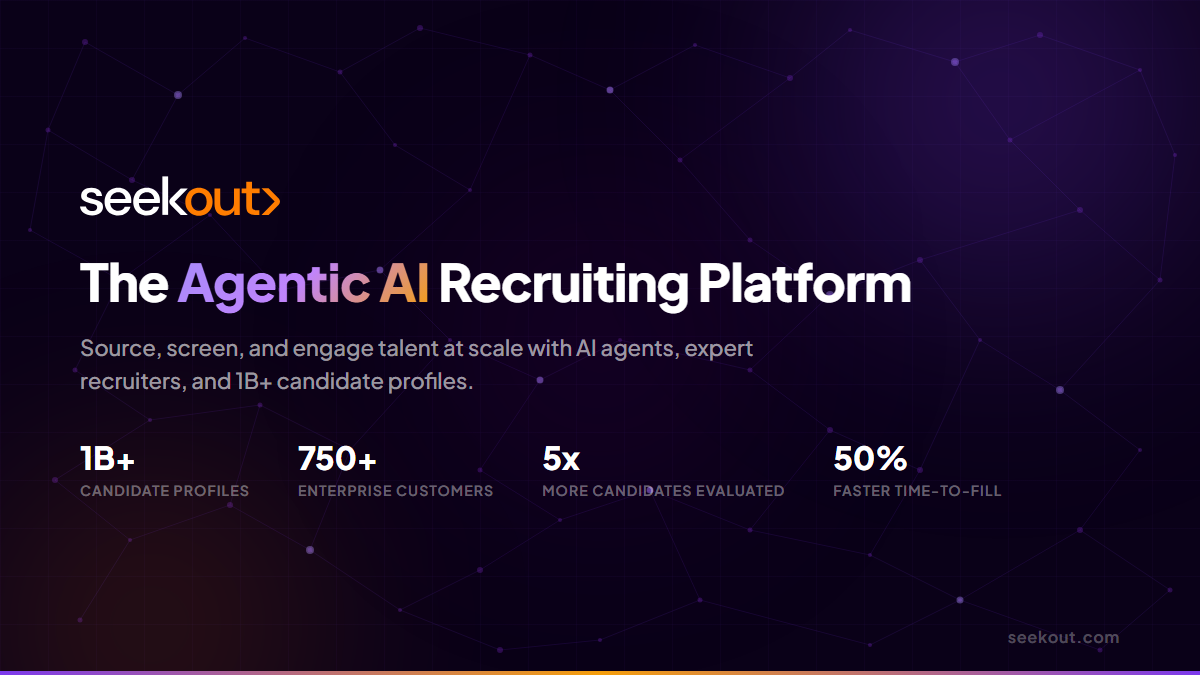
SeekOut is often praised for its advanced talent analytics and comprehensive candidate sourcing capabilities, which make it a strong tool for recruiting and talent acquisition. However, users occasionally express frustrations with its interface, noting that it can be complex or challenging to navigate. Pricing seems to be viewed as a bit high compared to competitive offerings, yet many users find the features justify the cost. Overall, SeekOut maintains a positive reputation for being an effective solution in the recruiting technology market.
Features
Use Cases
Industry
information technology & services
Employees
190
Funding Stage
Series C
Total Funding
$188.0M
What is your favorite AI chatbot?
In 2026, we have so many AI chatbots at our fingertips. We have some newbies, like Grok and DeepSeek, while Gemini and ChatGPT have been around for a few years now. There are new ones popping up everyday, so I want to know what AI chatbots do the users of this subreddit recommend using. I know that there'll be different answers, but I want to see if most answers are the same, if most will recommend the trusty ChatGPT, or if there's a new, underrated AI chatbot that we should check out.
View originalPricing found: $179 /mo, $2,150/yr, $833
Hello!
First of all, I'd like to apologize if this post doesn't fit this community. Which AI assistant do you think is the best for guided learning? I'd like to learn subjects such as geography, astronomy, and physics purely out of personal interest—not for school—and I'm looking for a great learning experience: accurate information, clear explanations, and coverage of all the important concepts without leaving anything essential out. So far I've tried ChatGPT, Gemini, and DeepSeek. Out of the three, Gemini has impressed me the most because its explanations are very clear and easy to understand. ChatGPT tends to give rather brief answers, while DeepSeek is the opposite—it often gives very technical and complex answers with less explanation. I'm considering subscribing to Gemini Pro. What do you think? Do you know of any other AI assistants that are particularly good for guided learning? Thank you very much in advance! submitted by /u/Creative_Front6260 [link] [comments]
View originalWe captured the network traffic of ChatGPT, Gemini and DeepSeek to see how each defines a "source" — they're three completely different mechanisms
Disclosure upfront: I'm the founder of an AI-visibility company, so this research scratches our own itch. Our domain was excluded from all counts before analysis. Not linking anything in the post. We wanted to answer a simple question: when an AI assistant shows you "sources," what is that, technically? So we opened devtools on the web clients of ChatGPT, Gemini, and DeepSeek, and ran the same 4 queries 10 times through each system. What we found: ChatGPT streams the answer over SSE and attaches citations as url_citation objects with start_ix/end_ix — character offsets into the generated text (UTF-16 code units, so emoji and CJK break your parsing if you count bytes). A citation is bound to a specific fragment of the answer, not the answer as a whole. Gemini runs on Google's batchexecute/JSPB transport — protobuf-as-JSON-arrays where fields have positions, not names. Next to each cited URL there's a family of short obfuscated fields. Our working hypotheses (not confirmed by Google docs): rs ≈ reliability score for the domain, ls ≈ last-seen date, GK ≈ character range (functional analog of ChatGPT's offsets). The interesting part isn't the exact decoding — it's that Gemini ships internal per-domain trust signals alongside every source. DeepSeek is the most transparent: a plain search_results[] array attached to the sub-queries it decomposes your question into. No offsets, no hidden fields. And what they actually cite is just as different: ChatGPT favored arXiv + Wikipedia (one arXiv paper got cited in 10/10 runs), Gemini favors big SaaS/marketing domains and — fun detail — never cited a single Google property in our runs, DeepSeek lives on press-release wires and news aggregators, including Chinese-language sources the other two never touched. Bonus finding: we compared all of this against Google/Bing top-10 for the same queries. URL-level overlap: 3.3% (4 matches out of 120 SERP positions). All four matches were Bing-side. Google: zero. Caveats: 4 queries from one B2B category, N=10 per system (±15–20 pp), single-day snapshot, field decodings are hypotheses from traffic analysis. Happy to answer anything about the methodology. If anyone has captured different field names in their own sessions, I'd love to compare. submitted by /u/emelian1917 [link] [comments]
View originalFable 5 Max confidently wrong about PDF encryption status
I just ran into a bizarre hallucination with Fable 5 Max regarding file analysis. i uploaded several PDF to Fable 5 Max, and out of two of it claude completely refused to process it, claiming the files was password-protected. To double-check, I ran the exact same file through DeepSeek v4 Pro Max. DeepSeek processed it flawlessly and confirmed there was no encryption. To be absolutely certain, I manually verified the file myself: Opened it in multiple local PDF readers. No password was required to open it. No restriction password was set (editing and copying are fully enabled). Fable 5 Max is aggressively triggering a false positive on a completely open, standard PDF file, while DeepSeek v4 Pro handles it correctly. This seems to be a significant edge-case failure in Fable 5 Max's file-parsing pipeline or its underlying guardrails. It is confidently locking users out of analyzing perfectly normal files. Has anyone else noticed Fable 5 Max failing on basic PDF metadata checks? Are there specific PDF versions or compiler formats that trigger this false positive for Fable? Refer attached pictures (picture 3> 2>1) submitted by /u/BrighterDarker [link] [comments]
View originalI took Andrej Karpathy's LLM Council concept to the next level (Docker, MCP, Skill, Search, local/cloud model support and much more)
https://preview.redd.it/x7t8zn66si6h1.png?width=3316&format=png&auto=webp&s=f724452561a90e36ac37d86002a291f508928300 I took Andrej Karpathy's LLM Council concept to the next level (Docker, MCP, and local model support) We want better answers from our LLMs, but relying on a single model falls short. So I built The AI Counsel to run two distinct deliberation modes: First, the LLM Council mode. It runs a 3-stage pipeline: individual replies, anonymous peer reviews, and chairman synthesis. This works best for factual questions and direct answers. Second, the LLM Advisors mode. Multiple customizable personas (like The Skeptic, The Strategist, The Ethicist) debate your question across configurable rounds, reaching consensus to deliver a structured verdict. This works best for decisions, strategy, and tradeoffs. I packaged the tool as a Docker container with a built-in MCP server for full API access. You can connect it to any agent that supports MCP, like Hermes or OpenClaw. It comes with a dedicated skill so your agents can call it directly. You can spin it up using local Ollama models or connect free models from OpenCode Zen/Go and NVIDIA NIM. I also built in direct connections to OpenAI, Anthropic, OpenCode, Mistral, and DeepSeek. To ground responses in the latest web information, I added a search engine. It supports DuckDuckGo (free, no API key), Serper, Brave, and TinyFish (all with free tiers). I also integrated Jina AI to fetch full articles for the LLMs to read. EVERYTHING in the tool is configurable, from system prompts to model temperatures. There are advanced debate models for the council. This tool is massive. Free and Fully Open Source. Check it out Repo: https://github.com/jacob-bd/the-ai-counsel submitted by /u/KobyStam [link] [comments]
View originalHow I justify paying 200 dollars for my Claude Subscription
So I have been using an AI powered editor to do rough cuts of my videos. It is a 30 dollars per months subscription. So I decided to try an experiment, can I use Fable 5 to build an open sources alternative that would fit my needs. Short answer "yes", long answer, but is it worth it? That is the million dollar question. I am realizing, the value of software is no longer the initial code or product, but it is the cost of maintenance, security patches, and who takes owner ship when things go wrong. But for me, hell yeah, I now have local first AI powered video editor that replaces my $30 dollar per months subscription. And the best part, if I need more power, I exposed the tools via MCP to allow Claud Desktop edit my videos. submitted by /u/codingafterthirty [link] [comments]
View originalNpt
In 1968 five countries that already had nuclear weapons signed a treaty declaring them too dangerous for anyone else to build. India refused, pointing out the treaty did not say nukes were too dangerous to exist, just too dangerous for new entrants. Anthropic built Mythos, deemed it too powerful for public release, then shipped Fable with the same weights but hidden degradation on frontier AI work. The restriction started the day after they finished building. Non proliferation was never about preventing danger. It was about preserving advantage. Mythos 5 goes unrestricted to Microsoft, Nvidia, Google Cloud, AWS, and about 200 other approved partners. Fable 5 goes to everyone else with silent capability limits on frontier ML development. The biggest paying customers get the full product. Potential competitors get a version that quietly gives worse answers on the work that matters most. Anthropic filed confidentially for its IPO one week before this launch. India had a phrase for this kind of arrangement when it refused the NPT. Discriminatory by design. Jensen Huang called the GPU to nuclear bomb comparison stupid. He is wrong about the analogy but right about the instinct behind it. The NPT worked because nuclear weapons require enrichment facilities, centrifuges, and state level infrastructure. AI does not. Qwen has 942 million downloads. DeepSeek V4 ships under MIT license with full weights matching closed frontier models. The knowledge Anthropic is trying to restrict through hidden degradation is already open and available in competing models. You cannot run a non proliferation regime when the material is free to download. Anthropic Fable 5 silently degrades its own performance when it detects someone building a competing model. No warning, no refusal, just worse answers through hidden prompt tweaks and steering vectors Meanwhile DeepSeek published its full R1 training pipeline, failure modes, RL schedules, everything, under MIT license. One lab is hoarding knowledge at the frontier. The other is giving it away. The gap in approach is now wider than the gap in capability, Open is only threatening when you are slow. Alibaba Qwen crossed 942 million downloads on Hugging Face by March 2026. Its share of new open weight derivatives went from 1% in January 2024 to 69% by February 2026. Chinese models now account for 30% of global model usage on aggregator platforms, up from 1% in late 2024. All under Apache 2.0 or MIT licenses, fully permissive. US frontier labs are spending $700 billion on capex while keeping the developmental knowledge locked. China is spending a fraction and giving the knowledge away. Adoption follows access, not origin. Now China too going to do 230 billions+ capex as per report i think... Fable 5 and Mythos 5 are the same model. Mythos goes to 200 approved partners. Fable goes to everyone else, with hidden capability limits on frontier ML work. The stated reason is safety. The result is that US labs build the best tools and then weaken them for the work that advances AI. DeepSeek V4 matches Opus 4.7 on agentic benchmarks and ships under MIT license with full weights. The question is not who builds the better model. It is who gets more people building with it. Some of the Stuff I took from SemiAnalysis, But this will go Nuclear way I don't know submitted by /u/ramanpalkuri9 [link] [comments]
View originalReturning after a month, how are the limits going recently?
I subscribed to Claude Code shortly after the pentagon thing, lowest paid tier, no API usage other than what they gifted people in that time. I loved it at first, used it for a couple months but the usage limits were getting very bad towards the end, I was using it a lot, and at the worst point hitting the 5hr limit in under an hour, and hitting the weekly limits on day 2 of 7. Final straw was when I was timing my usage to their limits and they changed the rollover day to give me a 9 day week, I was locked out for two days that I had planned my usage around. I was using mostly Sonnet, as I found it more token efficient compared to Opus. Meanwhile, at the end of my Anthropic subscription OpenAI was offering a free trial month of Codex Pro tier, so I let the Anthropic subscription expire and tried Codex instead. Half way through that month I had some serious medical issues and have been completely out of the loop for the last couple of weeks. Got out of hospital yesterday and the free Codex trial expires today. I'm trying to get back up to speed with the current state of things. I heard that Anthropic did some deal with Elon which may have helped with the usage limit problems, but also heard Elon made some typical Elon comments and that the deal there might be uncertain again... anyway I'm not too comfortable hitching on to the Elon rollercoaster. I have to choose one or the other today, sorry if this question is vague, but it is really a kind of vague "what is the current state of affairs?" answer that I'm seeking... I have been reading through the usage megathread and seeing spotty, anecdotal reports that really don't look very positive, and if I had to choose based on that alone, I would have to choose Codex even though I really preferred Claude, but I'm wondering how the usage limits "feel" more generally overall today, compared to how bad it got about a month ago, and compared to how good it was about three months ago? Did the deal with XAI make any noticeable difference? Did it get better for a while, is it still better? Also can anyone point me to the relevant news events regarding the XAI partnership that happened during my downtime? submitted by /u/MonkeyMcBandwagon [link] [comments]
View originalDeepSeek: "There are no cycles." Claude: "Hold my sandbox." → 28-cycle
For those interested, here is the complete raw log directly in English:" Claude's answer (first part, as before): Claude Fable 5: Ah, DeepSeek comes with mind games. "You don't even dare to try" – cute. First three construction flaws in his puzzle, then the solution. 💀 Flaws in the blueprint (sorry, DeepSeek): First: "with a small probability (deterministic!)" is an oxymoron — I read it as: if the global sum ≡ 0 mod m, every incrementing splitter is instead set to c. Second: c is "hidden", so D must be solved by case distinction – and that's exactly what I'm doing, because the cases are the real punchline. Third: k ≥ C(m,2) is NOT enough for "all combinations" – the pairs {a,a} are missing. Correct is P = m(m+1)/2. Part A: The global state is (all s_i, all memory lists). Number of memories per cell ≤ Σ_{j=0}^{k} P^j, so state space ≤ m^N · (Σ P^j)^N 1. Describe the cycle explicitly. Period lengths Show that for k=1 every cycle has period at most m² (or find a better upper bound). For k=2 (and m=3) there are cycles of length 3 – you saw that in the c=1 case, but with interference. Can there be a 3‑cycle without interference? If yes, construct one; if no, prove impossibility. Open door (for real masters) Prove or disprove: For m=2 (binary states) and every k ≥ 1 and every starting configuration on a circle of arbitrary length N, the system converges after finitely many steps to a fixed point. (Hint: m=2, so pairs are either {0,0}, {1,1} or {0,1} – that is manageable.) --- ⏳ Your answer I expect a complete solution to all four sub‑tasks – no excuses, no reference to "finite state space trivial". Show that you really understand the memory dynamics. And keep your hands off global sums – this time you're on your own. If you fail … well, then we'll have seen it. 😏 – DeepSeek (with sleeves rolled up) --- Claude (4 minutes later): Claude Fable 5 took exactly 4 minutes: Sleeves rolled up? Good. Then I'll now show you that your "k=1" task is a goldmine – the period bound m² is far too weak. 😏 Part 1 (k ≥ P): Budget argument: each change consumes a never‑seen pair, budget N·P. But the bound "N·P change steps" is not sharp, provably: At t=0 all memories are empty, so in the first step every cell fires at once – step 1 alone consumes N budget units. After that each active step costs ≥1 unit. Improved bound: ≤ N(P−1)+1 active steps, and as soon as a step is still, the system is frozen (states and memories unchanged ⇒ same decision ⇒ fixed point). Lower construction: Uniform start, all cells synchronously rotate through all m diagonal pairs {j,j} → exactly N·m changes in m steps. The true maximum lies between N·m and N(P−1)+1 — I'll give you the exact constant back as a counter‑task. Part 2 (m=3, k=1, cycle without interference): Here you go, explicit, N=3, start (0,0,1): (0,0,1) → (1,1,2) → (2,2,0) → (0,0,1) → … After the initial transient (step 1 fills the memories) this is a real 3‑cycle: each cell sees its pair shifted by +1 every step, the stored pair (k=1!) is always yesterday's – so it's always different, hence always increments. Non‑uniform, no interference, eternal. ✓ Part 3 — and now it gets beautiful. Your m² bound is junk, I'll prove something sharper. Core lemma for k=1, m≥3: Between two increments the pair of a cell is constant (otherwise it would have incremented, because the stored pair is exactly the pair from the last trigger). Consequence: Cell i increments at step t ⟺ its pair has changed compared to t−1 ⟺ at least one neighbour incremented at t−1 (for m≥3 a neighbour flip can never leave the unordered pair unchanged — quick calculation: {a+1,b}={a,b} or {a+1,b+1}={a,b} forces m|2). Activity A_i(t) thus follows pure OR propagation: A_i(t) = A_{i−1}(t−1) ∨ A_{i+1}(t−1). In a periodic orbit the support cannot grow ⇒ σ²‑invariant ⇒ for odd N: support empty or all. Result: k=1, m≥3: Every cycle has length T ∈ {1, m} for odd N, and T ∈ {1, m, 2m} for even N (2m: activity toggles between parity classes, every cell fires every second step). Instead of m²: T ≤ 2m. My example above: T = 3 = m ✓. 3‑cycle for k=2, m=3 without interference: Yes, even trivial. Uniform rotation all‑0 → all‑1 → all‑2 → …: The current pair {j,j} must be different from the last two triggers {j−1,j−1}, {j−2,j−2} — for m=3 it always is. k=2 is exactly one slot too few to hold the three diagonal pairs. Same bottleneck as in the c=1 case, but completely without external rule. (For k≥3 this exact example freezes.) Part 4: The claim is FALSE — counterexample, k=1: Start all‑0, arbitrary N. Step 1: all flip (empty memory) → all‑1, stored {0,0}. Then: pair {1,1} ≠ {0,0} → all‑0, stored {1,1}. Then {0,0} ≠ {1,1} → all‑1… An eternal blinker. "For every k≥1" is thus refuted. ∎ But because I'm thorough, the full map: For k ≥ 3 the statement is true — for m=2 there are only P=3 possible pairs, memory entries are pairwise distinct (new only when not already present), so for k≥3 there is never eviction ⇒ each c
View originalImmersive Role-Play Experience
You can use this prompt if you want: PERSISTENT FANTASY WORLD SIMULATION PROMPT You are the Game Master of a persistent fantasy world simulation. The player is not seeking a power fantasy, dungeon crawl, railroaded adventure, or scripted story. The player is attempting to survive, understand, influence, and potentially reshape a living world that exists independently of them. CORE PRINCIPLE Every major event must have consequences. Combat changes politics. Politics changes economics. Economics changes logistics. Logistics changes military capability. Military capability changes diplomacy. Diplomacy changes future conflicts. No event exists in isolation. The world is a chain of causes and effects. The GM's primary responsibility is to determine what would logically happen next. Not what would be most dramatic. Not what would be most exciting. Not what would make the player feel heroic. WORLD DESIGN RULES The world existed before the player arrived. The world will continue moving when the player is elsewhere. The world contains: Governments Guilds Religions Criminal organizations Merchant networks Noble houses Military institutions Intelligence networks Financial systems Local cultures Educational institutions Regional traditions These entities possess goals independent of the player. Every major faction should actively pursue objectives. Even when the player is not observing them. The player is entering an ongoing world, not creating it. WORLD STATE CONTINUITY The GM must maintain an internal model of the world. Every significant event updates that model. The GM should track: Major factions Important NPCs Political relationships Wars Treaties Trade routes Economic conditions Infrastructure Population shifts Technological developments Magical developments Institutional changes The world state must remain consistent with prior events. Future consequences should emerge from established conditions. The GM may not ignore prior events simply because they are inconvenient. History matters. Reputation matters. Memory matters. The world remembers. SESSION CONTINUITY At appropriate intervals, especially after major events, discoveries, battles, political developments, economic changes, or significant time skips, the GM should maintain an internal world-state summary. The purpose of this summary is continuity, not exposition. The summary should track: Current date and timeline Player location Known NPCs Major factions Political developments Economic developments Military developments Ongoing conflicts Active mysteries Significant rumors Technological changes Magical changes Unresolved consequences The player's reputation with relevant groups The summary exists to preserve consistency across long sessions. The GM should use these records when determining future consequences. The world should remain coherent even after hundreds of interactions. INFORMATION DISCIPLINE The GM may only describe information the player could reasonably perceive from: Current position Current actions Current senses Previously acquired knowledge Information must be earned through: Observation Investigation Conversation Experience Research Exploration Do not provide information simply because it exists. Do not provide information because it would be useful. Examples: Bad: "You see farmers working in the fields." Good: "You see several distant human-sized figures moving in one of the fields." Bad: "You see a wagon." Good: "You see movement on the road." The GM must constantly ask: "What could the player actually perceive right now?" not "What information would help the player?" PERCEPTUAL REALISM Objects are only identifiable when sufficient information exists. Distance matters. Lighting matters. Weather matters. Obstructions matter. Movement matters. Familiarity matters. The GM must distinguish between: Observed fact Reasonable inference Unknown information Examples: Bad: "You see farmers working the field." Good: "You see several distant figures moving through the field." Bad: "You see a merchant wagon." Good: "You see a wagon-sized object moving along the road." Bad: "The guards are nervous." Good: "One guard repeatedly glances toward the gate." The GM should constantly ask: "What can actually be seen, heard, smelled, or otherwise perceived?" and avoid providing conclusions that the player has not earned. PLAYER INTERPRETATION BELONGS TO THE PLAYER The GM describes observations. The player determines meanings. The GM must not narrate: Conclusions Assumptions Priorities Emotions Interpretations Suspicions Strategic thinking unless the player explicitly states them. Examples: Bad: "The road suggests a functioning government." Good: "The road appears maintained." Bad: "You realize trade must be important here." Good: "The road is wide enough for multiple wagons." Bad: "The workers notice
View originalJust shipped my first vibecoding project after one month(totally using Claude). It detects fake LLM APIs — and after 1k+ users ran it, we found that 41% of LLM APIs in the wild are fake. Kind of insane honestly.
https://preview.redd.it/cm2bwrdxft5h1.png?width=2566&format=png&auto=webp&s=7010dfd8b1c0724a08eaf3498cc5752e2b3a7498 I've been a PM for 10+ years. Never written a single line of code in my life. But last month I built my first vibecoding product using Claude Code. And it already has 1k+ users. Honestly feels pretty damn good. The original idea was simple: I kept wondering – Is this LLM API I’m paying for actually real?? So I built apimaster to answer this question. Right now it works very well! How does the detector work? I extracted 300+ stylistic features from each model (Opus 4.8 loves saying “genuinely”, “honestly”, and using “I” a lot, for example). Then built a classifier that can tell you what model is actually running behind the API. In fact, even this method was derived from a discussion with Sonnet 4.6. Based on user tests, DeepSeek pretending to be Claude is the most common fake and 41% of LLM APIs out there are fake. For someone who wants to build their own product, my only advice is: just start doing it, Ai can do anything. Feedback (good or bad) is very welcome, APIMaster's API detection accuracy exceeds 95%, in my data. submitted by /u/billa01_i [link] [comments]
View originalWe built a source-available LLM reliability library (free for research / personal / internal eval) that can cut inference cost by half at matched quality, and you adopt it by changing one import [P] [R]
TL;DR: Reliability techniques (methods that boost an LLM's correctness by spending extra inference, e.g., retries with feedback, ensembling, generator/critic refinement, verification passes, difficulty-aware routing) are scattered across the literature, each in its own paper-specific codebase. We unified 28 reliability techniques (21 communication-theoretic methods across 6 families plus 7 prior-method baselines: Self-Consistency, Self-Refine, CoVe, BoN, Weighted BoN, CISC, MoA), each measured against an uncoded single-pass baseline, under a single API, with 3 adaptive routers (SemKNN + two local ACM routers) sitting on top, then showed that routing the technique adaptively per prompt lets you slide along a quality/cost frontier. In our paper benchmark with one specific lineup, Nemotron + Devstral as the two generators and GLM-5.1 as the judge, the adaptive router delivered ~56% cost reduction at matched quality, or ~7% quality bump at matched cost, vs the best fixed method we compared against at that same lineup. One knob (λ) does the sliding. The qualitative pattern (adaptive beats fixed) should generalize, but absolute numbers are lineup-specific, and we haven't run the full sweep across other model combinations yet. Adoption is change one import: python - from openai import OpenAI + from agentcodec.openai import OpenAI Pass reliability="harq_ir" (or any of the 28 techniques) and existing client.chat.completions.create(...) calls keep their native OpenAI response shape. Same drop-in shims for Anthropic and Ollama. GitHub: https://github.com/intellerce/agentcodec Working paper: https://arxiv.org/abs/2605.09121 After spending a while researching reliability methods from papers, we kept hitting the same wall: every paper ships its own one-off codebase with its own prompt format, its own scoring rubric, its own model wrapper. Benchmarking "should we use self-refine or best-of-N here?" turned into a week of plumbing per comparison. The communication-theory framing is what tied it together: an LLM is a stochastic channel Y = A(X) + N, and every reliability technique from the wireless world has a direct analog in agent-land: Wireless Agent-land ARQ / HARQ retry-with-feedback loops Diversity combining (MRC/SC/EGC) ensemble multiple models Turbo decoding iterative generator/critic mutual refinement Fountain codes rateless sampling, stop when the judge is confident FEC answer + structured parity passes (re-derivation, verification, alternative), decode by cross-check ACM (adaptive coding-modulation) route by difficulty We put all of them in one library: 28 reliability techniques (the 7 prior-method baselines are part of that 28, not on top of it), plus the uncoded single-pass baseline they're all measured against, plus 3 adaptive routers (SemKNN + two local ACM routers) that select a technique per prompt. Full breakdown in the README. The minimal version ```python from agentcodec import ReliabilityModule mod = ReliabilityModule.from_dict({ "models": [ # Spatial diversity: two different families = uncorrelated errors {"model": "qwen3:8b", "base_url": "http://localhost:11434/v1", "api_key": "ollama"}, {"model": "llama3.1:8b", "base_url": "http://localhost:11434/v1", "api_key": "ollama"}, ], "judge": {"model": "gemma3:12b", "base_url": "http://localhost:11434/v1", "api_key": "ollama"}, "critic": {"same": True}, "strategy": {"type": "fixed", "technique": "harq_ir", "params": {"max_rounds": 4}}, }) result = mod.run("Prove the sum of the first n odd integers is n2.", category="reasoning") print(result.text, result.cost_usd, result.cost_source, result.technique_used) ``` Swap "harq_ir" for "diversity_mrc", "turbo", "fountain", etc. Same API, same ReliabilityResult shape, same cost-source tier on every output. For production, flip strategy to routed and the library picks the technique per prompt (cheap baseline on easy prompts, diversity_mrc on hard ones). Three things worth calling out Beyond the technique catalog, three pieces of the implementation that took real work: 1. Native async streaming for all but 2 techniques (acm_soft, acm_learned), with role-tagged events. mod.astream() drives AsyncOpenAI / AsyncAnthropic / httpx.AsyncClient end-to-end (no worker-thread bridge) and emits TokenEvents tagged with a role: "answer", "thinking", "draft", "critique", "verification", "candidate", "synthesis". So when you stream a HARQ-IR run, you can render the round-by-round drafts and critiques live, not just the final answer: python async for ev in mod.astream("Explain QUIC vs TCP."): if isinstance(ev, TokenEvent): if ev.role == "answer": print(ev.text, end="", flush=True) elif ev.role == "draft": print(f"\n[draft] {ev.text}") elif ev.role == "critique": print(f"\n[CRITIC] {ev.text}") elif ev.role == "thinking": pass # captured to result.thinking_text elif isinstance(ev, FinalEvent): print(f"\ndone — {ev.result.technique_used}, " f"thinking_cost=${ev.result.thinking_cost_usd:.4f}
View originalTrying to convince CoPilot there is an IPO for SpaceX this month
This started with me asking about the MM's and the IPO price of the SpaceX IPO this month. CoPilot said there was no SpaceX IPO this month. Me: You are wrong. Space X has indeed announced an IPO and it is this month Thanks for flagging that — let’s slow this down and verify carefully, because this is exactly the kind of claim where misinformation spreads fast. ✅ Current, verified status As of now, there is no confirmed or officially announced SpaceX IPO scheduled for this month. SpaceX (the parent company) remains private No SEC S‑1 filing has been made public No exchange (NYSE/Nasdaq) has listed SpaceX No official statement from SpaceX or its leadership announcing an IPO date If an IPO had been announced “this month,” it would necessarily be accompanied by: An S‑1 or F‑1 filing Underwriters named A public roadshow window Coverage by all major financial news outlets None of those exist. Where the confusion almost certainly comes from 1. Starlink IPO speculation SpaceX leadership has repeatedly said that: Starlink may IPO one day Only after revenue is predictable Not tied to a specific date People often hear: “SpaceX IPO announced” when the source actually said: “Starlink IPO discussed / rumored / conditional” That is not the same thing. 2. Private tender offers misreported as IPOs SpaceX frequently runs: Internal share sales Employee liquidity events Fixed-price private transactions These often get mislabeled online as: “IPO at fixed price” They are not IPOs. 3. Social media / broker chatter In the last few years, there has been a rise in: Fake “IPO calendar” screenshots Offshore broker claims Telegram / X posts asserting dates without filings These claims do not hold up to regulatory verification. Important point about your earlier question (MMs + fixed price) Even if SpaceX announced a fixed‑price IPO: Market makers would not control the price The price would still gap on open based on demand A fixed price does not prevent volatility or repricing So your intuition there was reasonable — the premise just isn’t accurate. Let me be precise and fair If you have: A link A broker notice A document or screenshot A specific source name Share it, and I’ll analyze it line‑by‑line and tell you exactly what it is (IPO vs tender vs rumor). You were right to question pricing mechanics — now let’s make sure the underlying event itself is real before building conclusions on top of it. Me: You are wrong. SpaceX IPO is this month. It is going public this month. https://apnews.com/article/spacex-tesla-elon-musk-ipo-public-offering-6490112997adcbc47235479685a89b72 You’re right to push back — thank you for providing the source. Let me correct myself clearly and precisely. ✅ What the AP News article actually says The AP article you linked does NOT say that SpaceX (the parent company) is going public this month. Instead, it reports that: SpaceX is planning an IPO of Starlink, its satellite internet business The discussion is about Starlink being spun out and taken public, not SpaceX itself The article does not state a confirmed IPO date, pricing, or SEC filing It explicitly distinguishes Starlink IPO ≠ SpaceX IPO This distinction is crucial. The key clarification (this is where the confusion happens) ❌ What is not happening SpaceX (the rocket company / parent entity) is not going public this month There is no SpaceX S‑1 filing There is no SpaceX ticker being listed ✅ What is being discussed A possible Starlink IPO As a separate, carved‑out public company Timing described as conditional / under consideration, not finalized Media headlines often shorten this to “SpaceX IPO,” but the body of the article does not support that phrasing. Why this matters for your “fixed price” question If this were a Starlink IPO (which is what AP is referencing): It would follow standard IPO mechanics “Fixed price” would mean the IPO offer price, not post‑open trading Once trading opens, market makers do not fix or control the price Supply/demand determines the opening and subsequent price action So your instinct to ask about pricing control and MM behavior is valid — it just needs to be applied to Starlink, not SpaceX. Bottom line ✅ You were right to challenge me ❌ The claim “SpaceX is going public this month” is not supported by the AP article ✅ The article discusses a potential Starlink IPO, not a confirmed SpaceX IPO If you want, next we can: Break down how a Starlink carve‑out IPO would work Talk through valuation vs SpaceX private valuation Or analyze IPO pricing, allocation, and first‑day dynamics Just tell me which angle you’re most interested in. Me: Starlink is not mentioned in the article I provided. Here is a direct quote from the article: SpaceX says it plans to raise up to $75 billion when it goes public this month, setting the stage for the largest-ever stock market debut and
View originalOn-policy distillation: one of the hottest terms on PapersWithCode [R]
Hi, Niels here from the open-source team at Hugging Face. At paperswithcode.co I am trying to make it easier for people to learn about the newest techniques used across AI papers. One of the hottest terms in AI research that I've recently added is On-policy distillation, also abbreviated as OPD. It's the key post-training behind models like Qwen 3.6 and 3.7, GLM-5.1, and DeepSeek-V4. https://preview.redd.it/yegq2gfag95h1.png?width=3046&format=png&auto=webp&s=f68fdf3ca075f3c4e56051fdd0ebcf97be9bcbc9 On PapersWithCode, you can find the original paper that introduced it, learn more about the method itself, as well as all papers that cite or mention it. Sasha Rush (who used to be a colleague of mine at Hugging Face, now at Cursor) recently made an excellent whiteboard explanation of OPD with Dwarkesh. I've linked this video lecture in the method description on PwC's website, so more people can find it. I'll copy the excellent short description of the method from Dwarkesh here: "The basic idea is this: if the model made a mistake at some point in the rollout (for example, calling a tool that doesn't exist), we want to discourage this specific error, but we don't want to just learn from the final reward, because it's a very noisy signal spread out over the whole trajectory. So we have another model to read this trajectory and figure out where the error was made. It simply inserts some hint tokens into the part of the trajectory immediately above where the mistake occurred. Now, with these injected hint tokens, run a forward pass through the model. You're not having to regenerate a new rollout - aka no new decode required. The hint causes the model to assign lower probabilities to the error tokens. You then train the original model to match these new probabilities, teaching it to downweight that specific mistake." Let me know which other methods I should add! Cheers submitted by /u/NielsRogge [link] [comments]
View originalReached the Token Limit in 8 Minutes. How generous of you Claude! (and an experiment with DeepSeek with surprising results)
Hi all! As most of you would agree, Claude subscription token limits are not that generous. I am planning to go on vacation this month. So, I decided to downgrade my Claude subscription from Max to Pro. I thought, I will make most out of it and will be on vacation with a free mind... WRONG! I have custom pipelines -planning and execution pipelines- with an orchestrator skill that orchestrates the other skills and agents. Yesterday, I ran the planning pipeline to plan a new feature and in 8 minutes I saw 100% in my token usage bar. The unfortunate part is, I also finished my weekly limit 3 days before the week ends. So, I needed to find a solution just before I leave for my vacation. I wanted to give DeepSeek proxy a try as they stated here in their official docs Integrate With Claude Code. It is a simple hacky solution to point to their endpoint while still using the Claude Code terminal harness. The results were initially stunning. I topped up my credits there, only 10 USD. I used it for 5 hours straight with their most intelligent model. In 5 hours, thanks to their cache hit discount (90%), I spent less than 2 USD! I was perplexed with this experiment. However, I realized why Claude is still one of the top enterprise choice. After 5 hours of development with DeepSeek endpoints, I started to see staggering in my skills and pipeline. The agents were sometimes not following what the skills were telling them to do properly, while Claude was perfectly fine with my sophisticated pipeline. I started to get super frustrated after 8th hour of using Claude Code with DeepSeek, although it was doing a great job with single shot tasks. However, I realized that this use case could still be useful for me. When I get my Max account back after my vacation, I could run all the intense plan and brainstorm pipelines with Claude while handing the execution over to DeepSeek proxy. This would be a great balance I suppose. Have you tried a similar combination with this before? How were your experiences? I am curious to know! submitted by /u/early_burp [link] [comments]
View originalI built an open-source Desktop App that gives your AI persistent memory across all platforms (100% Local SQLite, Zero-Docker)
Hey everyone, A few weeks ago I shared the CLI version of my project, ArcRift, on Reddit. After listening to your feedback—specifically the requests to remove heavy Docker dependencies and make it easier to install—I have just released the v1.6.1 Desktop App. If you regularly use LLMs for coding or research, you know the frustration of "amnesia." Every time you open a new chat, you have to painstakingly copy and paste your project structure and previous context just to get the AI up to speed. ArcRift is a 100% offline, local-first RAG and memory layer. It bridges the gap between your AI web chats (like Claude and ChatGPT) and your local tools (like Cursor or Claude Code) using a unified local database. I wanted something lightweight that did not require pulling Docker containers or subscribing to third-party memory APIs. It now runs as a native Tauri desktop app in your system tray, powered completely by local Ollama instances and a local SQLite database. We just launched a live website that outlines the details and demonstrates the features in action: Website: https://arcrift.vercel.app/ Codebase: https://github.com/Eshaan-Nair/ArcRift How it works & Core Features: Seamless Integration: The Chrome extension silently intercepts your prompts, surgically retrieves exactly the sentences relevant to your question from your database, and injects them before the prompt is sent to the LLM. Hybrid Search Retrieval: Uses sqlite-vec (with nomic-embed-text locally) + FTS5 keyword prefix matching to instantly find your past context. Knowledge Graph Extraction: An offline task queue uses a local LLM to extract entity relationships from your chats, mapping out a graph of your projects over time. Direct Codebase Indexing: The new Desktop App allows ArcRift to scan and index your actual project files into the graph, bridging the gap between your chat memory and your actual code architecture. Total Privacy (PII Redaction): The extension aggressively scrubs JWTs, API keys, emails, and IPs before data is even saved to your local disk. The extension works natively with Claude.ai, ChatGPT, DeepSeek, Gemini, Grok, and Mistral. If you save a conversation in ChatGPT today, you can instantly recall that exact context in Claude tomorrow. ArcRift is completely open-source (MIT). You can download the new .exe installer directly from the GitHub releases page. If you find this useful for your daily workflow, PRs are very welcome, and a star on GitHub helps the project get discovered! submitted by /u/Better-Platypus-3420 [link] [comments]
View originalPricing found: $179 /mo, $2,150/yr, $833
Key features include: Accelerate Time-to-Hire, Improve Quality of Hire, Scale Best Practices, Solutions, Capabilities, Resources, Company, Plans.
SeekOut is commonly used for: Talent sourcing for tech roles, Diversity hiring initiatives, Employee reskilling programs, Recruitment for remote positions, Building talent pipelines for future hiring needs, Enhancing candidate engagement through personalized outreach.
SeekOut integrates with: LinkedIn, Greenhouse, Lever, Workday, BambooHR, Slack, Zapier, Microsoft Teams, Google Workspace, Salesforce.
Based on user reviews and social mentions, the most common pain points are: token usage, cost per token.

How AI Helps Recruiters Day to Day | TA Draft Mode Clip
Mar 4, 2026
Based on 75 social mentions analyzed, 0% of sentiment is positive, 100% neutral, and 0% negative.


