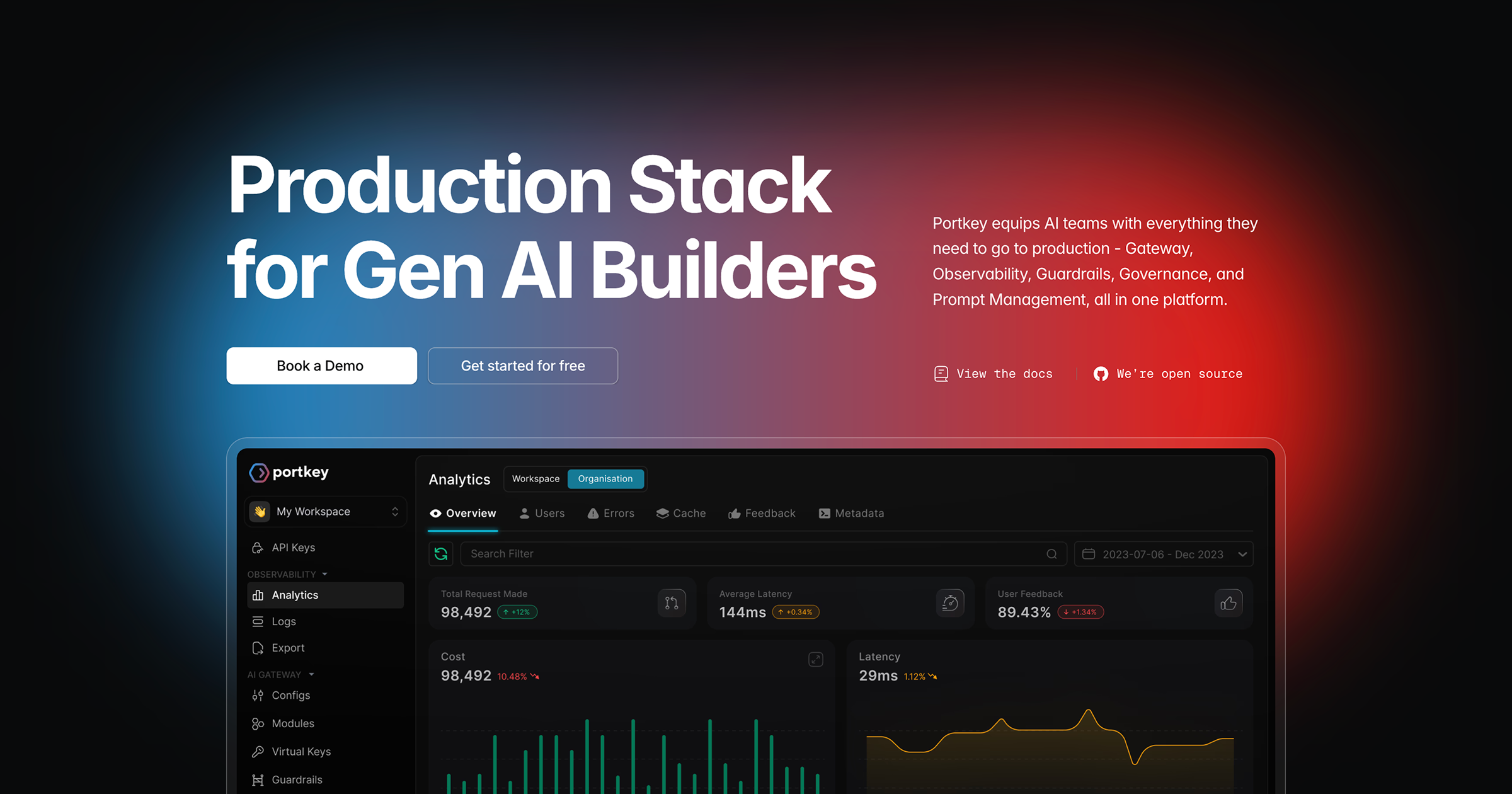
Portkey
Democratize and productionize Gen AI across your entire org with Portkey
Portkey is highly praised for its robust functionality and ease of use, consistently receiving ratings between 4.5 and 5 out of 5 from users. The most frequent complaints revolve around occasional glitches, which seem to affect a minority of users based on the overall high scores. While there is limited information on pricing sentiment, the overall reputation of Portkey remains positive, with strong endorsements visible through social media mentions and high satisfaction ratings.
OpenRouter
The unified interface for LLMs. Find the best models & prices for your prompts
OpenRouter is highly praised for its robust open models and detailed statistical insights, particularly excelling in handling large volumes of programming tokens. Users appreciate its flexibility and wide integration capabilities, especially in AI agent applications. Complaints highlight issues with token costs and efficiency, with some users developing complementary tools to mitigate these concerns. Overall, pricing sentiment is generally positive due to its open-source nature, and OpenRouter maintains a strong reputation in the developer and AI community for its functionality and adaptability.
Portkey
+100% vs last weekOpenRouter
-62% vs last weekPortkey
OpenRouter
Portkey
OpenRouter
Portkey
Pricing found: $49/month, $49/month, $9, $49/month, $9/month
OpenRouter
Pricing found: $10
Portkey (10)
OpenRouter (8)
Only in Portkey (10)
Only in OpenRouter (4)
Shared (12)
Only in Portkey (5)
Only in OpenRouter (4)
Portkey
What do you like best about Portkey?Portkey is a comprehensive platform for gen AI builders os its AI gateway is smooth integration with large language models and its guardrails have a proactive usage with its prompt management and resilience helps to track costs as per use case and save repeated llm calls which has minimum 3-5 usage per day and its implementation is super easy for any beguines and its customer support is too friendly and responses quickly and its integration is super easy and efficient. we usally have a AI integration in large scale and has the guardrails for a limited usage and this software helps me alot. Review collected by and hosted on G2.com.What do you dislike about Portkey?the software has a lot of bugs and its complexcity for newcomers are too high with missing advanced analytics and its GUI documentation must be more flexible. Review collected by and hosted on G2.com.
What do you like best about Portkey?It allows you to attach metadata (key-value pairs) to each request, enabling cost breakdowns per user. Review collected by and hosted on G2.com.What do you dislike about Portkey?Lack of control You can’t choose your destination last minute. Once it’s activated, it takes you where it’s been enchanted to. Review collected by and hosted on G2.com.
What do you like best about Portkey?What I appreciate most about Portkey is its simplicity and performance. It brings clarity and structure to API management, making it easy to track, debug, and optimize requests without needing a complex setup. The real-time monitoring tools and intuitive dashboard help identify issues instantly, and I really like how lightweight and fast the whole platform feels compared to traditional observability tools. The integration process is smooth, and the documentation is clear, even for more technical setups. Their support team is very responsive — you get real answers from engineers who actually understand the product. Review collected by and hosted on G2.com.What do you dislike about Portkey?Portkey is evolving quickly, so there are still a few advanced analytics and visualization options missing compared to older, enterprise-level tools. Also, some custom alert configurations could be more flexible. But the team is clearly improving things rapidly, and updates come frequently with noticeable improvements. Review collected by and hosted on G2.com.
OpenRouter
What do you like best about OpenRouter?Unified API Access: The ability to call a multitude of LLMs from different providers (like OpenAI, Anthropic, Google, and various open-source models) through a single, consistent API endpoint is a game-changer. This drastically reduces the integration overhead and code maintenance associated with managing individual provider APIs and SDKs. Simplified Cost Management & Tracking: OpenRouter provides a clear, consolidated view of our LLM usage costs across all models. The pay-as-you-go pricing, with standardized per-token rates for many models, makes budget forecasting and expense tracking much more straightforward than juggling multiple billing dashboards. Rapid Prototyping and Model Benchmarking: The platform is excellent for quickly testing and comparing the performance of different models for specific tasks. Switching between, for instance, a Llama model and a GPT variant for a text generation task requires minimal code changes Developer-Focused Features: Tools like the model explorer, the ability to see real-time model rankings based on community usage or specific metrics, and features like request fallbacks or automatic retries demonstrate a clear understanding of developer workflows and pain points in LLM Operations (LLMOps). Review collected by and hosted on G2.com.What do you dislike about OpenRouter?While the benefits are substantial, one aspect that I've noted is the potential for slightly increased latency compared to direct API calls to the model providers. This is somewhat expected given the nature of an aggregation service acting as an intermediary. For extremely latency-sensitive applications, this might require careful benchmarking, though for most of our use cases, the difference has been marginal and outweighed by the convenience and flexibility offered. Review collected by and hosted on G2.com.
Portkey
OpenRouter
Portkey
OpenRouter
Portkey
OpenRouter

Portkey
OpenRouter
Portkey
OpenRouter
Going from 3B/7B dense to Nemotron 3 Nano (hybrid Mamba-MoE) for multi-task reasoning — what changes in the fine-tuning playbook? [D]
Following up on something I posted a few days back about fine-tuning for multi-task reasoning. Read a lot since then, and I've moved past the dense 3B vs 7B question — landing on Nemotron 3 Nano (the 30B-A3B hybrid Mamba-Attention-MoE NVIDIA released recently) instead. Architecture maps to the multi
Shared (2)
Only in Portkey (3)
Only in OpenRouter (1)


