
Democratize and productionize Gen AI across your entire org with Portkey
Portkey is highly praised for its robust functionality and ease of use, consistently receiving ratings between 4.5 and 5 out of 5 from users. The most frequent complaints revolve around occasional glitches, which seem to affect a minority of users based on the overall high scores. While there is limited information on pricing sentiment, the overall reputation of Portkey remains positive, with strong endorsements visible through social media mentions and high satisfaction ratings.
Mentions (30d)
0
Avg Rating
4.6
19 reviews
Platforms
2
GitHub Stars
11,123
968 forks
Portkey is highly praised for its robust functionality and ease of use, consistently receiving ratings between 4.5 and 5 out of 5 from users. The most frequent complaints revolve around occasional glitches, which seem to affect a minority of users based on the overall high scores. While there is limited information on pricing sentiment, the overall reputation of Portkey remains positive, with strong endorsements visible through social media mentions and high satisfaction ratings.
Features
Use Cases
Industry
information technology & services
Employees
45
Funding Stage
Merger / Acquisition
Total Funding
$18.0M
368
GitHub followers
33
GitHub repos
11,123
GitHub stars
20
npm packages
Pricing found: $49/month, $49/month, $9, $49/month, $9/month
g2
What do you like best about Portkey?What I like best about Portkey is that it brings structure to what is otherwise a very chaotic part of building AI products. When you're working with multiple LLMs, APIs, and edge cases, things break silently—and debugging becomes painful. Portkey acts as a unified gateway that gives you visibility, control, and reliability out of the box. The biggest win for me is observability + control. Having centralized logs, request tracking, cost insights, and performance metrics in one place makes a huge difference. Instead of guessing what went wrong, I can actually see how prompts behave, where latency spikes happen, and how much each request costs. It also simplifies multi-model integration. Rather than managing different APIs and retry logic across providers, everything runs through a single layer with built-in fallbacks, routing, and caching. That alone removes a lot of engineering overhead and lets me focus more on building features instead of infra. Another big plus is cost optimization. Features like caching, usage tracking, and model routing help avoid unnecessary LLM calls and keep spend predictable, which is critical when scaling. Review collected by and hosted on G2.com.What do you dislike about Portkey?What I dislike is that the platform can feel a bit complex initially. There’s a learning curve, especially if you’re new to LLMOps, and some areas like advanced analytics and documentation could be more polished. Review collected by and hosted on G2.com.
What do you like best about Portkey?We started using Portkey when our AI usage began getting messy across multiple models and providers. What stood out immediately was how it brings everything into one place without adding complexity. The biggest win for us has been visibility. You can actually see what’s happening with every request — cost, latency, failures — which makes debugging and optimization way faster. The observability layer alone is worth it, especially when you’re running multiple use cases in production. Review collected by and hosted on G2.com.What do you dislike about Portkey?The product is evolving quickly, which is great, but it also means some advanced analytics and customization options are still catching up. The UI can improve in a few areas. Review collected by and hosted on G2.com.
What do you like best about Portkey?The standout feature is the dashboard and analytics, which make observability and monitoring straightforward. Implementation is simple thanks to the available APIs, and there is a wide selection of LLM models and providers. It integrates smoothly into daily monitoring and troubleshooting routines. Review collected by and hosted on G2.com.What do you dislike about Portkey?The documentation falls short and often requires users to figure things out on their own. Additionally, price tracking does not work universally across all models, and for air-gapped setups, pricing updates must be done manually, which can lead to delays in getting accurate information. Review collected by and hosted on G2.com.
What do you like best about Portkey?Portkey is a comprehensive platform for gen AI builders os its AI gateway is smooth integration with large language models and its guardrails have a proactive usage with its prompt management and resilience helps to track costs as per use case and save repeated llm calls which has minimum 3-5 usage per day and its implementation is super easy for any beguines and its customer support is too friendly and responses quickly and its integration is super easy and efficient. we usally have a AI integration in large scale and has the guardrails for a limited usage and this software helps me alot. Review collected by and hosted on G2.com.What do you dislike about Portkey?the software has a lot of bugs and its complexcity for newcomers are too high with missing advanced analytics and its GUI documentation must be more flexible. Review collected by and hosted on G2.com.
What do you like best about Portkey?It allows you to attach metadata (key-value pairs) to each request, enabling cost breakdowns per user. Review collected by and hosted on G2.com.What do you dislike about Portkey?Lack of control You can’t choose your destination last minute. Once it’s activated, it takes you where it’s been enchanted to. Review collected by and hosted on G2.com.
What do you like best about Portkey?Single gateway to many LLMs so less work integrating separate APIs. Guardrails + compliance features help avoid bad or undesired outputs. Good security, standards (SOC2, ISO27001 etc.). Helps reduce costs via caching, fallback, routing to cheaper providers where possible. Review collected by and hosted on G2.com.What do you dislike about Portkey?Complex feature set. Pricing are high for smaller teams. Documentation or value for some advanced parts is still growing so a little gaps are still there in execution. Dependency on external LLM providers Review collected by and hosted on G2.com.
What do you like best about Portkey?What I appreciate most about Portkey is its simplicity and performance. It brings clarity and structure to API management, making it easy to track, debug, and optimize requests without needing a complex setup. The real-time monitoring tools and intuitive dashboard help identify issues instantly, and I really like how lightweight and fast the whole platform feels compared to traditional observability tools. The integration process is smooth, and the documentation is clear, even for more technical setups. Their support team is very responsive — you get real answers from engineers who actually understand the product. Review collected by and hosted on G2.com.What do you dislike about Portkey?Portkey is evolving quickly, so there are still a few advanced analytics and visualization options missing compared to older, enterprise-level tools. Also, some custom alert configurations could be more flexible. But the team is clearly improving things rapidly, and updates come frequently with noticeable improvements. Review collected by and hosted on G2.com.
What do you like best about Portkey?- Onboarding implementation is straightforward and is aided by good documentation - Its helped us maintain a high degree of reliability for production systems by features including fallbacks - The dashboard is helpful for daily observability with custom metadata filters and cost aggregates being particularly helpful - Helpful support and excellent community - The pace of adding new features is great Review collected by and hosted on G2.com.What do you dislike about Portkey?The ability to export response data from the dashboard is a missing piece. We have received data exports by interfacing with the support team in the past but the manual process adds friction. Review collected by and hosted on G2.com.
What do you like best about Portkey?Very easy to use, an amazing amazing support team, and a perfect product for running an LLM. Review collected by and hosted on G2.com.What do you dislike about Portkey?Nothing - I like everything about the tool - a few bugs here and there that I've run into, but the support team helped with all of them, which I'm grateful for. Review collected by and hosted on G2.com.
What do you like best about Portkey?IT helps me keep the logs of my usage, very easy to integrate. Gives me an estimate of my costing. Review collected by and hosted on G2.com.What do you dislike about Portkey?None as of now. Its solving the problems i expected it to. Review collected by and hosted on G2.com.
Creating an AI artifacts App, thinking about pivoting
Quick context, my brother and I run an AI consultancy. We do a bit of everything, but lately we've been focusing on building custom skills and plugins for companies, nothing generic, everything tailored to the client's use case. The cool part is that it's not no-code, no n8n or anything like that, they're workflows written in natural language. A non-technical person can read what the agent does, in English or Spanish, and modify it if needed. The recurring problem with clients is how these components get shared. Some don't have GitHub, others have them dumped in Google Drive, and it's not comfortable for anyone. So we built an app, ezcontext, which is something like a "GitHub for non-technical people" focused on AI artifacts, plugins, skills, subagents, mostly markdown, although it also supports some Python or JSON when needed. We built it because we wanted a context-only app, simple, not a Langfuse or a Portkey, no observability, just text, since those tools can sometimes be a bit complex and that wasn't what we were looking for. The idea is that an org admin, someone with a bit of a technical and business profile, creates the components, and then the rest of the users with access sync them to their local harness, Claude Code, Codex, very Claude-focused for now, so the whole team works with the same tools and the same pre-built context. For example, a marketing plugin with skills for copywriting, or for pulling data from Google Search and Analytics, without needing to explain the context to each person, it works the same for everyone. The new feature we want to add is "memory", if a plugin or skill has the memory flag enabled, each run dumps that conversation's context into ezcontext, a shared memory layer across everyone who uses that resource. We're not yet clear on the how, but the most natural thing, following the pattern the components are built with, would be a "memory" folder inside the skill or plugin itself, so that when another user uses that resource, they have the feedback or context of what's been done in another session. And here's the real question, my brother wants to pivot so the product is only that shared memory layer. I don't see it, it seems like a completely different product to me, and I don't know if something like that already exists, whereas what we already offer I think has real fit. So I'm asking you, would you pivot to memory and nothing else, or keep it as just another feature? Do you know of anything similar already on the market? Do you see any usefulness in what we do? It's at ezcontext.ai in case you want to tinker with it. Right now it's free and we have literally 0 users, we're still developing it, so if you spot bugs or feel something's missing, let me know. And if you find it useful, how much would you be willing to pay per user per month? The app it's free. submitted by /u/WiseSignificance1207 [link] [comments]
View originalMoved my heavy automation off the max subscription onto metered api after the fcc ad complaint, here is the honest tradeoff
tl;dr I still use claude every day and the subscription is great for interactive work, but I moved all my batch and automation traffic onto the metered api, and the main reason is I could never actually tell how much of the max quota I was getting. The fcc ad complaint this week, the one claiming max5x and max20x don't deliver the usage they advertise, isn't really news to anyone who has run heavy automation on a subscription. Whether or not the enforcement claim holds, the underlying thing is real. On a subscription you get an opaque weekly ceiling, no per call meter, and a "you've hit your limit" wall you had no way to predict. That's totally fine for me typing in the app. It's a nightmare when a scheduled job needs to finish and you're budgeting against a number you cannot see. So a few weeks ago I split it. Interactive claude stays on the subscription, that's still the best writing and reasoning experience and I'm not switching that. Anything programmatic moved to pay as you go api: the batch summarization, the nightly classification runs, the little agent that files tickets. On the api every single call shows up with input and output tokens and a cost, so I can finally set a budget, see which job is expensive, and get alerted before a runaway loop drains anything. What made the split clean was putting a gateway in front so I have one key with per project budget caps and metering, instead of wiring that logic into every script. You could do the same with portkey or just litellm if you want to self host. We went with tokenrouter for it recently, since the billing thing made us rethink how we meter stuff. What we actually care about is the per key spend cap and the line item breakdown. Honest downside, since this sub can smell a one sided take: the metered api is not automatically cheaper. For my interactive usage the subscription is still the better deal by a wide margin, which is exactly why I kept it. The win here isn't cost, it's that the part of my usage I actually need to forecast is now measurable. Opaque quota for the stuff I do by hand is fine. Opaque quota for the stuff that runs while I sleep is not. submitted by /u/obxsurfer06 [link] [comments]
View originalMade an awesome-list for everything LLM cost, would love contributions
So a few months back I got surprised by my Anthropic bill which somehow racked up like $400 ish on a staging key in a few weeks just running evals, no budget cap pretty dumb in hindsight I mean it’s not a big cost but I should have been careful nonetheless After that I started keeping a notes file of tools that actually helped reduce cost stuff like token counters, pricing pages that update properly, caching layers, prompt compression libs, observability tools (helicone, langfuse, langsmith, etc) it slowly grew to 80–90 entries so I cleaned it up and put it on github: https://github.com/ankitvirdi4/awesome-llm-cost what’s in there right now: pricing calculators + token counters observability / tracing (helicone, langfuse, langsmith, openllmetry, phoenix) caching (gptcache, semantic caching approaches) model routers (openrouter, notdiamond, portkey) prompt compression + context window stuff eval cost tracking self hosting / GPU cost calculators everything is linted (awesome-lint), short descriptions for each entry, and I checked links recently so nothing should be dead if there’s anything you’ve used that saved you money on inference, drop it here or send a PR especially looking for more prompt compression stuff, that section feels kinda weak rn not affiliated with anything listed btw just got tired of having 80 bookmarks submitted by /u/OldComposerbruh [link] [comments]
View originalAnthropic just banned "claude -p" from their Quota - BIG MISTAKE!
So Anthropic just announced that starting June 15, claude -p, Agent SDK usage, Claude Code GitHub Actions, and third-party Agent SDK apps will stop counting against the normal Pro/Max interactive Claude usage. Instead, they now go into a separate monthly Agent SDK credit bucket. For Max 5x, that is apparently $100/month. Which sounds fine until you realize any serious autonomous agent setup can burn through that very fast. So yeah, if you built anything around: tickets -> agents -> hooks -> executor -> claude -p -> background automation you are probably cooked. I was building exactly this kind of thing with AgentiBridge / AgentiCore / AgentiHooks. Basically a framework for orchestrating Claude Code agents at scale. The idea was simple: run Claude Code not as a human sitting in the terminal, but as a worker inside a larger production system. And now Anthropic basically said: “Nice automation stack bro, please move to the paid SDK/API bucket.” FML. But I don’t think the solution is to cry forever or keep playing cat-and-mouse with tmux hacks. The real solution is model routing. My plan is this: Keep Claude for interactive operator work. Use Claude where the reasoning actually matters: architecture decisions debugging hard shit reviewing plans high-context coding anything that needs taste and judgment But for background agents, automation loops, disposable workers, CI-style jobs, and dumb task execution? Fuck burning premium Claude credits on that. Put LiteLLM, Portkey, or another LLM gateway in front. Then route the worker swarm to cheaper models: Gemini DeepSeek Qwen OpenAI-compatible models local/self-hosted models where possible Claude Code already supports custom model options through environment variables. So in theory, you can have different profiles/scripts/aliases that swap model routing depending on what you are doing. One profile for interactive Claude. Another profile for automation. Another profile for cheap background agents. So instead of every autonomous goblin using the expensive brain, you send the cheap goblins to cheap models and keep Claude for the operator layer. This was always where agent orchestration was going anyway. One model for everything is stupid. The future is gateways, routing, workload separation, and not letting every background agent torch your best model quota because it decided to rewrite the same YAML file 11 times. Anthropic didn’t kill agent orchestration. They just made the architecture more obvious. submitted by /u/nestorcolt [link] [comments]
View originalRepository Audit Available
Deep analysis of Portkey-AI/gateway — architecture, costs, security, dependencies & more
Yes, Portkey offers a free tier. Pricing found: $49/month, $49/month, $9, $49/month, $9/month
Portkey has an average rating of 4.6 out of 5 stars based on 19 reviews from G2, Capterra, and TrustRadius.
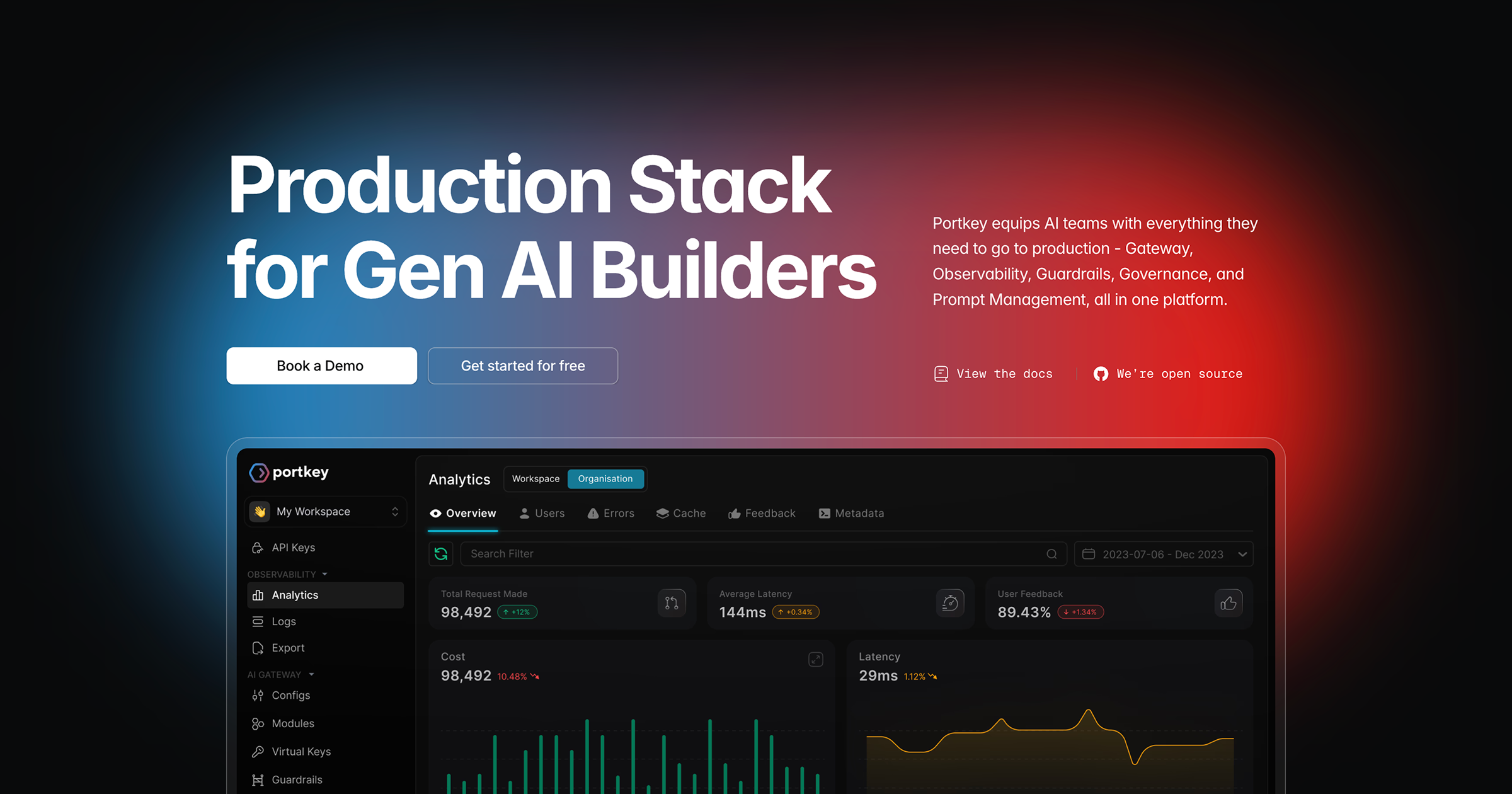
Key features include: Production Stack for Gen AI Builders, Introducing the AI Gateway Pattern, End-to-end LLM Orchestration, Secure access to MCP tools, Integrate in a minute, A reliable source of truth for LLM pricing, Take the driver's seat with AI Governance, Recognised by industry leaders.
Portkey is commonly used for: AI Gateway implementation, Observability for AI models, Governance of AI systems, Prompt management for LLMs, Integration with GitHub workflows, Caching test results to optimize costs.
Portkey integrates with: OpenAI, AWS Lambda, GitHub, Azure, Google Cloud, Slack, Jira, Trello, Zapier, Microsoft Teams.
Portkey has a public GitHub repository with 11,123 stars.
Based on user reviews and social mentions, the most common pain points are: cost tracking, anthropic bill.
