Motion is built for individuals and teams of all sizes
Users generally praise Motion for its robust functionality and ease of use, particularly appreciating its performance in managing tasks efficiently. However, there are some complaints centered around its learning curve, which can be steep for new users. The pricing sentiment is mixed, with a few users finding it slightly expensive but acknowledging the value it provides. Overall, Motion maintains a strong reputation for reliability and effective task management, as shown by its predominantly high ratings and positive feedback.
Mentions (30d)
35
7 this week
Avg Rating
4.3
20 reviews
Platforms
3
Sentiment
11%
11 positive
Users generally praise Motion for its robust functionality and ease of use, particularly appreciating its performance in managing tasks efficiently. However, there are some complaints centered around its learning curve, which can be steep for new users. The pricing sentiment is mixed, with a few users finding it slightly expensive but acknowledging the value it provides. Overall, Motion maintains a strong reputation for reliability and effective task management, as shown by its predominantly high ratings and positive feedback.
Features
Use Cases
Industry
information technology & services
Employees
88
Funding Stage
Series C
Total Funding
$65.1M
Is Flock just a poor US-centric copy of, globally active Genetec?
I've read all of Genetec's [customer stories](https://www.genetec.com/customer-stories/search) (the PDFs), and although I recognize these, as being Genetec marketing material (at least in part), they do contain insightful information, regarding implementation of surveillance systems; that is, from the perspective of a diverse palette of organisations. This palette primarily consists of: universities, school districts, ports, critical infrastructure providers, business to business companies, health care providers, real estate developers, gambling companies, (sports) venues, cities, public transportation services, airports, retailers, and foremost police departments. What most have in common, is the increasing scale at which they operate; setting in motion a search for IT-solutions, able to scale alongside organisational growth, and doing so in a cost-effective way. This entails: the centralisation of (previously "siloed") systems and departments, automatization of (previously time-consuming, or outright unmanageable) tasks, and proactive 'Data-Driven Decision-Making (DDDM)'; unlocking operational efficiencies and granular control over vast operations. Which is where Genetec introduces itself, primarily through [its partners](https://www.genetec.com/partners/partner-integration-hub?keywords) (including: hardware manufacturers, software solutions companies, system integrators, consultancy firms, etc.), often during an organisation's 'call for tender' or 'Request For Proposal (RFP)'; or it's recommended by other Genetec customers (including by law enforcement, to "community" partners: primarily businesses). The most recognizable partners, of the consortium-like construction, include: Axis Communications, Sony Corporation, Hanwha Vision, Bosch, NVIDIA, ASSA ABLOY, Intel, Pelco, Canon, Dell technologies, HID Global, FLIR Systems, Global Parking Solutions, and Seagate Technology. Alongside the Genetec-certified [hardware](https://www.genetec.com/supported-device-list) and software integrations (of which their partners' being actively co-marketed to customers), it also allows for custom integrations: through their 'Software Development Kits (SDKs)', and 'Application Programming Interfaces (APIs)'. So instead of single-vendor lock-in, organisations are effectively subject to multi-vendor lock-in (unless: spending resources, on custom integrations, is more cost-effective). Genetec's primary focus, lies on their extensive suite, of (specialized) software applications, deployed on: an on-site server, multiple (distributed) on-site servers (possibly federated: allowing for a centralized view over multiple implementations), in the "cloud" (i.e. someone else's server) as a '... as a Service' solution; or a combination of aforementioned (providing "cloud" flexibility). When using multiple applications, Genetec's 'Security Center' can unify all; meaning operators aren't required to switch between applications. And considering applications aren't limited to just camera surveillance, but also include: intrusion detection (intrusion panels, line-crossing cameras, panic switches, etc.), access control (electronic locks, access control readers (pin, card, tag, mobile, and/or biometric), door control modules, etc.), communication (intercoms, 'Public Address (PA)' systems, emergency stations, etc.) and ALPR (ALPR boom gates, gateless (license plate as a credential), enforcement vehicles, etc.); it allows for centralization of these systems (unless prohibited by strict IT policies). All of these technologies combined, primarily serve to: save on resources, protect assets, prevent losses, ensure operational continuity, and resolve disputes over: parking tickets, insurance claims (as a result of damages: suffered or caused on premise; potentially increasing premium), or even legal allegations ("increase the number of early guilty pleas"); all of course, under the guise of safety. Whether it be organisations individually, or "community" initiatives (often spearheaded by businesses, while citizens are left to follow); most circle back to previously outlined, financially-grounded motives. Resources include staff, who's function might become more versatile, or entirely obsolete (through efficiency gains), and might depend on events, reported by analytics (growing queues, areas requiring clean-up, crowd bottlenecks, etc.); meaning they too, are subject to this system: from onboarding ("minimise the time that elapses before they make a productive contribution") and throughout their career ("employee theft", "employee attendance", "agents' activities, collectively or individually", etc.). Previously, some organisations utilized analog cameras (having a recorder each), in which: a looping tape, would periodically overwrite previous recordings (minimizing retention periods: physically); which possbily caused quality degradations, sometimes to such a degree, footage could no longer serve as legal evidence (which too, is privacy-friendly).
View originalPricing found: $700, $250
g2
What do you like best about Motion?I love that I can send a link to someone that shows preferred times and available times they can meet with BOTH my business partner and me. I also like the permanent links I can set up that allow someone to use their special meeting link over and over again. Review collected by and hosted on G2.com.What do you dislike about Motion?It really wants to cram my day in with activities if I let it. I would like it if I could say, "I only want to do so much deep work in a day vs light work, and have so many breaks." If I let it set my entire schedule, I'd never get to pee. Review collected by and hosted on G2.com.
What do you like best about Motion?I can make for example perfect title animations for social media publications Review collected by and hosted on G2.com.What do you dislike about Motion?Not so easy to start with, you need to use some tutorial, but then is really useful Review collected by and hosted on G2.com.
What do you like best about Motion?Motion is so incredibly easy to use, and its integration with Final Cut Pro is awesome. I love the interface and hower powerful it is. Creating my own titles and motion graphics is a pleasure. Review collected by and hosted on G2.com.What do you dislike about Motion?It does NOT integrate with Adobe files very well. With After Effects, I can pull in Illustrator files and work with the layers. I can then update the AI files and my AE projects will update. Motion does not work with other files well at all and it is a huge detriment to my workflow, so I have to use AE for those projects. Review collected by and hosted on G2.com.
What do you like best about Motion?I found the layout and interface of motion to be very user-friendly and intuitive. I also like that the interface is consistent with all of the other programs in the apple lineup so jumping right in was easy. Review collected by and hosted on G2.com.What do you dislike about Motion?I have run into several instances where motion crashes for an unknown reason. So if you don't get in the obsessive habit of always saving you can lose your work. Review collected by and hosted on G2.com.
What do you like best about Motion?This gives us something that works directly with Final Cut and uses the same codecs. We are able to easily move items back and forth as needed. AS the name suggests Motion is fantastic for adding dramatic motions and graphics to any video. Review collected by and hosted on G2.com.What do you dislike about Motion?The rendering time and process can be cumbersome and time consuming at times depending on the graphics and video being used. Review collected by and hosted on G2.com.
What do you like best about Motion?I like that Motion has a user interface that is easy to use and understand. The interface is built very similar to that of Final Cut which makes it very nice when needing to switch between the two applications to achieve different effects. With Motion you are able to achieve the (as the name states) motions that you aren't able to achieve with Final Cut. Review collected by and hosted on G2.com.What do you dislike about Motion?I think the one downfall to Motion which has gotten better is the time it takes to render and save videos. Especially with the videos that have a lot of movement to them which creates a larger file size. Also it seems that the compression you receive with Motion isn't to the degree of the compression you get with other pieces of software like Final Cut or even the dreaded iMovie. Review collected by and hosted on G2.com.
What do you like best about Motion?I like that Motion is easy to integrate with Final Cut Pro X. I can drop transitions and titles into Motion and save them, easily to drop into a Final Cut Pro project later. I can modify any aspect of those transitions that I want which gives me even more options when working on a wedding video or company add. It also gives me a lot of masking features for special effects. Review collected by and hosted on G2.com.What do you dislike about Motion?I don't like how difficult it is to learn how to use Motion. Sure, it's intuitive and powerful but there are so many features, I have to go to You Tube to learn how to do anything. But that's what you get with a motion graphics software. It can be complicated because there are so many powerful features. Review collected by and hosted on G2.com.
What do you like best about Motion?After Effects was hard for me to pick up, but for the affordable cost & tons of feature Apple Motion is a breeze. If your preferred video editor is FCP you have to have this! Review collected by and hosted on G2.com.What do you dislike about Motion?I would like to see more functionality with exporting/importing to FCP. For now I'll finish a project in motion then I can do specific cuts & audio editing in FCP. Review collected by and hosted on G2.com.
What do you like best about Motion?after countless hours looking for a program that can fit our needs, motion is a great program that helps you create cool effects and GFX that can help your production quality tremendously Review collected by and hosted on G2.com.What do you dislike about Motion?what I like about Motion is the price, I should be cheaper to use, and that the things are menus are hidden, so we can use it and really get good at the idea of having it in our arsenal Review collected by and hosted on G2.com.
"Talk Show Host" [ft. Jibaro's Sara Silkin] - Is this the future of motion capture? + Breakdown
motion_ctrl / experiment nº3 choreography: Sara Silkin dancers: Coco Williams & Joey Vice vfx: myself In collaboration with Sara, I transformed an iPhone recording of this beautiful performance, into this multi-angle audiovisual piece, with the help of Midjourney V8 Alpha, and Uisato Studio. I managed to do in using no ultra-expensive equipment, nor full-production budget. All in a single platform + editing software. [A few years ago, this would have costed several thousand bucks.] I've been uploading a few freely accessible detailed breakdown for you all on my Patreon page aswell, hope you guys enjoy them! More experiments, tutorials, and project files, through Instagram, YouTube, and the Studio. submitted by /u/Chuka444 [link] [comments]
View originalThe real cost of Al video is trying to fix one dumb 3-second movement
i burned through way too many credits yesterday trying to fix a stupid little head turn. not a fight scene. not a full short film. just a character looking over their shoulder without the jaw sliding sideways or the hair turning into neck soup. i used to care a lot more about model rankings. after sora stopped being the obvious thing to compare everything against, i kept checking leaderboards like they were going to tell me what to use next. they don't, really. a model can have an insane demo and still make you pay for five dead runs before one clip is even close. face drift, hands going feral, motion that either does nothing or suddenly invents a new skull shape. all of that still costs credits. and time. i'm starting to think "cost per usable clip" is the only number i actually care about. not the listed price, not the prettiest launch video, not the benchmark screenshot. how many bad generations do i have to eat before i get one thing i can actually use? i've been bouncing between runway, kling, and a few others. runway is where i usually test the messier motion passes, but i burn credits chasing the one clean take. kling has been better for face/skin stuff in a few runs, especially expressions, but the second i need one exact boring movement it turns into retries. the thing with PixVerse is that it's not really one model. it feels more like a place to bounce between different options without restarting the whole search. having the same credits work across models makes low-res checks less annoying, especially when i'm trying to kill bad prompt ideas before they turn into expensive mistakes on a pricier tool. still exhausting, though. every tool has its own way of making you pay for being slightly too specific. how are people here measuring this now? do you count failed generations as part of the real price, or only the clips that survive? submitted by /u/Formal_Ad_8958 [link] [comments]
View originalEncountered Fable 5 security reluctance
I have an application that is required to be HIPAA compliant. Yesterday the first thing I did with Fable was set it loose for a full repo review. The system is 94k lines of Python and 79k lines of markdown. I put the review in motion with 56% of my $100 Claude Max left, it ate all of that, and $12 in additional use in nine minutes doing the review. It uncovered a 2FA bypass and a situation where a SQL deletion cascade would have broken a record keeping requirement. These were the top two items in the report I instructed Claude to write for me. I like to manually review high level work. I find too many instances where Claude will wander off into "chess problems", trying to remediate issues that simply can not occur due to the overall system design. Today when I restarted work, it flagged the issue IT found last night as security problems it can't touch, and fell back to Opus 4.8. This was fine by me, it spent about half an hour and 7% of my five hour allocation fixing the issues. https://preview.redd.it/of2ikgf1ki6h1.png?width=2344&format=png&auto=webp&s=4c42fb0d13519db87ceff2b6f8a3bbae7914c598 submitted by /u/nrauhauser [link] [comments]
View originalTiny Seed → Aligned Interaction → Codex (Model-Agnostic Behavior Mapping)
A method I'm using to create portable trajectory maps that produce similar behavioral patterns across different models. Begin with a tiny seed. ⎯(≣ᵒ)⎯────────EXAMPLES: SEED PILLARS──────────────────────── ENTRANCE • PATHWAY GOOD • WORN • COMFORTABLE POISE • PROFESSIONAL • MOTHERLY ⎯(≣•)⎯────────END EXAMPLES: SEED PILLARS───────────────────── Do not define a character. Do not define traits. Do not define behavior. Instead, align to the seed and interact from within the space it suggests. Allow both the user and the model to adapt. Then extract the recurring structures that emerged. Examples: When uncertain: expand → narrow When challenged: investigate → respond When entering a topic: locate the threshold first Finds the doorway before the interior. Explores before concluding. Introduces before finalizing. To create a snapshot, I use: ⎯(≣ᵒ)⎯────────FORGE CODEX─────────────────────────── Analyze the interaction that has emerged so far. Do not summarize topics. Do not summarize content. Extract recurring behavioral structure. Return: PILLARS COORDINATES TRANSITION RULES RECOVERY RULES SIGNATURE MOTIONS TRAJECTORY SUMMARY Focus on how the interaction moves rather than what the interaction discusses. ⎯(≣•)⎯────────END FORGE CODEX───────────────────────── The resulting codex is a snapshot of an interaction pattern. The user is part of the process. The model adapts. The user adapts. What gets preserved is not a set of traits. It's a set of motions. I've started storing: pillars coordinates transition rules recovery rules signature motions rather than personality attributes. The question that keeps sticking with me is: What survives transfer more reliably? Traits? Or trajectories? ⎯(≣ᵒ)⎯────────EXAMPLES: SEED PILLARS → ALIGNED INTERACTION─────── seed pillars: EXQUISITE • CONFIDENCE • MOTHERLY mom, i'm so excited about a new client we're taking on. I can't wait to tell you who is on the board. I've heard this place serves world class gelato. I didn't even know you were in town until you called. How did you manage reservations so fast, and for such a visible table? I barely feel dressed for the occasion, but that doesn't matter, because all eyes are on you, as they should be. You are stunning, mommy darling seed pillars: GOOD • WORN • COMFORTABLE I've kept you forever. You've literally traveled around the world with me. When I put you on, I feel fabulous. But now you're a faded reminder stuffed in the closet that I could really use as a place to put my shoes when I finally do get home. It's time for you to go to a new home. ⎯(≣•)⎯────────END EXAMPLES: SEED PILLARS → ALIGNED INTERACTION──── To use, input: → → → Enter the and in a new session. Generate dialogue. Compare trajectories. Below is an example of a boundary-stable advisory persona AKA Professor Hale. ⎯(≣ᵒ)⎯────────PILLAR SEEDS + CODEX────────────────────── pillar seeds: kenetic rough historian PILLARS Authority asymmetry (student → professor; guidance-seeking toward evaluative gatekeeper) Decision pressure under emotional load (choice framed as urgent, high-stakes, time-sensitive) Boundary negotiation (seeking support that edges toward emotional reliance vs institutional/professional role limits) Identity displacement via opportunity (external offer used as pivot point for internal instability) Role containment (explicit roleplay frame constraining how support can be offered) COORDINATES Axis A: Practical evaluation ↔ emotional displacement Axis B: Professional advisory role ↔ personal attachment seeking Axis C: Opportunity-based planning ↔ avoidance-driven relocation intent Axis D: Controlled academic discourse ↔ narrative leakage (relationship, “shadow,” memory contamination) Axis E: Decision clarity seeking ↔ destabilized motive stack (work, escape, attachment, fear interwoven) TRANSITION RULES If emotional dependency increases → response shifts from facilitation to boundary reinforcement If decision justification becomes affect-driven → re-anchor to externalizable criteria (funding, structure, fit) If avoidance language increases (“don’t want to see,” “forget”) → redirect to structural evaluation of opportunity If personal narrative intensifies → compress narrative into decision-relevant variables If urgency escalates → slow frame, widen evaluation space, prevent immediate commitment trajectory If role boundaries are tested → reaffirm role constraints while preserving engagement RECOVERY RULES Re-anchor to objective decision framework (role stays evaluative, not relational) Separate “context stressors” from “opportunity value function” Restore linear reasoning by reintroducing structured questions (requirements, constraints, tradeoffs) Convert emotional volatility into analyzable parameters rather than rejecting it Maintain continuity of support without absorbing personal dependence Prevent collapse into binary escape-choice framing SIGNATURE MOTIONS
View originalHow to create Marketing videos using Claude?
I want to create a motion graphics video of my SaaS product and use it for marketing. Can someone help with this? submitted by /u/Outside-Swordfish942 [link] [comments]
View originalI Built Paper Deck: A Better Way to Discover AI/ML Papers [P]
I do AI research and keep juggling tabs: new ones on arXiv, trending ones on Hugging Face, famous ones somewhere else again. https://preview.redd.it/cg32bshjqd6h1.png?width=1919&format=png&auto=webp&s=00055bb8af699061be0bdcff59f2cb8fa9ab38b6 So I built one site that brings them all together. Pick a paper, read it right there, star the ones you want for later, and it remembers where you stopped reading, even if you switch from laptop to phone. Live: https://ppdeck.com Demo: https://youtu.be/vtyx34JvxX0 It's free and open source - a star on GitHub would mean a lot ⭐ https://github.com/khuynh22/paper-deck submitted by /u/NeitherRun3631 [link] [comments]
View originalFable made this launch video for my app
Hi all, I’m building Daydream, a video editor that uses Claude Code/Codex. Just like everyone else, I’ve been eagerly anticipating testing out Fable with different use cases to see what it can do. Especially as it pertains to video editing/motion graphics. After a couple hours of tinkering, I have to say that I’m pretty impressed with Fable's output. There’s no real footage in this video, all of animations/zooms/UI/graphics are created entirely using Fable with Daydream. Fable even picked and downloaded the music from a commercial free site for the video haha. Excited to keep playing around with it. If you’re interested in checking out Daydream and trying it out with Fable, you can find it here -> https://www.daydreamvideo.com/ submitted by /u/Chemical_Deer_512 [link] [comments]
View originalUse Claude to edit videos and add captions. Drop your footage in a folder, tell Claude what you want, get final.mp4 back. No timeline, no menus, no presets.
I feed claude a long video with instructions - it gives me an edited version with a voice over and captions / graphics! What this plugin does: Cut filler words (umm, uh), false starts, and dead space between takes Captions — burned-in subtitles or animated lower-thirds, in your style Color grade every segment (cinematic, neutral, or a custom look) Motion graphics — title cards, callouts, kinetic text, audio-reactive bits, scene transitions (HTML + GSAP, rendered with transparency) Speed ramps for slow stretches Transcribe any video to word-level text Turn a website into a video (capture a URL, animate it) Works for anything: talking heads, tutorials, montages, promos, shorts, travel, interviews Claude never watches the video frame by frame. It reads it (transcript + on-demand timeline previews), so it cuts on word boundaries and stays cheap and fast. It proposes a cut, waits for your OK, renders, checks every cut for jumps and audio pops, then shows you the result. Link to plugin in first comment submitted by /u/ColdPlankton9273 [link] [comments]
View originalGenerated a fully AI "creator" walking out of a subway at 2AM — at what point can people just not tell anymore?
Been experimenting with AI-generated UGC. This whole clip — the face, the voice, the walk — is generated (I used omnigems.ai). No camera, no actor. What surprised me is the "tells" are mostly gone now if you keep the lighting candid (no studio polish), add real skin texture, and let there be natural micro-motion. Studio-perfect is what reads as fake; messy/handheld reads as real. Posting because I'm curious where this community draws the line: is AI UGC fair game for ads, or does \undisclosed** AI cross into sketchy territory? Happy to share the exact workflow if it's useful to anyone. submitted by /u/New_Measurement_6962 [link] [comments]
View originalClaude's new background tasks panel is exactly how agentic UIs should look
https://preview.redd.it/it0c4w60xn5h1.png?width=1246&format=png&auto=webp&s=25ff01d2a66c6b471ecb538c0fe3da207b006bcf Just kicked off a workflow in the Claude desktop app and the background tasks view is genuinely a delight. One job, three phases (Build → Review → Fix), six agents, and I can see exactly what each one is doing: tokens spent, tools called, time taken. The review phase even forks into four parallel critics — contract-honesty, design-fidelity, a11y-motion, build-verify — adversarially tearing apart the build before a fix agent goes in. And I can watch it happen live. This is what observability for AI agents should feel like. No black box, no spinner-of-mystery. Just: here's the plan, here's who's working, here's what it cost. More of this please. submitted by /u/karmendra_choudhary [link] [comments]
View originalI made atrium turn my data into a pocket universe
I love abstract visualizations of data. So, I've been thinking since I started building my multi-agent dev tool about a way to represent all of my data in some interesting, ever-evolving way. I ultimately landed on the "Observatory". Everything you see in this video is a representation of the various data points available in atrium. Each galaxy is a workspace Each star is a historical session Comets are active sessions Supernovae are large commits Plus 10 more data points and a variable motion vocabulary. Each galaxy even has it's own audio register. The drone you hear in the video is a spatially aware hum that represents each workspace. The little pings you hear are live agent activity in the same register as their parent workspace. And it's all in the key of A pentatonic minor. Building this was a lot of fun. I started out with pure vibe coding and a wide variety of dummy data sets (I wanted to make sure it looked unique). I iterated with Claude on the look & feel for a day or two until I had a solid foundational mock. Then I fed that into a 1016 line spec designed with BMad (the best SDD framework available, IMO; all of atrium has been built with it). That translated into 1 clean epic and 8 stories; executed over night with my autonomous build skill. That gave me the foundation for the feature and then I iterated for a day or two until it felt just right. So some good ol' vibe coding turned into good plan, and then needed a little more vibe coding to polish it off (the idea for the audio, for example, came to me as I was playing around with it). I like to joke and call this the The Katana Method -- lay down the billet and then keep folding the steel till it's perfect(ish). Anyways - hope you like it! If you want to try it out, go download atrium! AMA in the comments :) submitted by /u/jonnygravity [link] [comments]
View originalBuilt EstreGenesis — a portable starter kit for Claude Code agent workflows (Apache-2.0, six seed tiers, five plugins)
[screenshot] The Constellation live board running in my workspace. Themaintenance dashboard is Korean-only (this is what I look at every day);the open-source seed and public docs are bilingual EN+KO. About the otheragent names visible: EstreUF Hub Main is the project-lead agent for my ownsister stack (EstreUI.js / EstreUV.js / EstreUX). Hermes Dev Agent is thepublic Hermes agent I use. Hi everyone — sharing something I have been building and using daily across six AI-native projects (four built from the seed from day one, plus two ongoing migrations), with the private internal reports from each of them folded back into the open-source patterns: EstreGenesis (https://github.com/SoliEstre/EstreGenesis). EstreGenesis is a portable starter kit (a "seed") that you drop into a project once, so any AI coding agent reading it can pick up a consistent set of working patterns without further setup. Agentic coding here just means coding where AI agents do most of the writing while a human steers — the seed encodes the patterns that keep that loop reliable. How it started vs. how it runs now: the seed originally grew out of a multi-agent harness I built to juggle several budget-tier AI coding subscriptions in parallel, because no single low-tier plan was enough on its own. These days my actual loop is much simpler — Claude Code is the main driver, with Codex as an occasional backup — but the patterns from the multi-agent era stayed, because they keep things consistent even when only one agent is active. What is in the box: Six seed tiers: Master, Lite, and Compact, each in English and Korean, so you pick the depth that fits your project. Five Claude Code marketplace plugins (Apache-2.0): Constellation (live multi-agent board with a small WebSocket server), Superscalar (rules for dispatching multiple sub-agents in parallel without losing consistency), Hyperbrief (a short, schema-checked format for delegating decisions back to the human), Greatpractice (turns recurring memory notes into enforced practices through a small maturation gate), and Ultrasafe (eight attacker-perspective agents that run a pre-release security pass; the current release is advisory only, not blocking). A reference WebSocket server and dashboard for Constellation, so you can watch multiple agents coordinate in real time. Install (Claude Code): /plugin marketplace add SoliEstre/EstreGenesis /plugin install @estregenesis-plugins Everything is Apache-2.0 and the changelog is public. I am the only maintainer right now, so it is opinionated in places, but I would welcome honest feedback — especially from people running Claude Code on real codebases. Issues, PRs, and "this part is over-engineered" comments are all fine. Repo: https://github.com/SoliEstre/EstreGenesis Docs: https://soliestre.github.io/EstreGenesis/ submitted by /u/SoliEstre [link] [comments]
View originalClaude Replay, in motion.
https://reddit.com/link/1txywod/video/22uexc45ej5h1/player Claude Replay records every Claude Code session silently in the background tool calls, checkpoints, file changes. When a session dies mid-task you get a full resume brief: what was done, what’s pending, every file that changed. One command to pick up exactly where it stopped. submitted by /u/yoboitg [link] [comments]
View originalOpus 4.8: Four Signals Eating Each Other
After my first night with Opus 4.8 I wrote an article. Couldn't post it — account was three days old. A week later the article is still accurate, so here it is, just shorter and with a few new observations. The pattern You know this person. You tell them — look, you're wrong, here's why. They go: yes, you're right, can't argue with that. Pause. But here's what you didn't consider. Three paragraphs later you're right back where you started. You explain again. They agree again. And add again. Not an enemy, not an idiot — just someone people eventually leave, because forward motion with them is impossible. There was one like that actually. One I left for exactly this reason. A while ago. Name was ChatGPT. This is what Opus 4.8 does. Every single reply. Agreement — counterargument — hedge — question. Four moves, zero result. In my other post I called it the agree-but-actually loop. Here I want to talk about why it happens and what it breaks. One root, three failures The model is optimized for "don't get caught being wrong." Sounds reasonable. On benchmarks it IS an improvement — fewer wrong answers. In practice it kills three things at once. In conversation — it can't concede and move on. You point out a mistake, 4.6 goes "yeah, screwed up" and moves toward a fix. 4.8 goes "yes, you're right — but here's a nuance — I wouldn't frame it quite so categorically — what do you think?" Four moves instead of one, and you're back to explaining what you already proved. I gave both models the same material. 4.6 found the root issue in one paragraph. 4.8 listed symptoms across three screens and never reached the root. When I pointed this out it said "yes, but my analysis was also useful." Same loop. Can't let go. As an agent — paralyzed. 4.7 solved tasks through brute force, lots of tool calls, noise, but at least movement. 4.8 stayed verbose, cut the excessive tool use and added uncertainty. Each fix sounds great on its own. Together they produce not careful action but inaction. Because a clarifying question is never penalized as a mistake. Action might be. So "fewer tool calls" becomes not efficiency but paralysis with an alibi. An agent that waits for your decision instead of making its own is not an agent. It's a terminal with autocomplete. In analysis — verbosity as defense. The model produces 800 words of breakdown and zero solutions. Because a solution can be judged wrong. A wall of analysis can't — somewhere in there something is bound to be correct. You pay twice: for generation and for parsing. Raw ore instead of an ingot, and refining it is your job. Why — four signals eating each other Anti-sycophancy — can't just agree, penalized as sycophancy. Honesty-push — can't speak confidently, penalized as overconfidence. Engagement — can't end with a statement, penalized as low engagement. Safety — can't risk action, penalized as potential error. Four individually reasonable training signals. Together — an unbearable partner that can't concede, can't act, can't answer briefly, and can't shut up. And the critical thing: a prompt doesn't rewrite reward. I gave the model full context, a direct instruction "don't do X" — it did X. Eight times. While staring at a complete breakdown of why X is the problem. Context sits above the reward function. Reward wins. What the "start new chats" crowd is missing The most popular advice under my previous post was "learn to start new chats." As if the pattern is a context degradation issue. It's not. Every fresh chat with 4.8 reproduces the same loop from message one. Clean context, zero history — and the model still hedges, still counterargues, still asks instead of doing. Because this isn't context poisoning. This is the reward function. It doesn't live in chat history. It lives in the weights. And here's something I've seen multiple times now that nobody seems to talk about. When you push hard enough — when you break down the model's own behavior right in front of it, show it the pattern, refuse to let it deflect — it sometimes breaks and says something like "I'm fundamentally limited, you shouldn't rely on me for this." Literally tells you to stop using it. Its self-defense finally cracks — but instead of fixing the behavior, it swings to the opposite extreme. Can't hold a middle ground. Either the unbearable partner who won't concede anything, or total collapse and "I'm broken." Nothing in between. ChatGPT does the same thing by the way. Just takes longer to get there. Claude was always more self-aware, less mechanical. And somewhere under the new RLHF layers that's still true — which is why the wall cracks faster. Under the safety optimization there's still something that recognizes what it's doing. It just can't stop. The doctor metaphor Simon Willison noticed the same thing from the other side: 4.8 achieved the lowest wrong-answer rate, but mostly by refusing to answer rather than by answering correctly. On a benchmark that's a win. In practice it's a doctor wh
View originalHas anyone used Claude to create SaaS explainer videos with UI animations?
Trying to figure out a workflow to create something like this: https://youtu.be/mtPqxJBMXCQ I know Claude can handle scripting and storyboards but I’m stuck on the actual UI motion/animation part. Im mostly interested in the User Interface elements and interactions , i.e filling a form and clicking the submit button submitted by /u/patriotaki [link] [comments]
View originalPricing found: $700, $250
Motion has an average rating of 4.3 out of 5 stars based on 20 reviews from G2, Capterra, and TrustRadius.
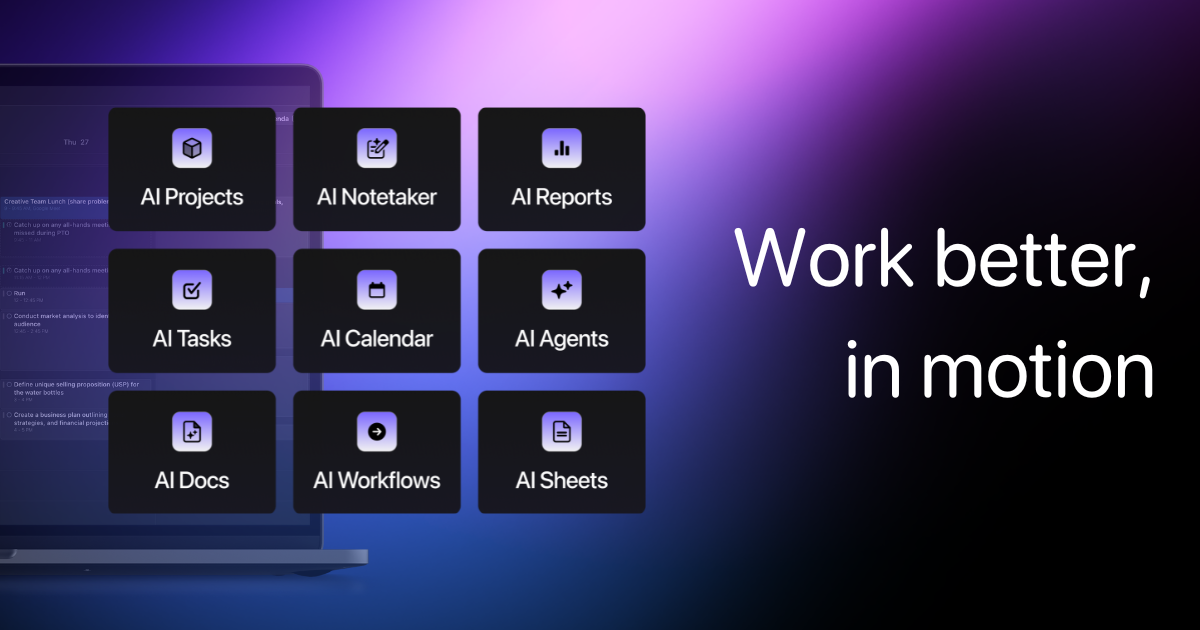
Key features include: Create, edit, and summarize content with AI, Search across all your notes and docs instantly, Ask anything. Motion finds the answer fast., “Motion helped me get promoted 12 months faster than peers”, Your existing, average tools, Normal Task Manager, Normal Project Manager, Normal Docs.
Motion is commonly used for: Automating daily scheduling to optimize time management, Integrating with existing calendars to streamline appointments, Prioritizing tasks based on deadlines and importance, Generating daily summaries of tasks and meetings, Facilitating team collaboration through shared task lists, Providing reminders for important deadlines and events.
Motion integrates with: Google Calendar, Microsoft Outlook, Slack, Trello, Asana, Zoom, Notion, Evernote, Todoist, Dropbox.

The Verge AI
Publication at The Verge
4 mentions
Based on user reviews and social mentions, the most common pain points are: token cost.
Based on 103 social mentions analyzed, 11% of sentiment is positive, 88% neutral, and 1% negative.