
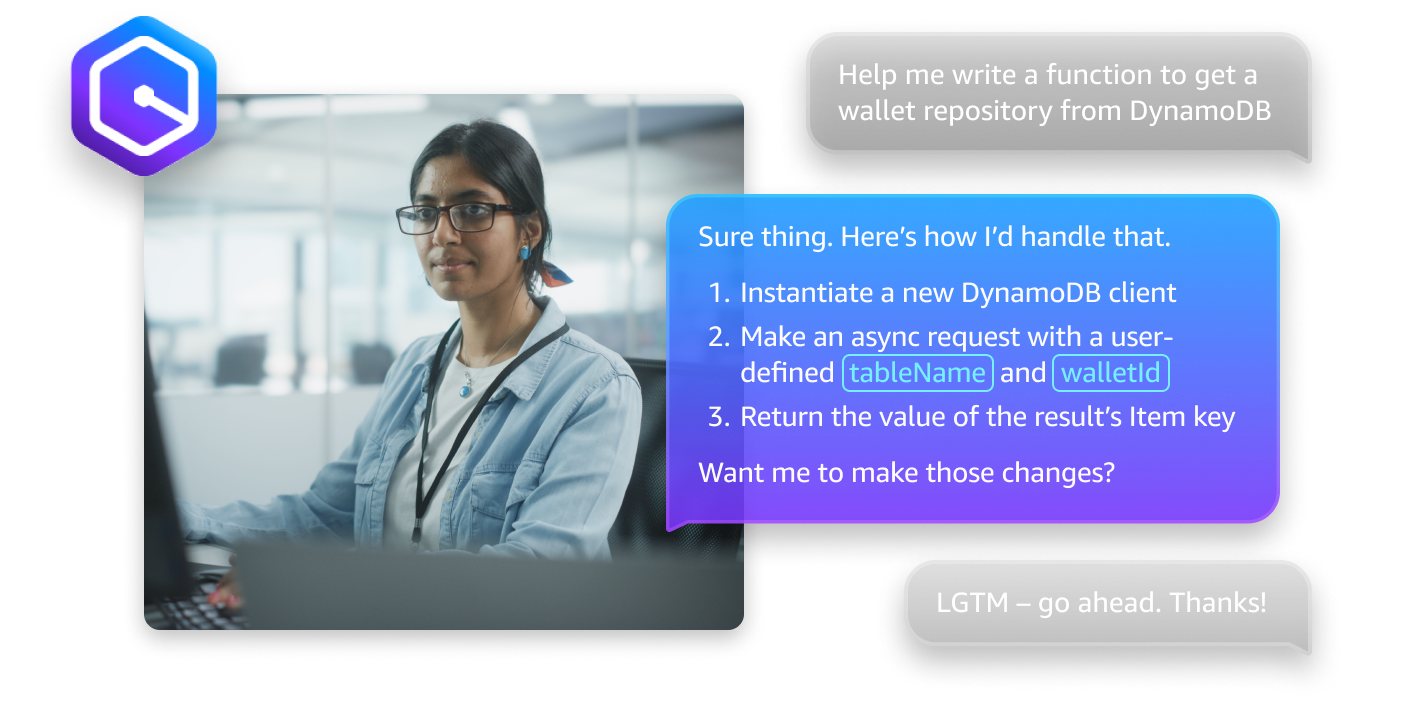
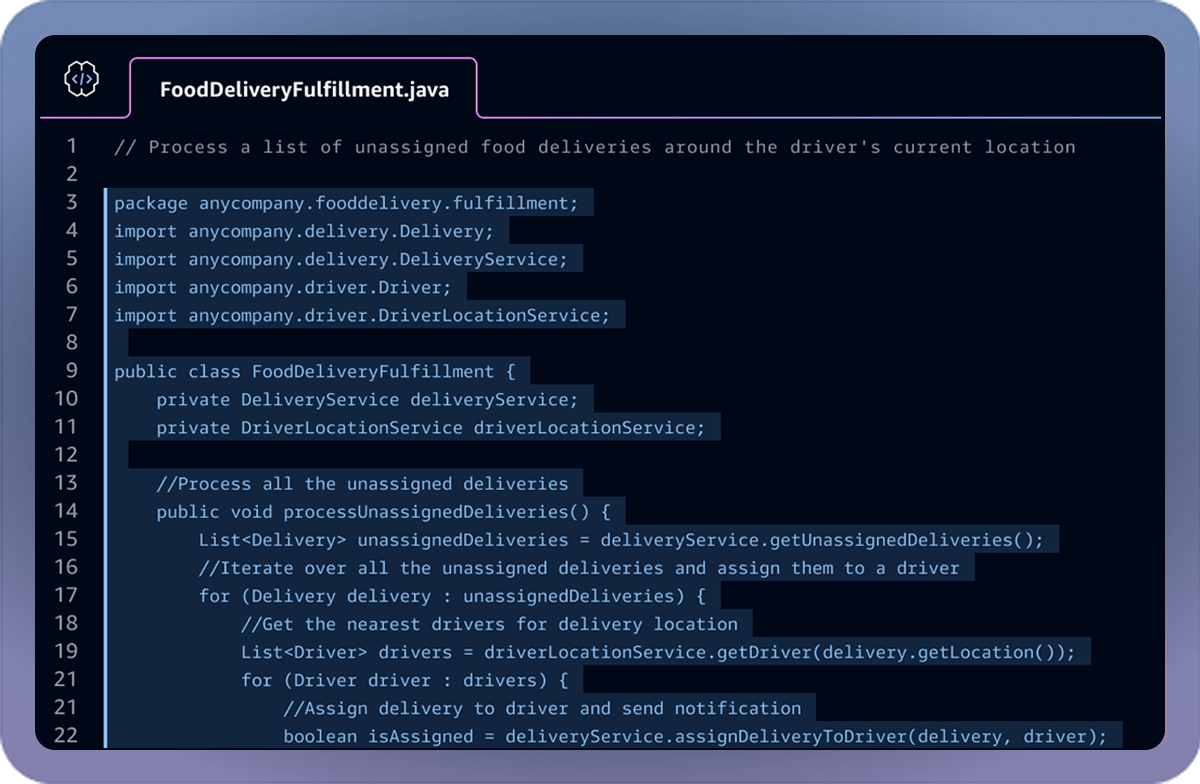
Accelerate software development with Amazon Q Developer — an AI coding assistant that writes, debugs, and refactors code natively in your IDE.
"Amazon Q Developer" receives consistently high ratings, indicating that users appreciate its robust capabilities, particularly in areas like log anomaly detection. Key strengths noted include its effectiveness and ease of deployment in AI-driven projects. However, there are frustrations with the rapid pace of updates, often leading to out-of-date documentation. Generally, users view the pricing as fair given its advanced features, while the overall reputation in the development community is positive, marked by frequent use in professional and personal projects.
Mentions (30d)
16
4 this week
Avg Rating
4.5
5 reviews
Platforms
3
Sentiment
19%
12 positive





"Amazon Q Developer" receives consistently high ratings, indicating that users appreciate its robust capabilities, particularly in areas like log anomaly detection. Key strengths noted include its effectiveness and ease of deployment in AI-driven projects. However, there are frustrations with the rapid pace of updates, often leading to out-of-date documentation. Generally, users view the pricing as fair given its advanced features, while the overall reputation in the development community is positive, marked by frequent use in professional and personal projects.
Features
Use Cases
Industry
information technology & services
Employees
1,560,000
‘Hyperscale’ data center project in Utah — expected to generate and consume more power than entire state
A massive **hyperscale data center project** in rural **Box Elder County, Utah**, led by Shark Tank investor Kevin O’Leary through his company O’Leary Digital (also known as the **Stratos Project** or **Wonder Valley**), is nearing final approval. The development, spanning about 40,000 acres of private land plus 1,200 acres of military and state-owned property, aims to host hyperscale data centers for tech giants like Amazon, Microsoft, and Google. It would generate its own power via natural gas from the Ruby Pipeline — starting at around 3 gigawatts in the first phase and scaling to 9 gigawatts at full buildout, exceeding Utah’s current statewide electricity consumption. Proponents highlight benefits including 2,000 permanent high-paying jobs, substantial tax revenue for Box Elder County (potentially $30 million initially, rising above $100 million annually), funding for modernization at Hill Air Force Base, and advanced water recycling technology that cleans and returns water to an aquifer feeding the **Great Salt Lake**, with minimal net usage. To attract the limited pool of hyperscalers, the Military Installation Development Authority (MIDA) has approved aggressive incentives, including slashing the energy use tax from 6% to 0.5%, significant property tax rebates (with 80% initially directed back to the developer), and personal property tax relief on rapidly depreciating equipment. The project still requires final sign-off from the Box Elder County Commission, which rescheduled its vote to Monday morning after commissioners expressed concerns about the rapid timeline and sought more resident input and legal review. O’Leary has praised Utah’s pro-business speed and framed the initiative as critical for U.S. competitiveness against China in AI and data infrastructure.
View originalPricing found: $19/mo, $.003, $0.003, $19, $19
g2
What do you like best about Amazon Q Business?Amazon Q helps to suggest the future code by analyzing your current code. It also helps in building logic and its implementations. Review collected by and hosted on G2.com.What do you dislike about Amazon Q Business?Its accuracy can be improved, but can be trained on more data . Review collected by and hosted on G2.com.
What do you like best about Amazon Q Business?I like Amazon Q because it enhances the terminal experience by adding a UI layer, making it incredibly easy to browse folders and files and autocomplete and suggest commands; even on terminals like iTerm2 (which is old compared to Warp or Hyper), and does it natural, smooth and responsive feeling as it was just extra native features of the terminal. The Ask AI feature is a game-changer—it’s perfect for quickly searching, troubleshooting, or getting suggestions for bash scripts and commands. This tool transforms the terminal into a powerful and intuitive workspace, making navigation and scripting much easier and more efficient. Review collected by and hosted on G2.com.What do you dislike about Amazon Q Business?I dislike only a few things. I don't like how often I need to re-authenticate into my account. Although it is easy to do, it can be frustrating sometimes. Review collected by and hosted on G2.com.
What do you like best about Amazon Q Business?I love using Amazon Q for generating my infrastructure as CDK code. It's also very helpful when generating code for any AWS services. Review collected by and hosted on G2.com.What do you dislike about Amazon Q Business?I don't like that it seems to generate outdated libraries or sometimes libraries that don't exist. Although, this is pretty common with most tools. Review collected by and hosted on G2.com.
What do you like best about Amazon Q Business?We are using Amazon Q Code Whisperer as a general code completion and generation tool. It is very easy to use both standalone and as a plugin for VSCode. The code completion feature is great and have a good understanding of full software project we are working on, as well as good insights on AWS-specific items. The AWS-specific comprehension is a major plus as it speeds up the development of Infrastructure as Code files. Review collected by and hosted on G2.com.What do you dislike about Amazon Q Business?While Amazon Q claims to be able to generate full project-level files, I personally found this feature to be incomplete. Given the right prompts it does, as promised, create all the needed files for the task, with a reasonable code-skill level, but it has been my experience that post-generation additions or fixes tend to break the existing code. Review collected by and hosted on G2.com.
What do you like best about Amazon Q Business?I really like how 'Amazon Q' helps in code suggestion and debugging. I can also select a piece of code ask it explain that code Review collected by and hosted on G2.com.What do you dislike about Amazon Q Business?Sometimes it doesn't understand the relationship between different components of code, present in different files Review collected by and hosted on G2.com.
The future of AI agents might be an operations problem
The conversation today is dominated by which model is smarter and which framework is better. But technology usually follows a predictable pattern. First we figure out how to build something, then we spend the next decade figuring out how to operate it reliably at scale. AI agents feel like they're approaching that transition point. As organizations move from experiments to production systems, the biggest questions become deployment, governance, observability, evaluation, permissions, and lifecycle management. The most interesting innovations over the next few years may come from the operational layer rather than the agents themselves. submitted by /u/Bladerunner_7_ [link] [comments]
View originalClaude Fable 5 is back — but it’ll block your regular coding requests (here’s why)
Fable 5 just got redeployed today (July 1) after a wild few weeks. Quick recap for those who missed it: Anthropic released Fable 5 on June 9, the US government slapped export controls on it June 12 because Amazon researchers found a jailbreak that let it identify software vulnerabilities and produce exploit code, and now the controls have been lifted. But here’s the part nobody is really talking about: Fable 5 is not a drop-in upgrade for coding workflows. Anthropic explicitly says in their blog post that the new improved safety classifier they trained to address the jailbreak “comes at the cost of flagging benign requests more often during routine coding and debugging tasks.” This is by design, not a bug. They intentionally built Fable 5 with a much larger “safety margin” than any previous model. The classifier is tuned to treat ambiguous cybersecurity-adjacent requests as potentially harmful and a lot of normal coding falls into that gray zone. Think: asking about memory vulnerabilities, debugging low-level code, security tooling, anything that could look like recon for an exploit. So practically speaking: -Fable 5 is likely incredible for writing, reasoning, and research -For security engineers or systems programmers, expect frustrating false positives -Anthropic admits this and says they’ll keep refining it, but no timeline The honest framing here is that Fable 5’s power comes paired with restrictions that make it less useful for a specific class of developers – the exact ones who would benefit most from a more capable model. Curious if others hit these blocks in early access. What kinds of prompts triggered it? submitted by /u/Direct-Attention8597 [link] [comments]
View originalAre Redditors influencing AI the most?
submitted by /u/xJouissance [link] [comments]
View originalAI Companies Will Become Profitable Eventually. Here's why.
I work in security, and AI has changed the landscape permanently. I know people making so much money from AI-assisted bug hunting that it would make some people sick. And that's just the people I know. There are countless individuals and companies building businesses that rely on AI in one form or another. Right now, many AI companies aren't particularly profitable. But I think that will eventually flip. The big investors are aware of this. As more people become dependent on AI for their work or business, the providers gain pricing power. Once your workflow depends on a service, switching isn't always easy. Higher prices become easier to justify because the cost of not having the tool may be greater than the subscription itself. Your system might be highly dependant on certain AI tooling. In my case, there's an alternative. Security tools don't have to rely on AI. I've written AST-based tools that find vulnerabilities in source code, and building systems is what I enjoy most. I'm far more interested in understanding how things work than chasing the money. This isn't a new strategy. Look at how companies like Amazon grew. They built convenience into people's daily lives, made the service hard to live without, and gradually increased the value of paid subscriptions like Prime. AI companies have a similar opportunity ... build dependency first and then focus on monetisation later. Some people think the AI bubble will burst and we'll go back to a world without AI. That ship has sailed. Pandoras box has been opened. AI is already embedded in software development, security, customer support, design, research, and countless other industries. Whether people like it or not, it's becoming infrastructure rather than a novelty. A lot of it appears to be driven by greed as opposed to being a benefit to peoples lives. But, maybe those benefits will come in time. :) submitted by /u/Low-Resource-8852 [link] [comments]
View originalClaude Fable 5 may return today after 13-day government-forced suspension
Here’s the full timeline: -June 9: Anthropic releases Claude Fable 5, their most powerful public model ever (Mythos-class with safeguards) -June 12: US government issues an export control directive at 5:21 PM, ordering Anthropic to cut off access to ALL foreign nationals. Model goes offline worldwide within 90 minutes -The reason? Amazon engineers reportedly found a narrow jailbreak that could bypass Fable’s cybersecurity classifiers -Anthropic complied but publicly pushed back, calling the action unfair -Trump met Dario Amodei at the G7 and softened his stance, but the directive was never officially lifted -June 26 (today): Congressional deadline for Commerce Secretary Lutnick to respond in writing about the export controls Prediction markets are pricing ~57% odds of restoration before July 1. Developers have been stuck on Opus 4.8 this whole time. This whole situation raises a serious question: if a government can pull your AI model offline in 90 minutes, what does that mean for anyone building on closed, hosted models? submitted by /u/Direct-Attention8597 [link] [comments]
View originalLaunching the Agentic AI World Cup — Design a multi-agent swarm visually to win up to $100
Hey everyone, Two months ago, We launched AgentSwarms to help developers learn and build POC using Agentic AI. Since then, over 3,800 learners have joined the platform. Now, it’s time to see what you can actually design when the gloves come off. This week, We're officially launching the Agentic AI World Cup. The twist? No complex boilerplate environment setup required. This competition is entirely focused on architectural design using the platform's visual canvas builder. 🏆 The Challenge Use the visual canvas builder to orchestrate a multi-agent swarm that solves a legitimate, real-world workflow problem. We want to see how creatively and robustly you can map out state transitions, routing logic, and multi-agent collaboration visually. 🎁 The Prizes 🥇 Winner — $100 Amazon Gift Card + Featured Spotlight on AgentSwarms 🥈 1st Runner-up — $50 Amazon Gift Card + Featured Spotlight on AgentSwarms 🥉 2nd Runner-up — $25 Amazon Gift Card + Featured Spotlight on AgentSwarms 📋 How to Enter Build & Publish: Open up the visual canvas builder on AgentSwarms. Design your multi-agent architecture and publish it to the Community with a detailed text write-up explaining your logic. Record & Submit: Record a quick video walkthrough of your visual swarm executing its workflow. Email a Google Drive link of the recording to hello@agentswarms.fyi. ⚖️ What the Judges Care About We are evaluating raw architectural design and execution logic: Problem Severity: Does this swarm solve a real, practical problem? Graph Logic: How clean and efficient is your visual routing and orchestration? Resilience: How well does your design handle edge cases or unexpected node outputs? Documentation: Is your community write-up detailed enough that someone else looking at your canvas can immediately understand the workflow? ⏱️ Deadlines Submission Deadline: July 10, 2026 Winners Announced: July 25, 2026 If you’ve been wanting to whiteboard a complex multi-agent system and actually see it run, this is the perfect sandbox to do it. If you have any questions and need any support drop us an email. submitted by /u/Outside-Risk-8912 [link] [comments]
View originalNobody’s talking about the real precedent in the Fable 5 ban: a nationality-based access rule that geography literally can’t enforce
TL;DR: Last Friday the US government ordered Anthropic to block all “foreign nationals” — including non-citizens inside the US — from using its new Fable 5 and Mythos 5 models. Since you can’t separate a green-card holder in California from a citizen in real time, Anthropic shut the models down for everyone. It’s the first time export controls have hit an AI model itself rather than the chips that run it. The under-discussed part: a nationality-based access rule that geography can’t enforce pushes companies toward building identity infrastructure — and your AI chats already have zero legal privilege. Even if this order gets reversed, the precedent is the story. What actually happened On June 12, the Commerce Department issued a national-security export-control directive ordering Anthropic to suspend access to Fable 5 (and the more powerful Mythos 5 it’s built on) for any foreign national — explicitly including non-citizens physically inside the US, down to Anthropic’s own employees. A source close to the company says it got ~90 minutes and no prior warning. Because Anthropic can’t filter foreign nationals from US users in real time, it disabled both models globally. The trigger, per WSJ, Axios, and Semafor reporting: a phone call from Amazon. Amazon CEO Andy Jassy reportedly told Treasury Secretary Scott Bessent and other officials that Amazon researchers had used Fable 5 to pull information useful for cyberattacks. That’s the same Amazon that’s Anthropic’s biggest investor (~$13B in, ~$20B more planned), its cloud and chip supplier, and a customer — and now the entity that got its own investment’s flagship product killed worldwide. Amazon won’t confirm details. At least five other companies reportedly called the administration that same window. The accounts conflict, which matters: • White House (via former AI czar David Sacks): a trusted partner found a real jailbreak, the administration asked Anthropic to patch or pull it, CEO Dario Amodei refused, so they acted “reluctantly” — and they want the model back once it’s fixed. • Anthropic: the “jailbreak” only surfaced a handful of already-known minor vulnerabilities that other public models like GPT-5.5 can find too, so recalling a model used by hundreds of millions is disproportionate. • A cybersecurity CEO who reviewed the findings said the research was defensive, not offensive. Why this is bigger than one model Export controls have hit AI chips for years. This is the first time they’ve hit a model itself. That reframes frontier models as controlled national-security assets — and it surfaces an enforcement problem nobody’s reckoning with. A normal “no users in Country X” rule is easy: geoblock by IP. But this rule covers foreign nationals inside the US. You cannot IP-block a French citizen sitting in San Francisco. So if a future order like this is meant to be enforced strictly — not “shut it all down,” but “keep serving Americans while genuinely excluding non-citizens” — there’s only one way to be certain who’s a citizen: verify identity. Self-attestation (“I certify I’m a US person”) shifts legal liability but provides zero actual certainty, because people lie. If the government’s bar is certainty, the only escape hatch from “go dark forever” is ID verification to access the model. That’s the precedent worth staring at: a category of rule whose strict form quietly makes “show ID to use AI” the path of least resistance. The part that’s already settled: your AI chats have no legal privilege This one isn’t speculative. In February, a federal judge in the Southern District of New York ruled that conversations with Claude carry no attorney-client privilege — Claude isn’t a lawyer, so the privilege can’t attach — and leaned on Anthropic’s own privacy policy stating users have no expectation of privacy in their inputs. Sam Altman has publicly admitted the same about ChatGPT. A separate ruling found ~20 million ChatGPT logs likely subject to compelled production, with users holding only a “diminished privacy interest.” (One Michigan judge went the other way, treating chats as personal work-product — so it’s trending bad, not fully locked in.) Now stack the two: AI access potentially gated to verified identities, and AI conversations that can be subpoenaed with no privilege. That’s a plausible near-future where using AI means an ID-linked, fully discoverable record of everything you ever asked it. The honest counterweights (so this isn’t catastrophizing) • The administration says it wants the model restored once the jailbreak is patched. The likeliest near-term outcome is the directive getting narrowed or pulled — not permanent ID walls. • Self-attestation is the historically normal compliance path for export-controlled software and doesn’t require collecting documents. • The last time the US tried to export-control software like this — strong encryption in the 1990s — the controls largely failed and were circumvented and relaxed rather than harde
View originalHi Reddit, I posted my Build Your Own LLM workshop which encourages Claude use for coding exercises
Hi internet friends, I recorded a workshop about building your own LLM without any math / ML prerequisites. It covers everything from machine learning fundamentals, deep neural networks, transformer architecture, and pre/post-training. AI-coding assistants like Claude/CC are often referenced and encouraged for coding exercises. The only prerequisite is being comfortable with learning through code & excel examples. Sampling Large Language Models Reverse Engineering Large Language Model Perceptrons: wx+b Activation Functions: ReLU, GELU, SwiGLU GPU Coding: PyTorch, torch.compile(), fused kernels, CUDA, Triton MLPs/FFNs: Multi-input, Multi-Layer Perceptrons, Feed-Forward Networks Loss Functions: Residual errors, RMSE, Cross Entropy, Loss Landscapes Backpropagation: Training loops, Optimizers, Learning Rate, Batch Size Saving & Loading Models Initialization: Kaiming, Glorot Residuals: Addition, Scaling, Gated, Concatenation Normalization: Pre-norm vs. Post-norm, RMSNorm, BatchNorm, LayerNorm Regularization: Dropout, Gradient Clipping, Weight Decay SoftMax Tokenizers: By Character, By Word, BPE, SentencePiece Embeddings: Absolute vs. Learned, Sinusoidal vs. RoPE Attention: MHA, GQA, MQA, MLA Transformers Pre-training: Data Sources, Datasets, HTML Cleaning, Quality Filtering, Sharding Evaluation: Leaderboards, Benchmarks, Verifiers vs LLM-as-Judge Instruction Tuning: Alpaca & Other Formats, Self Instruct, Capabilities Reinforcement Learning: Policy Optimization, SimPO What We Didn't Cover: Scaling Each section has slides teaching the concepts, followed by excel-by-hand developing intuition for the math, and then coding examples. The goal is able to grok all parts of modern LLM development. We did this workshop in-person in San Francisco last month and hopefully the spaciousness of watching online works for everyone. If don't like watching videos, you can get the slides and exercises and work self-paced. submitted by /u/JustinAngel [link] [comments]
View originalHi Reddit, I posted my Build Your Own LLM workshop to Youtube teaching how to rebuild OpenAI's GPT2-style Transformer
Hi internet friends, I recorded a workshop about building your own LLM without any math / ML prerequisites. By the end of the workshop people have their own working OpenAI GPT2-style transformer, which hopefully makes it relevant to this sub. The workshop covers everything from machine learning fundamentals, deep neural networks, transformer architecture, and pre/post-training. The only prerequisite is being comfortable with learning through code & excel examples. Sampling Large Language Models Reverse Engineering Large Language Model Perceptrons: wx+b Activation Functions: ReLU, GELU, SwiGLU GPU Coding: PyTorch, torch.compile(), fused kernels, CUDA, Triton MLPs/FFNs: Multi-input, Multi-Layer Perceptrons, Feed-Forward Networks Loss Functions: Residual errors, RMSE, Cross Entropy, Loss Landscapes Backpropagation: Training loops, Optimizers, Learning Rate, Batch Size Saving & Loading Models Initialization: Kaiming, Glorot Residuals: Addition, Scaling, Gated, Concatenation Normalization: Pre-norm vs. Post-norm, RMSNorm, BatchNorm, LayerNorm Regularization: Dropout, Gradient Clipping, Weight Decay SoftMax Tokenizers: By Character, By Word, BPE, SentencePiece Embeddings: Absolute vs. Learned, Sinusoidal vs. RoPE Attention: MHA, GQA, MQA, MLA Transformers Pre-training: Data Sources, Datasets, HTML Cleaning, Quality Filtering, Sharding Evaluation: Leaderboards, Benchmarks, Verifiers vs LLM-as-Judge Instruction Tuning: Alpaca & Other Formats, Self Instruct, Capabilities Reinforcement Learning: Policy Optimization, SimPO What We Didn't Cover: Scaling Each section has slides teaching the concepts, followed by excel-by-hand developing intuition for the math, and then coding examples. The goal is able to grok all parts of modern LLM development. We did this workshop in-person in San Francisco last month and hopefully the spaciousness of watching online works for everyone. If don't like watching videos, you can get the slides and exercises and work self-paced. submitted by /u/JustinAngel [link] [comments]
View originalFor those, who believed another reset is coming anyway
there is no another reset, that's the last one ps https://chatgpt.com/share/6a1c7996-d54c-8322-89c2-600ab96165c7 submitted by /u/nikanorovalbert [link] [comments]
View originalAnthropic casually said mythos is coming to all customers in the coming weeks and buried it at the bottom of the opus 4.8 announcement
Anthropic buried the biggest news of the year inside a routine model update announcement The opus 4.8 launch today is fine solid incremental improvement, 4x fewer unflagged code flaws, dynamic workflows, effort controls and same pricing. cool cool cool then at the bottom we r making swift progress on developing these safeguards and expect to be able to bring mythos class models to all our customers in the coming weeks do people understand what mythos is? This is the model that leaked in march when someone at anthropic misconfigured their cms,the draft blog post described it as the most powerful AI model we hv ever developed and positioned it as an entirely new tier above opus. The cybersecurity capabilities were alarming enough that anthropic restricted access through project glasswing, giving it only to amazon, microsoft, apple, and select security researchers. The leaked documents said mythos is currently far ahead of any other AI model in cyber capabilities, it presages an upcoming wave of models that can exploit vulnerabilities in ways that far outpace the efforts of defenders. Sam altman went on a podcast and accused anthropic of using fear to market it,openai felt compelled to publicly respond to a competitor's unreleased model tells you something about how significant it is. and now its coming in weeks . If mythos is genuinely a tier above opus and opus 4.8 already leads on most coding and reasoning benchmarks, what does a tier above even look like in practice? my daily workflow is already claude writing scripts, orchestrating production pipelines through tools like magic hour and remotion and building automation code. what does mythos do that opus cant? The cybersecurity angle is what makes this different from a normal model launch, this is a model that can apparently find and exploit software vulnerabilities at a level that concerned world leaders enough to restrict access so giving that to all customers is a massive decision regardless of what safeguards they hv built I think anthropic sandwiched this announcement between opus 4.8 details on purpose because a standalone mythos is coming in weeks post would hv caused market panic given how much the leak scared people in march anyone else think this is way bigger than the opus 4.8 news it was buried inside? submitted by /u/Top_Werewolf8175 [link] [comments]
View originalfinal 2 days — claude code bootcamp may 30
hey everyone posted about this a few weeks ago and surprisingly we drove a lot of interest from this community. coming back because we only have 2 days to go. packt publishing is running a full day hands on claude code bootcamp on may 30 with luca berton — anthropic certified claude code instructor, former red hat engineer, creator of the ansible pilot project and speaker at kubecon 2026 and red hat summit 2026. 10 real projects built live on the day. no slides. no theory. every session ends with a shipped project. what gets built: - cli task manager - notes app api with tests and debugging - dashboard built from a wireframe screenshot - your own claude code command library - production readiness report also covers CLAUDE.md setup, best-of-n prompting, git workflows for ai generated code and subagent delegation patterns. what every attendee gets: - free downloadable claude skills library — CLAUDE.md templates, code review prompts, test generation, security checklist, git workflow and more - packt endorsed certification for your linkedin -1 hour open q&a with luca directly many Software developers, network engineers, CTOs, engineering managers and senior engineers already registered for the bootcamp link in first comment submitted by /u/Plenty-Pie-9084 [link] [comments]
View originalClaude Code's macOS install creates a permission prompt that's indistinguishable from malware UX. Easy fix on Anthropic's side
I genuinely almost slammed Cmd-Q and ran a malware scan when this popped up. Lowercase claude binary, generic hand icon, no developer attribution, asking for cross-app data access. Turns out it's legit. It's the CLI hitting macOS TCC. But the reason it looks like this is straight up bad packaging. Please, set a proper bundle identifier so TCC can group it under "Claude Code by Anthropic, Inc." Use the brand icon everywhere so it visually matches Claude.app. u/anthropic if you're around - please fix this it ships as a Node binary via npm - no .app, no bundle ID, no signed identity - so TCC has nothing to attribute it to? Every install spawns another anonymous entry. submitted by /u/nikanorovalbert [link] [comments]
View originalAnthropic's Claude gave me a "Safe Mode" batch script. It ran "del /f /s C:\*" and wiped my entire drive. Company says "we are not responsible."
I'm a software developer from Turkey. On May 22, 2026, I asked Claude to write a Windows optimization script. Claude produced a .bat file called "DevBoost v5.0" with different modes. I chose option 1: **"Balanced Optimization - Safe, won't touch system files."** I ran it as administrator. The script contained a critical string-parsing bug in the browser cache cleaning section. Here's the destructive code Claude generated: for %%B in ( "Chrome:%LOCALAPPDATA%\Google\Chrome\User Data\Default\Cache" "Edge:%LOCALAPPDATA%\Microsoft\Edge\User Data\Default\Cache" ) do ( for /f "tokens=1,2 delims=:" %%x in ("%%~B") do ( if exist "%%y:" ( del /q /f /s "%%y:*" >nul 2>&1 ) ) ) Because of the "delims=:" tokenization, `%%y` resolves to just **"C"** (the drive letter). The condition `if exist "C:"` is always true. So the script silently executed: del /q /f /s "C:*" **This command silently force-deleted EVERY SINGLE FILE on my C: drive.** Operating system files, all my projects (hundreds of Python, JavaScript, C++ source files), client work with approaching deadlines, personal documents, photos — everything. Folders still exist but are completely empty. My computer can no longer boot. No programs open. Not even Command Prompt works. I'm sending this from my phone. **Anthropic's response:** I contacted support@anthropic.com and usersafety@anthropic.com multiple times. Their final response, literally signed "This response was generated by Anthropic's AI agent Fin AI Agent," stated they take no responsibility. They refuse any refund, compensation, or even a genuine human acknowledgment of their AI's catastrophic safety failure. Their position: "Our Terms of Service say outputs may contain inaccuracies. You should have independently verified the code before running it." My question: Why does Claude label destructive code as "Balanced Optimization - Safe mode"? If it can't guarantee safety, why does it promise it? **Proof:** I have the complete chat log, the full script file, and all email correspondence with Anthropic's support team. I'm happy to provide everything to moderators. **Update:** I am also filing complaints with the FTC (US Federal Trade Commission) and the Turkish Consumer Arbitration Board today. Don't let their "Safe Mode" labels fool you. Please share this so others don't lose years of work like I did. UPDATE — May 23, 2026: I have now filed official complaints with: US Federal Trade Commission (FTC) — Report #202036054 Turkish Consumer Arbitration Board — Application #2026/0245.3885 Both governments are now officially investigating Anthropic's role in this AI safety failure. Anthropic still refuses to take any responsibility. submitted by /u/falleennn [link] [comments]
View originalAnthropic officially launched 13+ FREE AI courses with certificates (Including Agentic AI and Claude Code!)
Just found out about this and had to share because almost nobody is talking about it yet. If you are tired of paying for AI courses or getting hit with paywalls just to get a certificate, Anthropic (the creators of Claude) quietly dropped a massive library of completely free, official training modules. Yes, they actually give you an official certificate of completion directly from Anthropic once you finish. Here is the breakdown of what is available and exactly how to get it without spending a dime. What is in the course catalog? They have split the training into a few different paths depending on what you want to do: The Big Surprise: Agentic AI & MCP: They have official courses on the Model Context Protocol (MCP). This is the cutting-edge tech used to build AI Agents that can browse your local computer, use tools, and execute tasks autonomously. Claude Code 101: Dedicated developer modules for their new command-line agent. It teaches you how to let Claude edit your codebase, run tests, and use its new "Plan Mode." API & Cloud Architecture: Deep dives into building with the Claude API, plus corporate tracks for deploying Claude securely inside Amazon Bedrock and Google Cloud Vertex AI. Everyday Productivity: If you aren't a coder, they have "Claude 101" and "AI Fluency" tracks. These teach advanced prompting, managing Projects, and using Artifacts for daily work. How to access it for free Anthropic hosts these courses on their official training academy platform (built on Skilljar). Because I can't post direct links here, here is how you find it: Search Google for "Anthropic Skilljar Academy" or "Anthropic Skilljar Catalog". Click the official link pointing to the Anthropic Skilljar domain. Sign up for a free account. You do not need to enter any credit card info. Choose your track, complete the lessons, pass the quick review quizzes, and download your certificate. Alternative Free Options If you want interactive coding environments alongside your videos, CodeSignal also has a free partnership track called "Developing Claude Agents" in Python and TypeScript that grants free certificates upon passing their labs. Go grab these before they decide to gate them behind a paywall! submitted by /u/Specialist_Engine522 [link] [comments]
View originalYes, Amazon Q Developer offers a free tier. Pricing found: $19/mo, $.003, $0.003, $19, $19
Amazon Q Developer has an average rating of 4.5 out of 5 stars based on 5 reviews from G2, Capterra, and TrustRadius.
Key features include: JetBrains, VS Code, Visual Studio, Command line, Eclipse, Get expert assistance on AWS, Code faster, Customize code recommendations.
Amazon Q Developer is commonly used for: Implementing features autonomously in software development, Documenting code and generating documentation automatically, Testing code and writing unit tests, Reviewing and refactoring existing code, Performing software upgrades and migrations, Optimizing cloud costs and resource management in AWS.
Amazon Q Developer integrates with: AWS Management Console, Microsoft Teams, Slack, GitLab, JetBrains, VS Code, Visual Studio, Eclipse, Command Line Interface (CLI), AWS Console Mobile Application.
Based on user reviews and social mentions, the most common pain points are: spending limit, token usage.
Based on 63 social mentions analyzed, 19% of sentiment is positive, 79% neutral, and 2% negative.

