Build amazing customer experiences on the Twilio platform with APIs for SMS, RCS, voice, and email, plus conversational AI for smarter engagement, and
Twilio AI is generally perceived positively among users, with particular strengths in its efficient and automated communication solutions, notably aiding local businesses in managing Google reviews via SMS. However, specific feedback and detailed user experiences appear limited as seen in the mentions. There is not much sentiment shared about its pricing in this dataset, indicating that users might not have strong opinions or it wasn't prominently highlighted. Overall, Twilio AI maintains a reputable presence, likely due to its integration capabilities and brand recognition.
Mentions (30d)
2
Reviews
0
Platforms
2
Sentiment
0%
0 positive

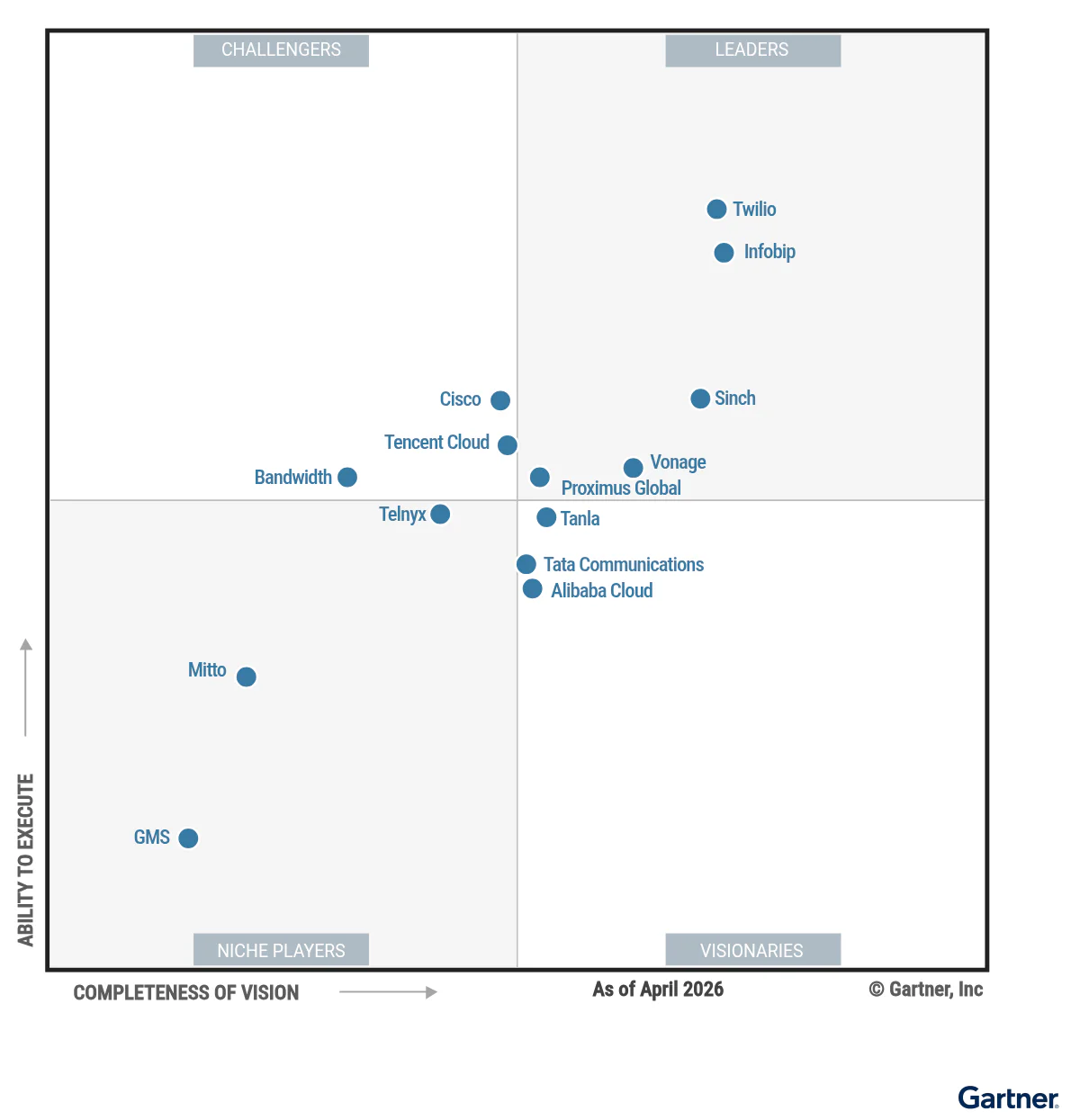






Twilio AI is generally perceived positively among users, with particular strengths in its efficient and automated communication solutions, notably aiding local businesses in managing Google reviews via SMS. However, specific feedback and detailed user experiences appear limited as seen in the mentions. There is not much sentiment shared about its pricing in this dataset, indicating that users might not have strong opinions or it wasn't prominently highlighted. Overall, Twilio AI maintains a reputable presence, likely due to its integration capabilities and brand recognition.
Features
Use Cases
Industry
information technology & services
Employees
5,600
Pricing found: $0.0002/1k, $0.005/1k, $0.002/1k, $0.018/1k, $0.0028/1k
MCP Generator v2.0.0
Built this with Claude/Claude Code — it generates MCP servers from OpenAPI specs, free and open-source on GitHub. A feel days ago I posted a CLI that converts OpenAPI specs into MCP servers. The feedback here was brutal and exactly what I needed. Here's what I actually fixed and shipped based on your comments: The original post got two pieces of feedback that changed the project: "Raw endpoints wrapped as tools is a poor LLM interface pattern" — Fair. The generator now produces a scaffold you're supposed to implement, not ship. Incremental generation (@@mcp-gen:start/end markers) means you regenerate without losing your handler logic. "console.log leaking into stdio corrupts the JSON-RPC stream" — This was a real bug. Fixed with a log() helper that writes to stderr and a safeSerialize() that handles Buffer/Uint8Array as base64 before anything touches stdout. Circular $ref schemas were the next wall — fixed with SwaggerParser.dereference({ circular: "ignore" }) + a visited-Set guard in the schema walker. What shipped in v2.0.0: YAML input (.json, .yaml, .yml, URLs) Python/FastMCP + Pydantic v2 target Incremental generation — re-run the generator without losing custom handlers oneOf/anyOf/discriminator support for complex specs Auth stubs from securitySchemes Interactive CLI mode for first-time users Built-in registry: mcp-gen init --from stripe (10+ APIs: Stripe, GitHub, Slack, OpenAI, Twilio, Shopify, Kubernetes, DigitalOcean, Azure) stdout isolation + safe binary serialization Circular $ref safety Published on npm and pip Use cases: Give Claude instant access to any REST API in under 2 minutes Generate internal API MCP servers for your team Rapid prototyping — have a working server before writing a single handler API-first development — spec first, scaffold second, logic last 2-minute setup: npm install -g mcp-gen mcp-gen init --from stripe --out ./stripe-mcp cd stripe-mcp && npm install && npm start Then add it to claude_desktop_config.json and Claude has full Stripe access. GitHub: https://github.com/ChristopherDond/MCP-Generator npm: https://www.npmjs.com/package/mcp-gen Install: npm install -g mcp-gen Questions? Want to contribute? Drop a comment or check out CONTRIBUTING.md on GitHub: https://github.com/ChristopherDond/MCP-Generator/blob/main/CONTRIBUTING.md Still a lot to do — oneOf edge cases, better binary streaming, more registry entries. If you find a spec it chokes on, open an issue. Thanks for all feedbacks and stars!!! submitted by /u/ChristopherDci [link] [comments]
View originalI built an AI tool that helps local businesses respond to Google reviews and request new ones via SMS. Would love feedback
Hello everyone. I've been working on a SaaS called StarSteady and just launched it. The idea is simple. Local businesses (auto shops, dentists, restaurants, salons) get Google reviews but almost never respond to them. And they rarely ask customers for reviews either, which kills their ranking. What it does: Paste a Google or Yelp review → get an AI-crafted response in seconds (professional, warm, or casual tone) Send SMS review requests to customers with one click. They get a link straight to your Google review page Tracks your monthly usage, response history, everything in one dashboard The backstory: I built this solo. No co-founder, no team. Just me, VS Code, and way too much coffee. Took a few weeks of building, debugging Twilio A2P compliance (absolute nightmare), and figuring out billing software. Already have my first real client using it, an auto transport company. The SMS requests actually work and the AI responses are genuinely good. Free trial has 5 AI responses + 5 SMS to test it out. Paid plans start at $39/month. Would love honest feedback from anyone willing to try it - what's missing, what's confusing, what would make you pay for it. 👉 starsteady.io Thanks a bunch guys! Your feedback is greatly appreciated! submitted by /u/dpanev [link] [comments]
View originalI got tired of the current ticketing systems, so I (Claude ofc) built a better one for everyone — thank you Claude
WARNING: anecdotal rant incoming. Jira requires a PhD to administer properly, and a second one to figure out why a Story is in the wrong sprint. ServiceNow requires the wealth of a cartel drug lord and a procurement team to even get a quote. Freshservice and Zendesk are fine until you need anything custom, then they fall apart. Most of the rest are form-builders with status fields strapped to a queue. Y'all know what I mean. For the better part of my career — 15+ years in IT — auditing tickets for accuracy (ticket triaging) was just taking up too much time. Tickets where the priority was wrong, the category was blank, the subject line three words and a typo. Then writing reports (this is not the focus of the tool, use something else for better reporting, like powerbi / tableau or w.e.) from that data. Manually. Like it was 2010. So I built my own. It's called BITSM. Multi-tenant IT helpdesk with an AI layer called Atlas baked in from day one — not bolted on. Atlas runs a tool-use loop rather than one-shot completions. It searches the knowledge base, looks up ticket history, writes custom fields, and decides when to hand off to a human. The whole point is to handle the grunt work that fills up support queues — tagging, categorizing, routing, drafting responses, flagging when something looks like a known issue — so the people on the queue can focus on the things that actually need a human. Intake channels: web portal, chat widget, inbound email (Cloudflare Email Worker), SMS, WhatsApp, and a voice agent (Twilio + ElevenLabs). Three-tier escalation — Claude Haiku for frontline, Sonnet for harder problems, human for everything else. BYOK for every external service: Anthropic, OpenAI, Voyage, Resend, Twilio, ElevenLabs, Stripe. Stack is Flask 3.x, React 19, PostgreSQL 16 with pgvector, Redis 7, Docker Compose. Running in production at bitsm.io. Built solo on weekends over the past year — and full transparency: I pair-programmed a huge amount of this with Claude (Anthropic's). I'm a one-person shop and that collaboration is the only reason it shipped at the scope it did. If you're a solo builder hesitating on AI-assisted dev, stop hesitating. License note, because someone will ask: Business Source License 1.1, not open source. Self-hosting for your own team is free. If you're building a hosted or managed service on top of it, that requires a commercial license. Converts to Apache 2.0 in four years. Upfront rather than buried. The repo: https://github.com/NovemberFalls/BITSM Happy to answer questions about the architecture or the AI design. A lot of the Atlas patterns came out of Ed Donner's agentic LLM courses, which I'd recommend to anyone building in this space. submitted by /u/Novaworld7 [link] [comments]
View originalJL-Engine a sub ms julia based ai agent?
Has anyone built a Julia‑based AI assistant.... an agent that can just make new tools and horde code snippits? Ahh the agent i made this little bundle of sarcasm to solve problems it shouldnt be able too. so "If it can't, it reiterates until it can. browser, direct os access, social media, ect ect. This project has changed alot in the last 7 months and im stoked to be able to show it. https://reddit.com/link/1slo319/video/6lh6s1wfu7vg1/player forge new Julia functions on the fly store and query a persistent SQLite memory for notes, telemetry, budgets, code Snippets auto pulled from github .etc., send SMS messages via Twilio or another provider, and pillage GitHub repositories fetch file trees, raw blobs, or whole repos LICENSE FRIENDLY i could go on but u get it. wont hopefully lookin to make something of this. Also looking for thoughts on this. dev tool? hacker toy? ill keep on it till im rendering applications on demand! submitted by /u/Upbeat_Reporter8244 [link] [comments]
View originalMy Claude.md file
This is my Claude.md file, it is the same information for Gemini.md as i use Claude Max and Gemini Ultra. # CLAUDE.md This file provides guidance to Claude Code (claude.ai/code) when working with code in this repository. ## Project Overview **Atlas UX** is a full-stack AI receptionist platform for trade businesses (plumbers, salons, HVAC). Lucy answers calls 24/7, books appointments, sends SMS confirmations, and notifies via Slack — for $99/mo. It runs as a web SPA and Electron desktop app, deployed on AWS Lightsail. The project is in Beta with built-in approval workflows and safety guardrails. ## Commands ### Frontend (root directory) ```bash npm run dev # Vite dev server at localhost:5173 npm run build # Production build to ./dist npm run preview # Preview production build npm run electron:dev # Run Electron desktop app npm run electron:build # Build Electron app ``` ### Backend (cd backend/) ```bash npm run dev # tsx watch mode (auto-recompile) npm run build # tsc compile to ./dist npm run start # Start Fastify server (port 8787) npm run worker:engine # Run AI orchestration loop npm run worker:email # Run email sender worker ``` ### Database ```bash docker-compose -f backend/docker-compose.yml up # Local PostgreSQL 16 npx prisma migrate dev # Run migrations npx prisma studio # DB GUI npx prisma db seed # Seed database ``` ### Knowledge Base ```bash cd backend && npm run kb:ingest-agents # Ingest agent docs cd backend && npm run kb:chunk-docs # Chunk KB documents ``` ## Architecture ### Directory Structure - `src/` — React 18 frontend (Vite + TypeScript + Tailwind CSS) - `components/` — Feature components (40+, often 10–70KB each) - `pages/` — Public-facing pages (Landing, Blog, Privacy, Terms, Store) - `lib/` — Client utilities (`api.ts`, `activeTenant.tsx` context) - `core/` — Client-side domain logic (agents, audit, exec, SGL) - `config/` — Email maps, AI personality config - `routes.ts` — All app routes (HashRouter-based) - `backend/src/` — Fastify 5 + TypeScript backend - `routes/` — 30+ route files, all mounted under `/v1` - `core/engine/` — Main AI orchestration engine - `plugins/` — Fastify plugins: `authPlugin`, `tenantPlugin`, `auditPlugin`, `csrfPlugin`, `tenantRateLimit` - `domain/` — Business domain logic (audit, content, ledger) - `services/` — Service layer (`elevenlabs.ts`, `credentialResolver.ts`, etc.) - `tools/` — Tool integrations (Outlook, Slack) - `workers/` — `engineLoop.ts` (ticks every 5s), `emailSender.ts` - `jobs/` — Database-backed job queue - `lib/encryption.ts` — AES-256-GCM encryption for stored credentials - `lib/webSearch.ts` — Multi-provider web search (You.com, Brave, Exa, Tavily, SerpAPI) with randomized rotation - `ai.ts` — AI provider setup (OpenAI, DeepSeek, OpenRouter, Cerebras) - `env.ts` — All environment variable definitions - `backend/prisma/` — Prisma schema (30KB+) and migrations - `electron/` — Electron main process and preload - `Agents/` — Agent configurations and policies - `policies/` — SGL.md (System Governance Language DSL), EXECUTION_CONSTITUTION.md - `workflows/` — Predefined workflow definitions ### Key Architectural Patterns **Multi-Tenancy:** Every DB table has a `tenant_id` FK. The backend's `tenantPlugin` extracts `x-tenant-id` from request headers. **Authentication:** JWT-based via `authPlugin.ts` (HS256, issuer/audience validated). Frontend sends token in Authorization header. Revoked tokens are checked against a `revokedToken` table (fail-closed). Expired revoked tokens are pruned daily. **CSRF Protection:** DB-backed synchronizer token pattern via `csrfPlugin.ts`. Tokens are issued on mutating responses, stored in `oauth_state` with 1-hour TTL, and validated on all state-changing requests. Webhook/callback endpoints are exempt (see `SKIP_PREFIXES` in the plugin). **Audit Trail:** All mutations must be logged to `audit_log` table via `auditPlugin`. Successful GETs and health/polling endpoints are skipped to reduce noise. On DB write failure, audit events fall back to stderr (never lost). Hash chain integrity (SOC 2 CC7.2) via `lib/auditChain.ts`. **Job System:** Async work is queued to the `jobs` DB table (statuses: queued → running → completed/failed). The engine loop picks up jobs periodically. **Engine Loop:** `workers/engineLoop.ts` is a separate Node process that ticks every `ENGINE_TICK_INTERVAL_MS` (default 5000ms). It handles the orchestration of autonomous agent actions. **AI Agents:** Named agents (Atlas=CEO, Binky=CRO, etc.) each have their own email accounts and role definitions. Agent behavior is governed by SGL policies. **Decisions/Approval Workflow:** High-risk actions (recurring charges, spend above `AUTO_SPEND_LIMIT_USD`, risk tier ≥ 2) require a `decision_memo` approval before execution. **Frontend Routing:** Uses `HashRouter` from React Router v7. All routes are defined in `src/routes.ts`. **Code Splitting:** Vite config splits chunks into `react-vendor`, `router`, `ui-vendor`, `charts`. **ElevenLabs Voice Agents:** Lucy's
View originalYes, Twilio AI offers a free tier. Pricing found: $0.0002/1k, $0.005/1k, $0.002/1k, $0.018/1k, $0.0028/1k
Key features include: Messaging, Email, Voice, User authentication, Customer data, Sources.
Twilio AI is commonly used for: Sending SMS notifications for order updates, Implementing two-factor authentication for user accounts, Creating a customer support chatbot using voice and messaging, Automating email campaigns for marketing purposes, Building a real-time communication platform for remote teams, Integrating customer data for personalized marketing strategies.
Twilio AI integrates with: Salesforce for CRM integration, Zendesk for customer support ticketing, Shopify for e-commerce notifications, Slack for team communication alerts, Zapier for workflow automation, Google Sheets for data management, HubSpot for marketing automation, Microsoft Teams for collaboration.

Episódio 2 - T2 - Twilio Talks. Creditas: Como IA e Comunicação Transformam o Futuro do Crédito.
Mar 12, 2026