Julius excels with its ease of use for natural language data analysis, trusted by over 2 million users, while ThoughtSpot shines with its robust integration and powerful BI capabilities at a larger scale, rated 4.3 out of 5 from 20 reviews. Julius targets small to medium companies with specialized analysis and visualizations, whereas ThoughtSpot offers in-depth analytics for larger enterprises, backed by significant funding of $663.7M.
Best for
ThoughtSpot is the better choice when you require comprehensive BI capabilities and seamless integration across multiple enterprise platforms, ideal for larger teams looking for extensive data insights and real-time analytics.
Best for
Julius is the better choice when your team needs intuitive, rapid data analysis and visualization without a heavy technical setup, especially for organizations with limited data staff.
Key Differences
Verdict
For smaller teams or those just starting with data analytics, Julius provides a user-friendly, efficient solution that simplifies data reporting and visualization. Larger enterprises looking to integrate complex BI tools across multiple departments should lean towards ThoughtSpot, which offers robust support and comprehensive analytics features. Ultimately, the choice depends on team size, budget, and specific analytic needs.
ThoughtSpot
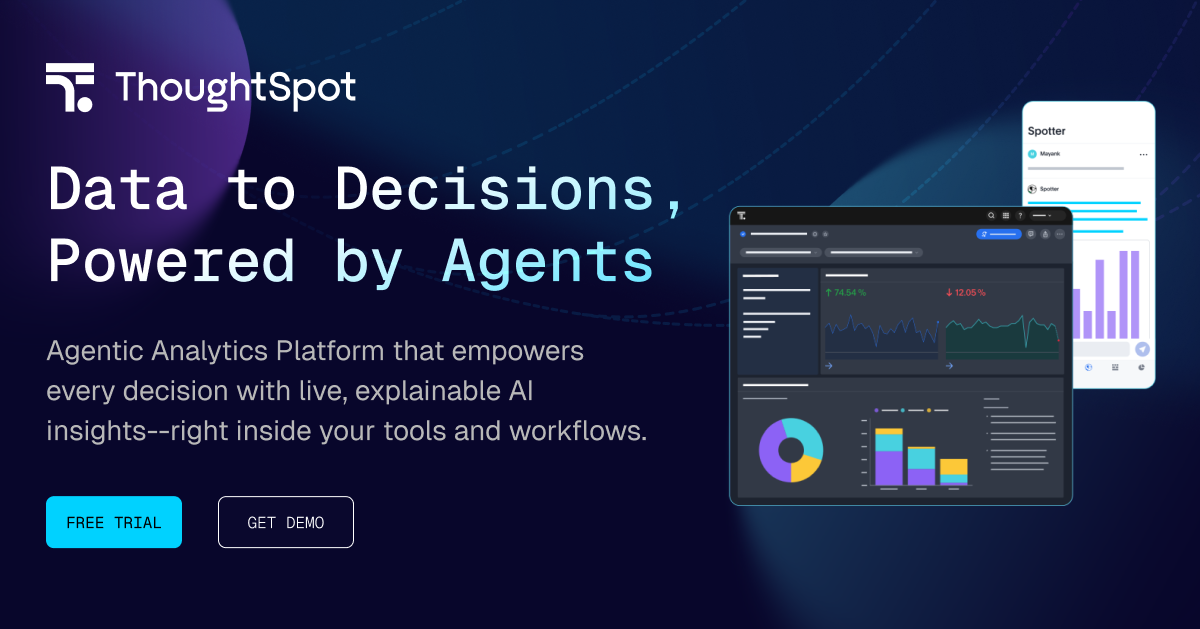
Transform insights into action with the ThoughtSpot Agentic Analytics Platform—AI agents, automated insights, and embedded intelligence.
I don't have enough information about ThoughtSpot from these mentions to provide a meaningful summary. The social mentions provided are primarily about general AI tools like Claude, ChatGPT, and Reddit data analysis, with only repetitive YouTube titles mentioning "ThoughtSpot AI" but no actual user feedback or review content. To accurately summarize user sentiment about ThoughtSpot's strengths, complaints, pricing, and reputation, I would need actual user reviews and discussions specifically about the ThoughtSpot platform and its business intelligence capabilities.
Julius
Julius Business Plan
Loved by 2,000,000+ users and trusted by teams at Ask for what you want and Julius analyzes the data for you Connect with data sources like databases, spreadsheets, and more You provide the questions, Julius handles the analysis Choose from charts, tables or full reports tailored to your data From spreadsheets to databases, ask questions in natural language and get instant insights. Get context-rich analysis, connecting the dots between your different tools to see the full story. Your team can ask questions, generate reports, and share insights directly in Slack. Simply tag @Julius and ask. Set your schedule once, then get fresh reports delivered automatically every morning via Slack or Email. I’m big on data analysis (spreadsheets DAU!), but often find myself frustrated by errors and slowness in trying to even analyze a basic spreadsheet in ChatGPT. Julius is good at this, and has only gotten better over time. It’s both very reliable, and can generate helpful ideas for extra analysis as well as visualizations. AI Partner, Andreessen Horowitz Julius.ai completely changed how I approach growth. I can analyze multiple datasets at once and turn them into insights for customer acquisition, retention, and marketing campaigns, all without waiting on engineering or hiring data analysts. I’ve used it at two companies now, and it’s saved us hours while helping us make smarter decisions every day. Head of Growth, HomeFromCollege No coding or complex setup required. Turn your data into clear visuals that explain your findings. Ask questions for quick insights, or switch to R, Python, SQL for reproducible analysis. Gets better at understanding your data with every use, learning your business logic to surface relevant insights. Stop wasting time with tools that aren't optimized for data analysis. Use Julius and transform the way you analyze and visualize data. See how companies use Julius to transform their data analysis See how AthenaHQ cut data analysis time from a full day to under an hour with Julius. Discover how SpellBook cut 8–10 hours of manual data work every week down to minutes using Julius. Your data stays private and is never used to train AI. Julius is compliant with industry-leading standards including SOC 2 Type II, TX-RAMP, and GDPR. Balance sheet creation for a SaaS company Acquisition channel efficiency analysis Forecasting and inventory optimization Cash flow forecasting and budgeting Correlation matrix on genetic dataset With Julius, you can get the most out of your data.
ThoughtSpot
-17% vs last weekJulius
Not enough dataThoughtSpot
Julius
ThoughtSpot
Julius
ThoughtSpot
Pricing found: $25, $0.10, $25, $50
Julius
ThoughtSpot (10)
Julius (1)
Only in ThoughtSpot (9)
Only in Julius (10)
Only in ThoughtSpot (21)
ThoughtSpot
What do you like best about ThoughtSpot?As a fraud analyst, what I like most about ThoughtSpot is how quickly it lets me explore large datasets, spot unusual patterns, and turn what I find into actionable insights in real time. I can do all of this without needing deep technical skills, which helps me respond to suspicious activity faster and more effectively. Review collected by and hosted on G2.com.What do you dislike about ThoughtSpot?For a fraud analyst, the main downside of ThoughtSpot is that, although it’s great for getting quick insights, it can still require fairly complex data preparation. It may also become costly at scale, and it isn’t the best fit for very advanced predictive fraud modeling. Review collected by and hosted on G2.com.
What do you like best about ThoughtSpot?I really like the Conversational AI, Agentic features, and the Spotter functionality of ThoughtSpot. They provide additional insights and explanations, making the platform thorough, easy to access, and ubiquitous. The value comes in speed, clarity, and broader access to insights, as it reduces the friction between a business question and a usable answer. I appreciate how users can ask questions naturally, iterate quickly, and transition from data to action with less effort. I find Spotter particularly valuable as it goes beyond just information retrieval by explaining data, providing additional context, and guiding users to insights they might not think of on their own. ThoughtSpot becomes more than a reporting tool; it is a decision-support capability helping users interpret results, explore implications, and act confidently. Review collected by and hosted on G2.com.What do you dislike about ThoughtSpot?There is clear value in ThoughtSpot, but the opportunity is in making advanced capabilities more consistently intuitive and dependable for everyday business users. At times, the experience can still require too much user interpretation, especially when moving from a question to a fully trusted, decision ready insight. Areas for improvement include making outputs more consistently context-aware, improving the precision and relevance of generated insights, and simplifying the experience so users can navigate advanced capabilities without needing significant enablement. In short, the platform is strongest when it reduces complexity. The more seamless, explainable and business-friendly the experience becomes, the more broadly and confidently it will be adopted. Review collected by and hosted on G2.com.
What do you like best about ThoughtSpot?I love how ThoughtSpot is quick and enables us to democratize data, allowing more people to access it. It's fun to build with, and it offers many unique features. I appreciate the specific visuals we can create, such as heat maps and bar and line charts, which serve multiple purposes for our users. I find it very intuitive to use ThoughtSpot, making it easy to create quick answers with filters. I've learned to perform tasks rapidly and provide a lot of value with engaging visuals instead of just showing quick tables. People respond well to these visuals, which has been really helpful. Additionally, I enjoy ThoughtSpot for its ability to handle a vast amount of data and manipulate it, impressing everyone I have shown it to with how fast they can create reports and customize data. Review collected by and hosted on G2.com.What do you dislike about ThoughtSpot?Sometimes, it does take a little bit of time to index the data when a new data model is created, and that is a little frustrating. So being able to get that indexing time down would be great. Review collected by and hosted on G2.com.
Julius
No reviews yet
ThoughtSpot

How One Data Spike Saved the PGA with WHOOP | The Data & AI Chief
Apr 10, 2026

WHOOP x Cornell: Transforming HRV Trends into Life-Changing Outcomes | The Data & AI Chief
Apr 9, 2026

WHOOP: The Science of Early COVID-19 Detection with Respiratory Data | The Data & AI Chief
Apr 9, 2026

Inside WHOOP's Wearables AI Engine for Predictive Health
Apr 8, 2026
Julius
No YouTube channel
ThoughtSpot


Julius
No screenshots
ThoughtSpot
Julius
ThoughtSpot
Julius
For natural language-based querying and user-friendly visualization, Julius is preferred, while for complex, integrated BI needs across departments, ThoughtSpot excels.
Julius uses a tiered pricing model but doesn't specify costs publicly, whereas ThoughtSpot offers per-seat pricing with options starting at $25, plus a free tier.
ThoughtSpot likely offers more extensive support, with a larger team size and developed discussion topics, whereas Julius, with its smaller team, may focus on direct user feedback.
Yes, they can be complementary, as Julius can handle quick analyses and visualizations, while ThoughtSpot can manage deeper BI integrations and detailed insights.
Julius is easier for immediate use due to its straightforward setup and natural language capabilities, while ThoughtSpot may require more initial configuration but offers greater long-term functionality.


