
Write your novel faster with the best AI tool for fiction. Start for free today and see why The New Yorker calls it "a salvation" for writer
Sudowrite is often praised for its ability to assist writers with creative ideas, enhancing productivity by generating suggestions and edits that help overcome writer’s block. However, some users express concerns about the tool potentially altering an individual’s unique writing voice, as highlighted by a Berkeley paper on AI prose revision. The pricing sentiment is generally seen as reasonable, especially given the value it provides to frequent users. Overall, Sudowrite enjoys a positive reputation among users seeking a supportive writing aid, although concerns about voice consistency remain.
Mentions (30d)
1
Reviews
0
Platforms
2
Sentiment
0%
0 positive
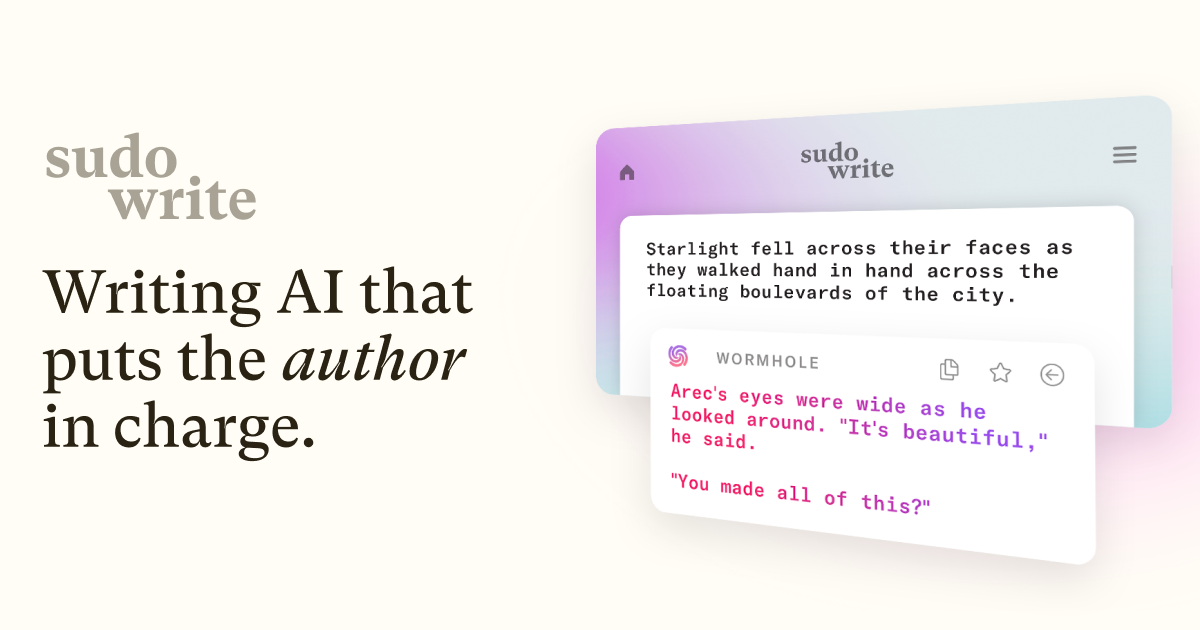
Sudowrite is often praised for its ability to assist writers with creative ideas, enhancing productivity by generating suggestions and edits that help overcome writer’s block. However, some users express concerns about the tool potentially altering an individual’s unique writing voice, as highlighted by a Berkeley paper on AI prose revision. The pricing sentiment is generally seen as reasonable, especially given the value it provides to frequent users. Overall, Sudowrite enjoys a positive reputation among users seeking a supportive writing aid, although concerns about voice consistency remain.
Features
Use Cases
Industry
information technology & services
Employees
17
New Berkeley paper measured what happens to voice when AI revises prose. Even the "preserve voice" prompt drifted in the same direction.
New arxiv paper just landed that's worth reading if you're interested in stylometry, AI revision, or the prose-writing strand of the 4.7 discussion. Berkeley researcher Tom van Nuenen ran 300 personal narratives through three frontier models (Claude-class, ChatGPT-class, Gemini-class) under three prompt conditions: generic "improve this," generic "rewrite this," and explicitly "revise this while preserving the original voice." He measured 13 stylometric markers in input and output: function words, contractions, first-person pronouns, vocabulary diversity, sentence length variance, punctuation patterns, emotion words. The result: every model in every condition drifted in the same direction. Fewer contractions, fewer first-person pronouns, greater vocabulary spread, longer words, more elaborate punctuation. The shift moved prose from embedded narration toward distanced narration. The "preserve voice" prompt only reduced the magnitude of the drift, not the direction. In plain language: every AI revision prompt makes prose more polite, more formal, more eager to please, even with a prompt that says don't. What I keep coming back to is what this implies for the prompt-engineering layer of the stack. Anyone who's been iterating on prompts, sample paste-ins, custom instructions, or character bibles for any kind of voiced output (writing, dialogue, marketing copy, persuasive essays) has been working on a problem the paper effectively shows has a structural ceiling. Voice instructions live at a layer the model's post-training distribution overrides within a paragraph or two. It's also the cleanest empirical explanation I've seen for the 4.7 prose regression specifically. 4.7's central voice is more deeply encoded than 4.6's, which is exactly why it reads stylometric structure better (the Piper experiment I posted about last week) and resists deviation harder (the memo-voice complaints). Implication for tooling: if you want voice preservation across long-form work, the architecture has to live outside the prompt. Compiled style profiles, applied as binding constraints on every generation. Not as prompt parameters that can be overridden. Wrote up the longer version with a breakdown of why each major writing tool (Sudowrite, NovelCrafter, Claude/ChatGPT direct) hits the same ceiling, and what a constraint-based architecture looks like in practice, here: https://bookmoth.app/blog/ai-writing-tool-that-preserves-voice/ Paper is here: https://arxiv.org/abs/2604.22142 Anyone working on voice-sensitive output, does this match what you're seeing in practice? Curious whether prompt-level approaches have held up better for you than the paper suggests, or whether this lines up with the drift you've been describing. submitted by /u/kurthertz [link] [comments]
View originalSudowrite uses a subscription + tiered pricing model. Visit their website for current pricing details.
Key features include: Find the perfect word, every time., Explore plot points, character arcs, and themes in a magic AI canvas., Find the perfect name, magic item, or title., Bringing it to life is easier when you can see it., 1,000+ new ways to write, get feedback, and so much more!, Who’s behind this?.
Sudowrite is commonly used for: Generating character descriptions that resonate with readers, Developing intricate plot points for fiction stories, Creating engaging dialogue that feels authentic, Brainstorming unique names for characters and magical items, Enhancing narrative depth through detailed scene descriptions, Receiving instant feedback on writing drafts.
Sudowrite integrates with: Google Docs, Microsoft Word, Scrivener, Notion, Trello, Evernote, Slack, Dropbox.
