Statsig is your modern product development platform, with an integrated toolkit for experimentation, feature management, product analytics, session re
Statsig is generally praised for its robust feature set geared towards enabling data-driven development, which many users appreciate for improving decision-making processes. However, some users have raised complaints about the learning curve associated with mastering its more advanced functionalities. The pricing is perceived as slightly high but justified by its comprehensive features and performance analytics capabilities. Overall, Statsig holds a favorable reputation among its users for enhancing product experimentation and growth strategies.
Mentions (30d)
0
Reviews
0
Platforms
2
Sentiment
0%
0 positive


Statsig is generally praised for its robust feature set geared towards enabling data-driven development, which many users appreciate for improving decision-making processes. However, some users have raised complaints about the learning curve associated with mastering its more advanced functionalities. The pricing is perceived as slightly high but justified by its comprehensive features and performance analytics capabilities. Overall, Statsig holds a favorable reputation among its users for enhancing product experimentation and growth strategies.
Features
Use Cases
Industry
information technology & services
Employees
170
Funding Stage
Merger / Acquisition
Total Funding
$1.3B
Pricing found: $150 /mo, $0.05, $150 /mo, $0.05, $150
New secret Claude.ai feature gets its own rate limits
Background: You can see your Claude subscription's current rate limits here: https://claude.ai/settings/usage. You can see the current 5-hour session limit, your separate weekly limits for "All models" and "Sonnet only", your "Daily included routine runs", and your "Extra usage". The page uses a convenient API, https://claude.ai/api/organizations/ /usage, that returns a JSON object following the below format. What's interesting about it is that there's a new field, in addition to five_hour, seven_day (All models), and seven_day_sonnet, called seven_day_omelette, which unlike other currently-unused fields is 0% utilized, instead of just null. There's also a brand new omelette_promotional that wasn't here when I started writing this post! { // Standard limits. "five_hour": { "utilization": 5.0, "resets_at": "2026-04-16T01:00:00.596086+00:00"}, "seven_day": { "utilization": 80.0, "resets_at": "2026-04-17T14:00:00.596108+00:00"}, "seven_day_sonnet": { "utilization": 4.0, "resets_at": "2026-04-19T03:00:00.596116+00:00"}, // THIS IS NEW! "seven_day_omelette": { "utilization": 0.0, "resets_at": null }, // %0 // These ones were used at various times in the past several months and are no longer active; // hence "null" instead of "utilization": 0.0 like omelette above. "seven_day_oauth_apps": null, "seven_day_opus": null, // During the days when Sonnet was the standard workhorse and Opus usage was less common. "seven_day_cowork": null, "iguana_necktie": null, // The free $1000 credits for Claude Code Web in November. // ====== THIS IS NEW as of April 16th ====== "omelette_promotional": null, // Extra usage information. "extra_usage": { "is_enabled": false, "monthly_limit": null, "used_credits": null, "utilization": null } } This doesn't appear to be Opus 4.7—I've been using it and my omelette usage hasn't gone up. Closely tied to "omelette"-related areas are "lattice" and "trellis" codenames, which appear to be UI features. Based on some deep investigation, it seems to me that it's all some sort of specific Claude Code Desktop / Cowork feature, tied to some sort of "design page". Everything else pertaining to it is very carefully tucked away in Statsig/GrowthBook so there's nothing but obfuscated names and placeholders. Even the new feature's SVG content is stored up there. But it is listed in some strings collection as "Claude {featureName}". It doesn't appear to have anything to do with Claude Code specifically—not a single "omelette", "trellis", or "lattice" feature flag appears in CC's minified code, and none of the recent updates to its system prompts (https://github.com/Piebald-AI/claude-code-system-prompts), even gated/hidden ones, seem to mention anything in the way of "design". submitted by /u/Dramatic_Squash_3502 [link] [comments]
View originaldug into the browser console on claude.ai and found the flags that control how much opus 4.6 actually thinks
EDIT: was wrong about frontend flags causing this. See my comment below for updated data with timing tests across all models so like a lot of people noticed opus 4.6 sometimes barely thinks and just feels off, even with extended thinking enabled. got annoyed and just opened the browser console to see what claude.ai actually sends and receives behind the scenes. turns out if you pull the GrowthBook feature flags from the bootstrap endpoint you can see all the configs that control your account. and there's one config where the flag slate_ember_ridge is set to "adaptive". this sits next to other values in the same object like "max-effort-2026-01-24" and "supports_auto_thinking" so it pretty clearly controls the thinking effort level. adaptive just means the model decides itself how hard it wants to think per question. also intercepted the actual streaming response for a complex question about godel's incompleteness theorems. extended thinking was on. the thinking block lasted 0.5 seconds and the entire content was just "Interesting philosophical/technical question. No search needed." thats all the thinking it did before it started writing the answer. the request your browser sends has no parameters at all for thinking depth or effort level. nothing. meanwhile claude code users can just set CLAUDE_CODE_EFFORT_LEVEL=high. the infrastructure exists, web users just dont get access to it. you can check your own flags, paste this in your console on claude.ai: fetch('/api/bootstrap/' + document.cookie.match(/lastActiveOrg=([^;]+)/)[1] + '/app_start?statsig_hashing_algorithm=djb2&growthbook_format=sdk', {credentials:'include'}).then(r=>r.json()).then(d=>console.log(JSON.stringify(d.org_growthbook,null,2))); search for slate_ember_ridge in the output. thats the effort flag. let me know if anyone gets something different than "adaptive" submitted by /u/Purpleshitmalphite [link] [comments]
View originalCapybara V4 Log Appeared On Claude App
submitted by /u/Shoddy-Department630 [link] [comments]
View originalYes, Statsig offers a free tier. Pricing found: $150 /mo, $0.05, $150 /mo, $0.05, $150
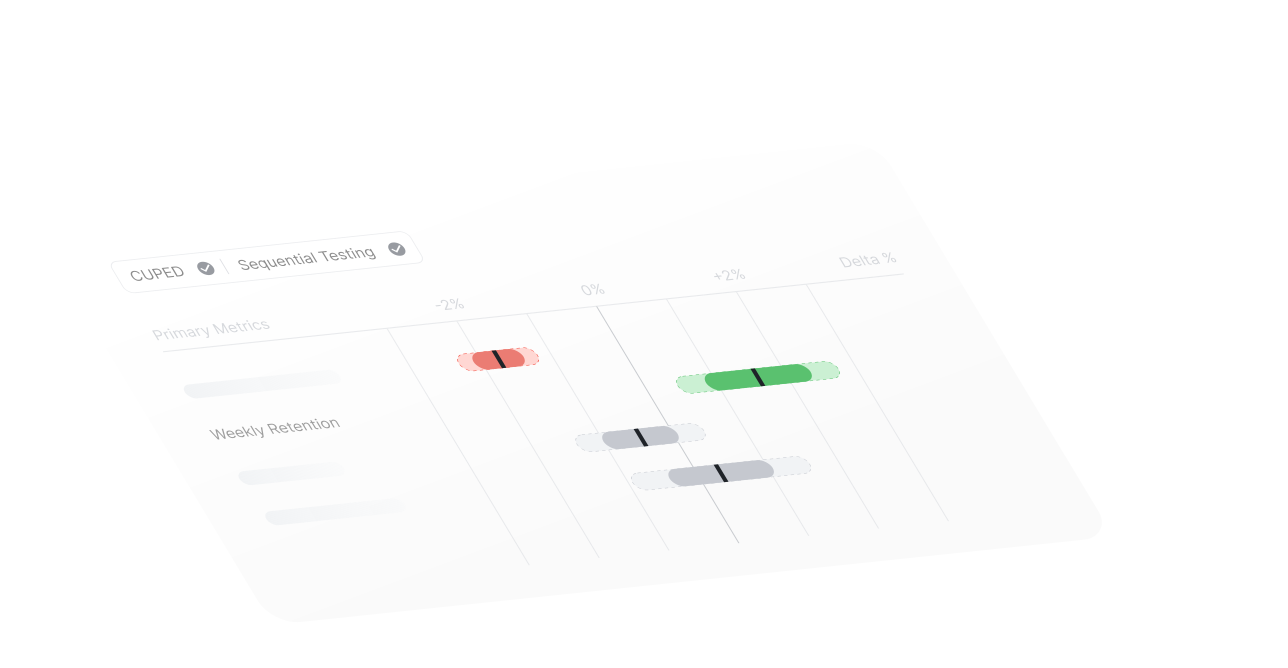
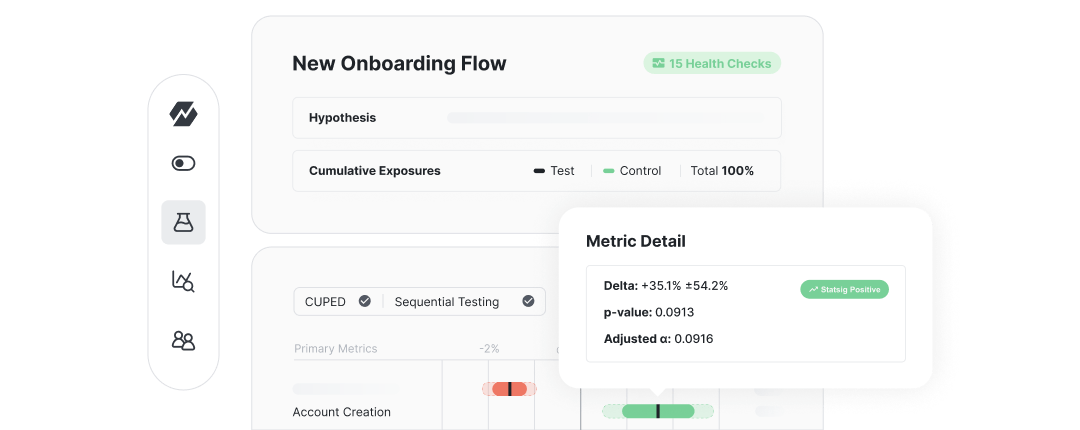
Key features include: Products, Solutions, Resources, Pricing, Experimentation, Feature Management, Product Analytics, Session Replays.
Statsig is commonly used for: A/B testing for web applications to optimize user experience., Feature flag management to control the rollout of new features., Real-time analytics to track user engagement and behavior., Personalization of user experiences based on data-driven insights., Performance monitoring of different product features over time., Segmentation of user data for targeted experiments..
Statsig integrates with: Google Analytics, Segment, Amplitude, Mixpanel, Snowflake, AWS S3, Zapier, Tableau, Looker, Slack.