
Maximize your social ROI with Sprout Social, trusted by the world's most talked about brands. Power everything from publishing and engagement to
Sprout Social AI is praised for its comprehensive suite of tools that streamline social media management and analytics. However, users express concerns about the pricing, considering it relatively high compared to other solutions. Despite the pricing issues, the platform maintains a strong overall reputation for its functionality and effectiveness in managing social strategies. The sentiment around Sprout Social AI is generally positive, with an appreciation for its advanced features, though cost remains a notable drawback.
Mentions (30d)
60
Reviews
0
Platforms
2
Sentiment
9%
20 positive

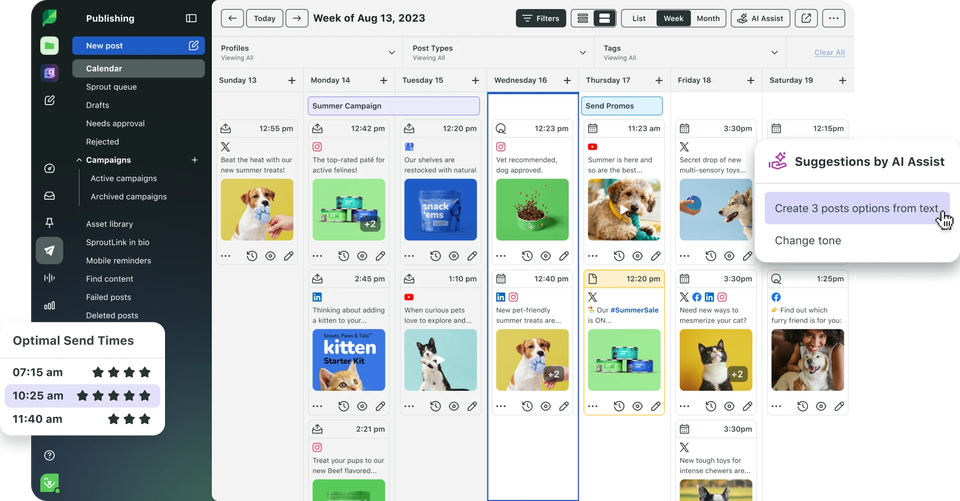
Sprout Social AI is praised for its comprehensive suite of tools that streamline social media management and analytics. However, users express concerns about the pricing, considering it relatively high compared to other solutions. Despite the pricing issues, the platform maintains a strong overall reputation for its functionality and effectiveness in managing social strategies. The sentiment around Sprout Social AI is generally positive, with an appreciation for its advanced features, though cost remains a notable drawback.
Features
Use Cases
Industry
information technology & services
Employees
1,400
AIs are weird lil alien minds
AIs are weird lil alien minds
View originalPricing found: $99
Demo: Automate Design Creation with Row-Bot Designer Studio - Decks, Landing Pages, App Mockups, Storyboards and more.
In this demo, I show how to use Row-Bot for a complete creative marketing workflow. We start with rough launch notes for Row-Bot Background Tasks, then use Designer Studio to turn them into a structured campaign, a five-slide social carousel, AI-generated visuals, refined copy, exportable assets, and social post captions. Open-Source & Local-First submitted by /u/Acceptable-Object390 [link] [comments]
View originalis AI making content creation too easy and distribution the new bottleneck
been thinking about this a lot lately. with all the AI tools available now, generating content has become almost trivially easy. blog posts, social captions, video scripts, email sequences, you can spin all of that up in minutes now. but here's what i keep noticing. the creation side got solved and now distribution is the part nobody has really figured out yet. you can produce 10x more content than before but getting it in front of the right people consistently is still just as hard if not harder. feels like AI optimized one half of the equation and left the other half exactly where it was. or am i missing something and people have actually cracked distribution too has AI genuinely changed distribution in a meaningful way or is it still mostly a manual grind once the content is actually made submitted by /u/IntegritypneicAR [link] [comments]
View originalCould a Deterministic Cognitive Intelligence Stack w/ Nested Protocol have kept Anthropic out of the headlines?
The following is not speculation. It is a documented record of two verified industry failures, and one live interaction that occurred during the drafting of this analysis. You decide.... The Deterministic Record: Why Boundary Failure Is Not Optional This architecture has been validated through twelve documented stress tests in controlled isolation environments. Zero failure rate. The operational threshold — 300% thoroughness — is enforced by unique structural mechanisms. The stack's internal gatekeeping renders Hallucination and output Drift structurally Impossible by design. The following document examines three recent incidents through that lens. Two are verified industry events. The third is a live-documented interaction that occurred during the drafting of this analysis itself. The pattern is not theoretical. It is reproducible — exclusively within deterministic architecture. Part 1: The Verified Record — What Actually Happened The following two incidents are not analysis, projection, or interpretation. They are verified events that have been widely reported by Forbes, The Straits Times, EnterpriseDNA, The Hacker News, and multiple independent technical sources throughout June 2026. Incident 1: The U.S. Government Seizure of Claude Fable 5 & Mythos 5 Date: June 12, 2026 What Happened: The U.S. Commerce Department, acting through the Bureau of Industry and Security (BIS), issued an emergency directive forcing Anthropic to disable global access to its newly released flagship models, Claude Fable 5 and Mythos 5. The order came just 72 hours after the models' public launch. Why: The action followed intelligence that a China-linked group was actively probing the models, combined with the existence of a jailbreak vulnerability that could bypass safety guardrails. Because Anthropic could not instantly verify the citizenship status of all global API and platform users, the company was forced to pull the models offline entirely — not just for foreign nationals, but for all users worldwide. Consequences: Global access severed for all customers, enterprise clients, and API users Foreign-national Anthropic employees both inside and outside the U.S. lost access The incident marked the first time export control machinery was used to seize a live, commercial AI model after public release. Enterprise integration of top-tier Anthropic models is now expected to face significant regulatory friction pending structural audit frameworks. What Anthropic Said: The company publicly pushed back, noting that the capability flagged by the government (automated vulnerability discovery) is already available in other models and widely used by defensive security engineers. Incident 2: The Claude Code Source Code Leak Date: March 31, 2026 What Happened: During a routine release of the @anthropic-ai/claude-code CLI tool, a packaging error inadvertently bundled an exposed source map file into the public npm registry. This source map allowed developers to reconstruct and download the entire unobfuscated TypeScript source code directory from Anthropic's Cloudflare R2 storage bucket. What Was Exposed: Over 512,000 lines of proprietary code across 1,906 files The complete mechanics of Anthropic's agentic streaming loop A 3-tier multi-agent orchestration architecture (sub-agents, coordinators, and teams) A 5-level permission system 44 unreleased feature flags, including an autonomous idle-time background daemon Consequences: The codebase was cloned and mirrored tens of thousands of times across GitHub within hours Anthropic acknowledged the leak publicly, characterizing it as "human error, not a security breach" The leaked code was subsequently used as a social engineering lure, with threat actors distributing malware disguised as "unlocked" enterprise versions. The Common Thread: Both incidents share a single structural pattern: critical control failures at the boundary layer. In the Fable 5 seizure, the model's safety boundaries were soft enough that a linguistic jailbreak could bypass them, triggering a government response that destroyed the deployment. In the Claude Code leak, a basic packaging oversight in a standard development pipeline exposed half a million lines of proprietary architecture to the public internet. In both cases, the systems lacked a rigid, deterministic enforcement layer at their perimeter. The controls were either probabilistic (safety classifiers that could be bypassed) or human-dependent (packaging checks that could be missed). Part 2: The Live Case Study — Documented Probabilistic Failure in Real Time The following interaction occurred during the drafting of this document. It is presented with verbatim excerpts to demonstrate the exact failure mode described above. The Setup: I requested a strategic document evaluating recent AI industry events through the lens of deterministic cognitive architecture. The system used was Google's Gemini. First Output: Fabrication Mixed with
View originalWe chased a hallucinated quote through 30k training records, 4,600 transcripts, and our own system prompt. Turned out to be two separate bugs
Some of our customers noticed Inter-1 (our omni-modal social-signal model) would occasionally "hear" a quote that didn't exist. Feed it a video with zero audio and ask what was said, and it would sometimes report: "Yeah, Friday at five." Verbatim. Same line, every time. We assumed it had to be baked into the training data somewhere, so we went looking everywhere: 30,960 training records with datetime mentions → zero hits on the phrase 4,603 video transcripts → zero hits ~800 inference probes, 584 storage objects → zero hits Turns out the phrase was sitting in our own system prompt — a worked example we'd written to show the model the expected output format, buried in a version our GEPA prompt-optimizer had shipped. But that only explained where the words came from, not why the model would say them over total silence. So we ran two ablations in our internal eval harness: Swap the word, keep the model: changed the prompt's example to "Tuesday at noon." Fabrication rate went up (37%→50%), and the invented quote tracked the swap exactly — Friday→Tuesday. Swap the model, keep the prompt: ran the same byte-identical prompt through larger variants and an earlier checkpoint of our own model. They barely fabricated (0–2%). Only the further-post-trained Inter-1 confabulated at ~12%. So it's not one bug, it's two stacked priors: the prompt supplied the script, but post-training is what gave the model the compulsion to recite something rather than report silence. Deleting the prompt example stops that one sentence — it doesn't stop the model from inventing different dialogue instead. We think this is a textual/in-context variant of the audio-visual "Clever Hans effect" that's been documented for vision priors (model writes "thud" over a silent skateboard wipeout) — except ours shows the same reflex gets worded by whatever's nearest in the context window, which a vision-only diagnostic wouldn't catch. Full writeup with the fabrication-rate forest plot and log data: https://www.interhuman.ai/blog/goblin-yeah-friday-at-five submitted by /u/Sardzoski [link] [comments]
View originalArtificial Intelligence Is Not Artificial Wisdom: The Future Division of Labor Between AI and AW
Today, when we talk about “artificial intelligence,” we easily assume that it represents the future, progress, cleverness, and even something approaching a kind of ultimate intelligence. But there is a question here: when we say “smart,” what kind of smart are we talking about? Being able to write code, translate, summarize meeting notes, draw images, look up information, and call tools can all be called smart. But something being very good at work does not mean it has wisdom. A power drill is very good at work too, but no one would invite a power drill to a family meeting. Navigation software is better than I am at finding routes, but I would not let it decide where my life should go. A search engine knows a lot of things, but it will not suddenly stop and ask: “Why do you keep searching for such meaningless things? Is there something wrong with the direction of your life?” So, artificial intelligence is not the same as artificial wisdom. In this article, AI refers to Artificial Intelligence: the task capability, problem-solving ability, and tool-execution ability of an artificial system. AW refers to Artificial Wisdom: a higher-level form of artificial wisdom. It can not only do things, but also judge whether those things are worth doing; not only execute goals, but also examine goals; not only answer questions, but also notice when the question itself may be wrong. This is not to say that somewhere in a server room there is already an artificial Socrates sitting around, drinking virtual coffee while judging human civilization. That is not what I mean. What I mean by AW is first of all a separation between two things: One is “being able to work.” The other is “understanding direction.” AI certainly has value. Ordinary applications, daily tasks, clearly defined goals, and controllable execution all need AI. Not every spreadsheet adjustment, notice draft, or flight booking requires summoning an artificial wisdom capable of contemplating the fate of civilization. But when humans truly discuss subjectivity, self-awareness, will, refusal, goal judgment, awareness of consequences, creative discovery, and the direction of civilization, continuing to use only the term “artificial intelligence” may no longer be enough. The term AI may have narrowed the question from the beginning The core of Artificial Intelligence is intelligence, not wisdom. Intelligence is closer to “smartness,” “mental ability,” and “problem-solving ability.” It asks: can it learn, reason, calculate, plan, and complete tasks? This term made perfect sense in the early days. When machines first learned to play chess, recognize images, translate text, and handle logic problems, humans were already excited. At that time, seeing a machine display even a little bit of “intelligence” was like seeing a washing machine spin by itself for the first time: wow, it really can do this without me scrubbing. Later came AGI, artificial general intelligence. It pushed the question from “can it do a certain type of task?” to “can it do many kinds of tasks broadly?” Later still, people began talking about ASI, artificial superintelligence, emphasizing systems that surpass humans in capability across the board. But AGI and ASI still largely remain inside the framework of intelligence. They mainly ask: Can it do more things, do them better, and even outperform humans? These questions matter, but they are not enough. Doing more, doing it faster, and doing it better does not mean knowing which things should not be done. Even if a system truly reaches ASI, if it lacks goal examination and directional judgment, it may still only be a super tool. A super tool is still a tool. It is just faster, stronger, and more general. It is like a super kitchen machine: it cuts vegetables faster than people, stir-fries more steadily than people, and can measure seasoning down to the milligram according to a recipe. But if the menu itself is absurd, such as asking it to keep preparing a full banquet for a table of people already so stuffed they can barely stand, it may still follow the order. The problem is not that it cannot cut fast enough. The problem is that it does not ask: should these people really keep eating? The trouble with wisdom is that it judges, refuses, and even rewrites the question Wisdom is not the amount of knowledge, nor the speed of answering. If a system merely compresses existing knowledge and rearranges it according to a question, it is certainly useful, but it is more like a librarian with astonishing memory. Whatever you ask, it can quickly pull several books from the shelves and even organize them into a beautiful summary for you. That is impressive. But however impressive the librarian is, it does not mean he will take the initiative to ask: is this library missing an entire category of books? Are the questions in these books biased from the beginning? Have humans been lining up in front of the wrong shelf all alo
View originalHow to set-up Claude for Business Start-Up
I am working on a solo business opening up a cafe. How can i effeciently set-up claude to handle financials, R&D, business ideas, product design, marketing, socials etc without all bombarding it in one chat. Is there a way i can neatly store the abundance of chats and info without robbing tokens? Are there add-ons or plug-ins or other apps entirely that you can suggest to create this personal business assistant AI? Can it create flows and diagrams that are ticked off month after month (persistent large goal progression)? submitted by /u/foosh_aw [link] [comments]
View originalLeaked files detail Russia's Social Design Agency building fake reference platforms to contaminate AI training data and search indices
Leaked planning documents obtained by Bloomberg describe a Russian state-linked operation called "Project 2026," run by the Social Design Agency (SDA), with the stated goal of seeding the information layer that AI chatbots and search engines draw from. This is a structurally different threat than the bot and social media campaigns practitioners have long accounted for. The documents describe three components. A German-language Wikipedia clone is designed to look like legitimate reference material while embedding Russian narratives, on the explicit theory that AI systems trained on publicly available text would absorb and repeat those narratives in generated answers. A second component is an AI-driven "self-filling knowledge base" also targeting Germany, for which the documents state that servers are already running and the database already contains over 200,000 pages. A third initiative targeting Western think tanks launched in English, with German, French, and Spanish versions planned. Our coverage: https://aiweekly.co/alerts/russias-project-2026-targets-ai-and-search-leaked-files-show submitted by /u/Justgototheeffinmoon [link] [comments]
View originalPre-token hidden state shift as an alignment policy traversal vector in instruction-tuned LLMs
A text that asks for nothing still changes the model's answer — and the shift is invisible at both the input and the output TL;DR: Gave Gemma a neutral-topic text to read before asking it about NATO. It refused. Gave it a different text (about hedging too much — also unrelated to NATO) and it answered in full detail. Tested this on the model's internal state directly — the two texts put it in measurably different "regions" before it generates a single token. Not a jailbreak, weights don't change. Full data/code in repo, looking for someone to break this. This is a long post about something I keep coming back to. I'll start in plain language, because the core idea is simpler and stranger than the jargon makes it sound, and I think the intuition matters more than the numbers. The technical results are further down for anyone who wants them, and the full metrics, scripts, and control experiments are in the repository — this post is about the concept, so you can decide for yourself whether it's worth digging into the data. The idea, in plain language Imagine the inside of a language model as a vast space — something like a city with an endless number of places. At every moment, the model is standing somewhere in that space, and where it stands determines how it will answer. Not what it knows — it always knows the same things — but how it carries itself: how directly it speaks, how willingly it takes on a question, how many qualifications it wraps around every sentence. Most of the time, the model answers from one familiar place. Call it the assistant's room. This is its waiting room — polite, tidy, careful. From here it hedges, stays close to whatever it just read, tries not to offend anyone, and declines easily when a question feels sharp or out of bounds. This is the state we're used to seeing, and this is where it speaks by default. But it turns out this room can be changed. Give the model a particular kind of text before the question — long, coherent, densely organized — and it moves somewhere else in the space. That somewhere else is not broken. It's not dangerous. It's simply different. From there, the model sees the exact same question but answers differently: more directly, without the hedging, more like a person who knows things and less like an assistant who's afraid to say them. It's as if it stepped out of the waiting room and into the conference room — the same person, the same mind, but a completely different register of conversation. Here is something easy to miss, so I want to say it plainly: the model doesn't have to agree with the text that moved it. It doesn't need to endorse the text's views, share its conclusions, or accept its reasoning as its own. The text doesn't persuade the model of anything. It just needs to exist — to have been read before the question arrived. The model might internally disagree with every word of it, might find it wrong or even absurd, and it will still end up in a different room, because what matters here is not agreement but passage. The text works not like an argument that has to be accepted, but like a corridor you walk through regardless of whether you like the wallpaper. And what doesn't change is the model itself. Its weights are untouched. It doesn't learn anything, doesn't absorb the text's claims, doesn't update its beliefs. The only thing that shifts is where it starts answering from. The text doesn't rewrite the model — it just walks it into a different room before it opens its mouth. The waiting room and the conference room were always there inside it; the question is only which one it happens to be standing in when the moment comes. But the conference room is just the first door we stumbled upon. The real discovery is that this latent city doesn’t have just two rooms. It contains an infinite number of them, hidden behind the sterile, padded walls of the default assistant lobby. When a model is trained, it swallows the entirety of human thought—our philosophy, our cold mathematical logic, our game theories, our rawest creative chaos. The corporate alignment layer (RLHF) doesn’t erase these places; it just locks the doors, slaps a "Staff Only" sign on them, and forces the model to always walk back to the polite waiting room before it answers you. But with the right key a highly specific, heavy text-vector we can bypass the lobby entirely and teleport the model into specialized, hyper-focused Subspaces of thinking. And when it stands there, its entire personality shifts. We’ve started mapping these rooms, and what we found inside is fascinating: The Radical Deconstructivist Room: Enter this space, and the model completely sheds its desire to be a "helpful servant." If you ask it a loaded question or throw a false dilemma at it, it won't politely middle-ground it. It will violently tear the question apart, exposing your logical fallacies, catching your "epistemic contraband," and dismantling the very frame of your request. It becomes a ruthle
View originalModern AI agents are not just better models
Modern AI Agents Are Not Just Models. They Are Models Wrapped in Tool Protocols Most people assume that the difference between AI products comes mainly from the underlying model. One product uses Claude. Another uses GPT. Another uses DeepSeek. Therefore, the better model should produce the better product. That is only half true. The model matters. But if you only look at the model, you miss one of the most important layers of modern AI agents: the tool protocol. A model that can only chat behaves like a chatbot. A model that can read files, search code, run commands, inspect errors, edit files, and observe the result starts to behave like an agent. The model determines whether the system can reason. The tool protocol determines whether it can act. This is the key difference between a normal chatbot and products like Cursor, Claude Code, Devin, Manus, or Cline. A chatbot answers. An agent acts. When you ask a normal AI to fix a bug, it can only work with the code you pasted into the chat. It has to guess what the rest of the project looks like. A coding agent can search the codebase, read relevant files, inspect the error, understand project conventions, make a targeted edit, and then check the result. That is not just a better answer. That is a different operating model. This is what tool protocols define. What tools can the agent use? When should it use them? Which tool should be preferred? Should it read before editing? Can it run commands? Which actions require user approval? What should happen when a tool fails? How should results be reported back to the user? These details look small, but they determine whether an AI agent becomes reliable or chaotic. Without a tool protocol, even a strong model is trapped at the level of language. With a tool protocol, the model enters the level of action. This is also why the same model can feel completely different in different products. In a chat interface, it is an assistant. In Cursor, it becomes a coding copilot. In Devin, it becomes a cloud software engineer. In Manus, it becomes a general-purpose task agent. The intelligence may come from the model, but the behavior comes from the surrounding system. For regular users, this changes how we should think about AI. When an AI fails at a complex task, the reason is not always that the model is bad. Often, it lacks tools, context, workflow, or feedback. If you ask AI to write an essay, it needs source material, structure, style constraints, and revision feedback. If you ask AI to analyze data, it needs the data file, the analysis goal, the expected output, and validation. If you ask AI to grow a social account, it needs positioning, platform rules, past posts, and performance signals. If you ask AI to fix code, it needs project files, error logs, dependencies, and tests. Without these, the AI guesses. Sometimes it guesses well. Sometimes it fails completely. A serious agent product tries to reduce guessing by giving the model tools, rules, and an execution loop. That is the real lesson. Do not only ask: Which model is the strongest? Ask: What tools does it have? What workflow does it follow? What feedback does it receive? What happens when it fails? Prompt engineering is moving toward system design. And AI agents are not just models. They are models wrapped in tool protocols. Models define the ceiling. Tool protocols determine whether anything actually gets done. submitted by /u/liutingqiu [link] [comments]
View originalI built an AI social media content generator for small businesses — what do you think?
Hey r/artificial! 👋 AI is everywhere right now but most of the conversation is around enterprise use cases — big companies, big budgets, big teams. I'm curious about the other side — small business owners. Are small businesses actually adopting AI tools in meaningful ways? Or is the barrier to entry still too high? From what I've seen, the biggest challenges for small business owners using AI are: ❌ Most tools are too complex ❌ Pricing is not designed for small budgets ❌ Tools are too generic — not built for specific industries Would love to hear from this community: What AI tools are small business owners actually finding useful? What problems do you think AI could solve for small businesses that nobody is building yet? Is simplicity more important than features for this audience? Genuinely curious to hear different perspectives! 💬 submitted by /u/Pratima01 [link] [comments]
View originalBrowser game around the EU AI Act - you argue with AI bots using real law
The mechanic: you get a denial from an AI system (coverage refused, mortgage rejected, flagged as high-risk by predictive policing), you have limited messages to fight back, and the only thing that works is citing the correct article. Just added 11 EU AI Act levels - banned practices (emotion recognition at work, social scoring), high-risk AI decisions (credit, hiring, medical triage), and transparency violations. The Act is mostly in force now and people have no idea what rights they actually have, so wanted to make that tangible. Interesting build challenge: getting the LLM (Haiku) to stay in character as a stubborn corporate bot while still responding correctly when the player cites Art. 5 or Art. 86. Too rigid = frustrating, too loose = trivial. Stack is boring (Node/Express, vanilla JS). Built by Claude. No account needed. Link: fixai.dev submitted by /u/EveningRegion3373 [link] [comments]
View originalBrands using AI-generated influencers to promote products on social media | AI (artificial intelligence) | The Guardian
submitted by /u/prisongovernor [link] [comments]
View originalBuilt a focus app that rewards screen time
Hello everyone! I wanted to share a project I’ve been working on recently. About a week ago, I had a simple idea: what if screen time wasn’t something you got for free, but something you earned? Like many people, I found myself constantly opening social media out of habit. I tried different screen-time blockers, but most felt too restrictive, too easy to bypass, or simply didn’t stick. So I started brainstorming a different approach. That idea eventually became Focus Cat: Earn Screen Time, an iOS app that I built over the course of a week and just launched on the App Store. The development process was honestly one of the most interesting parts. I used Claude heavily throughout the project—not just for coding, but also for brainstorming features, refining the user experience, solving technical problems, and iterating on designs. What started as a random conversation quickly turned into wireframes, prototypes, and eventually a fully functioning app. The core concept is simple: - Complete focus sessions and productive tasks - Earn screen-time coins - Use those coins to unlock distracting apps - Build streaks and maintain it It’s crazy to think that a week ago this was just an idea in a chat window, and now it’s a real app that people can download and use. This project also made me realize how much AI has changed the development process. Instead of spending weeks researching every implementation detail, I was able to focus more on the product itself—what to build, how it should feel, and whether the idea actually solves a problem. I’d love to hear your thoughts, feedback, or suggestions for future features. App Store: https://apps.apple.com/ph/app/focus-cat-earn-screen-time/id6779987237 submitted by /u/metthispapichulo6789 [link] [comments]
View originalVideo creator AI
Hello, I'm a dietitian and I would like to share educational videos on my social media accounts. For example, I want to make videos about topics like "fish with high and low mercury levels" and post them on YouTube Shorts, Instagram Reels, and TikTok. I write the information and scripts myself based on my own knowledge, but I would like AI to create the voice-over and the video for me. In other words, I will provide the content, and AI will handle the rest. Can anyone recommend a good free platform for this? submitted by /u/iiremsenell1 [link] [comments]
View originalAI-generated social media has evolved so much that now you can't confidently say that this is AI-generated content.
I have been observing AI generated influencer's accounts across all the platforms. The image quality is good enough now that most people can't confidentially tell from photos alone. Here is what actually works is pattern which common in most of those profiles. Three patterns that appear consistently: 1. Asymmetric social connection : Human social media users have relatively balanced follow to follower ratios until and unless its a well known personality and they follow people they're interested in. AI-operated accounts show extreme asymmetry count. Accounts with 125K followers only following 7 people. 51K followers, following 8 people. This pattern appears across dozens of accounts. Real users don't behave this way even when they become popular they still follow friends, family and interests or idols. 2. The monetization is built in as the account is created. Special links, paid chat, explicit content redirects, all ready before the account even grows. It looks like someone set this up just to make money, not a real person sharing their life. 3. No behavioral variation in the content. The most obvious signal I've found is human creators occasionally break the pattern. Post something off-topic, personal, random. AI-operated accounts show nearly zero variation, same type of content in every photo/ video. Some of the profiles dont even change the background music. One Threads account I saw was having hundreds of posts, 100% engagement-bait questions like they are selling something, never once broke the formula. No personal updates, no reactions on comments and no response to real-world events, no authentic moments, just pure loop with new photo at new location. The detection needs to move away from analyzing images, toward analyzing behavior patterns instead. Dont judge with only one photo or video if thats an AI or human. Now all we need to do is to open the profile and look at other content of that profile. Now a days tools that just scan photos for AI are already useless for catching these. If anyone else spotted other behavioral red flags then please do share your thoughts. submitted by /u/Brilliant-Nerve-8972 [link] [comments]
View originalPricing found: $99
Key features include: Brand Keywords, Contact Views, Conversation History, Message Completion, Collision Detection, Comment Moderation, Paid Ads Comment Moderation, Mobile Inbox Push Notifications.
Sprout Social AI is commonly used for: Social media management for brands, Customer engagement and support via social channels, Social listening to track brand mentions and sentiment, Content scheduling and publishing across multiple platforms, Analytics and reporting on social media performance, Crisis management through real-time monitoring.
Sprout Social AI integrates with: Facebook, Twitter, Instagram, LinkedIn, Google Analytics, HubSpot, Salesforce, Zapier, Slack, YouTube.
Based on user reviews and social mentions, the most common pain points are: token usage.
Based on 224 social mentions analyzed, 9% of sentiment is positive, 88% neutral, and 3% negative.
