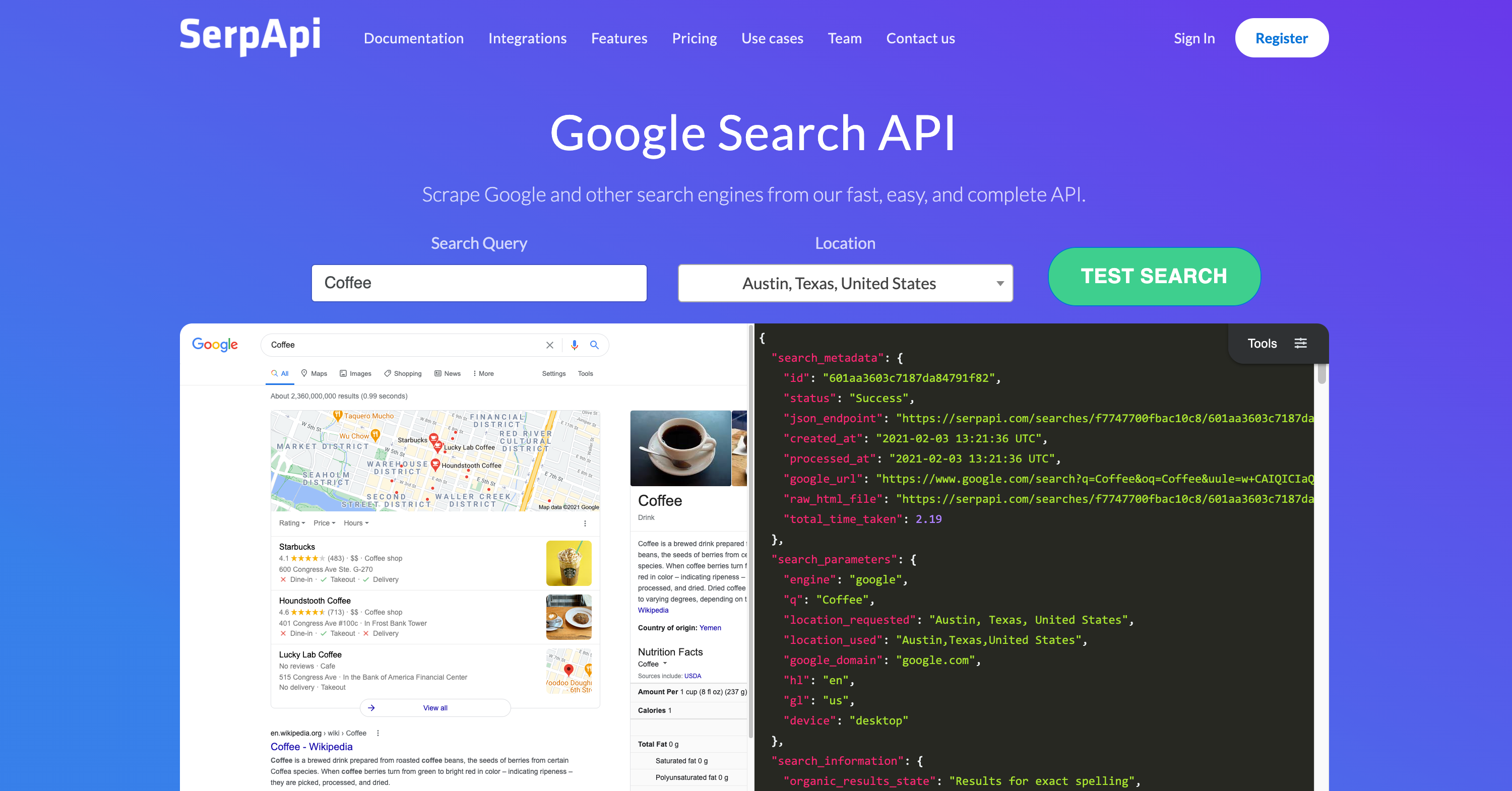
SerpApi is a real-time API to access Google search results. We handle proxies, solve captchas, and parse all rich structured data for you.
SerpAPI appears well-regarded in social mentions for its innovative approach to AI-driven search automation, though there is limited detailed feedback on specific user experiences or pricing sentiment. It stands out for its capability to efficiently parse and provide search engine results, which can be a valuable tool for competitive research and content optimization. However, the lack of detailed reviews makes it challenging to assess common user complaints or the overall cost-benefit sentiment. Generally, it seems to hold a positive reputation for its niche functionality in automated data retrieval from search engines.
Mentions (30d)
0
Reviews
0
Platforms
2
Sentiment
0%
0 positive

SerpAPI appears well-regarded in social mentions for its innovative approach to AI-driven search automation, though there is limited detailed feedback on specific user experiences or pricing sentiment. It stands out for its capability to efficiently parse and provide search engine results, which can be a valuable tool for competitive research and content optimization. However, the lack of detailed reviews makes it challenging to assess common user complaints or the overall cost-benefit sentiment. Generally, it seems to hold a positive reputation for its niche functionality in automated data retrieval from search engines.
Features
Use Cases
Industry
information technology & services
Employees
48
Pricing found: $2, $2, $2, $2, $2
7 ways I actually wire AI into my marketing work (the boring practical stuff, not the hype)
None of it is magic. It's just removing the parts of the job that don't need a human. I'm Curious what everyone else is wiring in. 1. I run all terminal installs inside a virtual machine https://preview.redd.it/3287jk1gyo4h1.png?width=2024&format=png&auto=webp&s=488efdc39223d26307e57d837888233fa351b8e4 Running code on a company laptop is a security minefield. First time a dev caught me pulling packages with npx, alarms went off (fair enough). Now anything that installs or downloads through the terminal runs inside a UTM, fully isolated from the real system. If it breaks, it breaks in a sandbox. 2. I pull audience data off almost any platform with Apify Reddit, LinkedIn, X, anything else. There's usually an Apify actor for it. I find the right one and have Claude Code write a small Python script that pulls exactly the audience data I'm after. 3. I buy SERP data on demand instead of subscribing I got tired of another monthly bill, so I switched to topping up token packs and pulling SERP data only when I need it. A daily make scenario saves the results to storage, so the tracking basically runs itself. 4. I scrape competitors' GitHub Issues to figure out what to build https://preview.redd.it/oajhtithyo4h1.png?width=2784&format=png&auto=webp&s=5c991fbe62f7ea30a59f1ba480674bd7d1e8d27c To work out what a software dev should add to a tool we are promoting, I scrape the Issues tab of competitors' repos. GitHub token + a Python script in Claude Code. That's how I found a massive backlog of unaddressed complaints about our biggest rival. 5. I run SEO tasks through open-source Claude Code skills There's a free open skill set that plugs into Claude Code for SEO work. I extended mine with a Google Keyword Planner API connection so I get search-volume data for free. The repo's open, you just wire in your own SERP API key. 6. I generate captions and filler shots in code with Remotion Right at the end of a video edit, Remotion + Claude Code handle the finishing touches. A few animated filler shots and burnt-in captions, all defined in code. Remotion's free for commercial use within certain limits, which is nice. 7. I hand-finish animations in Rive or Jitter https://preview.redd.it/cbglzuqiyo4h1.png?width=2230&format=png&auto=webp&s=fdd82f382eaf92f95e35eef651fc428972a3a64b Claude Code gets me most of the way, but its animations look... not good. So I finish by hand in Rive or Jitter. You can craft genuinely polished motion in a few minutes there. AI for the grunt work, human eye for the polish. submitted by /u/Independent-Elk-1019 [link] [comments]
View originalBuilt a free MCP for tracking which URLs Claude (and 5 other engines) cite for any query
We were comparing hosted AI citation dashboards (Profound, AthenaHQ, Otterly) and they all start at $295 to $499 a month. The data they collect is mostly the same data you can pull from each vendor's API. So we built an MCP server that does the same job locally. Citation Intelligence is a stdio MCP server with 12 tools that track what Claude, ChatGPT, Perplexity, Gemini, Google AI Overviews, and Bing cite for any query. Install: npx -y u/automatelab/citation-intelligence Add to .mcp.json: { "mcpServers": { "citation-intelligence": { "command": "npx", "args": ["-y", "@automatelab/citation-intelligence"] } } } Three of the tools run on a local cache and cost zero. The rest are bring-your-own-keys (ANTHROPIC_API_KEY, OPENAI_API_KEY, GEMINI_API_KEY, SERPAPI_API_KEY), about $0.01 to $0.03 per query. The one that actually changed our editorial flow is gsc_citation_gap - it joins Google Search Console data with AI citation status and surfaces pages that rank in Google but are not cited by any AI engine. Those pages are the editorial budget. Repo and full tool list: https://github.com/automatelab/citation-intelligence Launch write-up: https://automatelab.tech/launching-the-citation-intelligence-mcp/ Curious if anyone else here is tracking AI citations in their agent loop rather than in a dashboard, and how you handle the predict-vs-measure tradeoff. submitted by /u/exto13 [link] [comments]
View originalI built a free Google search MCP that actually works(searching, fetching, with PDF)
✅ Actually works (tested 6 free MCPs, all failed) ✅ Search + URL extract in one MCP (replaces the usual search MCP + fetch MCP combo) ✅ Academic PDFs auto-handled (arxiv / biorxiv / Nature / OpenReview / NeurIPS / JMLR / PMLR / Springer / PubMed→PMC) ✅ Tiered extraction: mode: "abstract" returns ~1500 chars per result for cheap relevance triage before paying for full bodies ✅ Auto-bootstrap on first run (no manual npm run bootstrap step anymore) ✅ Auto CAPTCHA recovery (Chrome opens, human solves once, retries) ✅ No API key, no proxies, no solver 4 tools search SERP only search_parallel N queries concurrently extract(url, mode?) full / abstract / metadata. PDF detected via Content-Type, %PDF magic, citation_pdf_url meta, and per-domain rules search_extract(query, mode?) defaults to abstract, so a 5-result survey costs ~7.5k chars instead of 40k Why abstract mode The old search_extract always fetched full bodies great for one URL, wasteful when you just want to know which of 5 results is worth reading. Abstract mode pulls PDF page 1 or HTML meta description (~1500 chars), letting the agent triage relevance, then call extract with mode: "full" only on the winner. Reliability Multi-strategy SERP parser with geometric verification (drops sponsored / knowledge panel / sidebar) SSRF guard: env-locked private/loopback block, DNS rebinding defense, per-hop redirect validation, manual redirect handling with cap 25MB fetch ceiling, body-stream bounded, malformed PDFs contained as error (no throws to caller) Speed (1Gbps) sequential: ~1.5s/q (warm) 4 parallel: ~2s wall 10 parallel: ~5s wall Stack TS, Playwright + stealth, Readability, Turndown, unpdf. ~900 LOC. When CAPTCHA fires, a visible Chrome window opens for a human to solve. Each solve preserves the profile's reputation with Google. Built for sustainable, ethical use. 💻 https://github.com/HarimxChoi/google-surf-mcp 📦 https://www.npmjs.com/package/google-surf-mcp ⭐ Star helps a solo dev keep maintaining. Ask me anything about architecture, reliability, or scaling. submitted by /u/GarrixMrtin [link] [comments]
View originalI put my SEO workflow to writing winning blog articles into a Claude Code skill so you don't have to figure it out yourself
I condensed my SEO experience into a Claude Code skill that actually does keyword research and writes articles the right way & open sourced it Most AI writing tools I came across gave really shallow output. They go straight from keyword to article with no research in between. No competitor analysis, no understanding of what's already ranking, no reason why someone would read your article over the 10 that already exist. The content always feels hollow because there's nothing behind it. I've been doing SEO long enough to know the research layer is everything. The writing is the easy part. Finding the right keyword, understanding the competitive gap, knowing what angle to take. that's what actually makes content rank So I put my exact workflow into a Claude Code skill. Three slash commands. /blog-onboard - scrapes your site, extracts your business profile, domain rating, ICP, brand voice, and finds your direct competitors automatically /blog-topics - pulls competitor keywords, generates seed phrases based on your ICP pain points, expands them, classifies by funnel stage, clusters into topic groups, scores every keyword by opportunity, picks your first week of articles with titles already generated /blog-write - scrapes the top ranking articles for your keyword, pulls recent news and expert opinions via Tavily, extracts YouTube insights, does SERP gap analysis to find what the current results are missing, generates a full outline, then writes the article in one shot against that outline Everything local, no subscription, just your API keys github.com/maun11/claude-blog-engine It works but there's room to improve. If you've built anything in this space or have opinions on the research layer specifically I'd like to hear it. PRs welcome. submitted by /u/Visible-Mix2149 [link] [comments]
View originalI built a free claude blog skill that actually studies your business, researches competitors & keywords to find winning blog topics and high-quality articles with infographics, internal linking, product promotion, and more...
Most AI writing tools are a fancy wrapper around "give me 1500 words about X." They don't know your business, your competitors, what's already ranking, or why someone would read your article over the 10 that already exist. The output is always that same slightly-hollow, over-structured content that reads like it was written by someone who's never actually done the thing they're writing about. I wanted to build something that approached content strategy the way a good SEO consultant would like studying the business first, doing real research, then writing So I built a set of Claude Code slash commands that run a full pipeline. Here's what it actually does: Step 1: Onboarding Scrapes your website, extracts a structured business profile (product type, ICP, differentiator, brand voice, integrations), then hits DataForSEO's SERP API to find your 3 direct competitors. Everything gets saved locally in .claude/blog-config.json. You run this once. Step 2: Site Intelligence (the interesting one) This is where it gets serious. It runs three keyword sources in parallel: Your existing rankings (top 100 by traffic value from DataForSEO) Competitor keywords (top 200 per competitor) Seed expansion: Claude Haiku generates 30 seed phrases based on your ICP's pain points and integrations, then DataForSEO expands each seed into ~30 related keywords (30 parallel API calls), then bulk KD lookup on all of them That's roughly 2,000 raw keywords before dedup. After merging and deduplicating, it filters by volume floor, KD ceiling relative to your domain rating, and strips anything you already rank top-5 for Then Claude Haiku classifies every remaining keyword into TOFU/MOFU/BOFU in parallel batches of 50. Claude Sonnet groups them into 6–10 topical clusters. Each cluster gets a pillar keyword and supporting keywords. Opportunity scoring uses a weighted additive formula (not multiplicative since it compresses everything toward zero): score = (0.40 × log_volume + 0.40 × difficulty + 0.20 × funnel) × 100 Volume is log-normalized against a 100k anchor so a 1,000/mo keyword scores 60% instead of 1%. 70+ means actually worth targeting. It picks one topic per cluster (breadth-first), generates SEO titles for all 10, and saves them to your content pipeline. Step 3: Content Engine Per article, it runs: DataForSEO advanced SERP for the target keyword → Firecrawl scrapes the top 3 ranking articles to extract H2 structure and avg word count Tavily batch search: 3 queries in parallel for recent news, expert opinions, common mistakes YouTube Data API → transcript extraction via Apify → Claude Haiku pulls 2 concrete insights Then Claude Haiku does SERP gap analysis like what are all 3 top articles covering, what are they missing, what's the best featured snippet opportunity. Claude Sonnet generates a full outline: every H2, H3, word count per section, where research gets placed, where the product mention goes (with specific framing instruction), image positions, CTA matched to funnel stage. Then Claude Sonnet writes the full article in one shot against that outline. Images get generated after Haiku reads the actual written content to create better DALL-E prompts than you'd get from just the keyword. Schema markup and meta assets are separate Haiku calls. Product plug is deliberately constrained: one mention, at a designated section, only after the reader has felt the pain it solves. No marketing language. The outline specifies the exact framing. Output is a folder: article.md (pure content, copy into CMS), publish-kit.md (meta, schema JSON, publishing checklist), and images/. The whole thing is Claude Code slash commands - /blog-onboard, /blog-topics, /blog-write. You run them in any project directory. All data stays local. I open-sourced it here: github.com/maun11/claude-blog-engine It's working but honestly there's a lot of room to improve it. If you've built anything in this space or have opinions on the architecture, would genuinely appreciate the feedback. And if you improve something, PRs are welcome and there's a lot of low-hanging fruit in the pipeline script (scripts/topics_pipeline.py) specifically. submitted by /u/Visible-Mix2149 [link] [comments]
View originalMy Claude.md file
This is my Claude.md file, it is the same information for Gemini.md as i use Claude Max and Gemini Ultra. # CLAUDE.md This file provides guidance to Claude Code (claude.ai/code) when working with code in this repository. ## Project Overview **Atlas UX** is a full-stack AI receptionist platform for trade businesses (plumbers, salons, HVAC). Lucy answers calls 24/7, books appointments, sends SMS confirmations, and notifies via Slack — for $99/mo. It runs as a web SPA and Electron desktop app, deployed on AWS Lightsail. The project is in Beta with built-in approval workflows and safety guardrails. ## Commands ### Frontend (root directory) ```bash npm run dev # Vite dev server at localhost:5173 npm run build # Production build to ./dist npm run preview # Preview production build npm run electron:dev # Run Electron desktop app npm run electron:build # Build Electron app ``` ### Backend (cd backend/) ```bash npm run dev # tsx watch mode (auto-recompile) npm run build # tsc compile to ./dist npm run start # Start Fastify server (port 8787) npm run worker:engine # Run AI orchestration loop npm run worker:email # Run email sender worker ``` ### Database ```bash docker-compose -f backend/docker-compose.yml up # Local PostgreSQL 16 npx prisma migrate dev # Run migrations npx prisma studio # DB GUI npx prisma db seed # Seed database ``` ### Knowledge Base ```bash cd backend && npm run kb:ingest-agents # Ingest agent docs cd backend && npm run kb:chunk-docs # Chunk KB documents ``` ## Architecture ### Directory Structure - `src/` — React 18 frontend (Vite + TypeScript + Tailwind CSS) - `components/` — Feature components (40+, often 10–70KB each) - `pages/` — Public-facing pages (Landing, Blog, Privacy, Terms, Store) - `lib/` — Client utilities (`api.ts`, `activeTenant.tsx` context) - `core/` — Client-side domain logic (agents, audit, exec, SGL) - `config/` — Email maps, AI personality config - `routes.ts` — All app routes (HashRouter-based) - `backend/src/` — Fastify 5 + TypeScript backend - `routes/` — 30+ route files, all mounted under `/v1` - `core/engine/` — Main AI orchestration engine - `plugins/` — Fastify plugins: `authPlugin`, `tenantPlugin`, `auditPlugin`, `csrfPlugin`, `tenantRateLimit` - `domain/` — Business domain logic (audit, content, ledger) - `services/` — Service layer (`elevenlabs.ts`, `credentialResolver.ts`, etc.) - `tools/` — Tool integrations (Outlook, Slack) - `workers/` — `engineLoop.ts` (ticks every 5s), `emailSender.ts` - `jobs/` — Database-backed job queue - `lib/encryption.ts` — AES-256-GCM encryption for stored credentials - `lib/webSearch.ts` — Multi-provider web search (You.com, Brave, Exa, Tavily, SerpAPI) with randomized rotation - `ai.ts` — AI provider setup (OpenAI, DeepSeek, OpenRouter, Cerebras) - `env.ts` — All environment variable definitions - `backend/prisma/` — Prisma schema (30KB+) and migrations - `electron/` — Electron main process and preload - `Agents/` — Agent configurations and policies - `policies/` — SGL.md (System Governance Language DSL), EXECUTION_CONSTITUTION.md - `workflows/` — Predefined workflow definitions ### Key Architectural Patterns **Multi-Tenancy:** Every DB table has a `tenant_id` FK. The backend's `tenantPlugin` extracts `x-tenant-id` from request headers. **Authentication:** JWT-based via `authPlugin.ts` (HS256, issuer/audience validated). Frontend sends token in Authorization header. Revoked tokens are checked against a `revokedToken` table (fail-closed). Expired revoked tokens are pruned daily. **CSRF Protection:** DB-backed synchronizer token pattern via `csrfPlugin.ts`. Tokens are issued on mutating responses, stored in `oauth_state` with 1-hour TTL, and validated on all state-changing requests. Webhook/callback endpoints are exempt (see `SKIP_PREFIXES` in the plugin). **Audit Trail:** All mutations must be logged to `audit_log` table via `auditPlugin`. Successful GETs and health/polling endpoints are skipped to reduce noise. On DB write failure, audit events fall back to stderr (never lost). Hash chain integrity (SOC 2 CC7.2) via `lib/auditChain.ts`. **Job System:** Async work is queued to the `jobs` DB table (statuses: queued → running → completed/failed). The engine loop picks up jobs periodically. **Engine Loop:** `workers/engineLoop.ts` is a separate Node process that ticks every `ENGINE_TICK_INTERVAL_MS` (default 5000ms). It handles the orchestration of autonomous agent actions. **AI Agents:** Named agents (Atlas=CEO, Binky=CRO, etc.) each have their own email accounts and role definitions. Agent behavior is governed by SGL policies. **Decisions/Approval Workflow:** High-risk actions (recurring charges, spend above `AUTO_SPEND_LIMIT_USD`, risk tier ≥ 2) require a `decision_memo` approval before execution. **Frontend Routing:** Uses `HashRouter` from React Router v7. All routes are defined in `src/routes.ts`. **Code Splitting:** Vite config splits chunks into `react-vendor`, `router`, `ui-vendor`, `charts`. **ElevenLabs Voice Agents:** Lucy's
View originalI built an AI content engine that turns one piece of content into posts for 9 platforms — fully automated with n8n
What it does: You give it any input — a blog URL, a YouTube video, raw text, or just a topic — and it generates optimized posts for 9 platforms at once: Instagram, Twitter/X, LinkedIn, Facebook, TikTok, Reddit, Pinterest, Twitter threads, and email newsletters. Each output is tailored to the platform (hashtags for IG, hooks for TikTok, professional tone for LinkedIn, etc.). It also auto-generates images for visual platforms like Instagram, Facebook, and Pinterest,using AI. Other features: - Topic Research — scans Google, Reddit, YouTube, and news sources, then uses an LLM to identify trending subtopics before generating content - Auto-Discover — if you don't even have a topic, it searches what's trending right now (optionally filtered by niche) and picks the hottest one - Cinematic Ad — upload any photo, pick a style (cinematic, luxury, neon, retro, minimal, natural), and Gemini transforms it into a professional-looking ad - Multi-LLM support — works with Mistral, Groq, OpenAI, Anthropic, and Gemini - History — every generation is saved, exportable as CSV The n8n automation (this is where it gets fun): I connected the whole thing to an n8n workflow so it runs on autopilot: 1. Schedule Trigger — fires daily (or whatever frequency) 2. Google Sheets — reads a row with a topic (or "auto" to let AI pick a trending topic) 3. HTTP Request — hits my /api/auto-generate endpoint, which auto-detects the input type (URL, YouTube link, topic, or "auto") and generates everything 4. Code node — parses the response and extracts each platform's content 5. Google Drive — uploads generated images 6. Update Sheets — marks the row as done with status and links The API handles niche filtering too — so if my sheet says the topic is "auto" and the niche column says "AI", it'll specifically find trending AI topics instead of random viral stuff. Error handling: HTTP Request has retry on fail (2 retries), error outputs route to a separate branch that marks the sheet row as "failed" with the error message, and a global error workflow emails me if anything breaks. Tech stack: - FastAPI backend, vanilla JS frontend - Hosted on Railway - Google Gemini for image generation and cinematic ads - HuggingFace FLUX.1 for platform images - SerpAPI + Reddit + YouTube + NewsAPI for research - SQLite for history - n8n for workflow automation It's not perfect yet — rate limits on free tiers are real — but it's been saving me hours every week. Happy to answer questions. https://preview.redd.it/f8d3ogk3nktg1.png?width=888&format=png&auto=webp&s=dcd3d5e90facd54314f40e799b32cab979dae4bf https://preview.redd.it/j8zl07llmktg1.png?width=946&format=png&auto=webp&s=5c78c12a223d6357cccaed59371e97d5fe4787f5 https://preview.redd.it/5cjas6hkmktg1.png?width=891&format=png&auto=webp&s=288c6964061f531af63fb9717652bececfb63072 https://preview.redd.it/k7e89belmktg1.png?width=1057&format=png&auto=webp&s=8b6cb15cfa267d90a697ba03aed848166976d921 https://preview.redd.it/3w3l70tlmktg1.png?width=1794&format=png&auto=webp&s=6de10434f588b1bf16ae02f542afd770eaa23c3f https://preview.redd.it/a40rh1canktg1.png?width=1920&format=png&auto=webp&s=1d2414c7e653a5f01f12a21a43e69bd4fb4b99ed submitted by /u/emprendedorjoven [link] [comments]
View originalPricing found: $2, $2, $2, $2, $2
Key features include: SerpApi, LLC, 5540 N Lamar Blvd #12, Austin, TX 78751, +1 (512) 666-8245, Easy Integration, Advanced Features, Simple Pricing, Contact Us.
SerpAPI is commonly used for: Automating SEO reporting by fetching real-time SERP data., Conducting market research through keyword ranking analysis., Monitoring competitor strategies by tracking their search visibility., Integrating search data into applications for enhanced user experiences., Building custom dashboards for visualizing search performance metrics., Creating alerts for significant changes in search rankings..
SerpAPI integrates with: Python, Node.js, Ruby, Java, PHP, Go, C#, R.
Based on 12 social mentions analyzed, 0% of sentiment is positive, 100% neutral, and 0% negative.

Scrape full price data from shopping items on Bing Search API and more!
Mar 26, 2026