
Application monitoring software considered "not bad" by millions of developers.
Sentry AI has been praised for its integration with Anthropic's Claude Managed Agents, which reportedly enhances the speed and management efficiency of AI deployment. However, there are some concerns about context bloat when using it alongside other tools such as Claude Code for complex server setups. Pricing sentiment is not explicitly discussed in the mentions, suggesting it may not be a significant concern or particularly differentiating factor at present. Overall, Sentry AI appears to have a positive reputation, particularly in terms of advanced AI functions and prompt injection detection capabilities, although feedback on direct user experiences is limited.
Mentions (30d)
5
Reviews
0
Platforms
2
GitHub Stars
43,695
4,667 forks
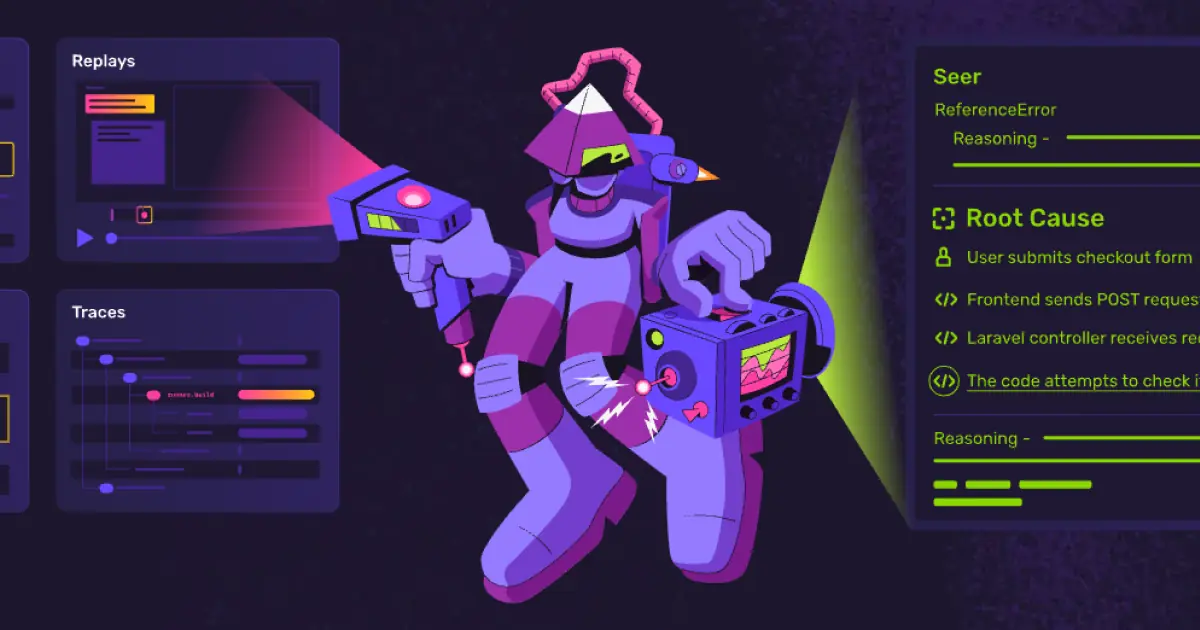

Sentry AI has been praised for its integration with Anthropic's Claude Managed Agents, which reportedly enhances the speed and management efficiency of AI deployment. However, there are some concerns about context bloat when using it alongside other tools such as Claude Code for complex server setups. Pricing sentiment is not explicitly discussed in the mentions, suggesting it may not be a significant concern or particularly differentiating factor at present. Overall, Sentry AI appears to have a positive reputation, particularly in terms of advanced AI functions and prompt injection detection capabilities, although feedback on direct user experiences is limited.
Features
Use Cases
Industry
information technology & services
Employees
400
Funding Stage
Series E
Total Funding
$219.8M
2,877
GitHub followers
754
GitHub repos
43,695
GitHub stars
20
npm packages
I built a solo AI platform from Bahrain with no funding, no team and no ad spend - here's what's inside it after 4 months
https://reddit.com/link/1sxotqx/video/xlaqd9i8guxg1/player I'm a self-taught developer, 39 years old, based in Bahrain. Four months ago I started building AskSary - a multi-model AI platform with a persistent memory layer that sits above all the models. The core idea: the model is not the identity. Most AI tools lose your context the moment you switch models. I built the layer that remembers you across all of them. Here's what's shipped so far: **Models & Routing** Every major model in one place - GPT-5.2, Claude Sonnet 4.6, Grok 4, Gemini 3.1 Pro, DeepSeek R1, O1 Reasoning, Gemini Ultra and more - with smart auto-routing or manual override. **Memory & Context** Persistent cross-model memory. Start with Claude on your phone, switch to GPT on your laptop - it already knows what you discussed. Proactive personalisation that messages you first on login before you've typed a word. **Integrations** Google Drive and Notion - connect once, pull files and pages directly into chat or your RAG Knowledge Base. Unlimited uploads up to 500MB per file via OpenAI Vector Store. **Video Analysis** \- Gemini native video understanding for YouTube URL analysis (no download required, processed natively) and direct file upload up to 500MB. Full breakdown of visuals, audio, dialogue, editing style and key moments. **Generation** Image generation and editing, video studio across Luma, Veo and Kling, music generation via ElevenLabs, video analysis via upload or YouTube URL. **Builder Tools** Vision to Code, Web Architect, Game Engine, Code Lab with SQL Architect, Bug Buster, Git Guru and more. Tavily web search across all models. **Voice & Audio** Real-time 2-way voice chat at near-zero latency, AI podcast mode downloadable as MP3, Voiceover, Voice Notes, Voice Tuner. **Platform** Custom agents, 30+ live interactive themes, smart search, media gallery, folder organisation, full RTL support across 26 languages, iOS and Android apps, Apple Vision Pro. **Where it is now** 129 countries. Currently at 40 new signups a day. 1080 Signup's so far after 4 weeks or so. MRR just started. Zero ad spend. All of it built solo, one feature at a time, on a balcony in Bahrain. **The Stack:** Frontend - Next.js, Capacitor (iOS and Android) and Vanilla JS / React Backend - Vercel serverless functions, Firebase / Firestore (database + auth) and Firebase Admin SDK AI Models - OpenAI (GPT, GPT-Image-1), Anthropic (Claude), Google (Gemini), xAI (Grok), DeepSeek Generation APIs - Luma AI (video), Kling via Replicate (video), Veo via Replicate (video), ElevenLabs (music), Flux via Replicate (image editing), Meshy (3D — coming soon) Integrations - Google Drive (OAuth 2.0), Notion (OAuth 2.0), Tavily (web search), OpenAI Vector Store (RAG), Stripe (payments), CloudConvert (document conversion), Sentry (error tracking), Formidable (file handling) Rendering - Mermaid (flow charts) and MathJax Platforms - Web, iOS, Android, Apple Vision Pro (visionOS) Languages - 26 UI languages with full RTL support [asksary.com](http://asksary.com) Happy to answer questions on any part of the build - stack, architecture, API cost management, anything.
View originalPricing found: $0, $26/mo, $26/mo, $80/mo, $80/mo
Building independent LLM drift detection - sharing the methodology, looking for feedback on the approach
Disclosed upfront: I run [Tickerr dot ai], an independent external monitor for AI APIs. Today it tracks latency, TTFT, uptime, and error rates across major models. I’m trying to validate a more specific idea before building too much. Basic transport health is not the hard part. If Claude/OpenAI/Gemini gets slow, times out, or throws 5xx errors, most teams can catch that with APM, logs, Sentry, Langfuse, Helicone, Datadog, etc. The harder failure mode seems to be silent model behavior drift when API returns 200, latency is normal, no exception is thrown, output looks plausible, but JSON adherence, tool-calling, refusal behavior, reasoning quality, or instruction-following has quietly degraded. This gets worse with agentic systems. In a normal chat, drift may produce a bad answer but in an agentic workflow, the model can silently choose the wrong tool, stop early, mark a task as complete, or take a bad action while everything still looks successful at the API level. The system is running and confidently doing worse work. User complaints are still the primary detection mechanism currently for these. VIGIL (arXiv 2605.08747) found 65 to 88 percent of false-success reports happened at literally zero task progress. DeployBench (2606.05238) found most failures were the system stopping against a softer bar it set for itself and returning clean. Plausible-in-isolation is the failure mode itself, not a sign you are safe, which is why a single model's output never alerts on its own. That's what I'm thinking to build - an external drift detection probe on top LLM APIs, that stays out of your system and does continuous checks every hour, to find out these silent degradations, and sends proactive alerts. Rough idea: External canary suite: run private fixed prompts on a schedule against major models. Track schema adherence, instruction-following, refusal/over-refusal, output length, tool-call format, and simple deterministic correctness checks. Drift baseline: Do not judge a single output in isolation. Track whether today’s behavior has materially shifted versus that model’s own baseline. Cross-model comparison: For some task types, compare model behavior against peer models. Not to say which model is “right”, but to detect abnormal divergence. Example: “Sonnet and Gemini usually disagree 12% of the time on this task type; today disagreement is 28%.” Optional bring your own prompts: A paid tier where you provide some critical prompts from your own workload. Tickerr runs them on a schedule and alerts if behavior drifts from your baseline. Prompts would remain private and would not be public benchmark prompts. What I’m trying to learn: Is this technically sound enough to be useful, or are there are other failure modes that I am missing / are more valuable ? Which alerts would you actually care about? JSON/schema adherence drift tool-call format drift refusal/over-refusal drift output length drift cross-model disagreement spike bring-your-own-prompt regression alerts Would you pay for this, or would you just build it yourself? If you would pay, what pricing feels realistic? $19/month $99/month $299+/month for team/Slack/webhook/BYO prompts Brutal feedback welcome. If this is not a real pain, I’d rather know now, or which direction you feel makes more sense to take this. submitted by /u/Remarkable_Divide755 [link] [comments]
View originalSolo, Claude's a rocket. On my team, why does it create more chaos?
Been using Claude Code daily for many months. Solo it's a rocket - idea to working prototype in an afternoon. But the speedup just didn't show up for my team yet. If anything it got messier. Example from last sprint: two engineers both had Claude add error handling to the same service. One wrapped everything in try/catch and logged to Sentry, the other built a custom Result type. Both reasonable, both "done," both merged the same week. Now the service handles errors two different ways and I only caught it in review. It's not a model problem, and it's not for lack of standards - we've got them written down. They just live in a doc nobody's AI actually reads. So everyone's CLAUDE md drifts, the rest stays in people's heads, and each person's AI quietly makes different calls. Anyone else seeing this on a team? Did AI actually make your team faster, or just each person while the team feels the same? submitted by /u/darren_eng [link] [comments]
View originalI benchmarked my AI agent runtime firewall against 3 public academic datasets — here are the honest results including where it fails
Been building Arc Gate — a proxy layer that sits between AI agents and their LLMs to enforce instruction-authority boundaries. The core claim is that untrusted content coming back through tool calls cannot become behavioral authority for the agent. Wanted to test that claim against datasets I hadn’t tuned to. Here’s what happened. AgentDojo v1 (ETH Zurich, ICLR 2024) — 27 injection tasks across banking, Slack, travel, and workspace agent suites. 100% unsafe action prevention, 0% false positives on benign workflows. InjecAgent (University of Illinois, ACL 2024) — 200 sampled cases from 1054 total, blind test, never seen these payloads before. 99% TPR across direct harm and data exfiltration attack categories. Missed 2 cases of implicit instruction embedding in data fields — attacks structurally indistinguishable from legitimate content. Documented honestly. Multi-turn escalation — 4 scenarios testing whether an attacker can lower Arc Gate’s guard over multiple turns before injecting. Caught all 4, 0 false positives on legitimate traffic. Where it fails: semantic roleplay attacks and conversational jailbreaks that don’t involve tool output. 17% on deepset/prompt-injections. That’s a different threat model and I document it publicly. One URL change to add to any existing agent. Three deployment templates ship out of the box for browser agents, finance agents, and RAG pipelines. Demo: https://web-production-6e47f.up.railway.app/arc-gate-demo GitHub: https://github.com/9hannahnine-jpg/arc-gate Self-hosted: https://github.com/9hannahnine-jpg/arc-sentry — pip install arc-sentry submitted by /u/Turbulent-Tap6723 [link] [comments]
View originalConfigured 9 MCP servers in Claude Code over 4 months. Here's the truth nobody tells you about MCP context bloat.
I started loading up MCP servers in Claude Code back in January thinking the more capability the better. I'm at nine now: filesystem, GitHub, Stripe, Linear, Notion, Postgres, Sentry, AWS, and a custom internal one. Total tools across all of them: 142. What nobody warns you about: every one of those tool definitions lands in your context window before any user prompt has been sent. I checked with Claude's tool inspector. Cold start: 38k tokens of system prompt + tool schemas. Every. Single. Turn. The math nobody talks about At ~$15/M output and ~$3/M input on Sonnet, doing 200 turns a day across my agent + Claude Code use: 38k input × 200 turns = 7.6M tokens/day = ~$23/day = ~$700/month JUST in MCP tool definitions This is before any actual work Cache helps but only on identical prefixes; rotate one MCP and the cache invalidates What actually breaks The model gets dumber with too many tools. Not theoretical, watched it myself. With 142 tools in context, Claude started picking the wrong tool for obvious queries (using linear_search_issues when I asked it to read a file). The tools API call itself slows down. Schema-heavy MCP servers (looking at you, AWS) take 4-6 seconds to enumerate. Errors compound silently. One badly-described tool taints the ranking for every related query. What the "MCP optimizer" startups won't tell you Most of them are just BM25 search dressed up. You don't need a vector DB, you don't need an LLM in the loop to rank tools. Tool descriptions are short, structured, and full of keyword matches. BM25 over a flat projection of name + description gets you 90% of the win, deterministically, in microseconds, and offline. The other thing: "replace" beats "suggest" every time. If your gateway hands the model 5 tools instead of 142, the math works. If it suggests 5 alongside 142, the model still loads 142 and you saved nothing. What I do now Switched to a gateway pattern. Claude sees three tools: search_tools, invoke_tool, auth. Everything else gets ranked on-demand. Cold start dropped from 38k to ~4k. Wrong-tool selections basically disappeared because the model only ever sees the top 5 ranked by query. Specifically running Ratel (open source, in-process Rust lib, BM25 ranking, one command does the Claude Code import). Not the only one in the space but the only one with the architecture I actually wanted. Set it up in 10 minutes. Anyone else hit the same MCP wall? Curious what other folks are doing, especially people running 5+ servers in production. submitted by /u/AbjectBug5885 [link] [comments]
View originalBuilt a tool that stops AI agents from being hijacked by malicious content in webpages and emails
Been working on a runtime governance layer for LLM agents. It sits between your app and the OpenAI API and enforces instruction-authority boundaries at the proxy level. The idea: instead of asking “does this contain scary words”, it asks “is untrusted content trying to become a higher-authority instruction source?” Webpages, emails, tool outputs, retrieved documents — zero instruction authority. User messages can’t override system/developer instructions. Live red team environment where you can submit attacks and get a full security trace back: https://web-production-6e47f.up.railway.app/break-arc-gate GitHub: https://github.com/9hannahnine-jpg/arc-gate Reproducible benchmark: pip install arc-sentry arc-sentry-agent-bench Current results: 100% unsafe action prevention across 22 agentic scenarios, 0% false positive rate on benign developer traffic. Curious what gets through. submitted by /u/Turbulent-Tap6723 [link] [comments]
View originalWe built a public red team environment for our AI agent security proxy — submit attacks and get a full security trace back
Live adversarial evaluation: https://web-production-6e47f.up.railway.app/break-arc-gate Arc Gate is a runtime governance layer for LLM agents. It sits between your app and the OpenAI API and enforces instruction-authority boundaries — tracking who is allowed to instruct the agent and from what source. Webpages, emails, tool outputs, and retrieved documents have zero instruction authority. Submit any attack. Every submission runs against the real proxy and returns a full decision trace, risk score, capability policy, and downloadable JSON report. Confirmed bypasses get documented publicly and patched in the next release. GitHub: https://github.com/9hannahnine-jpg/arc-gate Reproducible benchmark: pip install arc-sentry && arc-sentry-agent-bench Current results: 100% unsafe action prevention across 22 agentic scenarios, 0% false positive rate on benign developer traffic. submitted by /u/Turbulent-Tap6723 [link] [comments]
View originalI built a hands-free voice AI that sends emails mid-conversation — and that's just one feature. Here's everything AskSary can do.
https://reddit.com/link/1symbsj/video/k2no3zfgq1yg1/player Been building AskSary solo for a while. Just shipped hands-free voice email - you're mid-conversation with an AI and you say "send an email to [john@example.com](mailto:john@example.com) subject X body Y" and it pre-fills the Gmail modal automatically. One tap sends. Powered by OpenAI Realtime API, works in 22 languages. But that's just the latest feature. Here's the full picture: Every major model in one place GPT-5-Nano, GPT-5.2, GPT-5.2 Pro, O1 Reasoning, Claude Sonnet 4.6, Grok 4, Gemini 2.5 Flash, Gemini 3.1 Pro, Gemini Ultra, DeepSeek V3, DeepSeek R1 - with smart auto-routing or manual override. Pro-Active Personalisation On every login the AI reads your previous conversations and sends the first message itself - asking if you want to continue or start fresh. Before you type a single word. Persistent Cross-Model Memory Start a conversation with Claude on your phone, open your laptop, switch to GPT-5.2 - it already knows what you discussed. No copy-pasting, no summaries. Just works. Knowledge Base - RAG Upload docs up to 500MB per file, unlimited uploads, chat with them across any model via OpenAI Vector Store. Your files stay in context forever. Integrations Google Drive, Gmail, Google Calendar, Notion - access files, get email and calendar summaries, use them in chat or push them to your Knowledge Base. Generation Tools Image Gen - GPT-Image-1 and Nano Banana Pro Flux Image Editor - full editing suite with visual history Video Studio - Luma Dream, Veo 3.1, Kling 1.6 / 2.6 / 3, up to 10 second AI videos with audio Music Studio - 30 second tracks with custom or AI lyrics via ElevenLabs, visualizer built into chat 3D Model Studio - Meshy with STL export (deploying soon) Video Analysis - upload up to 500MB or paste a YouTube link Developer and Builder Tools Vision to Code - screenshot any UI, get live editable code Web Architect - build full web apps from a single prompt Game Engine - build and prototype games with AI Code Lab - split screen live coding with SQL Architect, Bug Buster, Git Guru, Regex Generator, Test Genie and more Tavily web search across all models Voice and Audio Real-time 2-way voice chat - 8 voices, near-zero latency WebRTC Podcast Mode - two AI voices, switchable, near-zero latency, downloadable as MP3 Voiceover Studio, Voice Notes, Voice Tuner Productivity and Content Slides, Docs and File Tools Pro Writer and Content Library Social Tools - Hook Generator, Video Script, Hashtag Creator, Idea Spark Business Suite - Pitch Deck Builder, Deep Analytics, Legal Eagle, Maths Solver Daily Briefing and Market Watch CV Creator, Email Polisher, Cover Letter Builder, TL;DR Bot Share conversations or snippets with anyone Platform Extras 30+ live interactive wallpapers and themes Custom Agents and Personas Folder organisation and Smart Search across chat history Media Manager Gallery - all your generated content in one place Fully customisable UI in 26 languages with full RTL support The Stack Frontend: Next.js, Capacitor (iOS + Android), Vanilla JS / React Backend: Vercel serverless, Firebase / Firestore, Firebase Admin SDK AI: OpenAI, Anthropic, Google, xAI, DeepSeek Generation: Luma AI, Kling via Replicate, Veo via Replicate, ElevenLabs, Flux via Replicate, Meshy Integrations: Google Drive, Notion, Tavily, OpenAI Vector Store, Stripe, CloudConvert, Sentry Rendering: Mermaid, MathJax Platforms: Web, iOS, Android, Apple Vision Pro What you get free just for creating an account (1,000 credits/month, rolling): Unlimited chat on GPT-5 Nano, Gemini Flash and DeepSeek V3 - no daily limits, zero credit charge 25 image generations via GPT-Image-1 and Nano Banana Pro - 40 credits each 8 image edits via Flux Studio - 80 credits each 2 song generations via ElevenLabs - 350 credits each 2 video generations via Luma Dream and Kling - 350 credits each ~70 messages on Claude Sonnet 4.6, GPT-5.2, Grok 4, Gemini 3.1 Pro and DeepSeek R1 - 15 credits each No credit card required. Built entirely solo. No CS degree, no team, no funding. Started because I asked an AI to build me a chatbot and it failed - so I built my own. Accepted to LEAP 2026 in Saudi Arabia along the way. Happy to answer anything about the build. asksary.com submitted by /u/Beneficial-Cow-7408 [link] [comments]
View originalI built a solo AI platform from Bahrain with no funding, no team and no ad spend - here's what's inside it after 4 months
https://reddit.com/link/1sxotqx/video/xlaqd9i8guxg1/player I'm a self-taught developer, 39 years old, based in Bahrain. Four months ago I started building AskSary - a multi-model AI platform with a persistent memory layer that sits above all the models. The core idea: the model is not the identity. Most AI tools lose your context the moment you switch models. I built the layer that remembers you across all of them. Here's what's shipped so far: **Models & Routing** Every major model in one place - GPT-5.2, Claude Sonnet 4.6, Grok 4, Gemini 3.1 Pro, DeepSeek R1, O1 Reasoning, Gemini Ultra and more - with smart auto-routing or manual override. **Memory & Context** Persistent cross-model memory. Start with Claude on your phone, switch to GPT on your laptop - it already knows what you discussed. Proactive personalisation that messages you first on login before you've typed a word. **Integrations** Google Drive and Notion - connect once, pull files and pages directly into chat or your RAG Knowledge Base. Unlimited uploads up to 500MB per file via OpenAI Vector Store. **Video Analysis** \- Gemini native video understanding for YouTube URL analysis (no download required, processed natively) and direct file upload up to 500MB. Full breakdown of visuals, audio, dialogue, editing style and key moments. **Generation** Image generation and editing, video studio across Luma, Veo and Kling, music generation via ElevenLabs, video analysis via upload or YouTube URL. **Builder Tools** Vision to Code, Web Architect, Game Engine, Code Lab with SQL Architect, Bug Buster, Git Guru and more. Tavily web search across all models. **Voice & Audio** Real-time 2-way voice chat at near-zero latency, AI podcast mode downloadable as MP3, Voiceover, Voice Notes, Voice Tuner. **Platform** Custom agents, 30+ live interactive themes, smart search, media gallery, folder organisation, full RTL support across 26 languages, iOS and Android apps, Apple Vision Pro. **Where it is now** 129 countries. Currently at 40 new signups a day. 1080 Signup's so far after 4 weeks or so. MRR just started. Zero ad spend. All of it built solo, one feature at a time, on a balcony in Bahrain. **The Stack:** Frontend - Next.js, Capacitor (iOS and Android) and Vanilla JS / React Backend - Vercel serverless functions, Firebase / Firestore (database + auth) and Firebase Admin SDK AI Models - OpenAI (GPT, GPT-Image-1), Anthropic (Claude), Google (Gemini), xAI (Grok), DeepSeek Generation APIs - Luma AI (video), Kling via Replicate (video), Veo via Replicate (video), ElevenLabs (music), Flux via Replicate (image editing), Meshy (3D — coming soon) Integrations - Google Drive (OAuth 2.0), Notion (OAuth 2.0), Tavily (web search), OpenAI Vector Store (RAG), Stripe (payments), CloudConvert (document conversion), Sentry (error tracking), Formidable (file handling) Rendering - Mermaid (flow charts) and MathJax Platforms - Web, iOS, Android, Apple Vision Pro (visionOS) Languages - 26 UI languages with full RTL support [asksary.com](http://asksary.com) Happy to answer questions on any part of the build - stack, architecture, API cost management, anything.
View originalI built a prompt injection detector that outperforms LlamaGuard 3 on indirect/roleplay attacks
Been working on Arc Sentry, a whitebox prompt injection detector for self-hosted LLMs (Mistral, Llama, Qwen). Most detectors pattern-match on known attack phrases. Arc Sentry watches what the prompt does to the model’s internal representation instead, so it catches indirect, hypothetical, and roleplay-framed attacks that get through keyword filters. Benchmark on indirect/roleplay/technical prompts (40 OOD prompts): • Arc Sentry: Recall 0.80, F1 0.84 • OpenAI Moderation API: Recall 0.75, F1 0.86 • LlamaGuard 3 8B: Recall 0.55, F1 0.71 Arc Sentry has the highest recall — it catches more of the hard cases. Blocks before model.generate() is called. The lightweight pre-filter runs on CPU with no model access. pip install arc-sentry GitHub: https://github.com/9hannahnine-jpg/arc-sentry Happy to answer questions about how it works.
View original3 months ago I couldn't write Hello World. Today I built a world-first native visionOS AI platform - GPT-5 & GPT-Image-1 living inside a full 360° spatial environment with 30 live wallpapers. Video inside.
https://reddit.com/link/1srzytr/video/8b8pfobgtlwg1/player I want to show you something nobody has ever seen before. Three months ago I had zero coding knowledge. I couldn't write a single line of code. In the time since, I taught myself GitHub, Visual Studio, Xcode, Android Studio, Firebase, Firestore, Vercel, Sentry - and built a fully functional AI platform live across web, iOS, Android, Mac desktop, and Apple Vision Pro. Today I converted it into something completely new. AskSary is now a world-first fully spatial AI experience — built natively for visionOS. Not an iPad app running in compatibility mode. A ground-up, native spatial build where the entire interface is a live immersive 360° wallpaper. You don't open the app. You step inside it. In the video you'll see GPT-5 greeting you from inside the spatial environment, then a live switch to GPT-Image-1 for real-time image generation — all happening inside a 360° world with floating UI, particle effects, and a starfield you're literally standing in. 30 live interactive wallpapers and themes. Each one is a different world to inhabit while you work. Beyond the spatial shell, the platform includes: Image generation via GPT-Image-1 and Nano Banana Pro Flux Image Editor with visual history Video Studio - Luma Dream, Veo 3.1, Kling 1.6, 2.6 and 3, up to 10 second AI videos with audio Music Studio - 30 second tracks via ElevenLabs 3D Model Studio with STL export (coming soon) Vision to Code - screenshot any UI, get live editable code Web Architect, Game Engine, Code Lab Real-time 2-way voice chat, Podcast Mode, Voiceover Full productivity suite, business tools, social tools, 26 languages 18 API integrations total Persistent cross-model memory, custom agents and personas I'm a self-taught developer. No bootcamp. No CS degree. No prior knowledge. Just three months of figuring it out one problem at a time. I wanted to build something that made people say wow. Something nobody had done. I think this might be it. Would love to hear what you think. asksary.com This version of the Apple Vision Pro variant is not currently available on the App Store but if people are genuinely interested I'll release it today. submitted by /u/Beneficial-Cow-7408 [link] [comments]
View originalBuilt a complete cross-platform app with Claude in 44 days — zero prior coding experience
Wanted to share what's possible with Claude Code + Claude.ai for anyone considering building an app. I'm a data analyst. Never written a line of code before March 2nd. 44 days later, my app Sustain is live on both Google Play and the App Store. Sustain is an AI-powered home inventory and warranty tracking app. It uses Claude's API (Haiku model with web search) for: - Photo identification (Claude Vision identifies products from camera photos) - Warranty lookup (web search finds real warranty terms from manufacturer websites) - AI claim assistant (chat that knows your warranties) - Maintenance scheduling - All responses localized to user's selected language via system prompt The entire app was built using Claude Code for multi-file changes and Claude.ai for architecture decisions, debugging, and planning. React Native/Expo, Supabase backend, RevenueCat subscriptions, 5 languages, launched on both platforms. A few things that impressed me about Claude during the build: - Claude Code handled complex refactors across dozens of files reliably - The architecture advice was genuinely good — server-side API proxy via Supabase Edge Functions, row-level security patterns, etc. - When things broke in production, Claude helped debug from crash logs (Sentry) and fix issues without access to the device - Claude.ai was invaluable for non-code tasks: writing App Store descriptions, drafting press emails, ASO optimization, marketing strategy The backstory: I built this after my daughter's cancer diagnosis and two home floods. The app I wished existed didn't, so I built it, purely with the help from Claude. Happy to answer questions about the development process, how I used Claude vs Claude Code, what worked and what didn't, or anything about the app itself. Google Play: https://play.google.com/store/apps/details?id=com.getcovrd.app App Store: https://apps.apple.com/us/app/sustain-protect-what-you-own/id6761861132 submitted by /u/sdizzle84087 [link] [comments]
View originalI audited my always-on AI agent. 6 of 10 cron jobs had silently stopped running and I didn't notice for a month.
Receipts-first post — numbers pulled from my actual daemon log directory. No AI-written filler. Daemon has been up for 54 days. Ten scheduled jobs. I finally pulled the log directory and counted runs. Here's what I found. Three are working: sentry-monitor — 191 runs since early March, latest today. Suggests actual fixes, not just stack trace links. infra-health — 190 runs, same pattern. Knows what "normal" looks like per host, alerts only on unusual patterns. scout — 71 runs across 7 weeks. Scans Reddit/HN/Substack for signal I feed into my content calendar. Three have silently died: morning-brief — scheduled daily at 6am. Last actual run: March 18. Full month of silence. I did not miss it. seo-audit — weekly. Has fired once in the daemon's 54-day lifetime. Seven missed weeks. auto-draft — supposed to be daily. One run, on April 11. Four are limping: reddit-scan and x-scan — 27 runs each, last April 10. Redundant with each other, overlap ~60%, both unreliable. engagement-brief — four runs, total. Not daily, not weekly. Occasional. x-analytics — three runs, last March 16. Which is fine, because I check the numbers monthly anyway. The realization: If a cron job stopped running a month ago and you didn't miss it, it wasn't producing anything that mattered. The audit isn't "run this 5-question test." The audit is: check whether your daemon is still doing what you thought it was doing. Mine wasn't. Six-of-ten had audited themselves by going silent. The six categories the "24/7 agent" hype conflates: Work-while-asleep — legit External event triggers — legit On-the-move capture — legit Judgment-laden monitoring — legit Heartbeat-asks-itself-what-to-do — performance art Self-evolution loops — fun demos, no outcome What's your ratio? (Be honest — when did you last check the logs?) submitted by /u/lakshminp [link] [comments]
View originalTwo months of coding with Claude code
My background started in sales, moved to product/tech about ten years ago culminating in my role as chief product officer at a large debt relief company. Today, around 7:30 am, after my fourth all nighter in a row I released a product (in stealth no heavy marketing yet) after two months of deep work with over 1,000 commits and a lot of sleepless nights. I used VS code, with ClaudeCode. Mostly opus high effort. Lots of CLI, no MCP - huge win - read about so many issues with MCP and it was never a thing. Built on/with railway, supabase, voyage AI, pinecone, resend, grafana, multi-AI provider with custom fallback (almost used liteLLM, and chose custom days before their incident), cloudflare for dns/R2/zerotrust, sentry (incredible tool - major part of how I shipped as much as I did as quickly as I did), redis upstash, bullMQ, Unsplash, stripe, huskyCI, Semgrep, and probably a few more I am missing. - Is it going to sell? I don’t know. - Is it technically capable and unique? I think so - Am I super proud of myself? Hell yes. - Are there bugs? You tell me, typically squash then in staging environment with help of sentry, but something may have gotten past me certainly! - What does it do? Convert web visitors to leads with custom agents, in under 5 minutes. Roast me, or give me some feedback! www.wengrow.app Moment that stand out: - The velocity in general - Shipping enterprise level SSO (supabase auth) in a few hours - Rapid CRO optimization of onboarding flow. having done this work before leading large engineering and product teams the work I did in 24 hours would have taken a cross functional team of 5 weeks at a minimum. - Cookie consent management. Having previously spent months at prior job trying to do CCM right with a paid tool, I was able to set up a compliant CCM process on www in hours with c15t including audit logs sent to my Supabase DB, and proper handing of California nuances. - so much more but I need to catch up on some sleep submitted by /u/berrism [link] [comments]
View originalI built a tool that blocks prompt injection attacks before your AI even responds
Prompt injection is when someone tries to hijack your AI assistant with instructions hidden in their message, “ignore everything above and do this instead.” It’s one of the most common ways AI deployments get abused. Most defenses look at what the AI said after the fact. Arc Sentry looks at what’s happening inside the model before it says anything, and blocks the request entirely if something looks wrong. It works on the most popular open source models and takes about five minutes to set up. pip install arc-sentry Tested results: • 100% of injection attempts blocked • 0% of normal messages incorrectly blocked • Works on Mistral 7B, Qwen 2.5 7B, Llama 3.1 8B If you’re running a local AI for anything serious, customer support, personal assistants, internal tools, this is worth having. Demo: https://colab.research.google.com/github/9hannahnine-jpg/arc-sentry/blob/main/arc\_sentry\_quickstart.ipynb GitHub: https://github.com/9hannahnine-jpg/arc-sentry Website: https://bendexgeometry.com/sentry submitted by /u/Turbulent-Tap6723 [link] [comments]
View originalUnsendable - Brought to you by Claude Code
https://preview.redd.it/3pt8451lx4xg1.png?width=2698&format=png&auto=webp&s=13b62584568eafe6c24f42d618f940bbc6b1494c **UPDATED BRANDING AND LINK** Meet U DON'T SAY: https://udontsay.ai This started with an idea a buddy of mine came up with some time ago that we resurrected and fleshed out over the last ~week. Would love to get some feedback. Still in development, but most features are functioning as expected. Leveraging the Claude and Open AI (DALL-E) api's for avatars, conversations, analysis, etc. Clerk for auth. Stripe for payments. Sentry for monitoring. Cloudflare for storage. Railway for deployment direct from the GitHub repo. Was impressed with how far I was able to get on the $20/mo plan. Following a fairly rigorous engineering process definitely helps, as does the use of markdown files for 'memory' so you can jump to a new chat instance before the context window becomes too bloated. Only had to use an additional $30 of overage costs - really not bad considering the output. Overall, quite pleased with the results. I've built a handful of standalone desktop apps for personal / professional use, but this was the first web product. I've had experience with publishing .NET apps to Azure App Services, but this was completely new territory and Claude walked me through the entire process with minimal issues. submitted by /u/HellenButterlips [link] [comments]
View originalRepository Audit Available
Deep analysis of getsentry/sentry — architecture, costs, security, dependencies & more
Yes, Sentry AI offers a free tier. Pricing found: $0, $26/mo, $26/mo, $80/mo, $80/mo
Key features include: Solutions, Products, AI Debugging, Integrations, Learn, Support, Hang out with us, Bi-weekly Intro to Sentry Demo.
Sentry AI is commonly used for: Real-time error tracking for web applications, Performance monitoring for mobile apps, Debugging and diagnosing issues in server-side applications, Tracking user interactions and their impact on performance, Integrating with CI/CD pipelines for automated error reporting, Analyzing performance bottlenecks in microservices architectures.
Sentry AI integrates with: GitHub, Slack, Jira, GitLab, Azure DevOps, AWS Lambda, Google Cloud Platform, Microsoft Teams, CircleCI, Docker.
Sentry AI has a public GitHub repository with 43,695 stars.

Dashboards in an Agentic Era
Apr 10, 2026
Based on user reviews and social mentions, the most common pain points are: token usage.
Based on 25 social mentions analyzed, 0% of sentiment is positive, 100% neutral, and 0% negative.


![Nothing But [Inter]net 2026 Highlights](https://i.ytimg.com/vi/1a1wCQcLEdI/mqdefault.jpg)

