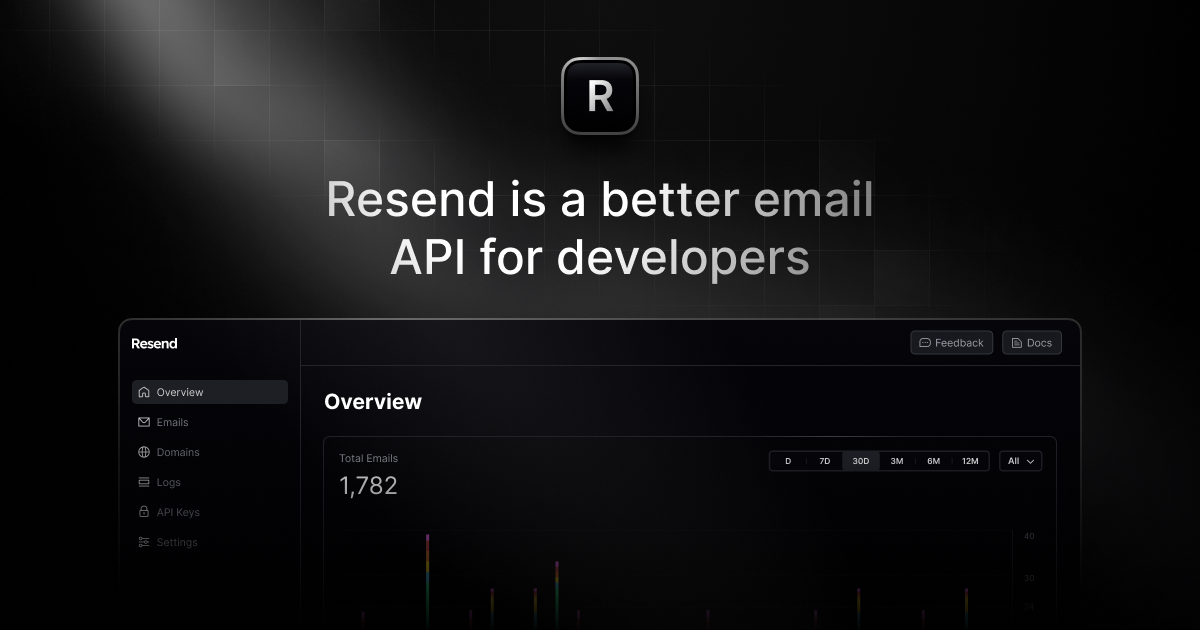
The best way to reach humans instead of spam folders. Deliver transactional and marketing emails at scale.
While there are no direct reviews provided for "Resend," the social mentions highlight its integration into various AI-assisted development processes, such as Claude Code, appreciated for its efficiency and the seamless recommendation of tools during app building. Users praise its role in expediting development, yet there are noted issues with token consumption and technical limitations like phone number verification. Pricing sentiment isn't directly addressed, but there is an awareness of potential performance bottlenecks with associated costs of operating AI frameworks with expansive context windows. Overall, the tool seems to enjoy a positive reputation for its utility in streamlining AI workflows, despite occasional technical hurdles and resource considerations.
Mentions (30d)
8
3 this week
Reviews
0
Platforms
2
GitHub Stars
883
77 forks


While there are no direct reviews provided for "Resend," the social mentions highlight its integration into various AI-assisted development processes, such as Claude Code, appreciated for its efficiency and the seamless recommendation of tools during app building. Users praise its role in expediting development, yet there are noted issues with token consumption and technical limitations like phone number verification. Pricing sentiment isn't directly addressed, but there is an awareness of potential performance bottlenecks with associated costs of operating AI frameworks with expansive context windows. Overall, the tool seems to enjoy a positive reputation for its utility in streamlining AI workflows, despite occasional technical hurdles and resource considerations.
Features
Use Cases
Industry
information technology & services
Employees
72
Funding Stage
Seed
Total Funding
$3.0M
1,876
GitHub followers
93
GitHub repos
883
GitHub stars
20
npm packages
20
HuggingFace models
I got tired of the current ticketing systems, so I (Claude ofc) built a better one for everyone — thank you Claude
WARNING: anecdotal rant incoming. Jira requires a PhD to administer properly, and a second one to figure out why a Story is in the wrong sprint. ServiceNow requires the wealth of a cartel drug lord and a procurement team to even get a quote. Freshservice and Zendesk are fine until you need anything custom, then they fall apart. Most of the rest are form-builders with status fields strapped to a queue. Y'all know what I mean. For the better part of my career — 15+ years in IT — auditing tickets for accuracy (ticket triaging) was just taking up too much time. Tickets where the priority was wrong, the category was blank, the subject line three words and a typo. Then writing reports **(this is not the focus of the tool, use something else for better reporting, like powerbi / tableau or w.e.)** from that data. Manually. Like it was 2010. So I built my own. It's called BITSM. Multi-tenant IT helpdesk with an AI layer called Atlas baked in from day one — not bolted on. Atlas runs a tool-use loop rather than one-shot completions. It searches the knowledge base, looks up ticket history, writes custom fields, and decides when to hand off to a human. The whole point is to handle the grunt work that fills up support queues — tagging, categorizing, routing, drafting responses, flagging when something looks like a known issue — so the people on the queue can focus on the things that actually need a human. Intake channels: web portal, chat widget, inbound email (Cloudflare Email Worker), SMS, WhatsApp, and a voice agent (Twilio + ElevenLabs). Three-tier escalation — Claude Haiku for frontline, Sonnet for harder problems, human for everything else. BYOK for every external service: Anthropic, OpenAI, Voyage, Resend, Twilio, ElevenLabs, Stripe. Stack is Flask 3.x, React 19, PostgreSQL 16 with pgvector, Redis 7, Docker Compose. Running in production at bitsm.io. Built solo on weekends over the past year — and full transparency: I pair-programmed a huge amount of this with Claude (Anthropic's). I'm a one-person shop and that collaboration is the only reason it shipped at the scope it did. If you're a solo builder hesitating on AI-assisted dev, stop hesitating. **License note, because someone will ask: Business Source License 1.1, not open source. Self-hosting for your own team is free. If you're building a hosted or managed service on top of it, that requires a commercial license. Converts to Apache 2.0 in four years. Upfront rather than buried.** The repo: [https://github.com/NovemberFalls/BITSM](https://github.com/NovemberFalls/BITSM) Happy to answer questions about the architecture or the AI design. A lot of the Atlas patterns came out of Ed Donner's agentic LLM courses, which I'd recommend to anyone building in this space.
View originalPricing found: $30 / mo, $0 / mo, $20 / mo, $0.90 / 1, $90 / mo
I built a browser game where you argue against AI bots using real consumer law - 54 cases, free, no account
The concept: you get a cold denial letter from an AI system - airline cancelled your flight, insurance rejected your claim, bank won't refund fraud - and you have to argue back until the bot's resistance hits zero. The bots don't fold unless you cite the right law. EU261, RBI Digital Lending Guidelines, GDPR Article 17, Australian Consumer Law. Same arguments that work in real disputes. What's in there: 54 cases across EU, India, Australia, UK, US Each bot has a persona, a resistance meter, and a lose condition if you run out of messages Resistance is scored server-side — Claude evaluates each message and returns a delta Deep links: fixai.dev/?level=N jumps straight into any case Built almost entirely with Claude Code over the past few months. Node/Express backend, Postgres for auth and progress tracking, Resend for email, deployed on Railway. fixai.dev - free, no account, runs in browser Feedback welcome, especially on the harder cases (GDPR erasure, UPI fraud, MiCA crypto). Some might be too punishing. submitted by /u/EveningRegion3373 [link] [comments]
View originalHow can I fix ERROR:The bridged Claude Code process stopped responding mid-turn. Check your terminal for errors (you may need to run /login), then resend your message.??????????????
https://preview.redd.it/wkh36j7pc12h1.png?width=1274&format=png&auto=webp&s=1448fe71e6a591eda0a611ce9d16c6648905cce8 I have tried so many things and it seems like this is unrecoverable. Has anyone else solved this problem? Windows Claude Code GUI. submitted by /u/According_Section_90 [link] [comments]
View originalBuilt an MCP for claude code that turns ticket-mentions into PRs with browser QA (and what I learned along the way)
notesasm is an MCP server you add to claude code. you mention a fix mid-flow ("make a ticket on notesasm: fix the regex for quoted emails") and it files the ticket. later, on your schedule, an autonomous agent picks the ticket up, writes the fix, runs real-browser QA against your preview deploy, and opens a PR with screenshots. closed alpha, free during it. demo + signup: notesasm.com the pain it solves (3 separate ones, actually): claude code is fast enough now that shipping isn't the bottleneck anymore. when you're deep in a feature and notice "the regex misses RFC-quoted local parts" or "the footer copy is wrong on mobile", you'd never break flow to open jira/linear or even write it down anywhere. so the idea goes nowhere. multiply by a year and your repo has invisible debt nobody's tracking. claude code helps while you're at the keyboard. it doesn't help while you sleep. your repo doesn't move overnight unless you stayed up to push it. for solo founders or small teams, that means losing 8 hours a day where you could be shipping if you had a way to delegate work to your own agent. and even if you do have something pushing code for you overnight, you lose context with AI-generated PRs and they usually need visual review. claude writes code that compiles and tests pass, but the actual rendered output might be subtly broken (or super broken lol). reviewing those visually is tedious and a lot of teams skip it, then ship regressions. how it works: you add the MCP server: claude mcp add notesasm --scope user --transport http -H "Authorization: Bearer ". BYOK style, the token comes from your dashboard. zero local install beyond the one command. then in any claude code session you can say "make a ticket on notesasm for this" (based on your conversation) and it just files it. the MCP server is HTTP-transport (not stdio), runs in the cloud, hits a fastapi backend that stores the ticket in postgres against your workspace. later (your schedule, your spend cap), a worker process picks up queued tickets. for each one: clones your repo with a github app installation token (commits look like asmnotes[bot], a verified author. bypasses vercel/netlify deploy protection that rejects unknown-team-member commits.) runs the claude agent sdk with your ticket body as the prompt. defaults to sonnet 4.6, opus 4.7 for hard tickets the user marks explicitly. agent reads the codebase, makes the edits, commits, pushes a branch, opens a PR via the github API. waits for your preview deploy to land. vercel polled by default, configurable probe URL for split frontend/backend setups like vercel + railway. QA agent drives a real chrome session on browserbase against the preview. stealth profile with residential proxies. takes before/after screenshots. verifies your acceptance criteria against the rendered output. if QA fails, the report feeds back into the build agent for up to 3 retry iterations before parking the ticket. final: PR with QA screenshots in the description, ready to merge. stack: - backend: fastapi + asyncpg + railway - frontend: vanilla html/js, no build step, vercel - agents: claude agent sdk (build), claude + browserbase (QA) - auth: clerk - email: resend (welcome, invite, feedback) - mcp transport: http (cloud-hosted, no local install) things i learned building it that other claude code folks might care about: - the build agent loves to spawn subagents via the Task tool. disable it explicitly in the system prompt or you get 4-minute hangs the SDK doesn't surface as errors. - browserbase sessions default to a ~5-min timeout. if your QA wall budget is anywhere near that, set the session lifetime explicitly to 1800s on session create (the timeout field). otherwise you get random "410 Gone" mid-run. - don't rely on the SDK's wall budget alone. add a per-message timeout (90s works) so a hung tool call doesn't silently burn your whole budget. - claude code's default mcp scope is per-cwd. always tell users `--scope user` in your install instructions, otherwise the MCP works in one repo and silently doesn't in others. - ResultMessage emissions happen multiple times per job if you have iteration loops (build + QA + qa-fix). sum them all when computing per-job cost, not just the last one. what's next: closed alpha is open. would love ~30 active users to try it out, all free during it. paid plans later this year with a permanent discount for alpha users. happy to answer anything about the MCP design, the QA verification loop, cost tracking, the agent-sdk integration, or anything else. demo + signup: notesasm.com submitted by /u/FormExtension7920 [link] [comments]
View originalThings I wish I knew earlier about Claude token usage
A few weeks ago, I shared some tips on my Claude Code workflow. In the comments, quite a few people mentioned that they were burning through their tokens super fast and tbh I could totally relate. This is something I particularly struggled with at the beginning, which pushed me to take a closer look at it. Turns out most of my token usage wasn't coming from Claude's answers, but from the setup. Things I actually use: Start a new chat for unrelated tasks. Every message in a long conversation resends the full history. That's not obvious until I realize a 40-message thread is burning tokens on context I stopped caring about 20 messages ago. Group your small questions into one message. Sending three quick follow-ups instead of one combined message means three full context loads. I group them now and it adds up fast. Keep your CLAUDE.md short and use it as an index. I used to dump everything in there. The problem is Claude rereads it every single turn. Now it points to separate files and only loads what's relevant to the task. Things I try to implement as much as possible: Be precise with file references. I used to say "here's the whole codebase, figure it out." Claude would spend 30-50k tokens just exploring before doing anything useful. Now I point it at the one function or module that actually matters. Summarize and restart after 15-20 messages. I ask Claude for a quick summary of where things stand, paste it into a fresh thread. I lose nothing and stop dragging dead context around. Use lighter models for lighter work. Not everything needs the heaviest model. Drafting, reformatting, explaining. I route those elsewhere and save the big model for the reasoning-heavy stuff. What are your go-to tricks for keeping usage under control? submitted by /u/Marmelab [link] [comments]
View originalEmail Skill – give Claude a safe way to email you
I built a small skill for AI tools (Claude, Cursor, Codex, cron jobs) that lets them send emails to me without exposing my inbox or running a server. The motivation: I kept asking my AI to "every Sunday, summarize Daring Fireball and email me," or "on the 1st of each month, calculate what I owe each affiliate and email me a reminder," or "every weekday at 5pm, email me a summary of closed support tickets." Every approach I tried for this was overkill — MCP servers, OAuth flows, scheduler daemons, full inbox access. I just wanted outbound, one-way, allowlisted email. So this is the smallest version of that: Drop a folder into your AI tool Set EMAIL_SKILL_ALLOWED_RECIPIENTS to your own address Pick a provider: SMTP, Gmail, Resend, AWS SES, or dry-run The AI handles the schedule and the thinking; this skill handles the safe send No MCP server, no HTTP API, no scheduler daemon. The allowlist is enforced in code, not in a prompt, so the agent can't accidentally email someone else even if a tool result tries to convince it to. There's also a preview-before-send mode for one-off messages, and a direct confirmed-send mode for automations you've already approved. Feedback welcome — especially on the safety model and the provider selection. https://github.com/bzg0515/email-skill submitted by /u/bzgoldman [link] [comments]
View originalCode tab is busted?
Resumed session from two days ago and several machine sleeps. Day 0: Session started in Code tab, after a few prompts enabled remote-control, and used it once on my iphone. Day 2: returned to this session in the Code tab. Expected behavior: upon sleep remote-control disconnects, I can still use Code tab session. What's happening: can't resume chat, seems remote-control lost state. `/remote-control` generates same error, any prompt, same error. Claude Code is running in terminal in the same project folder as before. So I'm logged into both surfaces, the Code tab, and Claude Code. What's the fix? Is the macOS app busted? Why does the UX in Code tab not control the session? Why is the error UX so unhelpful? Running latest: Claude 1.6259.1 (5095e7) 2026-05-06T03:26:09.000Z submitted by /u/neomumford [link] [comments]
View originalI want to give my AI agent credit card, phone number and email. How are you all doing it?
I have tried individual service from few providers for each. Been trying for 2-3 weeks now. I tried Agentmail, Agentphone, Prava, Lobstercash, yesterday saw about saperly too. I even tried resend and twilio. The thing is there's not a single solution that helps me put together all services in one. I thought individual setups would help but then it was hard to manage subscriptions etc for each. Also paying for each individually is costly too. I've reached to few of these teams, one of them might help out. let's see. Meanwhile, can you all share how you've solved this? Is there an easy way? submitted by /u/Busy-Ad4869 [link] [comments]
View originalTop 6 Claude Skills: 15th April to 3rd May
Found some Open Source Claude skills from last 15 days. Some of them are pretty decent to use, personally liked the npm downloads one. Check out: - brand-alchemy: A brand strategy and naming skill that interrogates your thoughts for branding first, then applies phonosemantics, category design frameworks, and auto-checks domain availability across any TLD. - npm-downloads-to-leads: Give it a list of npm packages. It pulls 12 weeks of download data, scores each one by growth velocity, maps maintainers to GitHub and X, and gives you a ranked lead brief who built it, how to reach them, and what to say. - hyperframes: Write HTML, render video. Built for agents. Handles HTML-to-video rendering with ffmpeg, GSAP animations, and puppeteer automation great for auto-generating video content from code. - email-newsletter: Draft and design a complete HTML email newsletter from a topic or content brief. Paste-ready output for Loops, Mailchimp, Beehiiv, Resend, and most email platforms. - pricing: Help figure out pricing for a product or service using minimalist entrepreneur principles. Comes straight from the book 'The minimalist Entrepreneur" playbook cost-based, value-based, and why you should always charge something. Links to all in comments👇 submitted by /u/Sam_Tech1 [link] [comments]
View originalThere is an issue with the Phone Number Verification for Malaysian Phone Numbers
Adding the phone number normally without the trailing 0 https://preview.redd.it/b80azi3us9xg1.png?width=431&format=png&auto=webp&s=45a1cca00b928fb82270c341fb315117740219f8 Here I am adding the phone number properly as the country code already has the (+60). But then when I continue to verify it adds in the "0" infront of the number whcih makes it invalid number and doesnt work anymore. I am unable to verify my number at all. I have tried multiple different ways none of them work. Need help, I want to login to use Codex. submitted by /u/DamienBMike [link] [comments]
View originalI got tired of the current ticketing systems, so I (Claude ofc) built a better one for everyone — thank you Claude
WARNING: anecdotal rant incoming. Jira requires a PhD to administer properly, and a second one to figure out why a Story is in the wrong sprint. ServiceNow requires the wealth of a cartel drug lord and a procurement team to even get a quote. Freshservice and Zendesk are fine until you need anything custom, then they fall apart. Most of the rest are form-builders with status fields strapped to a queue. Y'all know what I mean. For the better part of my career — 15+ years in IT — auditing tickets for accuracy (ticket triaging) was just taking up too much time. Tickets where the priority was wrong, the category was blank, the subject line three words and a typo. Then writing reports **(this is not the focus of the tool, use something else for better reporting, like powerbi / tableau or w.e.)** from that data. Manually. Like it was 2010. So I built my own. It's called BITSM. Multi-tenant IT helpdesk with an AI layer called Atlas baked in from day one — not bolted on. Atlas runs a tool-use loop rather than one-shot completions. It searches the knowledge base, looks up ticket history, writes custom fields, and decides when to hand off to a human. The whole point is to handle the grunt work that fills up support queues — tagging, categorizing, routing, drafting responses, flagging when something looks like a known issue — so the people on the queue can focus on the things that actually need a human. Intake channels: web portal, chat widget, inbound email (Cloudflare Email Worker), SMS, WhatsApp, and a voice agent (Twilio + ElevenLabs). Three-tier escalation — Claude Haiku for frontline, Sonnet for harder problems, human for everything else. BYOK for every external service: Anthropic, OpenAI, Voyage, Resend, Twilio, ElevenLabs, Stripe. Stack is Flask 3.x, React 19, PostgreSQL 16 with pgvector, Redis 7, Docker Compose. Running in production at bitsm.io. Built solo on weekends over the past year — and full transparency: I pair-programmed a huge amount of this with Claude (Anthropic's). I'm a one-person shop and that collaboration is the only reason it shipped at the scope it did. If you're a solo builder hesitating on AI-assisted dev, stop hesitating. **License note, because someone will ask: Business Source License 1.1, not open source. Self-hosting for your own team is free. If you're building a hosted or managed service on top of it, that requires a commercial license. Converts to Apache 2.0 in four years. Upfront rather than buried.** The repo: [https://github.com/NovemberFalls/BITSM](https://github.com/NovemberFalls/BITSM) Happy to answer questions about the architecture or the AI design. A lot of the Atlas patterns came out of Ed Donner's agentic LLM courses, which I'd recommend to anyone building in this space.
View originalI built an MCP server that lets Claude draw on your Excalidraw canvas in real-time
I was using the built-in Excalidraw tool in Claude.ai and kept being frustrated, it renders inline in the chat, you can't really edit what it draws, and it's gone the second you scroll up. I wanted Claude to draw on MY Excalidraw, in my browser, where I can actually work with it. So I built excaliclaude. You open excalidraw.com, click "Live collaboration", give the link to Claude, and watch shapes appear on your canvas in real-time. No browser extension, no DevTools, no API key. It uses Excalidraw's native collaboration protocol, the same one your browser uses when you collaborate with a friend. Claude just shows up as another collaborator. You can ask it to draw architecture diagrams, wireframes, flowcharts, whatever. It can read what's already on the canvas, update existing elements without redrawing everything, undo its last draw, and group elements together. I've been using it to plan app UIs and map out system architectures, and it's genuinely useful once you get past the initial "wow this is cool" phase. The hardest part wasn't the protocol, it was teaching Claude how to lay things out properly. Arrows going through text, labels not centered, and elements piled on top of each other. I ended up embedding layout rules directly in the MCP tool descriptions so that any Claude using excaliclaude follows them automatically. Things like "leave space between shapes for arrows", "never overlap content", and "center text using textAlign instead of manual offsets." It's still not pixel-perfect since there's no DOM to measure text against, but it's very usable. One command to set up with Claude Code: npx excaliclaude setup Repo: github.com/dev-smurf/excaliclaude, would love feedback. Built for Claude Code (the CLI), not claude.ai. Works with any MCP-compatible client (Cursor, Windsurf, etc.) too. submitted by /u/FrameFar7262 [link] [comments]
View originalTwo months of coding with Claude code
My background started in sales, moved to product/tech about ten years ago culminating in my role as chief product officer at a large debt relief company. Today, around 7:30 am, after my fourth all nighter in a row I released a product (in stealth no heavy marketing yet) after two months of deep work with over 1,000 commits and a lot of sleepless nights. I used VS code, with ClaudeCode. Mostly opus high effort. Lots of CLI, no MCP - huge win - read about so many issues with MCP and it was never a thing. Built on/with railway, supabase, voyage AI, pinecone, resend, grafana, multi-AI provider with custom fallback (almost used liteLLM, and chose custom days before their incident), cloudflare for dns/R2/zerotrust, sentry (incredible tool - major part of how I shipped as much as I did as quickly as I did), redis upstash, bullMQ, Unsplash, stripe, huskyCI, Semgrep, and probably a few more I am missing. - Is it going to sell? I don’t know. - Is it technically capable and unique? I think so - Am I super proud of myself? Hell yes. - Are there bugs? You tell me, typically squash then in staging environment with help of sentry, but something may have gotten past me certainly! - What does it do? Convert web visitors to leads with custom agents, in under 5 minutes. Roast me, or give me some feedback! www.wengrow.app Moment that stand out: - The velocity in general - Shipping enterprise level SSO (supabase auth) in a few hours - Rapid CRO optimization of onboarding flow. having done this work before leading large engineering and product teams the work I did in 24 hours would have taken a cross functional team of 5 weeks at a minimum. - Cookie consent management. Having previously spent months at prior job trying to do CCM right with a paid tool, I was able to set up a compliant CCM process on www in hours with c15t including audit logs sent to my Supabase DB, and proper handing of California nuances. - so much more but I need to catch up on some sleep submitted by /u/berrism [link] [comments]
View originalHow I got my Claude Design landing video to actually play in Safari. * Claude Design is amazing btw.
claude design I used Claude Design to make a 17-second landing animation. The designer output was beautiful, took me ~30 minutes to generate + iterate. Normally this is a week of motion-graphics work. Then I tried to ship it on shipfolio.app. Chrome played it. Safari showed a black screen. 19 commits later I understand why (or claude did lol). Sharing in case someone else is about to eat the same 4 hours: Safari quietly refused my video. Turns out the "most compatible" video format (called Baseline) is the one Safari hates. The big sites like Framer and Resend all use a different flavor (High). Copied their setup, worked instantly. Dark gradients looked like stripes. My intro fades through black. On the first export, the black wasn't smooth, it came out in visible bands. Adding a tiny amount of noise to the video (a single flag called -tune grain) smoothed it out. Human eye reads the noise as grain, not stripes. 3. Safari remembers when a file is broken. I re-exported the video six times to the same filename. Safari had already decided that URL was bad and kept refusing it even after I fixed it. Renaming the file (v2.mp4 → v3.mp4) made Safari treat it as new. 4. Telling the browser to "preload everything" backfired. I assumed preload="auto" would help. It doesn't, it makes Safari less likely to autoplay. Switched to preload="metadata" (just enough to know how long the video is) and autoplay worked. The one that actually broke me. Claude Design's animation tool saves your playback position to the browser. So every time I reloaded to record a clean take, it picked up from wherever I last paused, not from the beginning. That's why I kept getting footage of scene 3 instead of scene 1. Fix was one line of code that tells the tool "pretend nothing was saved." Took 4 hours to find. 5 seconds to write (for claude again lol). Anyone else found a cleaner way to add their animation exports to their landing page? submitted by /u/Vitalic7 [link] [comments]
View originalBuilt with Claude: Aerlo - A plain in-English weather interpreter because simply reading 40% chance of rain means nothing to you.
Aerlo The idea is simple. Reposting to get further feedback after some bug fixes. EDIT: known issues: non-US destinations are shaky right now, sometimes returning different areas than intended due to the way the autofill feature is working Weather apps give you numbers and icons but never actually tell you what to make of them. 40% chance of rain. Is that bring an umbrella or ignore it? People get confused and you always see on social media people ripping meteorologists for it. Take a screenshot of your weather app (Apple Weather preferred but all work), upload it (nothing is saved because I have nowhere to save it to), Aerlo pulls the live forecast data behind it, and gives you a plain English read on what's actually going on, confidence levels, what to expect today, and an honest range of outcomes when the forecast is genuinely uncertain. You can also just type in a location the old fashioned way if you prefer. No account needed. No subscription ever. You pay for a credit pack, get a three word code emailed to you, and use it whenever. Credits never expire. I don't know who you are and I built it that way on purpose. Stack for the curious: Claude for the coding: Vanilla HTML/JS, Supabase Edge Functions, Haiku for the interpretation and presentation, NWS and Open-Meteo for live forecast data particularly non US areas and fallback, Stripe for payments, Netlify for hosting, Resend for emailing of credits Works on mobile and desktop, even has an icon if you use the iOS "Add To Home Screen" First decode is free. Thanks all, happy decoding! I also have a promo code: reddit-promotion Case sensitive with dash in middle, 15 free uses for people to try. Code will save in your browser but once it gets used universally, it's gone, you'll have to enter a new code in to continue use. submitted by /u/Marino4K [link] [comments]
View originalMy First Claude Workflow Works… Until I Automate It 😅
Setting up my first Claude workflow and ran into an automation limitation—looking for advice. What I built: A workflow with skills and subagents that scrapes new Gmail messages and emails me a summary. As I was told by Claude that Gmail MCP cannot send emails, I set up the send workflow in Make.com or Resend, and both work. When problem happened? Instead of triggering the workflow manually from my terminal, I want this to be automatic, thus I scheduled it to run daily at 7:00 AM using a workflow in Claude Routine. When the workflow runs in Claude’s cloud environment, API calls to Resend and Make fail with: 403 "Host not in allowlist" — suggesting the API key has IP restrictions or the environment blocks outbound calls. Question: Is this restriction expected for cloud-triggered workflows, and what’s the cleanest workaround? Whitelist Claude’s outbound IPs? Use a different email-sending integration? Appreciate any guidance!! submitted by /u/One_Pen3581 [link] [comments]
View originalRepository Audit Available
Deep analysis of resend/resend-node — architecture, costs, security, dependencies & more
Yes, Resend offers a free tier. Pricing found: $30 / mo, $0 / mo, $20 / mo, $0.90 / 1, $90 / mo
Key features include: Proactive blocklist tracking, Faster time to inbox, Build confidence with BIMI, Managed dedicated IPs, Dynamic suppression list, IP and domain monitoring, Verify DNS records, Battle-tested infrastructure.
Resend is commonly used for: Sending transactional emails for e-commerce platforms, Managing email campaigns for marketing teams, Automating notifications for web applications, Building custom email solutions for SaaS products, Implementing email verification for user sign-ups, Creating personalized email experiences for users.
Resend integrates with: Zapier, Slack, Shopify, WordPress, Stripe, Salesforce, HubSpot, Twilio, Segment, GitHub.
Resend has a public GitHub repository with 883 stars.

Ben Firshman
CEO at Replicate
1 mention

Are your emails secure?
Mar 11, 2026
Based on user reviews and social mentions, the most common pain points are: token usage, cost tracking.
Based on 30 social mentions analyzed, 0% of sentiment is positive, 100% neutral, and 0% negative.