
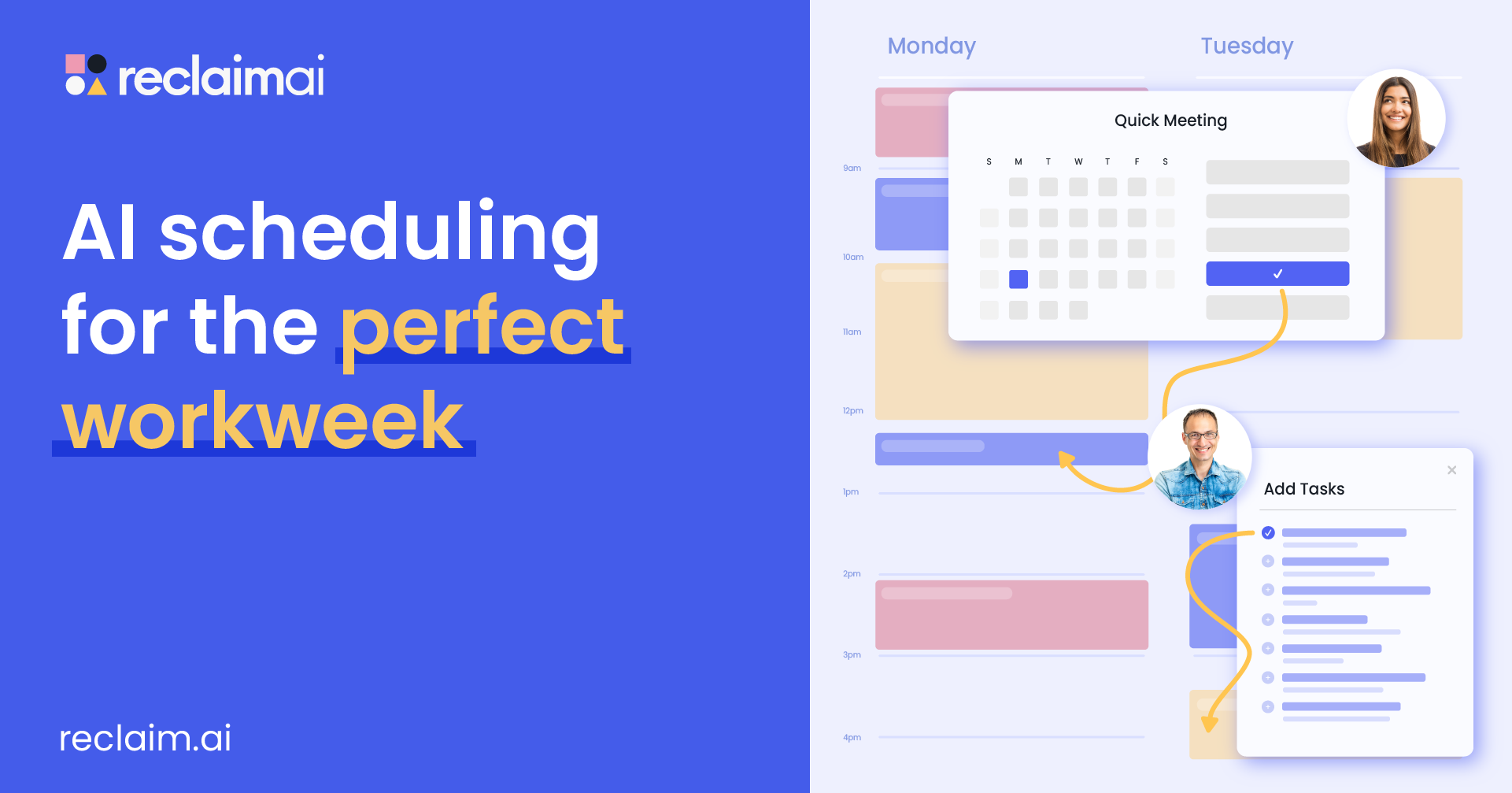
Reclaim is an AI-powered app that creates 40% more time for teams — auto-schedule tasks, habits, meeting & breaks – free on Google Calendar &
Reclaim AI enjoys a strong reputation among users, evident through consistently high ratings on G2, often praised for its effectiveness in organization and time management. A common strength highlighted is its ability to streamline tasks, making it ideal for users juggling multiple responsibilities. Complaints are minimal, with little negative feedback mentioned in social mentions. The pricing sentiment is not explicitly discussed, but overall, Reclaim AI is well-regarded in the community for its utility and reliability.
Mentions (30d)
3
1 this week
Avg Rating
4.7
20 reviews
Platforms
2
Sentiment
0%
0 positive

Reclaim AI enjoys a strong reputation among users, evident through consistently high ratings on G2, often praised for its effectiveness in organization and time management. A common strength highlighted is its ability to streamline tasks, making it ideal for users juggling multiple responsibilities. Complaints are minimal, with little negative feedback mentioned in social mentions. The pricing sentiment is not explicitly discussed, but overall, Reclaim AI is well-regarded in the community for its utility and reliability.
Features
Use Cases
Industry
information technology & services
Employees
23
Funding Stage
Other
Total Funding
$9.5M
Pricing found: $8/month, $16/month, $24/month, $32/month, $10
g2
What do you like best about Reclaim.ai?I’m especially fond of being able to sync my meetings to my Slack status in Reclaim, including using custom titles. I also regularly use the habits feature to schedule recurring time blocks that still need flexibility depending on my other tasks. Review collected by and hosted on G2.com.What do you dislike about Reclaim.ai?I do not personally have any dislikes about Reclaim. Review collected by and hosted on G2.com.
What do you like best about Reclaim.ai?I wasn't planning on getting another planning tool, but I found Reclaim.ai on Dropbox, and its features are perfect for my Real Estate Business. Its intelligent analytics work well to help me focus my time and manage my flexible lead-generation schedule. I'd definitely recommend it to other realtors and business owners. The scheduling/booking tool is an added bonus. Review collected by and hosted on G2.com.What do you dislike about Reclaim.ai?At this stage, I don't have any complaints about the product. I've been using it for just over a month and believe it's well worth the subscription cost. The great thing about technology is that I'm sure it will continue to evolve and only get stronger. Review collected by and hosted on G2.com.
What do you like best about Reclaim.ai?I like how Reclaim.ai combines all my calendars into one place, something Google can't even do. It links everything right away, making it really convenient for my family, personal, and business schedules. Review collected by and hosted on G2.com.What do you dislike about Reclaim.ai?I don't like that there's no app or actual calendar that I can use on my Android phone. I'd like to have an app that has all my calendars in one space so I don't have to switch between each one. It would also be nice if it could integrate with chat apps, as I have daily tasks I like to copy over when needed. Review collected by and hosted on G2.com.
What do you like best about Reclaim.ai?I love that Reclaim.ai helps me adopt habits and integrate them into the schedule with minimal presetting. There are great advanced customization options with the ability to set work hours and personal hours. It schedules tasks using artificial intelligence, allowing me to wake up and know what I will do today easily, thus reducing anxiety and helping to organize my days effortlessly. Review collected by and hosted on G2.com.What do you dislike about Reclaim.ai?There is none. Review collected by and hosted on G2.com.
What do you like best about Reclaim.ai?I like the fact that Reclaim.ai works around my schedule, never touching the appointments that I already have, but creating buffers before and after them according to my specifications. I also like that it takes the tasks I enter and organizes them with the time left. There's also a feature similar to Calendly that adds stability for people to schedule time with me that closes the loop on organizing my time completely. Review collected by and hosted on G2.com.What do you dislike about Reclaim.ai?The fact that reclaim always creates the tasks on the main calendar means that there's no way for me to look at my schedule without the reclaim changes. If I need to do something in the next two hours that was not on my schedule, reclaim would spend those entire 2 hours reshuffling my schedule and I will keep getting notified about it from my calendar. There needs to be a way to say "I stepped out", which will move tasks out of the way and stop refshuffling the calendar until I'm back. Some form of subtasks or a way to have a checklist in a task can be very useful. Tasks that take less than 15 min, which is more like a reminder to do something and check it off the list - that's just part of life, and we need that as well. Review collected by and hosted on G2.com.
What do you like best about Reclaim.ai?The thing I like most about Reclaim.ai is its ease of use and intuitive design, which just makes everything smoother. The smart booking for habits and tasks is fantastic because it means I don't have to think or worry about my bandwidth for the day ahead. My day is planned out by past me, so future me can just chill and follow the list of tasks in my calendar. The smart booking feature is great for scheduling things like competitive research and tasks you usually never make time for. It's awesome for setting priorities on different tasks I want to do. The biggest game changer for us has been the external calendar integration, which makes it easy for clients to book with our studio without the back-and-forth. Just sending them a link allows them to figure it out in their calendar, which I really appreciate. Also, the initial setup for Reclaim.ai is really easy, and its design is simple. Review collected by and hosted on G2.com.What do you dislike about Reclaim.ai?It's a relatively new software service (as I understand), so the only thing I'm very eager to get working is API integration. That hasn't worked very well for us yet. Review collected by and hosted on G2.com.
What do you like best about Reclaim.ai?I like Reclaim.ai for its easy integration with Google tasks and another product I use for getting things done. It's clear and helps me see what I need to do each day. The initial setup was very easy. Review collected by and hosted on G2.com.What do you dislike about Reclaim.ai?When I schedule a task, I'm not always able to do it at the time that it's planned. So, better rescheduling. Also, if I want a task that are daily such as, reviewing Gmail in the morning and reviewing Gmail in the afternoon. There is no easy way to semi force that, to be done at specific time. Review collected by and hosted on G2.com.
What do you like best about Reclaim.ai?Reclaim.ai is particularly valuable for protecting focus time in crowded calendars. Its ability to automatically prioritize and reschedule tasks and routines based on my real availability makes time management much more intentional and easier, without requiring constant manual adjustments on my end. It supports my time management efforts, shifting it from reactive to proactive. Instead of constantly negotiating calendar space, it helps me to create a system that enforces my priorities, creating some guardrails. Review collected by and hosted on G2.com.What do you dislike about Reclaim.ai?Some advanced features are locked behind higher-tier plans, which can be a limitation depending on how deeply you want to integrate it into team workflows. Another limitation is that missed tasks or deadlines don’t always surface with strong alerts. It’s possible to overlook a task without it creating enough friction or escalation, which means I still need to be vigilant and, in some cases, duplicate reminders to avoid things slipping through. Review collected by and hosted on G2.com.
What do you like best about Reclaim.ai?The auto-rescheduling of events. My work environment necessitates frequent and disruptive reshuffling of my work tasks due to new meetings or higher priority asks. It was such a burden to start the day with a to-do list, only to have to reprioritize and reshuffle the list by 10:00 AM. I especially appreciate that uncompleted work is auto-populated on my calendar for the following day, according to my rules. My second favorite feature are Habits. These consistent, automated calendar appointments allow me to meet my goals and resolutions while also flexing as I need when life gives me lemons. Review collected by and hosted on G2.com.What do you dislike about Reclaim.ai?I find the reporting could be better, demonstrating how and where I need to make adjustments in my working style. However, the annual recap does a really nice job at this! Review collected by and hosted on G2.com.
What do you like best about Reclaim.ai?Reclaim.ai helps me effectively manage the large amount of daily and weekly tasks. I like it because it is a streamlined, fast program, complete in its simplicity, and quite user-friendly. These features help me avoid wasting time, which is essential for achieving high productivity in one's work. Review collected by and hosted on G2.com.What do you dislike about Reclaim.ai?I would like all the features to be available in Italian and for the instructions on the various functions to be clearer (perhaps with some explanatory videos). Also, a dark mode wouldn't be bad at all. It was more difficult to understand how to make Reclaim.ai work at its best because the decision-making modes of the software are not very clear from the start. Review collected by and hosted on G2.com.
I’ve created a tool that helps you reclaim your privacy in the age of AI
But first, a little background: why did I create this tool? It’s simple: I work at a company where I manage the entire backend, data management, task optimization, automation, and so on. When ChatGPT came out in 2023, things went haywire, everyone was copying and pasting highly confidential info into it just to save 30 seconds on writing an email. So we had to rein all that in a bit, define how and when we use LLMs. But as you can imagine, to save time (or out of laziness, I don’t know), all that information kept getting sent in bulk. From customers’ first and last names to financial data, even passwords. Everything went in there. It’s been a year now since I left that company to focus on my own projects. And this issue came back to me: how can we save time without compromising our privacy and personal data? After weeks of testing and research, and two months of development, ONYRI Sanitize was born. ONYRI Sanitize is a simple web app connected to the latest AI model available, which uses scripts (without AI) to detect data that needs to be kept confidential. You continue to use AI just as you would on the official site, but this time, your data will remain confidential forever. When you consider that millions of users admit to having already used ChatGPT as a therapist, it would be naive to think that these companies aren’t using that data... A quote I grew up with: “Saying you don’t need privacy because you have nothing to hide is like saying you don’t need free speech because you have nothing to say.” — Edward Snowden submitted by /u/No_Computer_1247 [link] [comments]
View originalI’ve created a tool that helps you reclaim your privacy in the age of AI
But first, a little background: why did I create this tool? It’s simple: I work at a company where I manage the entire backend, data management, task optimization, automation, and so on. When ChatGPT came out in 2023, things went haywire, everyone was copying and pasting highly confidential info into it just to save 30 seconds on writing an email. As if all of Snowden’s warnings only applied to Google searches. So we had to rein all that in a bit, define how and when we use LLMs. But as you can imagine, to save time (or out of laziness, I don’t know), all that information kept getting sent in bulk. From customers’ first and last names to financial data, even passwords. Everything went in there. It’s been a year now since I left that company to focus on my own projects. And this issue came back to me: how can we save time without compromising our privacy and personal data? After weeks of testing and research, and two months of development, ONYRI Sanitize was born. ONYRI Sanitize is a simple web app connected to the latest AI model available, which uses scripts (without AI) to detect data that needs to be kept confidential. You continue to use AI just as you would on the official site, but this time, your data will remain confidential forever. When you consider that millions of users admit to having already used ChatGPT as a therapist, it would be naive to think that these companies aren’t using that data... A quote I grew up with: “Saying you don’t need privacy because you have nothing to hide is like saying you don’t need free speech because you have nothing to say.” — Edward Snowden submitted by /u/No_Computer_1247 [link] [comments]
View originalBernie Sanders: A.I. Belongs to the People, Not to Billionaires
Selected excerpts: "The question, then, is not whether A.I. will change the world. It will. The question is: Who will own and control that future? Who will benefit from it, and who will be hurt by it? Will A.I. be used to make life better for working families? Will it enrich our quality of life? Will it help us eliminate poverty, extend life expectancies and solve the climate crisis? Or will the future of humanity be determined by a handful of billionaires who have promoted and developed A.I., with virtually no democratic input, who stand to become even richer and more powerful than they are today? That is the choice before us. Let us be clear. Artificial intelligence was not created out of thin air. The data and language used by generative A.I. tools didn’t just pop into Sam Altman’s head or Elon Musk’s imagination. A.I. is built on our collective intelligence: our books, songs, artwork, journalism, computer code, scientific research, videos, conversations, images and ideas spanning generations. That is not just the opinion of Bernie Sanders. According to Mr. Altman, the head of OpenAI, A.I. models were trained on our 'collective experience, knowledge' and 'learnings of humanity.' For the most part, tech oligarchs have fed this knowledge into their A.I. models without permission, without acknowledgment, without compensation. In other words, the creative work of millions of people — writers, artists, musicians, journalists, teachers, scientists and ordinary citizens — has essentially been stolen by some of the wealthiest people in the world. It’s time for us to reclaim it. That is why I will soon be introducing the American A.I. Sovereign Wealth Fund Act. This legislation would give the public a direct ownership stake in the largest A.I. companies in our country. How? It would create a sovereign wealth fund through a one-time 50 percent tax — not on the profits of OpenAI, Anthropic, xAI and other companies, but paid with something far more valuable than that: the stock." submitted by /u/MnkyBzns [link] [comments]
View originalI spent $340 on AI subscriptions last month. Wrote down what I actually used each one for. It was depressing.
Going through the credit card statement, here's what I had active: Claude Pro (40), ChatGPT Plus (20), Cursor (20), Perplexity Pro (20), Notion AI (10), Granola (20), ElevenLabs Starter (5), Midjourney Basic (10), Gamma Pro (10), Beautiful.ai (12), Otter Pro (17), Loom Business (15), Zapier Pro (30), Make Core (10), Tactiq Pro (8), Descript Creator (15), Reclaim.ai Pro (8), Motion (19), Superhuman (30), one i can't remember the name of (10), some ai-something for instagram captions (11) Then I sat down and wrote next to each one the last time I'd actually used it. Not opened it, used it for a real piece of work. Claude (yesterday), ChatGPT (yesterday, voice mode in car), Cursor (yesterday), Perplexity (3 days), Granola (every meeting), Gamma (2 weeks), Zapier (a month, but the automations are still running), ElevenLabs (3 months ago), Midjourney (couldn't remember), Beautiful.ai (couldn't remember), Otter (replaced by Granola, just forgot to cancel), Loom (4 months), Tactiq (replaced by Granola, also forgot), Descript (used twice in 6 months), Reclaim/Motion (both, can't tell them apart, forget which one schedules my meetings), Superhuman (used the AI features twice), the instagram one (literally cannot remember signing up) Cancelled 11 things this morning. Saving $145/month. Nothing in my workflow actually changed. The pattern isn't that AI tools are bad. It's that I treat subscribing like trying. Every "I want to try this" became a recurring charge I forgot about. submitted by /u/OneSeaworthiness2676 [link] [comments]
View originalWhy We Build
One silver-lining to the dead internet we're living in, today, is that it's very quickly teaching us that we can't rely on our senses as much as we believe we can. It's not healthy to always live in skepticism, but it is necessary in a World where you don't know what's up or down anymore. That's why we need great minds to focus their attention on solving the problems associated with credible information sharing without it becoming some centralized playground designed to look like the free-flowing exchange of ideas. If we don't solve for that, then I guess we're heading into a future that a small handful of people want because elections or public opinion will no longer matter. One of the biggest focuses in AI should be in figuring out how to get it to provide deep credible knowledge in specific domains that can be best applied to the problems we're trying to solve. Sure, it can do this with enough fenagling, but what I really mean is having something easy for everyone to use like Perplexity or Gemini, only it doesn't simply find consensus information from the internet using all these black box methods that are owned by major corporations. Instead, it should use direct knowledge from domain experts who structure and cite their material and as users, we should be able to backtrack all of it, including the original author. And all of this should be achievable by simply engaging with a chatbot agent that can reliably go out and help me discover all of these things. Also, we shouldn't have to simply trust that the application works. We should be able to go in and see exactly how it's working. This way, the public can audit the systems we're relying on for grounding our worldviews. That, to me, is where we should be if we really want to break from the chains of propaganda and reclaim our genuine thoughts about how we ought to live. The alternative independent media space was co-opted long ago and now all of the feeds keep us in a state of perpetual dislocation from our friends, family, communities, new solutions, and better approximations to the truth. We exist in a walled-off digital pasture. But if regular people who are smart and capable enough decide to leverage this new technology, then we can break through the fencing and finally live in a world where discovery-based researching and learning can be easier than Google, which could eventually individuate society again, like how it was before, instead of keeping us clustered into specific groups based on our viewing preferences. That's why my brother and I got into this business. Yeah, sure, we also wanna make a buck so we can retire with dignity. That's true. But the drive has always stemmed from wanting to figure out a better way for people to share hidden insights and create things that are bigger than they thought they could handle. We have a long way to go, but we're making the first small steps, even if it isn't obvious, just yet. Bottom line, though? Humanity must figure out a way to help us master the means and methods of discovery-based knowledge acquisition, execution, and immediate distribution of information based on relevancy and needs from those who search instead of those who passively soak information in from the curated feeds. And all of this needs to be easy enough for a 12 year-old to do. If anyone else is working on this problem, we'd love to hear your thoughts, even if it's through a DM. We're living in the most exciting times, but with adventure, comes danger. So maybe, idk. Let's make it more fun and less hazardous, so that we can, at least, live long enough to re-tell this great story that we're all a part of. submitted by /u/CyborgWriter [link] [comments]
View originalLooking for an AI / system to basically manage my entire life 😭 Does this even exist?
Hi everyone, I genuinely feel overwhelmed and I’m wondering if there’s an AI tool, app, or system that can help me organize basically my entire life. I’m juggling a demanding full-time job, university, building a business from scratch, personal finances, and full wedding planning, and I feel like I need a personal chief of staff / executive assistant for life 😭 I’m looking for something that could help with: Work/project management (prioritizing, deadlines, helping me think through work) Calendar & scheduling (actually time-blocking and organizing my days realistically) Finances/budgeting and helping me stay on track financially Entrepreneurship/business building from scratch (planning, prioritization, next steps) University/studying support Wedding planning (timelines, vendors, budgets, to-do lists, reminders, etc.) Personal goals, habits, routines, and becoming a more organized/productive version of myself What I’m looking for is something that feels like a life operating system, not just a chatbot that answers questions. Ideally, I’d love something that: helps me decide what to prioritize reorganizes things when I inevitably fall behind 😅 integrates with calendars/tasks feels proactive instead of reactive I struggle a lot with overwhelm and procrastination when too many things pile up, so if you’ve found a setup that genuinely changed your life, I would LOVE recommendations. What are you actually using? One tool? A stack of tools? AI agents? Claude, ChatGPT, Motion, Notion, Reclaim, Goblin Tools, Sunsama, something else? And most importantly: what actually works in real life? submitted by /u/Lucky_Lie_917 [link] [comments]
View originalI moved to Claude because of the PBC commitment. The Colossus deal feels like a betrayal of that.
I am a Claude Pro subscriber. I use Claude Code. I moved to Anthropic specifically because it is a Public Benefit Corporation, and that distinction mattered to me when choosing which AI tools to pay for and build on. This week's compute deal nominally benefits me. More capacity, higher limits. I understand that, and I am not dismissing the compute scarcity problem Anthropic is solving. I still don't want it at this cost. What Colossus is Colossus was built by operating more than 30 methane gas turbines without Clean Air Act permits for nearly a year, in a majority-Black neighborhood in Memphis whose residents already face a cancer risk four times the national average. When the NAACP filed a notice of intent to sue, xAI removed the unpermitted turbines at Colossus 1 and built Colossus 2 in Southaven, Mississippi with 27 new unpermitted turbines, described internally as a "copy and paste" of the same strategy. The NAACP, represented by Earthjustice and the Southern Environmental Law Center, is now actively suing xAI. A congressional probe is open. Penalties sought are up to $124,400 per day of violation. At the time Anthropic signed, all of this was documented, litigated, and public. Why the PBC structure matters here Anthropic's PBC designation is not marketing. It is a legal governance obligation to weigh public benefit alongside profit. It is also why some of us chose Anthropic over competitors in the first place. Signing a comprehensive compute agreement with a facility under active federal environmental litigation, in a documented environmental justice community, with full prior knowledge, is a governance question under that obligation. I have not seen Anthropic address it publicly. One more thing worth flagging Musk has publicly stated he reserves the right to reclaim Colossus compute if Anthropic's AI "engages in actions that harm humanity." For developers building on Claude Code, that dependency now sits underneath your toolchain. The infrastructure provider's definition of harm has structural leverage over an AI safety company's infrastructure decisions. What I am asking I am not asking Anthropic to abandon its compute strategy. I am asking whether other users who chose Anthropic because of its PBC commitment feel the same way, and whether Anthropic intends to address how this decision is consistent with that commitment. I have filed a formal protest with Anthropic support citing these concerns. I wanted to raise it here because developers who build on these tools deserve to know what the infrastructure decision looks like from a user who specifically chose this platform for its stated values. submitted by /u/No_Boysenberry6890 [link] [comments]
View originalWorker-Positive AI: Why Skills, Not Job Titles, Decide Who Wins the Next Five Years
AI is not erasing UK jobs — it is reorganising them, worker-positive AI. Here is the evidence-led case for skills-based work, with named studies and a practical playbook. The doomsday story about AI and jobs keeps missing the point. Work is not disappearing. It is being reorganised. And the organisations that win the next five years will not be the ones with the flashiest AI stack. They will be the ones that shift from job titles to skills. The Technological Jerk of Software Development I have spent roughly 30 years in infrastructure and SRE work. I have watched a lot of technology waves sweep through. This one feels different — not because the tech is magical, but because the operating model around it has to change. Bolt-on AI does not move productivity. Redesigned work does. Here is the worker-positive case, backed by named research. The UK entry-level floor is dropping — and that is a skills story A King's College London study of millions of UK job listings found that firms most exposed to AI became 16.3 percentage points less likely to post new vacancies. Highly exposed occupations saw job postings fall by 23.4%. Technical and analytical roles — software engineers, data analysts — took the steepest cuts. Here is the part most headlines miss. Average pay at those same firms rose by more than £1,300. The remaining work carries more complexity. Fewer junior tickets to triage. More judgement calls about when the model is wrong. Customer-facing roles held steady. The KCL researchers noted that interpersonal skills remain a genuine complement to large language models. That should tell you something about where the human premium is moving. The real risk is not job loss. It is uneven access to the new, more complex tasks — and to the skills that qualify people for them. Skills-based work is the operating model, not a HR rebrand The World Economic Forum's Future of Jobs Report 2025 surveyed over 1,000 employers covering 14 million workers. Their finding: 39% of workers' core skills will be transformed or outdated between 2025 and 2030. AI and big data top the list of fastest-growing skills. Analytical thinking, resilience, and leadership are the human anchors. PwC's 2025 Global AI Jobs Barometer analysed close to a billion job ads. Workers with AI skills earned a 56% wage premium in 2024 — more than double the 25% premium a year earlier. Skills requirements are changing 66% faster in AI-exposed roles. Demand for formal degrees is falling in those same roles. Put those numbers together and the pattern is clear. The market is pricing skills, not titles. But most organisations still plan, hire, and promote around titles. That is the gap. The Workday UK playbook makes the practical case for a skills-first operating model. If a role loses tasks to AI, the worker does not lose their identity. Their skills travel with them to the next role. Internal talent marketplaces turn that clarity into movement. Skills taxonomies — one team says "coding," another says "React," another says "software engineering" — get reconciled into a shared vocabulary. This is the part I keep coming back to. It is not a tooling problem. It is a definition problem. When you cannot describe what people can actually do in a consistent way, you cannot redeploy them. You just hire externally and hope. Trust is infrastructure — and the UK that skips it ships slower Britain's regulatory stance is lighter touch than the EU's AI Act. Instead of a central regulator, sector bodies like the ICO and EHRC set context-specific guardrails. That is not a vacuum, though. The TUC's Artificial Intelligence (Regulation and Employment Rights) Bill sets out three demands. A ban on detrimental use of emotion recognition. A statutory right to disconnect. Algorithmic transparency — employers must explain how automated decisions get made and on what data. Worker sentiment backs this up. A YouGov poll commissioned for the TUC found 69% of UK working adults agree employers should consult staff before introducing new tech like AI. And the business case for governance is not soft. Workday research estimates UK leaders lose up to 140 working days per year to administrative friction. AI adoption could reclaim productive work worth £119 billion annually — but only when trust is there to carry adoption to scale. I have seen this pattern in SRE work for decades. Systems that hide their logic get distrusted and worked around. Systems that surface their reasoning get adopted faster. AI is no different. The practitioner's playbook Build a skills taxonomy before buying another AI tool. You cannot redeploy people through vocabulary you do not have. Audit your entry-level pipeline. If AI is eating junior tasks, where do senior people come from in five years? Bootcamp partnerships and apprenticeships become strategic, not nice-to-have. Treat governance as a speed lever, not a brake. Transparency, audit trails, and human review shorten the distance between pilot
View originalanthropic isn't the only reason you're hitting claude code limits. i did audit of 926 sessions and found a lot of the waste was on my side.
Last 10 days, X and Reddit have been full of outrage about Anthropic's rate limit changes. Suddenly I was burning through a week's allowance in two days, but I was working on the same projects and my workflows hadn't changed. People on socials reporting the $200 Max plan is running dry in hours, some reporting unexplained ghost token usage. Some people went as far as reverse-engineering the Claude Code binary and found cache bugs causing 10-20x cost inflation. Anthropic did not acknowledge the issue. They were playing with the knobs in the background. Like most, my work had completely stopped. I spend 8-10 hours a day inside Claude Code, and suddenly half my week was gone by Tuesday. But being angry wasn't fixing anything. I realized, AI is getting commoditized. Subscriptions are the onboarding ramp. The real pricing model is tokens, same as electricity. You're renting intelligence by the unit. So as someone who depends on this tool every day, and would likely depend on something similar in future, I want to squeeze maximum value out of every token I'm paying for. I started investigating with a basic question. How much context is loaded before I even type anything? iykyk, every Claude Code session starts with a base payload (system prompt, tool definitions, agent descriptions, memory files, skill descriptions, MCP schemas). You can run /context at any point in the conversation to see what's loaded. I ran it at session start and the answer was 45,000 tokens. I'd been on the 1M context window with a percentage bar in my statusline, so 45k showed up as ~5%. I never looked twice, or did the absolute count in my head. This same 45k, on the standard 200k window, is over 20% gone before you've said a word. And you're paying this 45k cost every turn. Claude Code (and every AI assistant) doesn't maintain a persistent conversation. It's a stateless loop. Every single turn, the entire history gets rebuilt from scratch and sent to the model: system prompt, tool schemas, every previous message, your new message. All of it, every time. Prompt caching is how providers keep this affordable. They don't reload the parts that are common across turns, which saves 90% on those tokens. But keeping things cached costs money too, and Anthropic decided 5 minutes is the sweet spot. After that, the cache expires. Their incentives are aligned with you burning more tokens, not fewer. So on a typical turn, you're paying $0.50/MTok for the cached prefix and $5/MTok only for the new content at the end. The moment that cache expires, your next turn re-processes everything at full price. 10x cost jump, invisible to you. So I went manic optimizing. I trimmed and redid my CLAUDE md and memory files, consolidated skill descriptions, turned off unused MCP servers, tightened the schema my memory hook was injecting on session start. Shaved maybe 4-5k tokens. 10% reduction. That felt good for an hour. I got curious again and looked at where the other 40k was coming from. 20,000 tokens were system tool schema definitions. By default, Claude Code loads the full JSON schema for every available tool into context at session start, whether you use that tool or not. They really do want you to burn more tokens than required. Most users won't even know this is configurable. I didn't. The setting is called enable_tool_search. It does deferred tool loading. Here's how to set it in your settings.json: "env": { "ENABLE_TOOL_SEARCH": "true" } This setting only loads 6 primary tools and lazy-loads the rest on demand instead of dumping them all upfront. Starting context dropped from 45k to 20k and the system tool overhead went from 20k to 6k. 14,000 tokens saved on every single turn of every single session, from one line in a config file. Some rough math on what that one setting was costing me. My sessions average 22 turns. 14,000 extra tokens per turn = 308,000 tokens per session that didn't need to be there. Across 858 sessions, that's 264 million tokens. At cache-read pricing ($0.50/MTok), that's $132. But over half my turns were hitting expired caches and paying full input price ($5/MTok), so the real cost was somewhere between $132 and $1,300. One default setting. And for subscription users, those are the same tokens counting against your rate limit quota. That number made my head spin. One setting I'd never heard of was burning this much. What else was invisible? Anthropic has a built-in /insights command, but after running it once I didn't find it particularly useful for diagnosing where waste was actually happening. Claude Code stores every conversation as JSONL files locally under ~/.claude/projects/, but there's no built-in way to get a real breakdown by session, cost per project, or what categories of work are expensive. So I built a token usage auditor. It walks every JSONL file, parses every turn, loads everything into a SQLite database (token counts, cache hit ratios, tool calls, idle gaps, edit failures, skill invocations), and an insi
View originalPrism MCP v5.1 - 10x memory compression and AI agent learning from mistakes
Posted Prism here before (persistent memory for AI coding agents). Two big releases since - here's what's new: 10x more memory in the same space. We ported Google's TurboQuant to pure TypeScript. Your agent can now store millions of memories on a laptop instead of hundreds of thousands. No vector database needed. Your agent learns from mistakes. When you correct your agent, Prism remembers. Important corrections auto-surface as warnings in future sessions. Your agent gets smarter every time you use it. Visual knowledge graph. See your agent's memory as an interactive neural map. Click any node to rename or delete it. Finally see what your agent actually remembers. Deep Storage cleanup. One command reclaims 90% of storage space from old memories. Safe by default - preview before deleting. Pure TypeScript, local SQLite, zero cloud dependencies. Works with Claude, Cursor, Windsurf, Gemini, and any MCP client. MIT licensed. 303 tests. GitHub: https://github.com/dcostenco/prism-mcp submitted by /u/dco44 [link] [comments]
View originalYes, Reclaim AI offers a free tier. Pricing found: $8/month, $16/month, $24/month, $32/month, $10
Reclaim AI has an average rating of 4.7 out of 5 stars based on 20 reviews from G2, Capterra, and TrustRadius.
Key features include: Product, Solutions, Teams, Integrations, Resources, Popular blog posts, Enterprise, Compare Reclaim Alternatives.
Reclaim AI is commonly used for: Automatically schedule meetings based on team availability, Block out focus time to minimize interruptions, Manage personal and team calendars in one place, Optimize workweek by suggesting the best times for tasks, Balance work and personal life with flexible scheduling, Set reminders for important deadlines and tasks.
Reclaim AI integrates with: Google Calendar, Microsoft Outlook, Slack, Zoom, Trello, Asana, Notion, Todoist, Calendly, Jira.

Best Clockwise alternative – Reclaim.ai demo (+ price-match info)
Mar 16, 2026
Based on user reviews and social mentions, the most common pain points are: token usage.
Based on 15 social mentions analyzed, 0% of sentiment is positive, 100% neutral, and 0% negative.


