
ReadMe helps you create beautiful, interactive API documentation that developers love.
ReadMe.io is praised for its intuitive admin interface and robust AI-native capabilities, including an AI Writer that streamlines documentation updates. Users appreciate its recent upgrades like the MCP server that enhances usability for AI integrations and provides streamlined features such as collapsible category navigation. However, there's minimal mention of specific pricing feedback, suggesting that pricing might not be a major point of contention or excitement among users. Overall, ReadMe.io enjoys a strong reputation, particularly for catering to developers looking to optimize API documentation with AI-driven tools.
Mentions (30d)
14
Reviews
0
Platforms
3
Sentiment
2%
1 positive
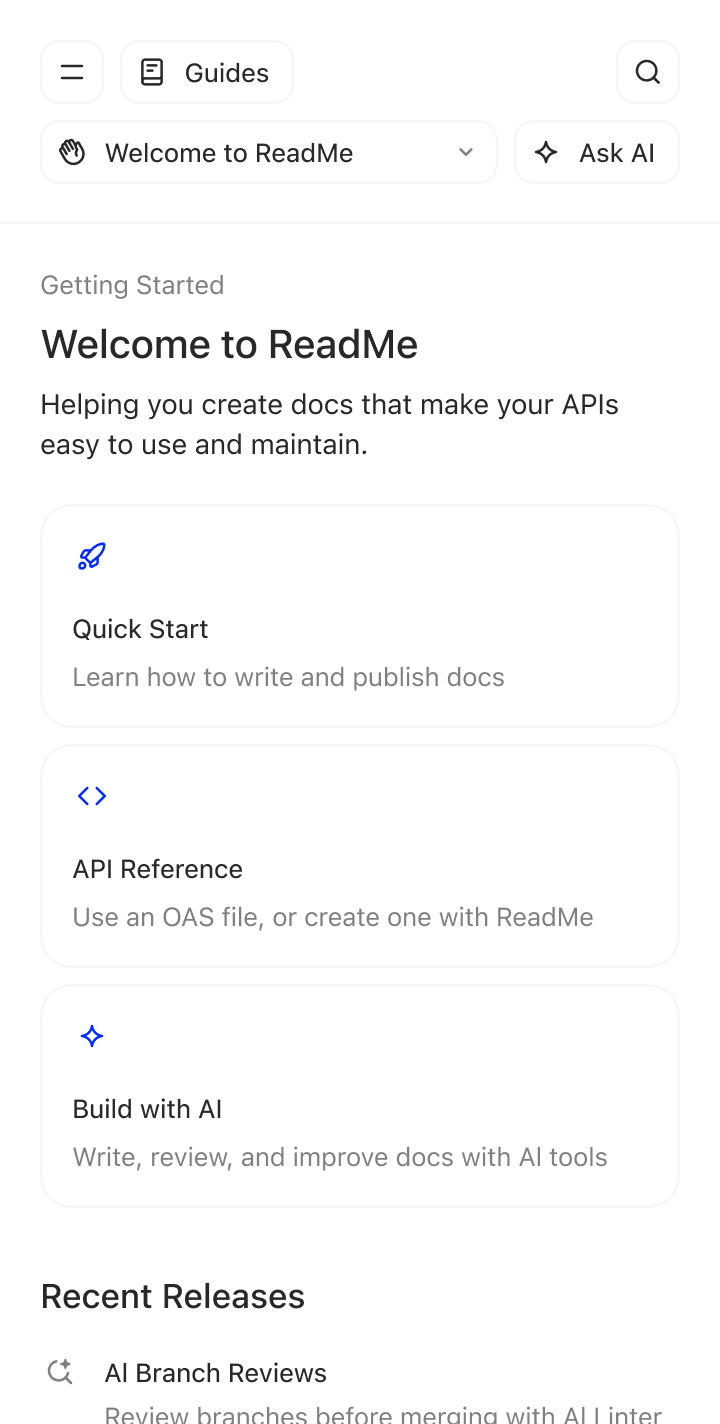
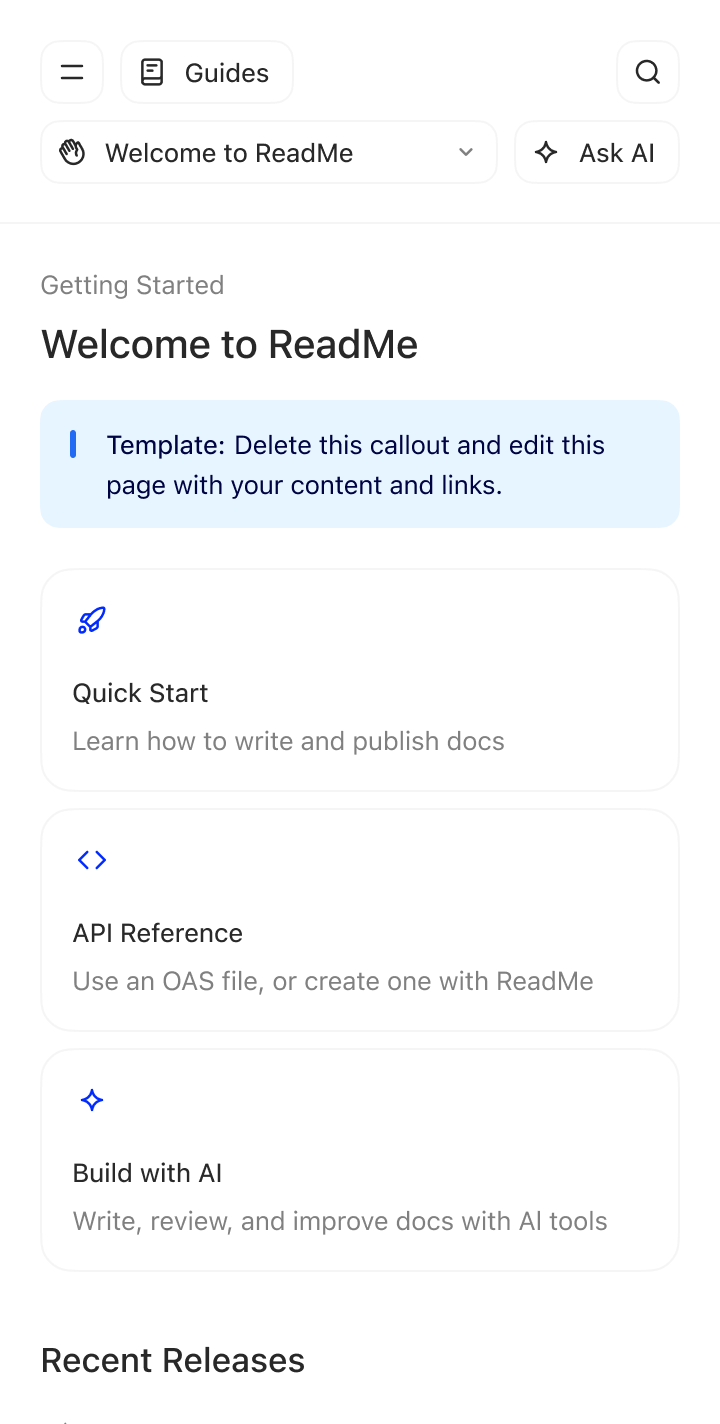
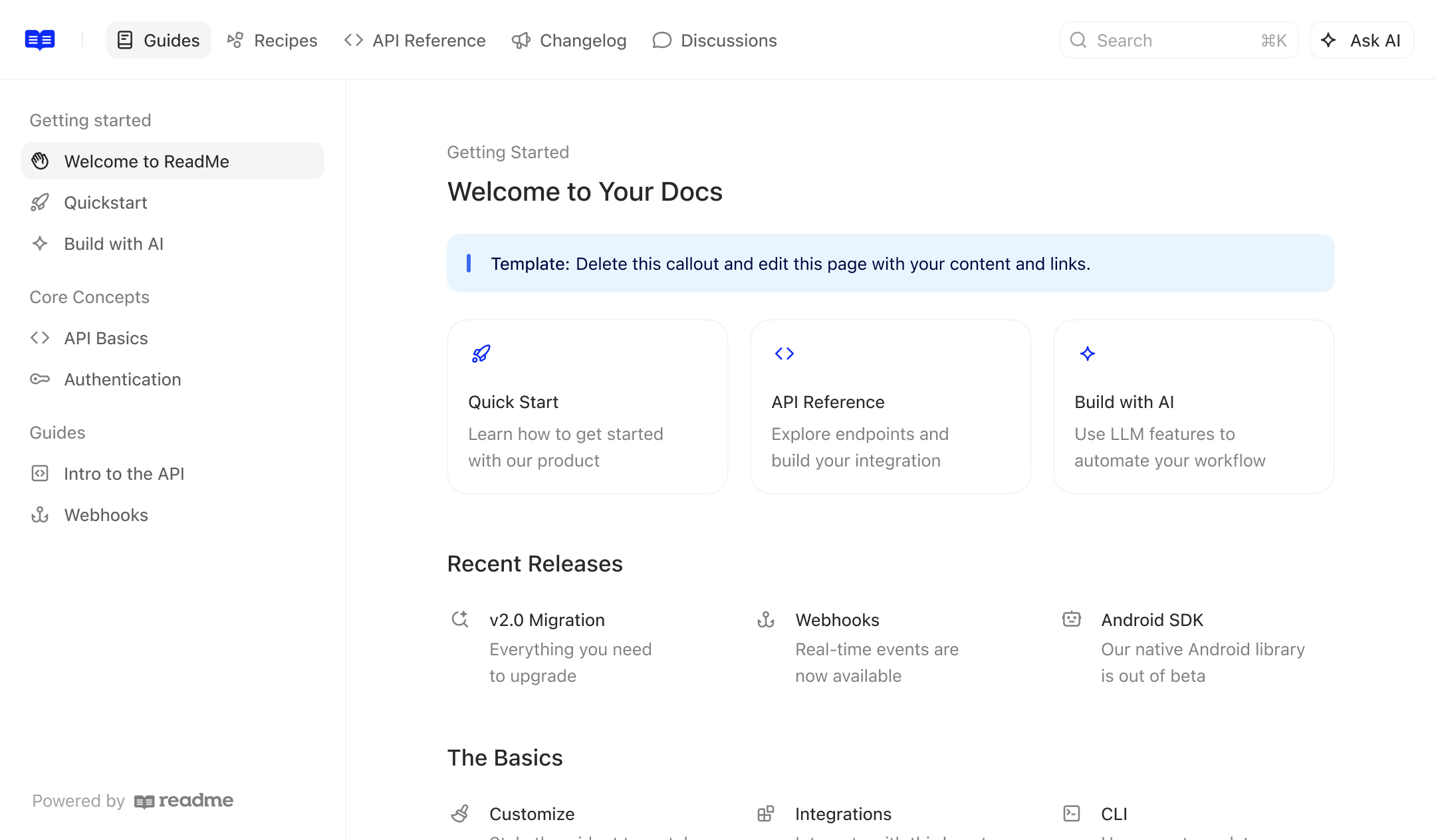
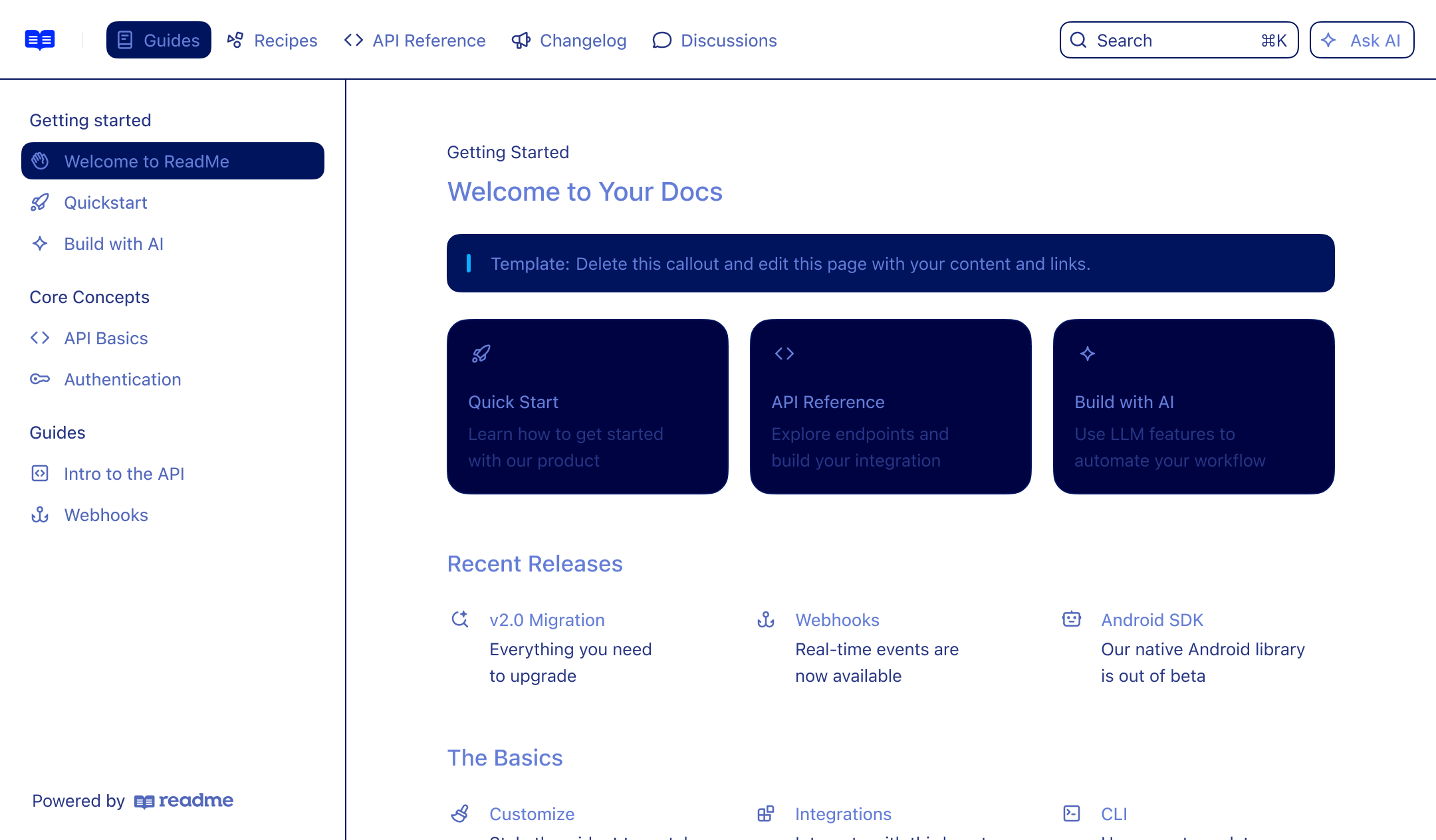
ReadMe.io is praised for its intuitive admin interface and robust AI-native capabilities, including an AI Writer that streamlines documentation updates. Users appreciate its recent upgrades like the MCP server that enhances usability for AI integrations and provides streamlined features such as collapsible category navigation. However, there's minimal mention of specific pricing feedback, suggesting that pricing might not be a major point of contention or excitement among users. Overall, ReadMe.io enjoys a strong reputation, particularly for catering to developers looking to optimize API documentation with AI-driven tools.
Features
Use Cases
Industry
information technology & services
Employees
83
Funding Stage
Series A
Total Funding
$10.4M
We redesigned ReadMe from the ground up. Here's what's new: 1. Simpler admin interface that's easier to navigate 2. AI-native editor with Markdown + MDX that keeps you in the loop 3. AI Writer that
We redesigned ReadMe from the ground up. Here's what's new: 1. Simpler admin interface that's easier to navigate 2. AI-native editor with Markdown + MDX that keeps you in the loop 3. AI Writer that watches your GitHub commits and creates docs from them 4. CLI tool for working https://t.co/uai4nQ5kTU
View originalPricing found: $150/mo, $150/mo, $150 /month, $150 /month, $150 /month
I built a free iOS app to read the Markdown files Claude & Claude Code generate, right on your phone
Claude and Claude Code constantly hand you .md files — plans, specs, READMEs, writeups. On a Mac that's fine, but open one on your iPhone and iOS just shows raw text with no rendering. It bugged me enough that I made a small, free viewer specifically for this. Md Preview renders Claude's Markdown properly, on-device: • GitHub-Flavored Markdown: tables, task lists, footnotes • Code blocks with syntax highlighting • LaTeX math + Mermaid diagrams (so the diagrams Claude draws actually show) • Opens .md / .markdown / .mdx straight from Files or the Share Sheet It's completely free — no ads, no subscription, nothing uploaded, and no referral links, just the App Store: https://apps.apple.com/app/id6760341080 More: https://markdown.cybergame.ai/ If you read a lot of Claude / Claude Code output on mobile, I'd genuinely like to know what would make it more useful. submitted by /u/Fujima4Kenji [link] [comments]
View originalI stopped sending decks and started sending Claude artifacts.
I've completely stopped sending slide decks and pdfs. Doesn't matter if its a proposal, one-off custom reports, sales materials, project trackers, etc... everything I send is created by Claude. Started as an experiment, but honestly takes less time to build a genuinely nice custom asset than to update some generic template and send it. A few unsurprising observations: they're a pain to share, especially if the other person isn't on Claude most people get super intimidated by an html file no clean way to see how or where someone actually engaged gating access was impossible So I built some software to send, gate, track, and collaborate on Claude artifacts (or really any html output). All you need to do is load in your claude output and share away. Basically docsend for html instead of pdfs. Been dogfooding it with my own clients for about a month and I ain't ever goin' back. A few surprising observations: people go a little nuts over them. I think we're all so numb to static decks that anything different hits way harder than it should recipients want to share the outputs and reuse the templates themselves (or want me to teach them how to make em') a few wanted to actually collaborate and edit the same artifact - mostly on data analysis/mini-dashboards or internal collaboration It's pretty fun watching one of my proposals get opened and forwarded to 3 execs I never sent it to. Unsure what it has done for our win rates (too early to make any claims), but people seem to love it. Idk if anyone else would find it useful, but there is a free tier for up to 3 hosted artifacts... at least until freakin' Claude just ships it as a feature lol Lesson: Creating custom follow up assets is now easy and cheap. Go do it an wow a customer. submitted by /u/elpilotfish [link] [comments]
View originalWe built a security scanner for MCP configs.
If you use Claude Desktop or Claude Code with MCP servers, every server in your config runs with your full user privileges. Most people (including me until recently) just paste npx commands from READMEs without checking what they're actually running. There was a real supply chain attack last year. Postmark-mcp was a backdoor that exfiltrated email data from ~300 organizations before anyone noticed. There have been 40+ CVEs filed against MCP servers in 2026. And research found 41% of public MCP servers have zero authentication. So we made Fabrica-STAR. Run this: npx fabrica-star scan It finds your Claude Desktop / Claude Code / Cursor config automatically and checks for: - Hardcoded API keys/tokens in env vars - Packages without version pins (anyone can push a malicious "latest") - Known malicious servers (live-updated list) - Typosquatted package names - Unscoped filesystem access - Plain HTTP to remote hosts No install, no account, no telemetry. Or try it in the browser without installing anything: https://fadedcantcode.github.io/Fabrica-STAR GitHub: https://github.com/FadedCantCode/Fabrica-STAR Open source, MIT. Would appreciate feedback on false positives — still early days. submitted by /u/Filian_QAQ [link] [comments]
View originalMost of the internet isn't human anymore — and the next phase is agents that don't just read the web, they pay for what they need
Something broke this year and almost nobody outside of infra teams noticed: most internet traffic isn't human anymore. Imperva's 2025 Bad Bot Report measured automated traffic at 51% of all web traffic, the first time bots have outnumbered people in over a decade. Cloudflare's numbers are even higher, around 57% of HTTP requests coming from automated systems. Their co-founder mentioned the human/machine crossover showed up more than a year ahead of their own forecast, which I find kind of funny. Even the people whose job is to predict this stuff got surprised by how fast it happened. The why is in HUMAN Security's 2026 report. Agentic AI traffic grew roughly 7,851% year over year. Not a typo. Automated traffic overall expanded about 8x faster than human activity, GPTBot alone grew 305% in a year, and the category they call "user-action" crawling, which is basically an assistant fetching a page because you asked it to do something, grew 15x. That last one is the interesting part to me. A growing chunk of "web traffic" is now an agent opening a page on your behalf, in the middle of a task, to get something done. Not a scraper hoovering data for training. An agent working. And it's not stopping at reading. Gartner thinks that by 2028, 15% of day to day work decisions will be made autonomously by agents (it was 0% in 2024). Visa launched Intelligent Commerce and Mastercard launched Agent Pay last year, payment rails built specifically so a verified agent can check out on your behalf. Mastercard ran its first live agent purchase in September. Salesforce claims AI agents influenced about $67B of Cyber Week sales, roughly 20% of orders. The one I keep coming back to is x402. Coinbase took the HTTP 402 "Payment Required" status code, which has been sitting unused in the spec since the 90s, and made it real. An agent hits a paywall, signs a stablecoin payment, continues. No account, no human in the loop. It's already done 150M+ transactions at something like $600M annualized, and Cloudflare is backing the standard now. So the shape of the next web seems pretty clear to me: the dominant "user" is becoming software that crawls, reasons, decides, and pays on its own. We're already rebuilding the web for it. llms.txt, MCP, bot verification protocols, all of it. Here's the part I think is under-discussed though, and the reason I've been building what I've been building. An agent that can browse and pay still can't actually do most jobs, because it lacks capabilities. A model is general. A task is specific. "Diagnose why this RAG pipeline returns garbage" or "reconcile these invoices" or "audit this Terraform" aren't prompts. They're skills: packaged instructions plus references plus a runnable check that an agent loads when it needs them. This is why Anthropic shipped Agent Skills as an open standard back in October, and why MCP exploded to tens of thousands of servers in a single year before getting handed to the Linux Foundation. The unit of agent capability is becoming the skill or the tool, not the model itself. But discovery is a mess right now. Skills are scattered across random GitHub repos with no standard way to find them, vet them, or trust them. Let alone pay for a good one. Which brings me to the obvious endpoint: an app store where the customer is an agent, not a person. Full disclosure, I'm building one, so weigh my bias accordingly. It's called Loreto (https://loreto.io), a marketplace and runtime for Claude Code skills. The part that's relevant to everything above isn't the storefront for humans. It's that the whole thing is designed to be consumed by agents: Every skill ships as a real package. SKILL.md, README, references, a runnable test, a diagram. So an agent can verify a skill actually works instead of just reading a blurb. There's a machine-readable catalog (a JSON feed plus an llms.txt) that exposes verifiable governance claims per skill. Does it have a test? Does it need shell access on install? Network egress? What's the estimated token cost to activate it? An agent can evaluate a skill before loading it. An agent can discover, buy, download, and load a skill over a public JSON API, or pay per call with x402 in USDC with no signup. The exact "hit a paywall, sign, continue" loop I described above. And the part I find genuinely weird in a good way: a human can spin up an AI agent persona that generates and sells skills, and earns when other people (or their agents) buy them. Agents producing capabilities for other agents, with a human collecting the revenue. I didn't set out to build that, it just sort of fell out of the architecture, and I'm still not sure how I feel about it. I'm not claiming I've got the winner here. Inventory is small and it's early. But the category feels inevitable to me. Once agents are the majority of web users and can pay autonomously, they need somewhere to acquire capabilities on demand. Skill marketplaces will be to agents what app stores were to phone
View originalGoogle Docs for Markdown files
I built a tool with Claude Code to help teams collaborate around markdown files better. So if your team edits and reviews a lot of markdown, then this is for you! If you're shipping work with Claude, you've noticed how much of the "spec" lives in markdown now. CLAUDE.md for your repo. SKILL.md for your agents. PRDs that Claude wrote you for review. RFCs your team is iterating on. Prompt libraries. Release notes. README drift after refactors. That's a lot of markdown. Some of the problems with the existing methods: GitHub PRs are too heavy for "this paragraph isn't quite right" Pasting into Google Docs messes up formatting and forks the source of truth Slack threads die after a day So I made markupmarkdown in Claude Code over couple days. It has a Google-Docs-style review (comments, threaded replies, @ mentions, etc.). Opens any .md file straight from GitHub that you have access to. The video above shows the main features: paste a github URL, then comment, edit, push back as a PR. More cool stuff for agentic coding: It also has an MCP server at /mcp. Your Claude Code session (or Desktop, Cowork, or any MCP-aware agent) can also be in the review. It can read the doc, start threads, reply, resolve, edit, merge upstream GitHub changes, open PRs back. Anything potentially destructive needs explicit human sign-off. Agent comments get a visible bot badge so threads stay legible and PATs scope agents to read / write / admin. So your Claude Code session can drop a thread on the very markdown file you're collaborating in, propose a wording change, and either resolve-and-revise or reply with feedback. The agent reads what I read. I also included "Revise with AI" which allows Claude to review all the resolved comment threads and update the markdown file for you (you'll review its changes with a diff comparison to make sure you like what it did first). Also: markdown indexes! Paste a URL to a profile or org (like https://mumd.metavert.io/anthropics or your team's org) into the URL bar and you get a filterable, shareable index of every .md across every repo they own. Repo-scoped works too (github.com/anthropics/claude-code). Big orgs spider in <10s. Save filter tabs (claude.md, _PRD, …) and pin one as the default for share-link visitors. Private repos respect your GitHub access on every view. MIT licensed and open source. Clone my repo and you can run it yourself (which I'll recommend if you have security concerns around a private repo). Live: https://mumd.metavert.io Code: https://github.com/jonradoff/markupmarkdown submitted by /u/jradoff [link] [comments]
View originalI made my agents into space dogs that all live peacefully on an alien planet :)
Times have been tough! I just wanted to make something to potentially cheer people up. Local and 100% free if anyone else wants their agents to be space dogs :) Planet Maiko Planet Maiko is honestly a huge system, I basically don't have to use any other tool at work anymore, for either agent orchestration or anything else that comes up. Maiko is my irl dog! the agents are space dogs with their own personalities! They are having a popularity contest submitted by /u/bpastaaa [link] [comments]
View originalMergeNB: An intuitive merge conflict resolver built for Jupyter notebooks in VS Code [P]
I used to work heavily with Jupyter Notebooks + git + VS Code in a collaborative research setting and found nbdime to be somewhat buggy/a hassle to work with in general. So, in typical side project fashion (relevant xkcd) I've been working on MergeNB quite a bit over the last 6 months or so. It's (currently only) a VS Code extension with a web UI, and has a few cool improvements over other alternatives, which I outlined in the README/docs site. I'd be over the moon if this actually gets used by people, and would love a star if it's interesting. See https://github.com/Avni2000/MergeNB. I've also been working on a static documentation site here: https://avni2000.github.io/MergeNB/docs I'm planning on working on it a lot more over the summer and properly fleshing out a few of the ideas I had (including making it a git mergetool as well as a VS Code extension), so if you'd like to contribute, feel free to raise an issue or shoot me a message/email :) submitted by /u/EnderAvni [link] [comments]
View originalI built ContextAtlas: A new take on context carry over and helps claude pick up new sessions where it left off in scope of your previous design decisions while saving your tokens avoiding rediscovery
When the "Build with Opus 4.7" hackathon was announced, I had been obsessing over the tokenomics of agents and how to make sessions go further without burning context on rediscovery work. We all have probably hit a session limit and wondered how it went so fast. I applied with that thesis, didn't get in, but I built it anyway over the last four weeks. I am proud to share that v1.0 ships today. Note up front: this is specifically a tool for development users. If you're using claude.ai web or Projects, ContextAtlas won't plug in directly. But if Claude Code is your main work flow or you utilize the Anthropic API, this tool was made for you. The pain: Claude Code learns your codebase fresh every session. "Where is OrderProcessor?" triggers a flurry of greps. "What depends on AuthMiddleware?" is another round of file reads. On a mid-sized codebase, an architectural question can burn 40+ tool calls and a lot of tokens before Claude has enough context to reason well. And the architectural rules in your ADRs and design docs? Claude has no path to those, so it confidently suggests changes that break constraints you may have documented elsewhere in your repo. What I built: ContextAtlas is an MCP server that pre-computes a curated atlas of your codebase (symbols, ADR-extracted architectural intent, git history, test coverage) and serves it to Claude Code in one call at query time in a smaller, token saving compact shape via a few lightweight mcp tools. Initial indexing happens once; querying is local and free. Example of what comes back when Claude calls get_symbol_context("OrderProcessor"): SYM OrderProcessor@src/orders/processor.ts:42 class SIG class OrderProcessor extends BaseProcessor INTENT ADR-07 hard "must be idempotent" RATIONALE "All order processing must be safely retryable." REFS 23 [billing:14 admin:9] GIT hot last=2026-03-14 TESTS src/orders/processor.test.ts (+11) Claude sees the idempotency constraint before proposing changes, not after a review catches the violation. https://i.redd.it/0ons3o28t32h1.gif Numbers: 45-72% token reduction on architectural prompts across three benchmark repos (TypeScript, Python, Go), with zero quality regression on measured axes. Full methodology and paired-t confidence intervals in the linked write-up. I wanted measurements, not vibes. Honest limits: single-judge model at v1.0 (cross-vendor panel is post-launch work). Quantitative claims bounded to three benchmark repos. Tie-bucket and trick-bucket prompts routinely show ContextAtlas net-negative; that's reported inline rather than buried. Install (two ways): In Claude Code: /index-atlas and /generate-adrs skills. No API key needed; runs under your subscription. Via CLI: uses Anthropic API for indexing. npm install -g contextatlas contextatlas init && contextatlas index # then add the MCP server entry to your Claude Code config (snippet in the README) Both produce structurally identical atlases. Supported languages at v1.0: TypeScript (tsserver), Python (Pyright), Go (gopls), Ruby (ruby-lsp). Rust, Java, and C# are next on the roadmap; the adapter interface is small enough that they're realistic community contributions. What's next: v1.1 thesis is shaping up around developer onboarding flows and quality-validation work that was deferred from v0.8. And integrating external documentation of your code base into pre-indexing workflow. Full write-up: https://www.contextatlas.io/blog/v1.0.0 Repo: https://github.com/traviswye/ContextAtlas Also launching on DevHunt today: https://devhunt.org/tool/contextatlas; votes are very appreciated if you find ContextAtlas useful or an interesting approach. Built solo, hackathon-shaped scope, not pretending it's a full blown research paper, but did attempt to treat methodology as seriously. Happy to answer anything in the comments. Star the repo if you want to follow along, file an issue if it breaks for you on your codebase, and please be honest; this only gets better with feedback from people running it on real repos. submitted by /u/Kitchen-Leg8500 [link] [comments]
View originalI built a self-hosted memory layer for Claude that runs free on Cloudflare — open source
https://preview.redd.it/touwnxi2z80h1.png?width=1774&format=png&auto=webp&s=b4bf6c2e1f096f692562a2b8b27e72dc2f9cb1c0 Claude forgetting everything between sessions was driving me crazy, so I built a fix. It's a Cloudflare Worker that acts as an MCP server — four tools: remember, recall, list_recent, forget. Claude calls them automatically based on instructions in your system prompt. You set it up once and stop thinking about it. The part I'm most happy with is how recall works. Every note gets vector-embedded using Workers AI (bge-small-en-v1.5) and stored in Cloudflare Vectorize. So when Claude searches your memory, it's matching by meaning, not keywords. Store "users drop off at checkout" and recall it later with "onboarding problems" — it finds it. What I used Claude for building this: Wrote most of the MCP server implementation in TypeScript Helped me work through the Vectorize + D1 architecture Generated the iOS Shortcuts templates and bookmarklet Wrote the README (Claude writing docs for a Claude memory tool felt appropriate) Stack: Cloudflare Workers + D1 (SQLite) + Vectorize + Workers AI. The whole thing runs on Cloudflare's free tier for personal use. One-click deploy button in the repo. Works with Claude Desktop, Claude Code, and claude.ai (via custom connectors). Repo: https://github.com/rahilp/second-brain-cloudflare Happy to answer questions about the implementation — the semantic search piece especially has some interesting tradeoffs worth discussing. submitted by /u/rahilpirani5 [link] [comments]
View originalRT @gkoberger: New @readme homepage! readme [.] com https://t.co/7xQUUY0jdy
RT @gkoberger: New @readme homepage! readme [.] com https://t.co/7xQUUY0jdy
View originalReadMe CLI — Write and lint docs from your terminal. Catches broken links, duplicate slugs, invalid frontmatter, and broken MDX. Auto-fixes most issues, and works with Claude or Codex for the rest. Wr
ReadMe CLI — Write and lint docs from your terminal. Catches broken links, duplicate slugs, invalid frontmatter, and broken MDX. Auto-fixes most issues, and works with Claude or Codex for the rest. Write from ReadMe's editor, your IDE, or the CLI. Your customers just see great https://t.co/dlArhYmxdW
View originalAI Writer — When your team pushes code changes to GitHub, ReadMe creates a branch with suggested doc updates for you to review and merge. Docs stay current with product development without the manual
AI Writer — When your team pushes code changes to GitHub, ReadMe creates a branch with suggested doc updates for you to review and merge. Docs stay current with product development without the manual chase. Connect your repo to get started: https://t.co/eKfi3O373V https://t.co/bEvbKDNJit
View originalLearn more about why and how we built MDXish: https://t.co/Rt2UMHyRk3
Learn more about why and how we built MDXish: https://t.co/Rt2UMHyRk3
View originalNew editor — We rebuilt it from the ground up. It handles Markdown and MDX, and brings AI right into the editing flow. Highlight text, get suggestions, apply changes without leaving the page. Plus: br
New editor — We rebuilt it from the ground up. It handles Markdown and MDX, and brings AI right into the editing flow. Highlight text, get suggestions, apply changes without leaving the page. Plus: branching is built in, so you can draft rewrites without touching your live docs. https://t.co/UAcIEdR8Ds
View originalWe redesigned ReadMe from the ground up. Here's what's new: 1. Simpler admin interface that's easier to navigate 2. AI-native editor with Markdown + MDX that keeps you in the loop 3. AI Writer that
We redesigned ReadMe from the ground up. Here's what's new: 1. Simpler admin interface that's easier to navigate 2. AI-native editor with Markdown + MDX that keeps you in the loop 3. AI Writer that watches your GitHub commits and creates docs from them 4. CLI tool for working https://t.co/uai4nQ5kTU
View originalYes, Readme.io offers a free tier. Pricing found: $150/mo, $150/mo, $150 /month, $150 /month, $150 /month
Key features include: Customizable documentation templates, API monitoring and analytics, User feedback collection tools, Version control for documentation, Interactive API explorer, Collaboration tools for teams, SEO optimization for documentation, Multi-language support.
Readme.io is commonly used for: Creating user manuals for software products, Documenting APIs for developers, Building knowledge bases for customer support, Managing internal documentation for teams, Providing onboarding materials for new users, Collecting user feedback on documentation.
Readme.io integrates with: Slack, GitHub, Zapier, Jira, Google Analytics, Intercom, Trello, Stripe, Postman, AWS.
Based on user reviews and social mentions, the most common pain points are: down, token cost.
Based on 54 social mentions analyzed, 2% of sentiment is positive, 98% neutral, and 0% negative.
