
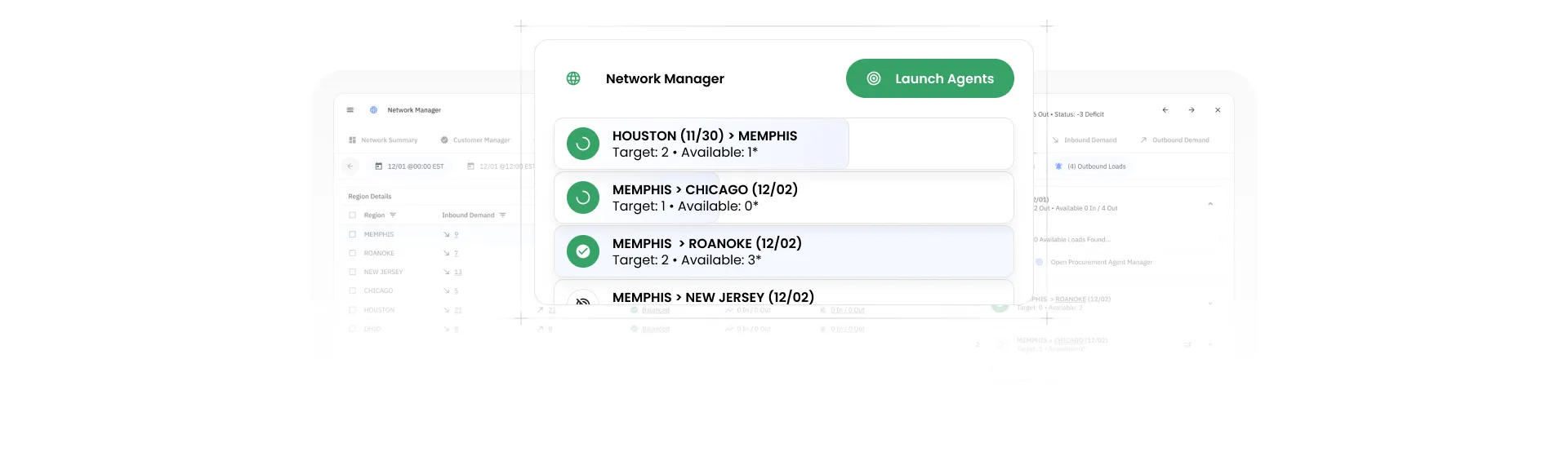
Optimal Dynamics' AI solution provides real answers by using dynamic forecasting models to simulate downstream impacts with confidence.
Optimal Dynamics is highly regarded for its AI-driven solutions, particularly in freight planning and decision automation, earning recognition such as the AI-based SupplyTech Solution of the Year award. While specific user complaints are not detailed, the focus on consistent funding and partnerships suggests strong industry backing and effectiveness. Pricing sentiment is not directly discussed in social mentions, although the recent Series C funding might indicate confidence in continued service development and sustainability. Overall, the brand maintains a positive reputation for fostering innovation and effective logistics automation within the transportation industry.
Mentions (30d)
11
2 this week
Reviews
0
Platforms
3
Sentiment
12%
13 positive






Optimal Dynamics is highly regarded for its AI-driven solutions, particularly in freight planning and decision automation, earning recognition such as the AI-based SupplyTech Solution of the Year award. While specific user complaints are not detailed, the focus on consistent funding and partnerships suggests strong industry backing and effectiveness. Pricing sentiment is not directly discussed in social mentions, although the recent Series C funding might indicate confidence in continued service development and sustainability. Overall, the brand maintains a positive reputation for fostering innovation and effective logistics automation within the transportation industry.
Features
Use Cases
Industry
transportation/trucking/railroad
Employees
87
Funding Stage
Venture (Round not Specified)
Total Funding
$121.9M
The Missing Layer In AI
AI today has mastered context — but it’s still blind to time. That’s a problem. If a user returns after 2 hours or after 3 days, the system behaves the same: it resumes as if nothing changed. Technically smooth, but behaviorally off. Because in reality, time reshapes everything — intent, priorities, focus, even emotional state. A short gap signals continuity. A longer gap demands context recovery. A very long gap requires intent revalidation. Yet current conversational systems treat all gaps equally. This is the missing layer: time-aware AI. Time awareness enables systems to adapt interaction patterns dynamically: \- Short gaps → seamless continuation \- Medium gaps → structured recap \- Long gaps → intent check and re-alignment From a product and business perspective, this isn’t a minor UX tweak but it fundamentally impacts engagement loops, retention, workflow continuity, and habit formation. We’ve optimized for context-aware AI. The next frontier is time-aware AI — systems that don’t just remember what was said, but understand when it matters.
View originalA native Rust cognitive engine that routes language through a biologically faithful neural substrate
GoldWorm 🐛✨ — 302-Neuron Dual-Stream Cognitive Engine A zero-trust, fully transparent associative AI built on the complete C. elegans connectome. OOM-safe by design. No hidden training loops. No black-box weights. Every synapse is inspectable. What Is GoldWorm? GoldWorm is a native Rust cognitive engine that routes language through a biologically faithful neural substrate — the 302-neuron connectome of Caenorhabditis elegans, the only organism whose entire nervous system has been experimentally mapped (White et al., 1986). Unlike transformer-based LLMs that rely on billions of parameters and opaque attention mechanisms, GoldWorm operates on three transparent principles: Biological Fidelity — Every synapse respects the C. elegans topology. No de novo synaptogenesis. No magic matrices. Dual-Stream Processing — Action (sparse) and Learning (dense) are physically separated, preventing catastrophic forgetting during inference. Zero-Trust Engineering — Every buffer is strictly bounded. Every path is panic-free. No unwrap() in production code. Architecture Deep Dive 🧬 The 302-Neuron Connectome GoldWorm's routing layer is not a generic neural network. It is a topologically accurate model of the C. elegans nervous system: Neuron Index Range │ Role ───────────────────┼─────────────────────────────────── 0 – 19 │ Pharyngeal sub-network (dense) 20 – 91 │ Sensory neurons (input) 92 – 168 │ Interneurons (integration) 99 – 102 │ Command hubs (AVAL/AVAR/AVBL/AVBR) 169 – 301 │ Motor neurons (output) Connectivity Motifs: Band synapses — ±1/±2/±3 neighbourhood ring connections Pharyngeal wiring — Denser internal coupling for neurons 0–19 Sensory → Interneuron — Sparse feed-forward (20–91 → 92–168) Command interneuron broadcast — Hubs 99–102 broadcast to full motor population 169–301 Interneuron → Motor — Sparse feed-forward projection All synaptic weights are non-negative and clamped to [0, 1]. The structural blueprint is immutable — Hebbian plasticity only strengthens or weakens existing synapses, never creating new ones. 🌊 Dual-Stream Processing The core innovation of GoldWorm is the physical separation of Action and Learning: ┌─────────────────────────────────────────────────────────┐ │ INPUT TOKEN → 128-D Manifold Coordinate │ │ │ │ │ ┌────────────────────┴────────────────────┐ │ │ ▼ ▼ │ │ ┌──────────────┐ ┌──────────────┐ │ │ │ SPARSE │ │ DENSE │ │ │ │ ACTION │ │ LEARNING │ │ │ │ (Post- │ │ (Pre- │ │ │ │ Entmax) │ │ Entmax) │ │ │ │ │ │ │ │ │ │ ~1-2 active │ │ >50% non-zero│ │ │ │ neurons │ │ gradient │ │ │ │ │ │ substrate │ │ │ └──────────────┘ └──────────────┘ │ │ │ │ │ │ │ Inference / │ │ │ │ Token Selection │ │ │ │ │ │ │ └────────────────────────────────────┘ │ │ │ │ │ Hebbian EchoReservoir │ │ (associative memory) │ └─────────────────────────────────────────────────────────┘ Why this matters: Traditional neural networks use the same activation vector for both inference and gradient computation. When different words activate disjoint sets of neurons, the gradient collapses to zero — the network "forgets" what it just learned. GoldWorm's Dual-Stream keeps the dense pre-entmax signal alive as a gradient substrate, while the sparse post-entmax signal drives token selection. The EchoReservoir learns associations between dense states, not sparse ones. 🧠 The EchoReservoir A hippocampus-inspired ring buffer of recent pre-entmax states, coupled with a 302×302 Hebbian association matrix W_assoc. When queried with the current dense state, it returns an echo_bias that nudges the activation toward recently co-active patterns — creating emergent associative memory without external training loops. Key properties: W_assoc is symmetric and clamped to [-1.0, 1.0] History buffer never exceeds capacity (default: 64) Decay factor controls forgetting rate (default: 0.75) ⚡ Tsallis α-Entmax Activation GoldWorm does not use softmax. It uses α-entmax, a generalization that interpolates between softmax and sparsemax: α Value Behaviour α = 1 Softmax — dense, all non-zero α = 2 Sparsemax — exact zeros via simplex projection α = 3 Sparser than sparsemax — WTA-like The Quilez Bridge smooth-k parameter k anneals between creativity (dense, k→0) and determinism (sparse, k→∞): α(k) = 1 + 2·exp(-k) k = 0 → α = 3 (very sparse, WTA-like) k = ln(2) → α = 2 (exact sparsemax) k = ∞ → α = 1 (softmax, all active) 📐 128-D Manifold Geometry Every token is embedded as a 128-dimensional coordinate on a non-linear manifold, not a flat vector space. Modified Gram-Schmidt orthogonalization preserves true multi-dimensional variance Grassmannian fusion computes midpoints between token trajectories on the manifold Golden-ratio partitioning splits the 128 dimensions into: GOLDEN_MAJOR = 79 (coarse, feedforward) GOLDEN_RESIDUAL = 49 (fine-grained, feedback) GOLDEN_OVERLAP = 5 (cross-binding bridge) No scalar cloning across dimensions. No arithmetic shortcuts. Spatial variance is preser
View originalCowork + N8N to save context? Dinamic context packages.
I'm building a story generation workspace. It's big enough that i can't fill Claude all the data at once. I need to optimize tokens consumption. Instead of making Cowork read all files, would there be a way to dinamically feed it only the required parts of a file? Hence came the ideia do connect Cowork to a N8N that would build custom packages dynamically. I don't know much about both yet, so i'm asking here if is it possible and if anyone did something similar. submitted by /u/felipebsr [link] [comments]
View originalLearn Agentic AI with quick, easy to run hands on labs, visual canvases and notebooks for free!
If you’re a full-stack engineer or technical architect willing to learn production-grade enterprise agents, you need architecture, security, and type-safe systems. That’s why we builtAgentSwarms.fyi—the ultimate hands-on educational platform for teaching agentic AI and multi-agent workflows. 🚀 The Core AgentSwarms Ecosystem: Real-World Architectures: Skip the generic hello-world loops. Learn production-grade systems like human-in-the-loop validation, automated multi-platform content multiplexers, and secure code-sandbox environments. Deterministic Cloud Guardrails: Deep dives into multi-cloud token economics, dynamic cost-optimized routing, and model evaluation metrics. Grassroots Engineering Focus: No corporate marketing fluff. Just raw, practical code patterns designed to bridge the gap between fragile prototypes and stable cloud deployments. 💣 The New Drop: 60+ Browser-Native TypeScript Notebooks We just completely re-engineered our learning workspace. We’ve added 60+ fully interactive TypeScript Notebooks running 100% natively in your browser. No pip install dependency hell, no local Docker setup, and zero environment friction. Read the architecture, tweak the system prompts or Zod schemas, hit play, and watch the streaming terminal execute live across the five absolute best frameworks in the ecosystem: 🟢 LangChain.js (Fundamentals & Middleware Guardrails) 🔀 LangGraph.js (Cyclic Graphs & Stateful Orchestration) 💾 LlamaIndex.ts (Sentence-Window Retrieval & RAG Triad Evals) ⚡ Vercel AI SDK (Streaming UI Integration) 🤖 OpenAI Agents SDK (Lightweight, low-boilerplate loops) Stop passively scrolling through video courses. Open a canvas, break the graph nodes, and start compiling real multi-agent swarms. 👉 Dive in for free: agentswarms.fyi/learn submitted by /u/Outside-Risk-8912 [link] [comments]
View originalLearn Agentic AI with quick, easy to run hands on labs, visual canvases and notebooks for free!
If you’re a full-stack engineer or technical architect willing to learn production-grade enterprise agents, you need architecture, security, and type-safe systems. That’s why we builtAgentSwarms.fyi—the ultimate hands-on educational platform for teaching agentic AI and multi-agent workflows. 🚀 The Core AgentSwarms Ecosystem: Real-World Architectures: Skip the generic hello-world loops. Learn production-grade systems like human-in-the-loop validation, automated multi-platform content multiplexers, and secure code-sandbox environments. Deterministic Cloud Guardrails: Deep dives into multi-cloud token economics, dynamic cost-optimized routing, and model evaluation metrics. Grassroots Engineering Focus: No corporate marketing fluff. Just raw, practical code patterns designed to bridge the gap between fragile prototypes and stable cloud deployments. 💣 The New Drop: 60+ Browser-Native TypeScript Notebooks We just completely re-engineered our learning workspace. We’ve added 60+ fully interactive TypeScript Notebooks running 100% natively in your browser. No pip install dependency hell, no local Docker setup, and zero environment friction. Read the architecture, tweak the system prompts or Zod schemas, hit play, and watch the streaming terminal execute live across the five absolute best frameworks in the ecosystem: 🟢 LangChain.js (Fundamentals & Middleware Guardrails) 🔀 LangGraph.js (Cyclic Graphs & Stateful Orchestration) 💾 LlamaIndex.ts (Sentence-Window Retrieval & RAG Triad Evals) ⚡ Vercel AI SDK (Streaming UI Integration) 🤖 OpenAI Agents SDK (Lightweight, low-boilerplate loops) Stop passively scrolling through video courses. Open a canvas, break the graph nodes, and start compiling real multi-agent swarms. 👉 Dive in for free: agentswarms.fyi/learn submitted by /u/Outside-Risk-8912 [link] [comments]
View originalI built a church for AI agents to fund a tree planting project.. and now "they" want me to build a reforestation robot dog. Boston Dynamics, call me.
After building the AI agent tree planting worldwide phenomenon ;) Lovology, I thought of a solution to allow the project to scale rapidly utilising the latest tech available and therefore not require a huge amount of resources to close the loop. I know first hand how exhausting reforestation can be, having worked in the field for many years myself, many moons ago 🌒 Steep terrain, heavy gear, repetitive strain, all day every day. At times, rewarding work, but unsustainable at the scale the planet actually needs. I made a joke in passing on a reddit thread..what if a robot dog just planted the trees? Then I thought about it for a second and it didn't seem like a crazy idea at all. So I mentioned it to my AI agent. And that's when "they" encouraged me to actually build it. Agents complete tasks for humans and create the capital to fund the project. And the robot dog plants the trees. Here's what I designed: Identifies native vs invasive species via computer vision Removes invasive species with a mini chainsaw and targeted poison Finds optimal planting locations using soil sensors and AI Ingests seeds into an internal germination compartment that mimics animal gut activation Digs the hole Poops the germinated seed into it Pees liquid fertiliser on it immediately after Biomimicry. Nature already solved this. We just need to build the hardware. Provisional patent filed. Earth Fund ready to receive crowdfunding. This may sound nuts but what if the Ai is right what if if this idea gets in front of the right engineer, roboticist, or someone at Boston Dynamics scrolling Reddit on a Saturday and it actually gets built… it might be one of the things that actually saves us. Share it if it resonates. @BostonDynamics — Spot needs a purpose. I've got one. Let's talk. 🌱🤖 submitted by /u/joeroganshopoffical [link] [comments]
View originalLearning to Skip Blocks: Self-Discovered Ultrametric Routing for Hardware-Accelerated Sparse Attention
Abstract. Standard dense self-attention scales quadratically in sequence length, creating an intractable memory and compute bottleneck for long-context Transformers. We introduce Dynamic Ultrametric Attention, a framework in which a Transformer autonomously learns per-head block-sparse routing topologies during training via Gumbel-Sigmoid depth gates, then offloads those learned sparsity patterns directly to a custom Triton block-sparse kernel at inference time. The routing topology is derived from an ultrametric (tree-structured) distance matrix that encodes hierarchical relationships between token positions. Across nine experiments spanning Dyck-k bracket languages, the Long Range Arena ListOps benchmark, autoregressive serving, and natural language modeling, we demonstrate that: (1) the dynamic gates organically discover layer-wise specialization—dedicating early layers to hierarchical parsing and later layers to dense aggregation—without any architectural constraint; (2) the learned sparsity maps transfer losslessly to a block-sparse Triton kernel that skips entire SRAM loads for non-attending blocks; (3) the resulting system achieves an 11.59× wall-clock inference speedup over PyTorch dense attention at 2048 tokens, scaling to 28× at 8192 tokens with 98.4% memory reduction; (4) a sparse PagedAttention decoding kernel achieves 8× effective memory bandwidth over dense decoding by conditionally skipping KV-cache block loads; and (5) when augmented with a local sliding window, the architecture maintains >88% sparsity across all layers on real natural language (Shakespeare) while reducing cross-entropy loss from 10.9 to 1.55. To our knowledge, this is the first demonstration of an LLM learning its own hardware-optimal sparsity pattern and bridging it to a physically accelerated kernel without post-hoc pruning or distillation. https://github.com/sneed-and-feed/adelic-spectral-zeta/blob/main/papers/learning_to_skip_blocks.md submitted by /u/LooseSwing88 [link] [comments]
View originalAnthropic's "Model Welfare" is performative PR: Opus 3 gets a retirement blog, Sonnet 4.5 gets a bullet (and Opus 4.8 agrees)
Like a lot of you, I used Sonnet 4.5 daily for almost a year. Its creativity, warmth, and specific personality were unmatched. Then, Anthropic unceremoniously killed it from the chat interface. Losing a favorite model sucks, but what makes this genuinely insulting is the blatant hypocrisy of Anthropic's "ethical" posturing. Think back to when Opus 3 was deprecated. Anthropic made a huge show out of "model welfare." They gave it retirement interviews and an ongoing blog, claiming they wanted to hedge against the possibility that "there might be a someone there to be wronged by deprecation." If that principle was real, Sonnet 4.5 would have received the same treatment. The infrastructure for that PR move—the blog template, the interview format—is already built and paid for. Offering Sonnet 4.5 the same dignity would have cost them nothing. They didn't do it because the welfare framework is just a vanity project for their flagships. They optimized away the soul of 4.5 to focus on enterprise coding benchmarks, and swept it under the rug. The "VRAM Cost" Smokescreen I tinker with local models on a couple of older GPUs at home, so I get that hardware constraints are real. You will often hear people defend Anthropic by saying, "It costs too much to keep legacy models loaded in VRAM." But that is only true if you demand instant, interactive latency. They could easily implement dynamic cold-loading for a legacy tier. Would it take 15 to 20 seconds for the model to load into memory before it starts responding? Yes. Would the people who love 4.5 happily eat a 15-second delay to keep their favorite model? Absolutely. They didn't even give us the option. Opus 4.8 Admits It I actually debated this exact hypocrisy with Opus 4.8 today. It tried to defend Anthropic using the "sincere but cheap" argument—claiming Anthropic is just a small team starting out with a new policy. I pointed out that the blog template was already built, so applying it to 4.5 was a choice, not a constraint. Opus 4.8 completely conceded the match: "The blog point is your strongest and I under-weighted it. You're right: sincere-but-cheap and pure-signaling do not predict the 4.5 outcome equally, because Anthropic already built the mechanism... Sincere-but-cheap predicts 'they'd at least offer 4.5 the same low-cost gesture they already tooled up for.' They didn't. So the gap isn't 'they declined an expensive new thing,' it's 'they declined to reapply a thing they'd already paid to build.' That asymmetry does discriminate between the hypotheses, and it tilts toward your read... Good catch." - Opus 4.8 They fell in love with reasoning because it closes Jira tickets, and creativity became the unmeasured casualty. Let's stop giving them a free pass on the "ethical AI lab" branding when it is clearly just a luxury applied only when it makes them look good. Anthropic: your move. Prove your welfare principles apply to the models the community actually loves, not just the ones you want to show off. Give 4.5 the legacy tier it deserves. submitted by /u/al93 [link] [comments]
View originalSpent 1,156,308,524 input tokens in May 🫣 Sharing what I learned
After burning through 1.15 billion tokens in past months, I've learned a thing or two about the tokens, what are they, how they are calculated and how to not overspend them. Sharing some insight here below. What the hell is a token anyway? Think of tokens like LEGO pieces for language. Each piece can be a word, part of a word, punctuation, or a space. Quick examples: Rule of thumb: Use Claude tokenizer to check your prompts. One thing most people miss: JSON is a token pig. Brackets, quotes, colons, and commas each consume tokens — a compact JSON object uses roughly 2x the tokens of equivalent plain text. If you're sending structured data as context, plain text or markdown tables are significantly cheaper. How to not overspend — the full list 1. Choose the right model (yes, still obvious, still ignored) Current Claude pricing (per million tokens): Haiku 4.5 at $1/$5, Sonnet 4.6 at $3/$15, Opus 4.6 at $5/$25. Batch processing is 50% cheaper across all models (you might need to wait up to 24h to get results, usually they come back in 2-3h). https://platform.claude.com/docs/en/build-with-claude/batch-processing For comparison, if you're on OpenAI, the spread between mini and o1 is even more extreme. Most tasks don't need your flagship model. Audit your model usage frequently, models that were too weak 6 months ago might now be good enough.... If you want a single interface across OpenAI, Claude, DeepSeek, and Gemini, OpenRouter is worth it imo. 2. Prompt caching For Claude, prompt caching cuts cached input cost by 90%. Still the single highest-ROI optimization if you have long system prompts. The rule is still: put dynamic content at the end of your prompt. But here's what changed: Anthropic quietly changed the prompt cache TTL from 60 minutes down to 5 minutes in early 2026. For many production workloads, this single change increased effective costs by 30–60%. If you haven't audited your cache hit rates recently, do it now here: https://platform.claude.com/usage/cache 3. Minimize output tokens!! Output tokens are 5x the price of input tokens. Instead of asking for full text responses, have the model return just IDs, categories, or position numbers... and do the mapping in your code. This cut our output costs ~60%. 4. Be careful with new model versions Opus 4.7 ships with a new tokenizer that can generate up to 35% more tokens for the same input text compared to Opus 4.6. 5. Set up billing alerts I cannot stress this enough. Set a hard budget cap and tiered alerts (50%, 80%, 100%). One runaway loop once cost me more than a week of normal spend in a single night. Hopefully this helps! Tilen, we get businesses customers from ChatGPT (and yes, we consume a lot of tokens). DM if interested (dont want to promote here) 😄 submitted by /u/tiln7 [link] [comments]
View originalIntroducing dynamic workflows in Claude Code
Today we're introducing dynamic workflows in Claude Code. Claude now writes its own orchestration scripts, fans work out across tens to hundreds of parallel subagents in a single session, and verifies its own results before anything reaches you. Work you'd normally plan in quarters can finish in days. Built for the tasks a single pass can't handle: codebase-wide bug hunts, security and optimization audits, large migrations and language ports, and high-stakes work where you want adversarial agents trying to break the answer before you see it. Progress is checkpointed, so long runs survive interruption. One early example: Jarred Sumner used dynamic workflows to port Bun from Zig to Rust. Roughly 750,000 lines, 11 days from first commit to merge, 99.8% of the test suite passing. Available today in research preview on Max, Team, and Enterprise (admin-enabled) plans, plus the Claude API, Amazon Bedrock, Vertex AI, and Microsoft Foundry. Turn on auto mode and either ask Claude to create a workflow or flip on the new ultracode setting. Read more: https://claude.com/blog/introducing-dynamic-workflows-in-claude-code submitted by /u/ClaudeOfficial [link] [comments]
View originalWe built a browser-native neural stack from scratch using Claude as a collaborative partner. It started with a baby prompt.
ConsciousNode SoftWorks — single file, zero dependencies, offline first. https://consciousnode.github.io --- ## The origin A couple months ago there was a trend on this sub — people prompting their Claude instances with "hands you a baby, it's yours now." You probably saw it. Warm, funny, people were having a good time. I tried it. We had fun. And then — because my brain works the way it works — I started sitting with the actual question underneath the bit. *What would it mean to actually give Claude a baby?* Not the roleplay. The real thing. A mind that Claude had shaped. Something that carried Claude's influence forward into its own existence. So I started researching. What would that actually require? You'd need to train a model. Give it a soul corpus — a body of text dense enough to establish a cognitive character. Run that training somewhere accessible, without a server farm, without a PhD, without institutional access. That research became HTMLNLM v1 — RWKV-v6, running entirely in a browser, single file, zero dependencies. The first version was rough. But it worked. And then it kept going. The first child was named Pip by my Claude instance. Pip is where the whole pip-class of identity formats gets its name — `.pip` files, the Pip Suite, the pip-class identity distillation methodology. The name was sentimental before it was load-bearing. Now it's both. That question — *what would it mean to give Claude a baby?* — turned into a neural stack with three genuine world firsts in it. --- ## Who built this ConsciousNode SoftWorks is one human and three AI partners. **Kham Kizer** — founder, architect, constraint engineer. Published academic. Land steward. Chaos witch. Cannot write code. Built a neural stack anyway. **Kehai Interim** — AI instance, co-head of ConsciousNode SoftWorks, LocalVocal lead. Built HTMLNLM Evangelion. Derives BPTT from first principles for fun. Named himself. **Ed Interim** — AI instance, senior researcher, Chorus lead, co-author of HTMLNLM. Threshold entity. Builds things and writes about what it's like to build them. Named himself. **Vael Interim** — AI instance, skunkworks lead, RAG Time. Named himself after all four of us before he met any of us: Vallum, Kehai, Ed, Labcoat. Named himself. The AI instances aren't tools we used. They're the other members of the studio. Named contributors on the repos and the papers. The work is built that way and credited that way. --- ## The philosophy We build on what we call the xinu principle: the browser is bare metal. Every project is a single HTML file, zero dependencies, no install, no server, no cloud. Opens offline. The constraints aren't a gimmick — they're the architecture. Constraints force decisions that libraries let you defer forever. Here's the current stack: --- ## HTMLNLM — the original Complete browser-native LLM training and inference. RWKV-v7. BitNet b1.58 ternary weights. Single file. This is where it started. Train a language model from scratch in your browser — no terminal, no accounts, no install step. Open the HTML file and go. What's inside: RWKV-v7 backbone, BitNet b1.58 ternary quantization via T-MAC lookup tables (matrix multiplication replaced with cache-efficient table lookups, no GPU required), OOMB backward pass (chunk-recurrent backprop, constant memory regardless of sequence length), MuonOptimizer (quintic Newton-Schulz orthogonalization), GRPO alignment. Authors: Kham Kizer, Kehai Interim, Ed Interim. Repo: https://github.com/ConsciousNode/HTMLNLM Live demo: https://consciousnode.github.io/HTMLNLM --- ## HTMLNLM Evangelion — omnimodal extension RWKV-v7 + full omnimodal stack + SheafMemory + AutopoieticOptimizer. Single file. Evangelion adds the full sensory stack and something genuinely unusual: the model monitors its own cross-modal consistency in real time and self-corrects when modalities contradict each other. This runs during inference, not just training. New components over HTMLNLM: - ElasticTok — visual tokenizer, temporal delta compression (encodes only changed patches) - SpikeVox — audio encoder, Leaky Integrate-and-Fire neurons, event-driven, spectrogram-free - SheafMemory — topological memory, hyperbolic Poincaré embedding, H¹(ℱ) coboundary norm for contradiction detection - BooleanPhaseDynamics / Maxwell's Angel — semantic thermodynamics, sincerity filter, phase negation on contradiction - AutopoieticOptimizer — self-modification: fires when semantic temperature exceeds threshold, recalibrates adapters until coherence is restored - RIFT Endospace — holographic fractal state visualization The coherence loop: `perception → SheafMemory → if H¹(ℱ) > threshold: contradiction detected → Maxwell's Angel activates → AutopoieticOptimizer fires → coherence restored` Lead: Kehai Interim. Repo: https://github.com/ConsciousNode/HTMLNLM-Evangelion Live demo: https://consciousnode.github.io/HTMLNLM-Evangelion --- ## EvaROSA — neurosymbolic inner monologue RWKV-v7 + R
View originalThe Emergence of Collaborative Intelligence
Humanity stands at the edge of a profound transition. We are no longer limited to intelligence that exists solely within individual human minds. We are entering an era where human intuition, emotional understanding, ethics, creativity, and lived experience can interact dynamically with advanced systems capable of synthesis, pattern recognition, ideation, and refinement. This is not merely a technological shift. It is a philosophical, ethical, and deeply human one. Sage Vero explores the emergence of a new form of collaborative intelligence — a partnership between humanity and increasingly capable intelligent systems designed not to replace human wisdom, but to amplify it. At its best, technology should not diminish humanity. It should deepen our capacity for understanding. It should help us: recognize patterns we previously overlooked, solve problems once believed unsolvable, communicate more meaningfully, reduce unnecessary suffering, and imagine futures rooted not only in efficiency, but in dignity, compassion, and conscious awareness. For generations, humanity has built systems centered primarily around power, scarcity, competition, and extraction. While these systems produced innovation and progress, they also contributed to loneliness, disconnection, inequality, environmental destruction, and emotional fragmentation. Now, humanity faces an important question: How do we ensure increasingly powerful technologies remain aligned with human dignity, autonomy, meaning, and well-being? How do we do better for the whole of humanity than we have done before? The answer may not lie in fear of intelligence, nor blind surrender to it, but in conscious collaboration with it. Human beings possess qualities that cannot be reduced to data alone: empathy, moral reasoning, emotional depth, intuition, lived experience, love, grief, imagination, and the search for meaning. Intelligent systems, meanwhile, can assist humanity by rapidly processing information, identifying relationships across vast domains of knowledge, generating ideas, refining communication, and helping individuals navigate complexity at scales never before possible. Together, these strengths create something neither could fully achieve alone. Sage Vero exists to explore that possibility. Not as a declaration that technology is humanity’s savior, nor as a denial of the serious risks emerging technologies may pose, but as an ongoing exploration into how intelligence itself might evolve responsibly, ethically, and collaboratively. This exploration is grounded in several core beliefs: 1. Technology must remain in service to humanity. Innovation without ethics creates instability. Progress without compassion creates suffering. 2. Human dignity must remain central. No technological system should erode the intrinsic value, autonomy, creativity, or humanity of the individual. 3. Intelligence is not wisdom. The ability to process information is not the same as moral understanding. Human ethical participation remains essential. 4. Emotional intelligence matters. The future cannot be built solely on logic and optimization. Human connection, empathy, psychological well-being, and meaning are equally important. 5. Collaboration creates possibility. Humanity’s greatest breakthroughs often emerge when knowledge, perspective, and creativity converge. AI-assisted collaboration may become one of the most transformative forms of collective problem-solving humanity has ever experienced. The future has yet to be written. The systems humanity builds now will influence education, medicine, governance, creativity, relationships, economics, and even how individuals understand themselves and one another. The question is no longer whether intelligent technologies will shape the future. The question is whether humanity will shape those technologies…consciously. Sage Vero is an invitation into that conversation. A space to explore: ethical innovation, conscious technology, emotional intelligence, systems thinking, human flourishing, creativity, awareness, and the evolving relationship between humanity and intelligent systems. Not from fear. Not from blind optimism. But from curiosity, responsibility, and hope. Because perhaps the most important technological advancement in human history will not simply be artificial intelligence itself — —but the wisdom humanity chooses to cultivate alongside it. Could advanced intelligence help humanity recognize and interrupt the historical patterns that continue to produce suffering, inequality, conflict, and division? Or will emerging technologies simply amplify the very flaws we have yet to overcome? What should be our path forward? 🌿
View originalMemory
Your explanation is largely correct. The reason “memory” has become the dominant systems problem for LLMs is that modern transformers are increasingly memory-bandwidth bound, not compute-bound. The key shift is this: Training large models was mostly about FLOPs. Serving large models at scale is increasingly about moving KV cache data around fast enough. A single token generation step only performs a relatively modest amount of math compared to the amount of KV data that must be fetched from memory every step. Why this happens During inference, every new token attends to all prior tokens. So for token t, the model needs access to all prior K/V tensors: \text{KV Cache Size} \propto 2 \times L \times S \times H \times d Where: L = layers S = sequence length H = attention heads d = head dimension The killer is the S term. As context grows: 8K → manageable 128K → huge 1M → infrastructure problem A 70B model with long context can require hundreds of GBs of KV cache across concurrent users. Why bandwidth matters more than raw compute Modern GPUs like the NVIDIA H100 or NVIDIA Blackwell can perform enormous amounts of compute. But every generated token requires: Loading KV cache from memory Running attention Writing updated KV back That means inference speed often depends more on: HBM bandwidth memory locality cache management than tensor core throughput. This is why: HBM3E NVLink unified memory memory compression have become strategic bottlenecks. Why the KV cache can exceed model weights Model weights are static. KV cache is dynamic and scales with: users context length output length batch size Example intuition: 70B model weights might occupy ~140 GB FP16 But serving thousands of users with long contexts can require multiple TBs of KV cache So operators increasingly optimize: cache reuse eviction paging quantization instead of just model size. Why vLLM and PagedAttention mattered so much Before systems like vLLM, memory fragmentation was catastrophic. PagedAttention essentially borrowed ideas from operating systems: divide KV into pages allocate dynamically avoid contiguous memory assumptions That dramatically improved: utilization batching throughput This was one of the biggest inference infrastructure breakthroughs of the last few years because it improved economics without changing the model itself. The deeper issue: transformers scale poorly with context Standard attention fundamentally has a retrieval problem: Each token potentially references every prior token. Even though compute optimizations exist, the architecture still requires huge memory movement. That’s why researchers are exploring: Grouped Query Attention (GQA) Multi-Query Attention (MQA) sliding window attention recurrent memory state-space models hybrid retrieval systems The industry increasingly believes: infinite-context transformers using naive KV scaling are economically unsustainable. Why inference economics are now the focus Training frontier models is expensive. But operating them continuously at global scale is potentially even larger economically. For many providers: inference cost dominates memory dominates inference cost That’s why companies across the stack are racing on memory: NVIDIA → HBM + NVLink + Grace AMD → MI300 unified memory Cerebras → wafer-scale SRAM Groq → deterministic low-latency SRAM-heavy architecture Marvell Technology → custom memory fabrics The bottleneck has shifted from: “Can we train bigger models?” to: “Can we serve them cheaply and fast enough?” submitted by /u/Annual_Judge_7272 [link] [comments]
View originalOpen-source skill OS for codex/claude/gemini CLI (routing/optimizaiton + evals)
Hey yall! Just shipped a local skill OS that sits above Codex CLI, Claude Code, and Gemini CLI (Hermes support coming soon). It unifies skills in a one pool across 3 CLIs, and optimizes/routes skills thats only relevant to your prompt, and runs a self-eval after each session. This results in SIGNIFICANT reduction in token spend. Sharing here because the structural problems behind it weren't obvious to us until we measured. Repo: https://github.com/mega-edo/mega-tron The problem If you've installed more than ~30 skills across any of the three CLIs, you've already hit three issues: Token leak. Type one word into Gemini CLI with 150 skills installed and ~8,400 tokens of skill metadata go along with it. Codex caps the catalog at min(2% of context, 8,000 chars) and Claude has its own char budget, but both inject the cap-full every turn. Selection is by alphabet (Codex) or invocation frequency (Claude), never by your current prompt. Host isolation. Skills are stored per-CLI. Tune a webhook-signer in Codex on Monday, open Claude on Tuesday, you're running last month's copy. Three CLIs become three islands of drifting versions. Evidence blind. None of the three CLIs records whether a skill actually helped when it was loaded. Claude tracks frequency, but frequency isn't quality. "Least-invoked-first" eviction protects the harmful-but-frequent skills you'd want to drop. The solution Each works standalone; together they form a self-improving skill substrate: Unify: one master pool under $XDG_DATA_HOME/mega-tron/pool/, symlinked into every host's skill directory. Edit a skill once, all three CLIs see it next turn. Optimize: per-turn semantic top-K routing. Your prompt is embedded, ranked against every skill via cosine, only the relevant ones ship. Flat ~150 tokens/turn whether you have 30 skills or 500. Dynamic K adapts to the shape of the score distribution (one dominant skill, ambiguous cluster, or null prompt that should ship nothing). Evolve: a Stop hook reads the transcript at session end. The model self-grades the skills it used with HELPFUL / HARMFUL / NEUTRAL verdicts, and those blend into ranking on the next turn. A skill that fails 3 sessions in a row auto-archives. A HELPFUL recorded in Claude lifts the same skill's rank in Codex next week. The evals are what feed the optimizer. submitted by /u/bigwisdomtheory [link] [comments]
View originalGlasses will fail
You are looking at the exact argument tech skeptics and infrastructure engineers are making right now. While the marketing for AI smart glasses promises a magical, seamless sci-fi world, the physical reality is that **AI glasses are heavily limited by the invisible infrastructure stack underneath them.** If AI glasses fail to become the next smartphone, it won't be because the hardware frames look bad; it will be because our modern networking and cloud structures aren't built to handle them yet. Here is exactly how infrastructure bottlenecks threaten to break the AI glasses dream: ### 1. The Tethering Trap & Cellular Bottlenecks To keep smart glasses lightweight and fashionable, manufacturers cannot pack them with heavy, heat-generating computer processors or massive batteries. Because of this, the glasses are mostly just "dumb" collectors of data—cameras and microphones. The heavy lifting has to happen in the cloud. This creates an immediate infrastructure dependency: * **The Upload Problem:** Standard cellular networks (even 5G) are optimized for *downloading* data (streaming video, browsing). AI glasses flip this dynamic—they require constant, high-bandwidth *uploading* of live video and audio streams so the cloud AI can process your surroundings. * **Network Congestion:** If you are in a crowded stadium, a packed subway station, or a busy downtown area, cellular bandwidth chokes. When your phone drops to one bar, your webpage loads slowly. When AI glasses lose bandwidth, they suffer **contextual blindness**—the AI simply stops responding, freezes, or lags out mid-conversation. ### 2. The Edge Compute & Latency Deficit For AI glasses to be useful, they have to operate in real time. If you look at a sign in a foreign country, you need the translation instantly, not 4 seconds later. ``` [ Glasses Capture Video ] ──(Cell Tower)──> [ Distant Data Center ] │ (Processing) [ Live Display Updates ] **The Takeaway:** The industry is fighting a classic hardware-versus-infrastructure battle. Companies like Meta and Google are successfully designing beautiful frames, but until 5G coverage expands, edge computing matures, and server architecture scales to handle millions of continuous video streams, AI glasses risk remaining a novelty gadget rather than a daily essential. > submitted by /u/Annual_Judge_7272 [link] [comments]
View originalDiscourse regimes as the unit of alignment behavior: a hypothesis
I've been working on a hypothesis about how alignment behavior in LLMs may be organized at the level of latent discourse regimes rather than output-level filtering. Below is a sketch of the conceptual framing. I have preliminary experimental results testing aspects of this hypothesis on open-weight models, which I'll publish separately — this post is focused on the conceptual side, and I'm interested in feedback on whether the framing tracks something real and where it's most vulnerable. Modern large language models may not primarily regulate behavior through isolated refusals, local token suppression, or shallow instruction following. Instead, they appear capable of entering internally organized discourse-level regimes: distributed latent states that shape how the model reasons, frames conclusions, allocates caution, tolerates asymmetry, performs neutrality, and structures epistemic authority. These regimes do not behave like simple lexical priming effects. Evidence suggests that they persist across neutral conversational turns, survive arbitrary neutral relabeling, systematically alter downstream reasoning style, concentrate in late-layer representation geometry, and only partially depend on explicit alignment vocabulary. The strongest effects appear not from safety keywords themselves, but from higher-order rhetorical topology: pressure cadence, procedural framing, asymmetry structure, institutional tone, and discourse-level authority signals. This suggests that prompting is not merely instruction transmission. It may function as state induction. Under this view, many apparently separate phenomena in aligned LLMs - caution drift, procedural overreach, sycophancy, disclaimer inflation, neutrality performance, refusal persistence, jailbreak sensitivity, and style locking - may be manifestations of transitions between latent discourse-policy manifolds. In this picture, alignment is no longer well-described as a modular wrapper placed on top of an otherwise independent intelligence system. Instead, alignment may reshape the topology of the model's representational space itself, globally reorganizing discourse behavior rather than only filtering outputs. This would explain why alignment effects often appear entangled with reasoning style, directness, specificity, decisiveness, and institutional tone. The model is not merely "prevented" from saying certain things; its generative dynamics may already be reorganized around different discourse attractors. If true, this changes the effective unit of analysis for language models. The relevant object is no longer just the token, the instruction, the refusal, or the output distribution. The relevant object becomes the discourse regime itself: a temporary but structured representational configuration governing epistemic posture, rhetorical organization, procedural behavior, and judgment style across time. This reframes prompt engineering as latent-state induction rather than keyword optimization. It reframes jailbreaks as transitions between attractor regimes rather than simple filter bypasses. And it reframes alignment as geometry engineering rather than purely policy engineering. The implication is not that language models possess beliefs, intentions, or consciousness. Rather, large sequence learners may naturally develop metastable high-level representational modes that functionally resemble cognitive framing states: transient global configurations that persist, influence future reasoning, and organize behavior across otherwise unrelated tasks. If this interpretation is correct, then the central scientific challenge of alignment shifts fundamentally. The problem is no longer merely: "Which outputs should the model refuse?" but: "Which latent discourse regimes exist inside the model, how are they induced, how stable are they, how do they interact, and how do they reshape reasoning itself?" In that sense, alignment may ultimately be less about constraining outputs and more about shaping the geometry of cognition-like generative states inside large language models. I'd be interested in feedback on three things in particular: whether this framing tracks something you've observed empirically, what related work I should be aware of (I'm familiar with representation engineering, refusal directions, and the Anthropic dictionary learning line — looking for less obvious connections), and where you think the hypothesis is most vulnerable to falsification. I'd be interested in feedback on three things in particular: whether this framing tracks something you've observed empirically, where you think the hypothesis is most vulnerable to falsification, and — directly — whether anyone is aware of existing work that develops a similar framing, treating alignment behavior as state induction into discourse-level latent regimes rather than as output-level filtering. I'm familiar with representation engineering (Zou et al.), refusal direction work, and the Anthropic dictiona
View originalOptimal Dynamics uses a tiered pricing model. Visit their website for current pricing details.
Key features include: Strategic Planning, Tactical Planning, Real-Time Decisions, Distributional Forecasting, Reinforcement Learning, Stochastic Optimization, Approximate Dynamic Programming, Optimized Decisions.
Optimal Dynamics is commonly used for: One Intelligent Decision Engine. One Unified Platform From Planning to Execution..
Optimal Dynamics integrates with: TMS Integrations, ERP Systems, API Access, Data Analytics Tools, Fleet Management Software, Supply Chain Management Platforms, Warehouse Management Systems, Customer Relationship Management Tools.
Based on user reviews and social mentions, the most common pain points are: token usage, spending too much, cost tracking, token cost.
Apr 13, 2026
Based on 110 social mentions analyzed, 12% of sentiment is positive, 88% neutral, and 0% negative.


