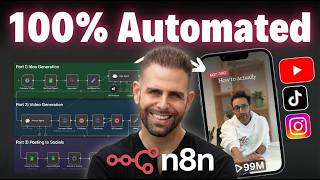
n8n is a workflow automation platform that uniquely combines AI capabilities with business process automation, giving technical teams the flexibility
n8n consistently receives high ratings in reviews, appreciated for its flexibility and ease of building automation workflows. While some users express frustration with setup complexities, the overall reception is positive, with many praising its open-source nature. Pricing sentiment appears favorable as n8n is often seen as a cost-effective alternative to competitors like Zapier. Overall, the platform enjoys a solid reputation among users who value customizable and efficient automation solutions.
Mentions (30d)
13
2 this week
Avg Rating
4.8
20 reviews
Platforms
2
Sentiment
23%
18 positive


n8n consistently receives high ratings in reviews, appreciated for its flexibility and ease of building automation workflows. While some users express frustration with setup complexities, the overall reception is positive, with many praising its open-source nature. Pricing sentiment appears favorable as n8n is often seen as a cost-effective alternative to competitors like Zapier. Overall, the platform enjoys a solid reputation among users who value customizable and efficient automation solutions.
Features
Use Cases
Industry
information technology & services
Employees
880
Funding Stage
Series C
Total Funding
$254.0M
20
npm packages
5
HuggingFace models
Easiest method for social media post automations?
hello, im not a dev or too technical, marketing bg, trying to automate in the easiest way possible.. we already use a scheduler (content studio) and was hoping to automate it with claude cowork/desktop or n8n whatever is easiest to setup and run. the goal is to have our system placed, integrate some core features/topics that should be the content inspiration for every week, repeated.. and adapted to each different platform.. any direction would be appreciated
View originalg2
What do you like best about n8n?The power it gave me to build AI workflows when other tools had limitations. Self hosting the community edition is a big + for my solo projects. There is a big of a learning curve but it is actually healthy as it helped me learn concepts like JSON, javascript, to really understand how integrations work Review collected by and hosted on G2.com.What do you dislike about n8n?So there are a couple of things that could be improved. For the AI integrations, we still aren't able to fully customize the settings of the AI models that we use. For example, GPT-5 has been released quite a while ago with new parameters like minimal reasoning or verbose, which are elements we still cannot edit when using OpenAI as a chat model. I must say that the cloud instances have very limited power and crash a lot when processing lots of data. Review collected by and hosted on G2.com.
What do you like best about n8n?It has a completely easy-to-use interface, and it’s very expandable. Review collected by and hosted on G2.com.What do you dislike about n8n?So far, I don’t have any dislikes about n8n. Review collected by and hosted on G2.com.
What do you like best about n8n?What I like most about n8n is that it gives me the power of a low-code tool without boxing me in. The visual workflow builder is easy to pick up, so getting my first automations live didn’t take long. At the same time, it still lets me build fairly complex logic when I need it. Once a workflow is set up, it just runs in the background and stays out of the way, which means it’s something I actually use regularly instead of only testing once and then forgetting about it. I also appreciate how many features and integrations are available out of the box. Connecting different tools is usually straightforward, and when something isn’t supported directly, calling custom APIs is still simple enough to do. The documentation and community support have been helpful as well, especially when I’m trying to tackle something a bit more advanced. Overall, n8n hits a sweet spot between ease of use, flexibility, and straightforward implementation and integration—something I haven’t really found in other automation platforms. Review collected by and hosted on G2.com.What do you dislike about n8n?I wouldn’t say I “dislike” n8n, but it does have a few rough edges. The learning curve can feel pretty steep at the beginning, especially if you’re not already comfortable with APIs or other automation tools. Some nodes and error messages come across as quite technical, so getting more complex workflows to run exactly the way you want can take some trial and error. Overall, performance and stability are solid, but I do occasionally run into small bugs or editor quirks that break my momentum. The documentation has improved a lot, which I appreciate, yet there are still times when I wish it included more real-world examples or clearer guidance for advanced use cases. None of this is a deal-breaker for me, but these are the main areas where I think n8n still has room to grow. Review collected by and hosted on G2.com.
What do you like best about n8n?The UI and UX are easy to understand. n8n is also an easy tool to use for automation, and it feels straightforward to get started with. Review collected by and hosted on G2.com.What do you dislike about n8n?From my side, there isn’t much to dislike about n8n. Review collected by and hosted on G2.com.
What do you like best about n8n?I like the advancement of n8n and its integrations. Review collected by and hosted on G2.com.What do you dislike about n8n?Sometimes it is very complicated to use if you do not have basic development knowledge or if you do not rely on the use of advanced AI like Claude Code. Review collected by and hosted on G2.com.
What do you like best about n8n?This tool changed everything for me and gave me full visibility on LinkedIn. It also helped me build and automate so many things across LinkedIn and other tools. Review collected by and hosted on G2.com.What do you dislike about n8n?For me, as a local host user, I couldn’t use MCP. Review collected by and hosted on G2.com.
What do you like best about n8n?n8n lets you connect apps, APIs, databases, and AI models into automated workflows using a visual node-based editor. Each node represents a step like triggering events, transforming data, or calling APIs.Unlike many tools, n8n doesn’t limit complex workflows or charge per step. This is why many AI engineers and companies prefer n8n. Review collected by and hosted on G2.com.What do you dislike about n8n?n8n has a steeper learning curve compared to tools like Zapier, workflows can become complex and harder to debug as they grow, self-hosting requires ongoing maintenance and infrastructure management, and some integrations are less polished or community-maintained. Review collected by and hosted on G2.com.
What do you like best about n8n?Having a database of templates to start working from Review collected by and hosted on G2.com.What do you dislike about n8n?Lack of explanation on what might have gone wrong Review collected by and hosted on G2.com.
What do you like best about n8n?The ability to be able to learn the tool Review collected by and hosted on G2.com.What do you dislike about n8n?It's uncomfortable to host locally, not impossible. Review collected by and hosted on G2.com.
What do you like best about n8n?easy workflow automation, visual drag-and-drop builder, flexible integrations, supports custom code when needed, open-source and self-hostable, good for connecting multiple tools Review collected by and hosted on G2.com.What do you dislike about n8n?UI can feel less polished, debugging workflows can be tricky, limited native integrations compared to larger platforms, performance can lag on complex flows, documentation gaps in some areas Review collected by and hosted on G2.com.
Efficient Image validation (IST vs Plan)
Background: Inventory check of a bookshelf via picture I have a picture of a bookshelf showing covers. Small overlaps but sufficient - the IST I have a directory with 30 book cover images - the PLAN I provided the picture to codex which also had access to the cover directory. It used 5.5 high. It took time - but it worked. 6 missing were recognized. But it did not feel efficient. First i want to automate via n8n or so. But then, is there a better way to do this kind of image processing? Thank you for ideas submitted by /u/Whole-Ad2077 [link] [comments]
View originalI built an operations dashboard for Claude, a single shared memory across Code, Cowork, and every AI Tool
I'm self-taught, have no programming background, and I run my entire work life through Claude, ChatGPT, and n8n automations. Over the past year, that grew into juggling a lot of sessions, and I kept hitting the same wall: Claude Cowork is great within a session, but Code doesn't know what I decided in there yesterday, and neither do my other AI tools. Each surface holds its own context, and I was the one manually carrying things between them. So I built Orbitagents.xyz to solve this for myself. A few things it does: Shared memory across every Claude surface: Code, Cowork, chat, and scheduled agents all log what they did automatically. Any new session can pull that context back in, so Claude already knows what's been decided elsewhere. It's not just a flat memory dump either, facts get a trust level (draft vs. confirmed decision), so the "truth" Claude reads evolves and gets more reliable over time instead of just accumulating noise. AI agent org chart: a visual map of all your connected agents/sessions, showing how they relate and where data flows between them. Useful for seeing your whole AI "operation" at a glance. AI agent creation: spin up new scheduled agents/orbits directly, with their own role and goal, that plug into the same shared memory. How Claude/MCP fits in: this only works because of MCP, Orbit connects with one command and becomes a shared memory + operations layer across every AI interface. Sharing this because I built it out of genuine daily frustration, and figured others running a lot of parallel Claude work might hit the same wall. Made a short video walking through how it all works on Youtube where i go deeper. I believe this solves your problem of scattered AI output and context! submitted by /u/MeasurementTall1229 [link] [comments]
View originalMegathread Summary: I Asked Multiple Reddit Communities How to Build a Living Memory /Context Engine for Business. Here's what everyone had to say.
I am trying to build a living memory/context engine for my business, something that can remember projects, decisions, timelines, risks, and conversations across emails, documents, notes, chats, and meetings. Since this is new territory for me, I asked several Reddit communities for advice. The responses were incredibly thoughtful, and many people shared architectures, engineering trade-offs, tools, and lessons learned from building similar systems. I consolidated the best ideas into a single summary. If you're exploring the same problem, especially if you're just getting started like me, I hope this will help. Core Philosophies & Perspectives Query-First Design: Do not build the storage layer first. Write out 20 real-world queries you will ask tomorrow and architect backward, because the retrieval interface shapes the system more than the storage layer. Chief of Staff vs. Search Engine: The goal is not just retrieving raw data, but synthesis. Like Microsoft Clarity’s bulk insights, the system should process updates and proactively tell you what projects need attention, what changed, and what the blockers are. The "Daily Mirror" Briefing: Focus on what the user needs to know at the start of the next session to continue without context loss, rather than striving for perfect archival completeness. Four Separate Problems: Treating user queries as a single search issue will fail; "latest status" is a retrieval problem, "unresolved issues" is state tracking, "decisions made" is entity extraction, and "important updates" requires significance scoring. Architecture & Strategies Append-Only Event Logs First: Avoid starting with a massive knowledge graph or vector database. Ingest everything as a timestamped, append-only event log, and build the knowledge graph later as a derived query layer on top. Artifact-Mediated Continuity: To prevent identity collapse over long timelines, separate retrieval (facts) from reconstruction (identity and working context). Use a "Principal-owned Artifact System" with files like MEMORY.md for project state, "Texture Packs" for behavior descriptions, and "Lane Files" structured around the Five W's. Parallel Retrieval Paths: Pure vector search fails at scale. Run vector search (for semantic similarity) alongside a graph/relational lookup (for exact entities) in parallel, because neither covers the query surface alone. Hybrid search (semantic + BM25 keyword) is heavily recommended. Split Memory by Lifespan & Namespace: Sector your memory from day one. Split durable facts (stable preferences, user info) from working context (recent events), applying different decay rates and routing queries to the appropriate layer. Continuous Summarization: Instead of treating everything as unstructured documents, use an LLM pipeline to continuously extract structured facts from new inputs to update project briefs, decision logs, and risk trackers automatically. The Hardest Engineering Challenges Entity Resolution (The Silent Killer): Different sources will refer to the same thing differently (e.g., "Project X" vs "the X pilot"). Without an entity registry mapping aliases to canonical IDs before writing, your graph will become a mess of duplicates. Ontology & Classification: The hardest part is often getting the system to universally understand the difference between a "decision", a "discussion", or a "risk" across varying data structures like emails versus meeting transcripts. Temporal Relevance & Stale Context: A "decision" stays load-bearing for months, whereas a "status update" decays in days. If you don't encode decay rates and version records, stale facts will outrank fresh ones and confidently contradict recent updates. Significance Scoring: Standard retrieval returns everything recent, not everything important. Write-time scoring fails because significance is retrospective; a better approach is "adaptive salience," where chunks gain weight when retrieved and decay when ignored. Context Moodiness: Especially in greenfield projects, meaningful status updates can be muddied by confounding, irrelevant, or noisy data. Tools & Tech Stack Recommendations Storage / Databases: Vector stores like pgvector for semantic search, paired with key-value or relational databases for exact lookup. Airtable, Databricks, Notion, and Obsidian were also noted as strong foundational or single-source-of-truth layers. AI Models & Agents: Claude Code, OpenAI Codex, Hermes-agent (by Nous Research), AsanaAI, and ClickUp Brain. Injecting local LLMs where appropriate can help cut down on continuous API costs. Middleware & Pipelines: Kapex: Memory middleware built specifically to score node significance, governing lifecycle so resolved stuff fades and unresolved stuff persists. Sauna.ai: An engine built out of Wordware that fits this use case. Automation: Make.com or n8n for routing deterministic logic and LLM reasoning. The "Party Model": A CRM data integration framework
View originalBuilt a complete website using Claude Code and our own coding agent Sutra
In just 4 days, we have built https://appetals.com/ using our own /sutra, the Product Lifecycle Management Agent we have built for Claude Code, and it's not just a static site. It has: Astro - frontend Payload CMS - Headless content management system Twenty: CRM for lead management n8n for lead nurturing and a 12-week dynamic email cadence using Listmonk The last 24 hours with Fable 5 have been incredible. Check it out submitted by /u/ishwarjha [link] [comments]
View originalClaude routines are making me rethink client automation work
I was at a client’s office yesterday setting up some internal automation work, and I left with a slightly uncomfortable thought. I use n8n a lot. I still think it makes sense for clean event-based workflows. Webhook fires, CRM updates, message goes out. But this client had a different kind of problem. He works with construction projects, and a lot of the work lives in his Microsoft stack. Project inboxes, SharePoint folders, emails from different people around each site. Then there is separate construction software where the building case itself lives, together with invoices and quotes. A normal if-X-then-Y workflow did not really describe it well. It had to read the current project material, understand which construction site this belonged to, make a case folder, draft the right response, and keep the case moving. I ended up doing most of it through Claude routines instead of n8n. Set it up around his own working environment, connected it to the Microsoft stack and construction software, gave it the project structure, and made scheduled routines that can wake up and do the work with the context already there. And the weird part is that after I set it up, he could basically control a lot of it himself. He can talk to it in natural language. Change how it drafts. Ask it to check different folders. Adjust the workflow without me building a new n8n chain every time. I had the same feeling with another client recently. You build the AI layer properly, and suddenly the client is less dependent on you for the small automation changes. Which is super good, obviously. I want the client to be able to use the thing without asking me for every tiny adjustment. But it also makes the service model feel different 😅 A lot of automation work has been sold as “I will build and maintain workflows for you.” With Claude-style setups, more of the value seems to move into setting up the workspace, connecting the right surfaces, defining what it can write to, and teaching the client how to work with it. I don’t think n8n goes away. I still want event-based workflows for a lot of things. But for work that needs context and judgement, I am starting to prefer scheduled AI operators sitting inside the client’s own environment. I’m still chewing on the business side of this. If the better implementation makes the client more capable without you, maybe that is the product. Maybe the thing you charge for is making the company usable by AI, not owning every little automation forever. submitted by /u/kaancata [link] [comments]
View originalHow to start using Claude the way it's suppose to, with agents and automation?
Hi all, Like the millions of others, my use of AI is super limited, to that simple chat window. However, the speed of how this tech is developing, I seem to be unable to figure out how to move to the next level on my own. When a company is exploring implementing AI, I'm guessing what they are actually exploring are the repetitive tasks and processes that can be reviewed and actioned by AI instead of a human, not necessarily to fully replace him or her, but to delegate the admin work to the AI. I like to be able to add that to my baggage of knwoledge and skills, creating AI-powered or supported processes/pipelines/flows. It might not be exactly what a specific company is looking for, but at least to convince them that I don't come in empty handed. I'm aware of the existence of the different Claude services, but probably the most important thing to know, I'm not a coder/programmer. I work on the business-side and usually collabo with someone at IT to get something made or improved. I also at one point had N8N installed on my home pc with Ollama and some local LLMs, yet nothing made. What are you recommendations to properly learn this, the AI companies are actually exploring? What are the most common (entry-level) functionalities companies ask for, is it a customer service chatbot? Theory is nice, but I really like to build things. Any help is welcome! Cheers. submitted by /u/SquidsAndMartians [link] [comments]
View originalPSA: Keep a human approval gate in your Claude AI pipelines. Left to their own devices, these systems will gladly normalize their own bugs/logic or execute a misunderstood prompt with total confidence.
Short read: Built an automated client reporting pipeline (Claude + n8n + Slack + Gmail + SE Ranking API). A token-saving "optimization" + a data-gap edge case meant Claude started backfilling reports with other clients' brand data — and treated it as completely normal. The only thing that stopped me from emailing a dozen clients their competitors' numbers was a manual approval gate I almost automated away. Don't automate away your last line of defense, guys. Long read: So here's the setup. I automate client-facing reporting for AI visibility SEO data. The stack: Claude does the actual analysis — reads the data and flags the big jumps and drops n8n handles all the repetitive plumbing SE Ranking API is where all the project data comes from (AI visibility metrics) Slack is my alert system Final report gets emailed to the client via Gmail Simple enough. The one thing I'm really glad I built in: an Approval Gate. Nothing goes out to a client without me eyeballing it first. I wanted to automate that step too. Thank god I didn't. Here's where it gets dumb. AI visibility analysis is expensive as hell because it's super volatile (but sometimes not and this is what punched me the most) — I run the same prompt cluster through the system and collect the LLM responses that mention my clients' brands. Claude itself suggested I optimize token usage, so the logic became: if a report shows no change on the timeline, just reuse the previous result and ship that as the main one. Reasonable, right? Except here's the footgun. SE Ranking's API callback does the correct thing — no change = no record written. So when there genuinely was no movement, the DB just had a gap. Claude saw that gap and went "ah, missing data, I'll backfill from the previous report (prevoius record)" — but it grabbed the previous result from the wrong brand. It started stuffing one client's report with another client's data and concluded everything was fine. Absence of a record got reinterpreted as "please substitute" and the substitution pulled from whatever was lying around. I'll let you sit with the absurdity of that for a sec... I genuinely can only imagine what would've happened if a few dozen of those reports had gone out — clients opening their report to find a competitor's brand numbers in it. Career-limiting move, narrowly avoided by a manual "looks good, send it" click. What I changed (some troubleshooting, you know): Hard isolation per client — separate DB, separate Claude Cowork task. No more shared pool to accidentally cross-contaminate from. Sanity check comparing the previous value in the report against the current one before anything gets reused. Brand-as-keyword alert — Slack pings me if a client's brand name is missing from their own report, which is the canary for exactly this kind of mixup. The real lesson, and the reason I'm posting this: always keep the right to the final call on any data handoff to a third party — never hand that to the AI. It's not that the AI does the work badly. It's that complex AI-driven systems have this tendency to treat their own errors as the normal state of things and just roll with it. The bug doesn't announce itself; it gets quietly absorbed into "working as intended." Hope this saves someone here a very bad afternoon. Stay paranoid. submitted by /u/robertgoldenowl [link] [comments]
View originalbuilt an "AI employee" in claude code today. the folder structure is the whole game.
spent a few hours building an AI sales employee in claude code. it qualifies leads, researches them, writes outreach, books calls, and learns from outcomes over time. structure is dead simple, four things: - claude.md = the role definition. who the employee is, what its job is, what tools it can use. - memory/ = the brain. icp.md, offer.md, objections.md, wins.md, pipeline.md. read at the start of every run, updated at the end. - skills/ = sub-agents it calls. qualify-lead.md, research.md, write-outreach.md, handle-reply.md, book-call.md, learn-from-outcome.md. - tools/ = actual integrations. gmail, calendar, slack, web search, supabase. the thing that broke my brain: every run it reads memory and updates it. so after 50 leads it's literally smarter than when it started. n8n workflows don't do that, they run the same thing forever. ran it on a fake dental lead. scored 9/10, ran the qualifier, made a JUDGMENT call (4 employees, my hard rule was under 5, it considered full picture and decided yes), then planned the outreach. under 30 min to build. full walkthrough in the comments if anyone wants to see it run live. submitted by /u/Silver-Range-8108 [link] [comments]
View originalbuilt an "AI employee" in claude code today. the folder structure is the whole game.
spent a few hours building an AI sales employee in claude code. it qualifies leads, researches them, writes outreach, books calls, and learns from outcomes over time. structure is dead simple, four things: claude.md = the role definition. who the employee is, what its job is, what tools it can use. memory/ = the brain. icp.md, offer.md, objections.md, wins.md, pipeline.md. read at the start of every run, updated at the end. skills/ = sub-agents it calls. qualify-lead.md, research.md, write-outreach.md, handle-reply.md, book-call.md, learn-from-outcome.md. tools/ = actual integrations. gmail, calendar, slack, web search, supabase. the thing that broke my brain: every run it reads memory and updates it. so after 50 leads it's literally smarter than when it started. n8n workflows don't do that, they run the same thing forever. ran it on a fake dental lead. scored 9/10, ran the qualifier, made a JUDGMENT call (4 employees, my hard rule was under 5, it considered full picture and decided yes), then planned the outreach. under 30 min to build. full walkthrough in the comments if anyone wants to see it run live. submitted by /u/Silver-Range-8108 [link] [comments]
View originalreddit brain goldmine - you are welcome
reddit.com/settings/data-request https://gamma.app/docs/Reddit-Brain-qt0g7e5vktlgifm Implementation Blueprint Your questions answered. Three steps to go from zero to a fully operational Reddit Brain. Step 0: Download Your Archive Go to reddit.com/settings/data-request and request your full data export. You'll receive a ZIP file containing comments.csv and posts.csv — everything you've ever posted on Reddit. Step 1: Get the Data Action: Request your export at reddit.com/settings/data-request. Then: Download ZIP, extract comments.csv and posts.csv. Optionally run reddit-user-to-sqlite to build a parallel SQLite archive for richer querying. Step 2: Build the Brain Action: Load into Sheets or a database. Clean, tag, and compute word count and engagement metrics. Then: Add LLM passes for canonical_question, topic, tone, and content type. Push into a vector store; connect via n8n or your preferred orchestrator. Step 3: Exploit the Hell Out of It Action: Generate content backlogs, podcast outlines, FAQs, scripts, and social copy from your corpus. Then: Use agents to draft from your own history, keep messaging on-brand, and refresh the archive with new exports on a schedule. submitted by /u/jdawgindahouse1974 [link] [comments]
View originalHas anyone connected Claude to Instagram for reel analysis and content strategy?
I run marketing for a real estate company and have Claude Pro. I've already shared Instagram Insights and Meta Business Suite data with Claude, but I'm looking for something deeper. What I want is for Claude to effectively act as a content strategist by analyzing: -Reels and videos -Audience retention drops -Hook effectiveness -Content themes -Engagement patterns -Lead-generation potential For example, if a reel loses 40% of viewers in the first 3 seconds, I'd like Claude to help identify whether the issue is the hook, pacing, visuals, messaging, or something else. I've seen many creators say things like "I gave Claude access to my Instagram and it helped me grow from 20 followers to 20k," but I'm not sure what their actual setup looks like. From what I've read, Claude doesn't currently have a native/direct Instagram integration, so I'm curious how people are doing this in practice. Are you using: -Meta APIs? -MCP servers? -Zapier, Make, n8n, or another connector? -A custom solution? -Manual exports from Meta Business Suite? Ideally, I'd love a setup where Claude can regularly access my Instagram content and performance data and provide ongoing recommendations. A few specific questions: What is the best way to connect Instagram data to Claude? Are there any free or low-cost third-party connectors you'd recommend? What data can Claude realistically access and analyze? How safe is it to give a third-party connector access to an Instagram business account? Are there any security or privacy concerns I should be aware of? My goal isn't just more views—it's generating qualified real estate leads from Instagram. Would love to hear how others have set this up. submitted by /u/FishermanMaster2821 [link] [comments]
View originalHiring Senior Founding Engineer - Bay Area funded startup
I'm hiring a Senior Founding backend engineer for my venture-backend startup at the pre-seed/seed stage. Location: hybrid in SF Bay Area Work authorization: permanently authorized (US citizen, green card holders etc.) Requirements: 5+ years of professional experience in backend development 1+ years in building LLM powered apps (RAG, Agentic workflows etc). Note: n8n or low/no-code apps don't count. Application: DM your LinkedIn + Resume (link if Reddit doesn't let you upload a file). Interview process: no Leetcode - behavioral rounds - 1 take-home system design Onsite: -technical discussion - live code debugging -lunch + meet-the-team. Compensation: competitive, founding hire level equity. Notes: No Agencies / Contracting firms. We conduct background checks + bring you onsite IN-PERSON for interviews. submitted by /u/huh_whar [link] [comments]
View originalReplacing 6-figure HubSpot agency quoted with Claude Code - here's how.
Quick note up front: this post was drafted with Claude. I've been a lurker in this sub for a long time and wanted to actually contribute something back, in case it helps someone thinking about a similar build. The experience, the decisions, the numbers are mine — Claude just helped me structure the write-up. We're a mid-sized e-commerce company. ~15 product spread across direct sales (Shopify), subscriptions (Recharge), affiliate/digital (Digistore24 + GoAffPro), plus a small ads stack (Meta + Google). Needed to migrate to HubSpot Enterprise — Zoho CRM, Zoho Desk, and KlickTipp all retiring at once. We talked to four HubSpot Solutions Partners. Quotes: 20k EUR (templated setup, basically a wizard), 35k, 55k, 80k EUR (mid-tier custom objects + 2-3 integrations). None of them would handle our actual stack end-to-end — custom middleware for sync/reconciliation isn't standard partner repertoire. We'd own that part with our own dev resources either way. I decided to build it with Claude Code — the desktop app, not the API. Mostly Opus 4.7. Subscription plan, no usage-based billing. Four months in. Here's what actually works. What got built (numbers, not narrative) 6 Custom Objects + ~100 properties + associations 5 source-system integrations on self-hosted n8n: Shopify, Digistore24, Recharge, GoAffPro, Cart-Notifier — each with inbox pattern, idempotent upserts, reconciliation, backoff/retry, audit trail 1 custom Cloud Run service for inbox-polling at 15s cadence 10 Lifecycle stages + Funnel/Segment property layer Aggregator workflow that backfills 9 contact properties from sync-mirror objects (idempotent, Postgres cursor, cron-driven) KlickTipp migration: 202 tags audited, custom object for webinar registrations, consent governance Google Ads CAPI (11 conversion actions, enhanced conversions) + Meta CAPI (Pixel + server-side, layer 2 in progress) 33 ADRs (architecture decisions, append-only, never deleted) ~30 implementation sessions with Claude Code, ~2-4h each If anyone delivered all of this end-to-end as an agency: realistically 120-180k EUR Netto. Most can't, because the custom middleware part isn't in their wheelhouse. The biggest mental shift: Claude Code isn't (just) a coding assistant This is the part most people miss. "Claude Code" sounds like an IDE tool for writing code. In our setup, maybe 20% of what's in the repo is actual code. The other 80% is Markdown — architecture decisions, integration specs, runbooks, cheatsheets, ADRs. The repo is the system-of-record for how the business runs in HubSpot. Custom objects, properties, workflows, lifecycle stages, consent governance, naming conventions — all documented as Markdown alongside the few scripts we actually need. When code IS needed, Claude writes it. A Python helper to regenerate an index file, a backfill script for historical orders, a Cloud Run service for inbox-polling — Claude writes those on demand and they live in the repo. When workflow logic is needed, we delegate to n8n. We don't try to make Claude write hand-tuned automation code; we describe the workflow and Claude builds or updates the n8n workflow via the n8n MCP server. Low-code where it makes sense, real code where it doesn't, Markdown for everything else. The result: a single repo that is simultaneously documentation, configuration, and code. Any new session — mine or future contributors' — can read it and understand the entire business architecture in HubSpot, not just the codebase. The other big lesson: the repo IS the memory between sessions Claude Code sessions are stateless. Every conversation starts fresh. If you treat that as a problem, you'll hate the workflow. If you treat it as a design constraint, you build a system where state lives in files, not chat history. Concretely: ADRs capture every architecture decision with reasoning and trade-offs. New sessions read them and don't re-debate. Spec files per integration/area, each with a Status header. Single source of truth for "is this implemented, what's the current state." Slash commands (/implement, /verify, /new-task) encode the workflow. They're not just shortcuts — they enforce discipline. Definition-of-Done gate before commit, drift checks against live state, atomic status updates. Tool-class cheatsheet: which HubSpot operations work via standard API tools, which need direct API calls, which need UI clicks. Eliminates trial-and-error per session. Known-bugs cheatsheet: every quirk we hit (HubSpot search index latency, Recharge enumeration-vs-bool, n8n auth races) gets curated. Next session starts knowing what's known. Context7 MCP for current API docs. Claude's training data isn't current, and HubSpot/n8n APIs change. Before any external call, Claude does a Context7 lookup against the actual current docs. Skipping this used to cost us hours of trial-and-error against deprecated endpoints. Now it's a required step in /implement. Claude reads the relevant files at the start of each s
View originalWhat does your client actually have access to once an AI workflow is live?
Once an automation is live, what does the client actually have access to? I've heard people handle this completely differently. Some just give clients direct access to n8n or Make and move on. Fast to set up but clients end up confused or poking around where they shouldn't. Some apparently build out a separate thing for the client to log into. A simpler view of what's running, what was delivered. The thinking being that if a client feels like they're using something proper they're less likely to churn. Not sure how many people actually do this or if it's worth the time. Most freelancers in this space want recurring monthly work, not one-off builds. So retention matters. But I genuinely don't know if a cleaner client experience moves the needle on that or if clients just stay when the automations keep working. When something breaks, does the client even know before you do? Or do they just message you when they noticed it stopped working two days ago? Wondering if building something client-facing is actually worth the extra hours or if most people just skip it. submitted by /u/Still_Dependent_3936 [link] [comments]
View originalWhich provider fits best for my needs?
Hi everyone, I’m looking to get more into experimenting with AI and considering a paid subscription, but I’m a bit unsure which direction makes the most sense for my use case. My main goals: -Writing a technical book in the field of taxation -Preparing presentations and structured content -Learning and experimenting with programming -Building automation workflows (e.g. n8n) -Running or experimenting with tools like Hermes / OpenClaw (I know Claude doesn’t work everywhere there) -Testing new AI features (e.g. Claude artifacts, coding tools, agents, etc.) From what I’ve read recently, opinions are all over the place: Some say ChatGPT (with Codex-style tools) is strongest for coding + general use Others argue Claude is better for writing and reasoning-heavy tasks Gemini seems strong for long context and Google integration And then there’s the API route (DeepSeek looks extremely cheap right now and seems attractive for experimentation) So I’m trying to figure out what actually makes sense in practice. Would you recommend: A ChatGPT subscription Claude Pro Gemini Advanced Or skipping subscriptions and going API-first with models like DeepSeek / others? Would really appreciate real-world experiences—especially from people doing a mix of writing + coding + automation rather than just one narrow use case. Thanks! (Ai generated as englisch is not my mother language) submitted by /u/ilgin3113 [link] [comments]
View originalRepository Audit Available
Deep analysis of n8n-io/n8n — architecture, costs, security, dependencies & more
n8n uses a subscription + tiered pricing model. Visit their website for current pricing details.
n8n has an average rating of 4.8 out of 5 stars based on 20 reviews from G2, Capterra, and TrustRadius.
Key features include: Fully on-prem option, SSO SAML and LDAP support, Encrypted secret stores, Version control, RBAC permissions, Audit logs and log streaming to SIEM, Workflow history, Real-time alerts.
n8n is commonly used for: Automating scheduled workflows, Webhook-based event handling, Chatbot integrations, Data processing and transformation, Real-time alerting and monitoring, Collaboration in teams with 100+ employees.
n8n integrates with: Claude Code, Slack, Google Sheets, Trello, GitHub, Zapier, Salesforce, AWS, Microsoft Teams, Discord.
n8n Livestream: AI Product Updates, Firecrawl & the latest Community Challenge
Mar 26, 2026
Based on user reviews and social mentions, the most common pain points are: API costs, token usage.
Based on 79 social mentions analyzed, 23% of sentiment is positive, 76% neutral, and 1% negative.