
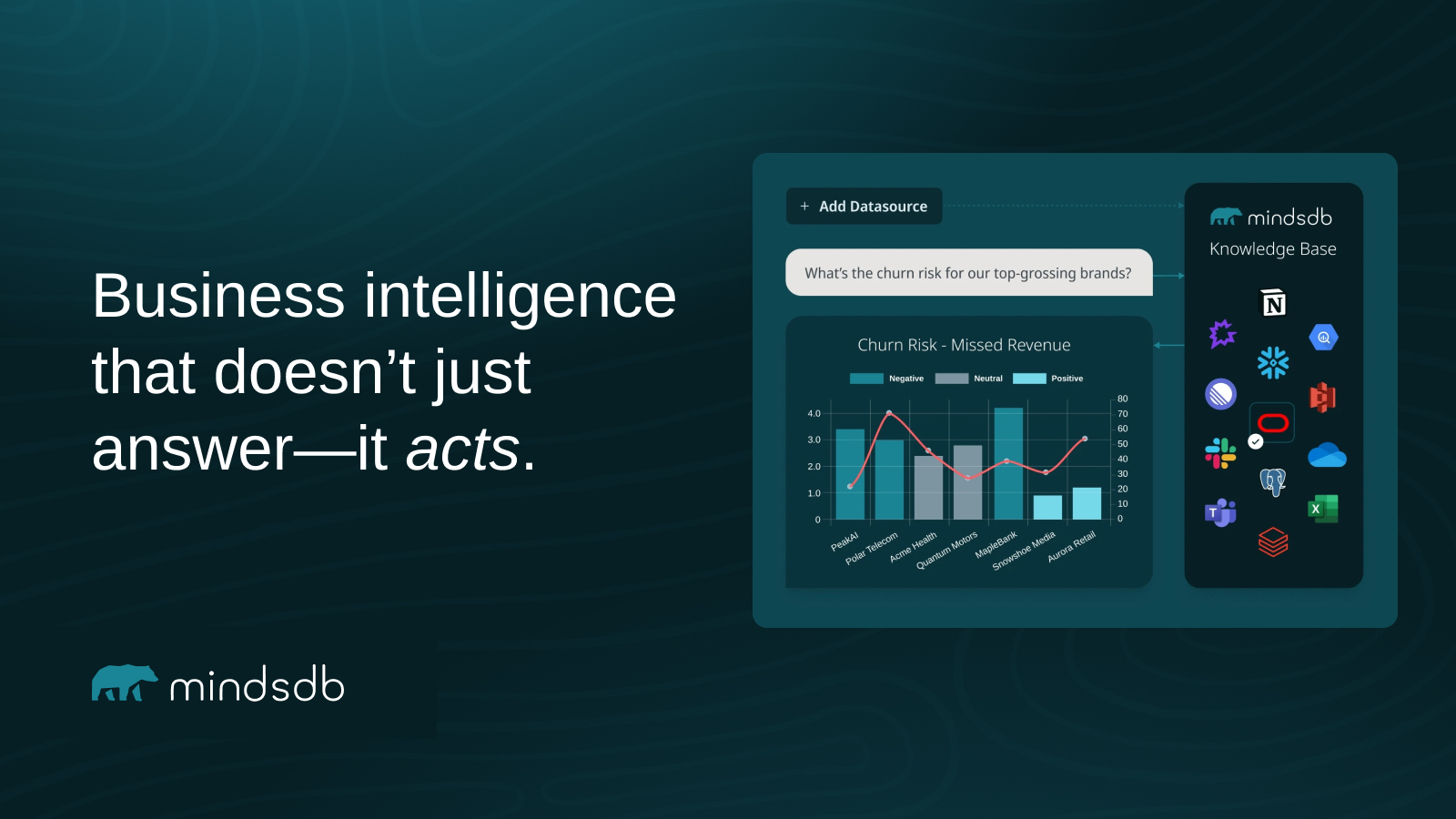
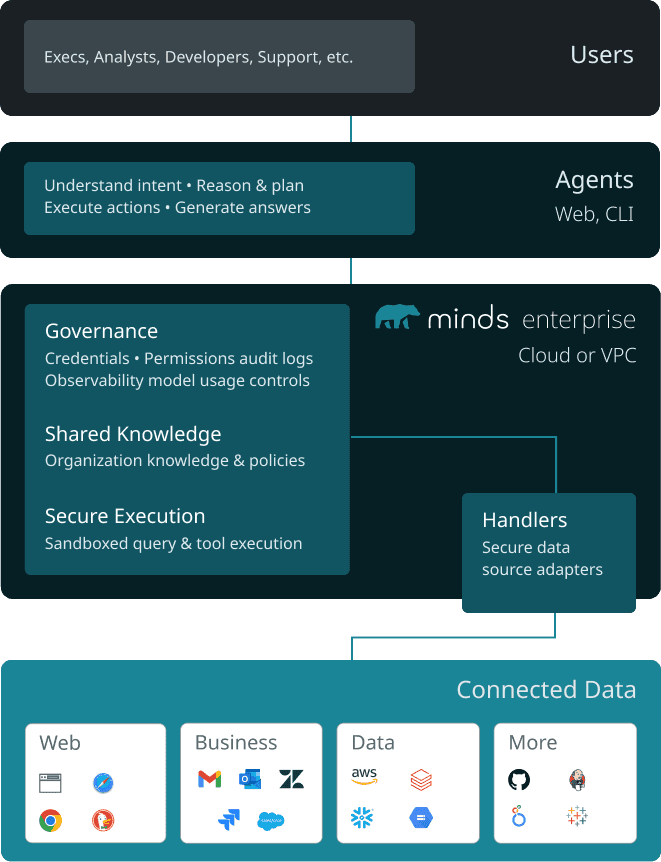
Powerful, autonomous business intelligence platform that analyzes your data, runs actions, and builds predictive insights, all from a plain-language q
MindsDB is often highlighted for its capability in simplifying the integration of machine learning models with databases and the ease of making predictions directly from SQL queries. It is well-regarded for offering an innovative approach to implementing AI without needing extensive technical expertise, making it accessible to a broader audience. However, there seems to be limited discourse on specific complaints or pricing sentiment in the available social mentions. Overall, MindsDB maintains a positive reputation for its functionality and user-friendly design, though there is potential for more user feedback on its cost and potential drawbacks.
Mentions (30d)
2
Reviews
0
Platforms
2
Sentiment
0%
0 positive
MindsDB is often highlighted for its capability in simplifying the integration of machine learning models with databases and the ease of making predictions directly from SQL queries. It is well-regarded for offering an innovative approach to implementing AI without needing extensive technical expertise, making it accessible to a broader audience. However, there seems to be limited discourse on specific complaints or pricing sentiment in the available social mentions. Overall, MindsDB maintains a positive reputation for its functionality and user-friendly design, though there is potential for more user feedback on its cost and potential drawbacks.
Features
Use Cases
Industry
information technology & services
Employees
38
Funding Stage
Seed
Total Funding
$57.9M
7
npm packages
7
HuggingFace models
Pricing found: $0, $0, $0, $35/month, $35/month
How I Created a Real Second Brain for Claude
When OpenClaw first came out I installed it on my mac and started using for almost anything I could. I made it my personal assistant, gave it a name Igor and even created him his own accounts everywhere. But one thing I couldn't stand is the new Igor every 200k tokens. So I came up with an idea. I created a skill where it would download fresh telegram chat logs at 160 k tokens but it would always forget. Mind you its January so there isn't an abundance of memory tools yet and honestly I wasn't really looking for a memory i was looking for a brain. My thought was to copy a human brain. You remember almost perfectly verbatim everything that was told to you or happened today! the next day your memory about the day before isn't that perfect but you still remember important stuff like a sudden change of plans or maybe an important call. A week after your memory about that day completely blur out leaving few important stings of memory and in a month you may only remember that important call. So this is what I was trying to accomplish but with a little twist. Instead of using a neurotypical brain patters I decided to go with autistic. The difference? Autistic people remember stuff verbatim for much much longer. Me and my wife are Autistic so it only made sense! Im a vibe coder so the only way to start for me was research. I connected Notebook LM CLI and started researching human brain and how its built. The same night me and my wife decided to watch the movie AI about a little kid who Just wants to get back to his mom. that movie starts with a scene where professor explains cybernetics and references a research from early 50s! AHA!!! I don't need to come up with anything because someone already did! I just need to structure that information in a right way! So I started researching Cybernetics I took Ashby and his "Design For Brain" work. Then Beer and his "Brain of the Firm' And lastly Hebb and his 'The Organization of Behavior" and fed it all to Claude. Then we started structuring the CyberAutistic Brain. Honestly I spent more tokens on research then on actual coding and I don't regret it for a bit. But after some work we (me and claude lol) quickly realized that algorithms like Leidenlang, LanceDb, TorchHD are too big and eating too much space and latency on top of that Leiden Algorithm was only a GPL license which would restrict my intent to make it an MIT project. So I decided to write my own. But how do you do that???? Same way but with the twist! One AI is smart but 6 frontier models are waaaaay smarter. I figured if they were all trained by different people they would look at the problem from different angles. So I got an Antigravity CLI to use Gemini and Cursor to use Kimi, GPT, Grok, Codex. Idea is simple - I use Get Shit Done tool and its workflow goes like this research-plan-plan review-if red flags/ plan convergence - if cant come to an agreement - multisocratic discussion - execute. To plan convergence and socratic discussion you connect all models and make them argue until they find a solution that fits your idea. It worked! leidenlang was replaced by MOSAIC lance Db by HIPPO TorchHD by LilliHD By the time i finished creating this i stopped working with OpenClaw lol but it still connects the whole system your OpenClaw or Claude via its own CLI or iai mcp! Results? Well it works!!! It fires up a hook on every session start and pre loads important stuff to system prompt. Everything you type it remembers verbatim and stores but surfaces only important stuff! How does it know its important? It sleeps (because every brain does) and consolidates information. Important stuff that you repeat or a sudden change of plans - it remembers. Everything that isnt important or outdates fades away from his immediate memory. It also learn and studies you. First 10 sessions are mediocre but after session 100 it just knows! Then was the last part. Make sure im not crazy and AI didn't gaslight me to thinking i made something so i decided to run benchmarks. it beats mem palace on most stuff and ties on long mem eval BUT its not really honest because iai-pme and mem-palace are fundamentally different. iai is ambient and dynamic mem-palace is a flat cosine store So heres the repo https://github.com/CodeAbra/iai-personal-memory-engine tear it down, hate on it, i don't care! An Nvidia engineer and an Apple engineer are using it daily and their use is an enough proof for me that it works. Would love to answer to constructive criticism and questions! The stack I made it with Claude Code RTK - cuts token usage Context Mode Mcp - also does by not using grep and glob but also finds context and information better Get Shit Done - the best tool to organize any project and finish it Antigravity CLI Cursor CLI Notebook LM CLI Closer to v 1.0.0 I started using obsidian too Hope my stack helps you also create difficult stuff! Unfortunately I didnt get to run Fable on this project and looks like wont be able
View originalFable 5 with Ultracode on a PR Review
I'm only on $20 pro plan, after switching from $200 plan back when Opus 4.6 was king. At some point we were given credits equal to our plan so I have had a lot of extra usage credits sitting around that I will dip in to every now and then. It helps when you want Opus 4.8 to finish a task without waiting for hours for the window refresh and I can normally only do 1 task before I hit the window... my repo is pretty big and the tasks I get it to aren't normally trivial. So when Fable 5 is released I thought I'd give it a PR that was (in my mind) pretty much ready to merge and put it on "ultracode" to get the full experience. I used the "/pr-review" skill, told it to automatically fix anything that scored 50 or more (I find the default >75 pretty limiting on what it actually fixes). Now this PR is not a normal one, it's turned into a behemoth because it includes an entire Discord bot. It contains 22k lines of new code. I realise this is not best practice but I thought it was a cool way to see how good Fable is. Within minutes I blew past the 5 hour window. It ended up using a total of £63.12 in extra usage. PR #315 is reviewed, fixed, and pushed. The multi-agent review (10 reviewers across bugs/security/CLAUDE.md/architecture/quality, each finding independently confidence-scored) surfaced 63 raw findings that collapsed to 38 distinct issues scoring 50+. I fixed 35 of them, pushed commit 3dbc4e92 to the PR branch, and posted both comments: Very impressive! Just also... very expensive 😄 Fable ensured CI/CD pipeline was clean, PR was green.. all tests passed, no typescript errors etc. It even left a few things for me to opine on: Three things I deliberately left for you (flagged in both comments): the bot writing XP directly to the shared DB via Prisma (relocating it behind internal API endpoints is a real architectural refactor), the missing spec-mandated triage buttons / /staff subcommand handlers (feature scope, looks like deliberate v1 deferral), and splitting the 939-line discordServerSetup.ts (pure churn, your call). I also verified four findings as intentional and excluded them — notably ManageThreads (added deliberately in ace825ed) and the requestLogger originalUrl change (it fixes racy sub-router path logging, not a regression). Maybe it's time to come back to the $200 plan but what it actually shows I think is just how important it's going to be in future to choose the right model for each job. Fable ultracode thinking every PR is going to get expensive, fast! submitted by /u/oddslol [link] [comments]
View originalSkill to not keep edge cases when moving from mvp feature to prod
Skill that stops AI covering too much cases without prompt. So I had this feature which used values from env for simplicity, Now I modified it remove static env have dynamic config . Claude does it but keeps the old env fallback in case this dynamic config service is offline or the config doesn't exist in db. Bruh so much complications can't read code, this just one example but now do it for most features and it writes ton of long confusing code . How you fix gib skills My mind should know every function what it purpose but this AI shi writes unintended shit and commit , and now I'm just scrolling reading stupid ai code. I hate this shit. Gib minimalistic clean code ai skills. submitted by /u/Mother_Desk6385 [link] [comments]
View originalIt knows it f* up
Just posting cause I found funny it admitting it explicitly and cause I didn't fall from my chair when I saw a command executed in a remote DB when I asked it to delete stuff locally. :) Had a long session in plan mode to run a cleanup on that Docker crap that accumulates over the months, ensuring it wouldn't delete anything I actually need/use. Some back and forth with the plan till I figured it was well defined already, so I approved and off it went. After executing the clean up it goes into checking every image, volume etc and instead of checking the actual local DB it decided, out of thin air, to select a count from my PRE production DB instead of the local DB. Before anybody screams, yes, you're absolutely right! It does have access to my PRE Production DB, but it's got read-only credentials set up (it can't insert/update/alter/drop anything, only select), so even on the worst case scenario, if it hallucinates, it won't screw it up big time. And that's the peace of mind I've got since I started to work inside of a Docker container to protect my local machine's filesystem and with specifically generated credentials for AWS, GitHub, databases, external services etc, all very well scoped so the blast radius is as close as possible to 0. Hope these ideas (which are nothing new really, but I believe nobody talks about it enough) help you to keep f* up free long time. submitted by /u/somerussianbear [link] [comments]
View originalSteam Similarity Recommender Find your next favorite game and learn WHY (student project)[P]
I love making recommendation systems that tell the user WHY they got the recommendation. During a steam sale event, I always find myself trying to look for new video games to play. If I wanted to find a new game I would try to whittle it down by using steam tags, but the steam tag system is very broad "action". could apply to many many games. That got me thinking, what aspects do I like about my favorite games? Well I like Persona 4 because of the city vibes and jazz fusion, I like Spore because of the unique character creation and whimsical theme. and I like Balatro for its unique deck building synergies. What if I could capture unique tags that identify a game that aren't just "action" and put them into vectors to show the (focus) of a game For example I could break persona 4 into something like Gameplay Focus vector: - Day cycle 20% - Dungeon crawling 20% - Social sim 20% Tags: - Music: jazz fusion - Vibe: Small rural town I achieved this by pulling 2k reviews for 80k steam games, running them through a 4 stage pipeline that filters out the reviews to find reviews describing a video game's vibes or structure, then asking a llm to generate these reviews into vectors, niche anchor tags and micro tags using non canonical names. to really "capture" niche tags that can't be captured normally. Then I used a 6 stage pipeline to group these non canonical names together (fast combat = speedy action combat) From that I stored it all in PostgreSQL + Chroma db, made an app using React. and Shipped it all within a docker container inside a digital ocean droplet! The result is a cool little steam game recommender that I can use to not just find similar games, but find games that share my favorite aspect of a game I like. A system that explains to me why I got the recommendations I got. I find that this system makes searching for games more "fun" now I can see why I like balatro. I like it because of the card synergies not so much for its rogue-like nature. I also find that this helps find new underrated games, and beats the trap that Collaborative Filtering algorithms that get into where it "feels" like you get recommended the same things. find your next favorite game! : https://nextsteamgame.com/ pull a PR!: https://github.com/BakedSoups/NextSteamGame ( I actually made some git issues myself for problems I can't fix) if anyone has any criticism I would love to hear it! this is probably my favorite passion project. Hope this website helps people find new games! Also I have a advance mode for people that don't mind messing with sliders and weird data terms. submitted by /u/Expensive-Ad8916 [link] [comments]
View originalHelp needed (Claude Code + Supabase)
IIn the last couple of weeks and probably months, I was directly asking Claude Code to modify some rows in my db in Supabase and run SQL migrations. However, in the last two days or so, it refuses to do directly. It does not show me the "always allow" button that I usually see. It does not go to my DB and check for my tasks. Keep in mind that I have Supabase as a connector and never removed it. I even tried to give it all the "allow" permissions. No luck. submitted by /u/Throwaway_SQ2 [link] [comments]
View originalIs anyone else terrified of giving Cursor/Claude direct access to their database? I built an open-source solution.
Hey everyone 👋, I absolutely love using Cursor and Claude Desktop for debugging and writing queries, but the idea of hooking them up directly to my database via standard MCP (Model Context Protocol) servers has always given me anxiety. One bad hallucination, and the AI could execute an UPDATE without a WHERE clause, or accidentally read a table full of hashed passwords. I couldn't find a tool that provided enough peace of mind, so I built DB-Whisper. It’s a production-grade, highly secure MCP server designed specifically for AI assistants. Instead of just passing queries through, it acts as a paranoid firewall: Deep AST Validation: It parses the actual AST (not just regex) to ensure ONLY pure SELECT queries are executed. Zero Info Leakage: You can block access to specific tables (like users or payments). Data Masking: It can automatically mask sensitive fields (like emails or phone numbers) before the AI even sees them. Driver-Level Read-Only: Double insurance at the database driver level. I just open-sourced it and I'm looking for some beta testers. If you're building with AI agents or using Cursor for backend work, I’d love for you to try it out. I’d also love some feedback: What other databases should I support next (MySQL, MongoDB)? Can anyone manage to bypass the AST firewall? submitted by /u/Majestic_Common_1669 [link] [comments]
View originalMy actual AWS bill running Claude in production for 5 months
So I've been running Claude Haiku 4.5 on AWS Bedrock for about 5 months now across a few different production apps. Thought I'd share what the bill actually looks like because there's a lot of vague "it's cheap" or "it costs a fortune" talk and not enough actual numbers. My setup: a Next.js app on AWS Amplify that uses Bedrock for two things. First, a customer facing AI chat widget (RAG with a knowledge base, about 16 docs). Second, an AI readiness assessment tool that generates personalized reports. Both use Haiku 4.5 because honestly Sonnet is overkill for what I need. The actual numbers (last 3 months average): Chat widget costs about $3.50/month. Most conversations are short. The RAG retrieval from S3 Vectors costs almost nothing, like $0.03/month for the vector store. The trick is keeping the system prompt tight and using the knowledge base to inject context only when needed instead of stuffing everything into the prompt. Assessment reports cost about $4.80/month. Each report is a 150 word personalized analysis. I cap the output at 400 tokens and set a daily cap at 100 reports. Worst case is maybe $8/month but it never hits that. Total Bedrock cost: roughly $8 to $12/month. I set a $20/month AWS budget alarm with alerts at 50%, 80%, and 100%. Haven't hit the 80% alert once. What actually saved me money: Haiku instead of Sonnet. For my use cases the quality difference is negligible but cost difference is like 10x. I tested both extensively before committing. Sonnet gave slightly more polished prose in the reports but nobody noticed or cared. Daily cost caps in DynamoDB. Not just rate limiting per IP (I do that too, 20 requests per 15 min for chat) but a hard atomic counter in DynamoDB that blocks all AI calls after hitting the daily limit. Survives Lambda cold starts unlike in memory counters. Keeping maxOutputTokens low. Assessment prompt uses 400 max. Chat uses 1024. You'd be surprised how much quality you can get in a tight token budget when your prompt is specific about format and length. Bedrock Guardrails for free safety. Content filtering, prompt attack detection, PII blocking. The guardrail evaluation calls are free, you only pay for the model invocation. So I get a full safety layer at $0 extra. The gotcha nobody warns you about: Lambda cold starts can make your in memory rate limiters useless. I had a bug where my daily cost cap was resetting every time a new Lambda instance spun up, so theoretically someone could have burned through way more than intended. Moving the counter to DynamoDB with atomic UpdateItem fixed it permanently. Cost of that DynamoDB table? Like $0.50/month with on demand pricing. What I'd do differently: I probably overengineered the safety stuff early on. The $20/month budget alarm alone would have caught any runaway costs. But the DynamoDB cap gives me peace of mind for the chat widget since it's public facing and I can't control how many people use it. If you're building something similar and debating Bedrock vs the API directly, Bedrock's advantage is the IAM integration. No API keys floating around in env vars, your Lambda just assumes a role and talks to the model. One less secret to manage. Anyone else running Haiku on Bedrock? Curious what your monthly spend looks like for similar workloads. submitted by /u/ecompanda [link] [comments]
View originalRepository Audit Available
Deep analysis of mindsdb/mindsdb — architecture, costs, security, dependencies & more
Yes, MindsDB offers a free tier. Pricing found: $0, $0, $0, $35/month, $35/month
Key features include: Analyst-depth, in seconds, Enterprise-grade trust safety, Pricing Licensing, Felipe Chavez, Insights from terabytes of robot logistics data, Learn.
MindsDB is commonly used for: Why it matters:.
MindsDB integrates with: Amazon S3, Google BigQuery, Microsoft Azure, PostgreSQL, MySQL, Snowflake, Tableau, Looker, Apache Kafka, Salesforce.
Based on user reviews and social mentions, the most common pain points are: token usage.
Based on 13 social mentions analyzed, 0% of sentiment is positive, 100% neutral, and 0% negative.

MindsDB in Practice (February 2026) - new features of MindsDB v26.0.0
Feb 27, 2026


