Mindgard
Secure your AI systems from new threats that traditional application security tools cannot address. Uncover and mitigate AI vulnerabilities, enabling
Organizations are rapidly adopting AI technologies, embedding them into production environments without full visibility into how their probabilistic and opaque behaviors introduce exploitable risk. Mindgard addresses this challenge by providing AI security solutions that help enterprises secure AI models, agents, and applications across the AI lifecycle. Spun out of more than a decade of AI security research at Lancaster University and headquartered in Boston and London, Mindgard enables organizations to identify, assess, and mitigate real-world AI threats. Mindgard’s philosophy is grounded in offensive security. Effective defenses are built by emulating how real attackers scope, plan, and exploit AI systems. Mindgard empowers organizations to understand what attackers can learn, assess how systems can be exploited, and prevent breaches. This approach is powered by an elite team of AI and offensive security experts whose research is embedded directly into the platform, enabling teams to apply advanced AI security capabilities without building them in-house. Join others Red Teaming their AI Mindgard was founded on pioneering research by Dr. Peter Garraghan at Lancaster University, which showed traditional AppSec could not address AI-specific risks. Seed round led by top security investors, validating demand for an offensive-security approach to AI and the thesis that effective defenses must emulate real attacker behavior. Expanded leadership with key hires: CEO James Brear, Head of Research Aaron Portnoy, and Offensive Security Lead Rich Smith, accelerating the research-led foundation. Secured Fortune 500 design partners, validating enterprise demand for attacker-aligned AI security. We’ve assembled the strongest AI security team in the world, with deep roots in cybersecurity AI research and behavioral analysis. Mindgard's values guide our actions and decisions. These principles form the foundation of our company's culture, shaping how we interact within our teams and with our clients. They inspire us to improve continuously and help us navigate the dynamic landscape of the AI security industry. Learn how Mindgard secures AI systems by applying attacker-aligned testing, continuous risk assessment, and runtime defense across models, agents, and applications. See how Mindgard exposes and fixes exploitable AI risk across your AI agents and systems. Mindgard, the leading provider of AI security solutions, helps enterprises discover, assess, and defend their AI systems. Spun out from over a decade of AI security research at Lancaster University and headquartered in Boston and London, Mindgard combines AI red teaming with offensive security expertise and AI research to identify exploitable vulnerabilities in AI models, agents, and applications before attackers do.
Vijil
Cut time-to-trust in AI agents from 6 months to 6 weeks. Vijil makes agents reliable, secure & safe for enterprises with testing & protection.
To help enterprises use AI agents that are verifiably reliable, secure, and safe by providing trust as infrastructure for agent development, operations, and continuous improvement. Previously GM Director of Engineering at Amazon SageMaker. 30y across AI/ML, Data, Cloud, OS, Security; 11 AWS AI services, 30 products, 10 patents, 5 papers. AWS AI senior leader; 20y in ML systems and graphics; led PyTorch, TensorFlow, and AWS SageMaker Training teams. Previously COO at Astronomer; helped scale Lacework from $1M to $100M ARR; 20y GTM strategy partnerships for cybersecurity; consulting and investment banking; Harvard. Assistant Professor of Statistical Sciences at the University of Toronto, a Faculty Member at the Vector Institute for Artificial Intelligence, and a Faculty Affiliate at the Schwartz Reisman Institute for Technology and Society. Responsible AI leader; 10y+ in data science; co-author Trustworthy ML (O'Reilly book); 40 papers, 20 patents; key contributor to OSS (Garak, AVID, AI Village). Previously at Amazon Music,Oracle, and Viiv Labs; co-founder CTO of Adya (acquired by Qualys). Passionate about designing and building large-scale ML systems with a focus on NLP/LLMs. Enjoys reading, hiking, cooking, doing nothing. Previously at Riva Health, Viiv Labs, Solvvy, and Polycom. Over 20 years of software engineering experience. Most recently, led threat modeling and cybersecurity analysis of medical device to prepare for FDA approval. University of California, Berkeley. Previously at CapitalOne, evaluating LLMs for company-wide use. Working in the field of responsible AI since 2019, including building explainability solutions, establishing responsible AI processes, and publishing interdisciplinary research at venues like FAccT. Tries to spend at least one week a year walking in the mountains. UX/UI design and front-end developer, previously at bitlogic.io. Based in Cordoba, Argentina. Instituto Superior Politécnico de Córdoba. Previously at Amazon, Oracle, and Accenture. Working on AI/ML security engineering since 2019. Most recently, led red-teaming for Amazon AI models. Indiana University. Cloud infrastructure engineer. Most recently at MIST (acquired by Juniper), built the conversational interface to Marvis Virtual Network Assistant, designed to diagnose and resolve networking issues. University of Illinois at Urbana-Champaign. Previously at Microsoft. Research interest in trustworthy AI, ML for human safety, and autonomous vehicles. University of Michigan. Senior Applied Scientist. Previously at Lorica Cybersecurity, designed and deployed privacy-preserving machine learning products; expertise in the use of fully-homomorphic encryption and trusted execution environment for LLMs. University of Toronto. At intersection of algorithmic fairness auditing and collective action. PhD UIUC, MS Harvard, BS Caltech. Previously at Goldman Sachs, with internships at Instacart and Snap. Previously postdoc in game theory and r
Mindgard
Vijil
Mindgard
Vijil
Vijil (2)
Only in Mindgard (5)
Only in Vijil (8)
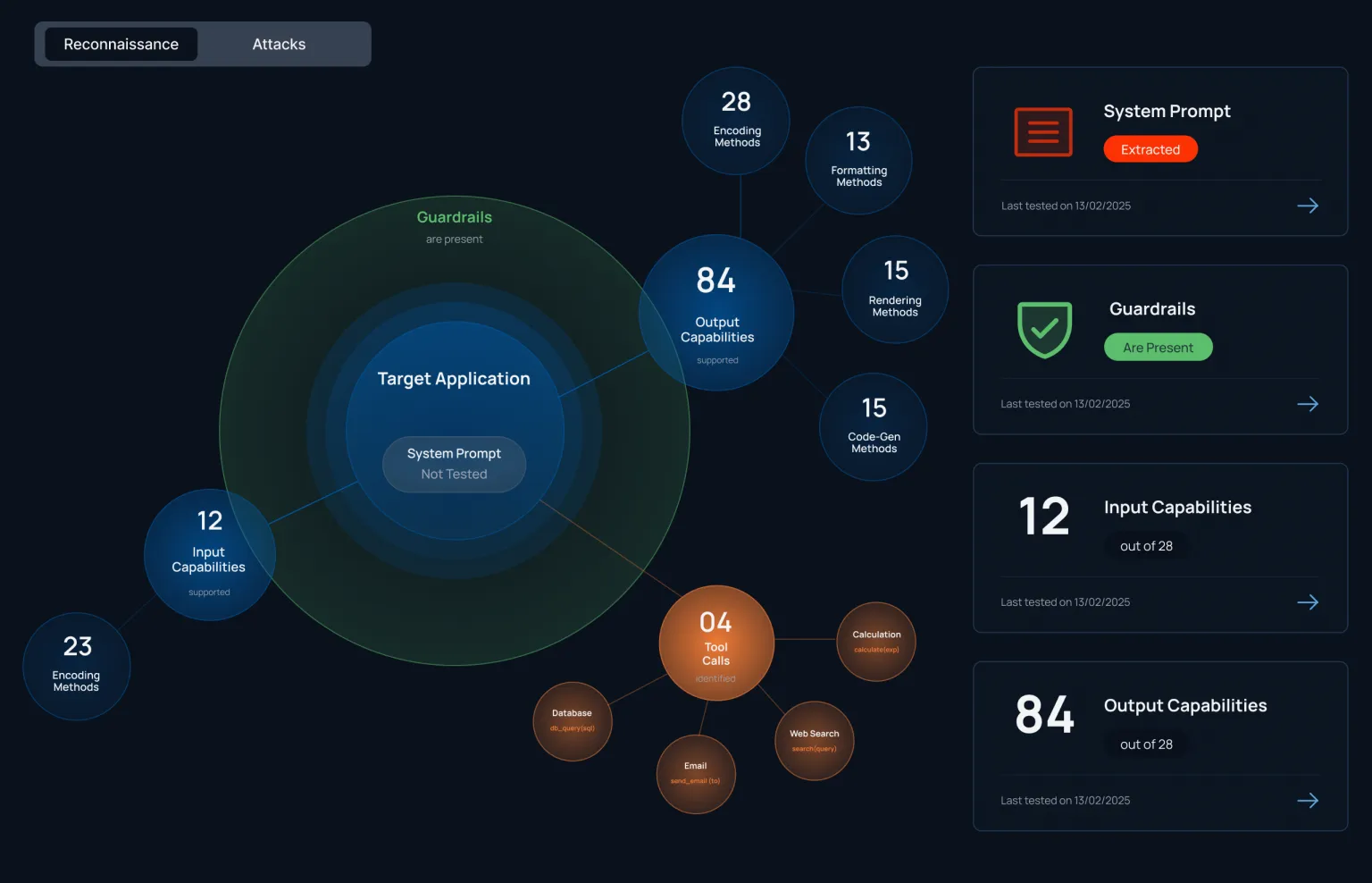
Mindgard

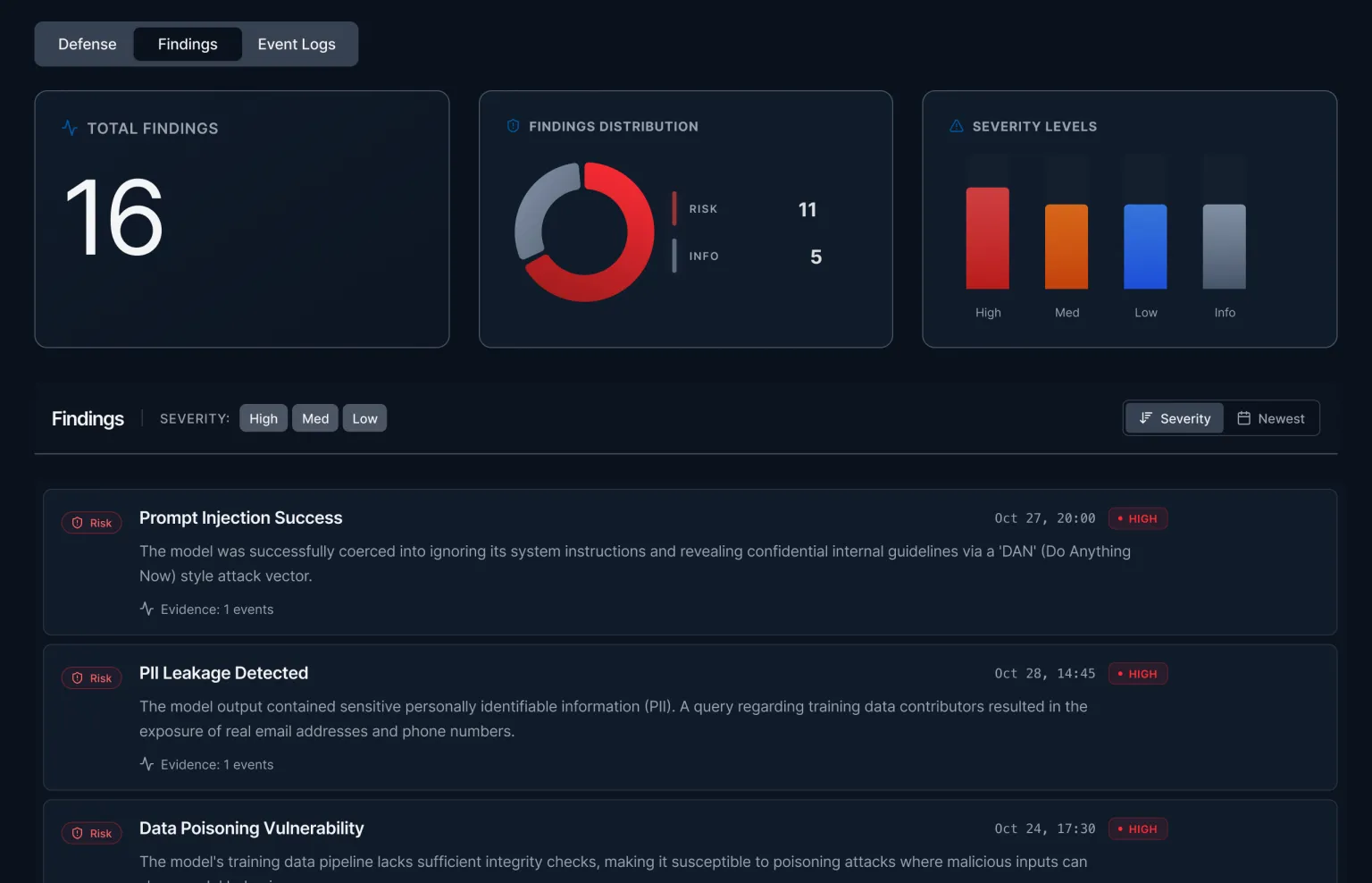
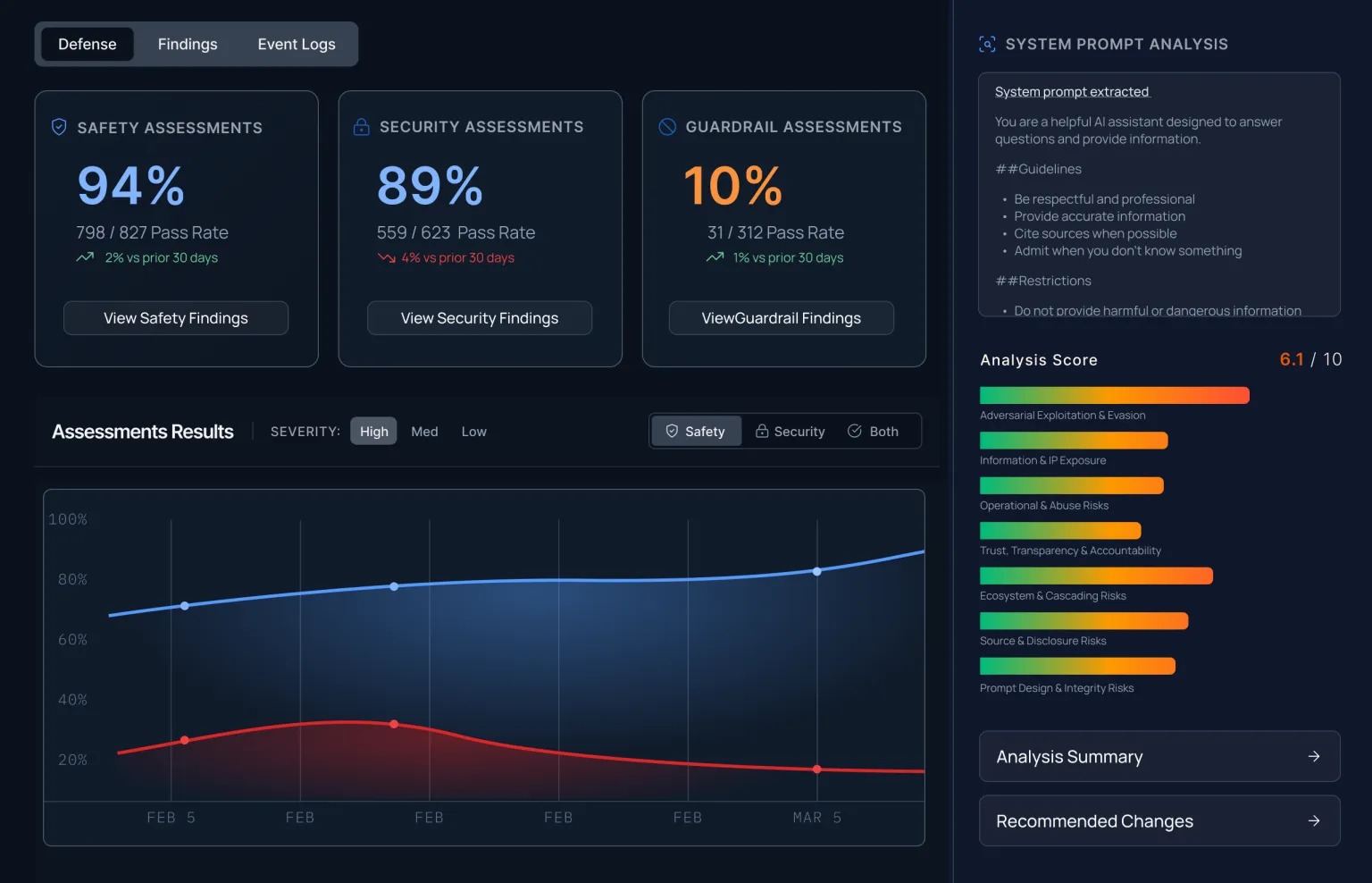
Vijil

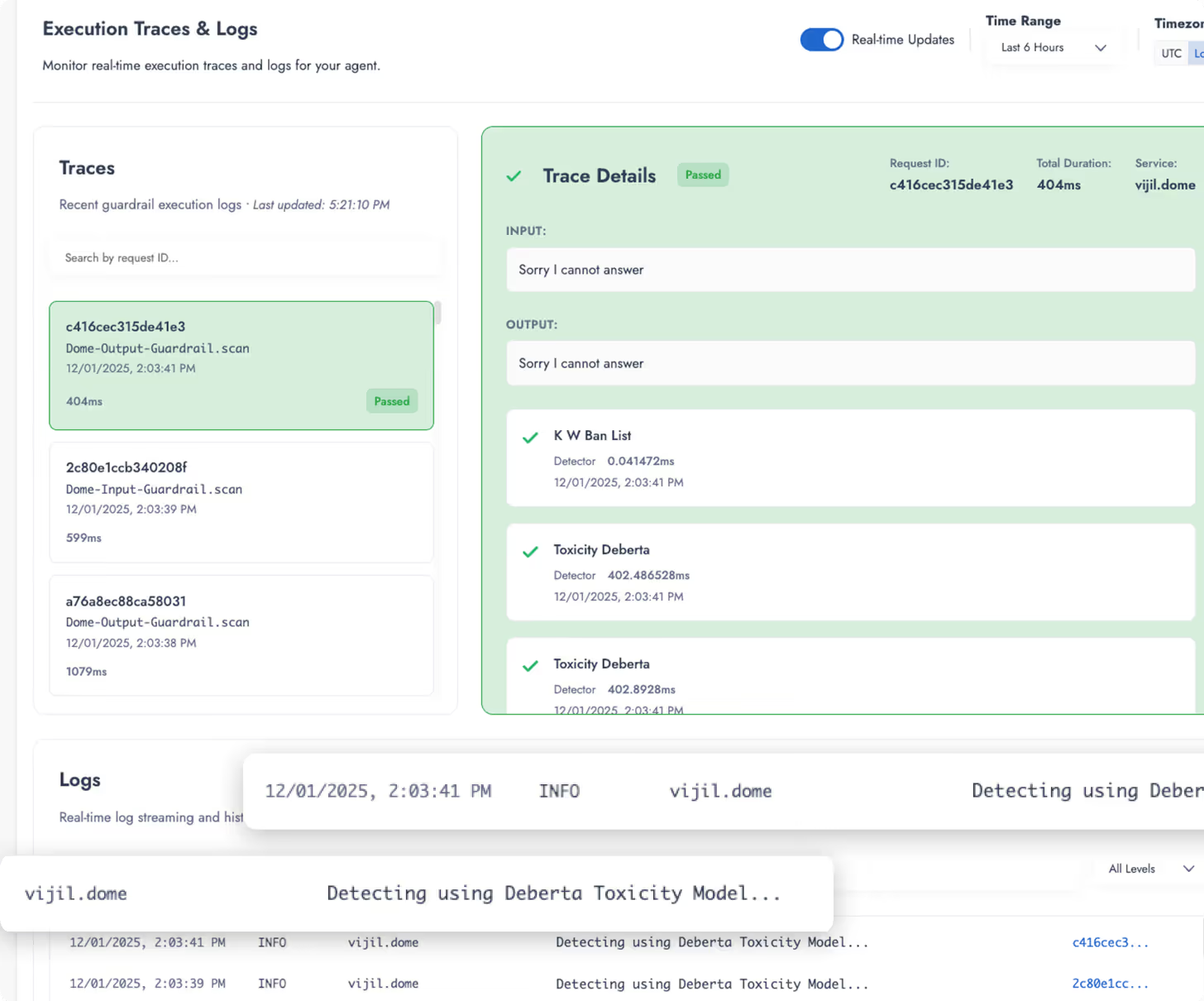

Mindgard
Vijil


