Metronome is the usage-based billing platform that helps you launch products faster. Easily model your pricing today, iterate confidently tomorrow.
Users of Metronome generally appreciate its ability to help with identifying repetitive AI writing patterns, highlighting its utility in refining AI-generated content. However, the tool seems to face criticism for its limited features or effectiveness, as suggested by the moderate ratings on platforms like G2. Pricing sentiment isn't clearly indicated from the available reviews, but overall, Metronome seems to have a mixed reputation, with users finding it somewhat useful but not universally essential or comprehensive. The presence on platforms like YouTube suggests there is a niche interest or curiosity in its functionalities.
Mentions (30d)
0
Avg Rating
2.8
2 reviews
Platforms
2
Sentiment
0%
0 positive





Users of Metronome generally appreciate its ability to help with identifying repetitive AI writing patterns, highlighting its utility in refining AI-generated content. However, the tool seems to face criticism for its limited features or effectiveness, as suggested by the moderate ratings on platforms like G2. Pricing sentiment isn't clearly indicated from the available reviews, but overall, Metronome seems to have a mixed reputation, with users finding it somewhat useful but not universally essential or comprehensive. The presence on platforms like YouTube suggests there is a niche interest or curiosity in its functionalities.
Features
Use Cases
Industry
information technology & services
Employees
130
Funding Stage
Merger / Acquisition
Total Funding
$128.0M
g2
What do you like best about Metronome?Basic metronome, cover the essential use. Review collected by and hosted on G2.com.What do you dislike about Metronome?Lacks lots of extra and more advanced functionalities. Review collected by and hosted on G2.com.
What do you like best about Metronome?Metronome made is efficient for me to be able to manage various projects among my teams and helped me and my teams communicate better to upper management. Review collected by and hosted on G2.com.What do you dislike about Metronome?I did not like that certain tools were only editable by the original creator. I felt that if my team was also able to add topics it would help us out as we did not use all tools available to us due to their limitations. Review collected by and hosted on G2.com.
I catalogued 112 patterns that make AI writing obvious — then built a Claude Code skill to fix them
I read a lot of AI-generated text for work — in Korean and English. After a while I started noticing the same patterns over and over. The triple-item lists. The "it's important to note." The bold on every key phrase. The conclusions that say nothing. So I started writing them down. First in English, then Korean, then Chinese and Japanese. Ended up with 112 specific patterns across four languages — 28 per language. Each one has a regex/heuristic detector and a description of what makes it a giveaway. A few examples from the English set: - "delve into", "tapestry", "multifaceted" clustered in one paragraph (Pattern #7: AI Vocabulary Words) - Starting three consecutive paragraphs with the same structure — claim, evidence, significance (Pattern #25: Metronomic Paragraph Structure) - "Despite these challenges, the industry remains poised for growth" (Pattern #6: the classic challenges-then-optimism closer) - "serves as a vital hub" when "is" would work fine (Pattern #8: Copula Avoidance) I turned this into a Claude Code skill called **patina**. You run `/patina` and paste your text. It flags what it finds and rewrites the flagged parts. It has a few modes: - Default: detect and rewrite - `--audit`: just show what's wrong, don't touch anything - `--score`: rate text 0-100 on how AI-like it sounds - `--diff`: show exactly which patterns were caught and what changed - `--ouroboros`: keep rewriting until the score converges There's also a MAX mode that runs your text through Claude, Codex, and Gemini, then picks whichever version sounds most human. Quick before/after: > **Before:** AI coding tools represent a **groundbreaking milestone** showcasing the **innovative potential** of large language models, signifying a **pivotal turning point** in software development evolution. This not only streamlines processes but also fosters collaboration and facilitates organizational alignment. > **After:** AI coding tools speed up grunt work. Config files, test scaffolding, that kind of thing. The problem is the code looks right even when it isn't. It compiles, passes lint, so you merge it — then find out later it's doing something completely different from what you intended. The full pattern list is in the repo README if you just want the checklist without the tool. GitHub: https://github.com/devswha/patina Based on [blader/humanizer](https://github.com/blader/humanizer), extended for multilingual support. MIT license. Happy to hear if you've spotted patterns I'm missing — the pattern files are just markdown, easy to contribute to. submitted by /u/Old-Conference-3730 [link] [comments]
View originalMetronome uses a usage-based + subscription + contract + tiered pricing model. Visit their website for current pricing details.
Metronome has an average rating of 2.8 out of 5 stars based on 2 reviews from G2, Capterra, and TrustRadius.
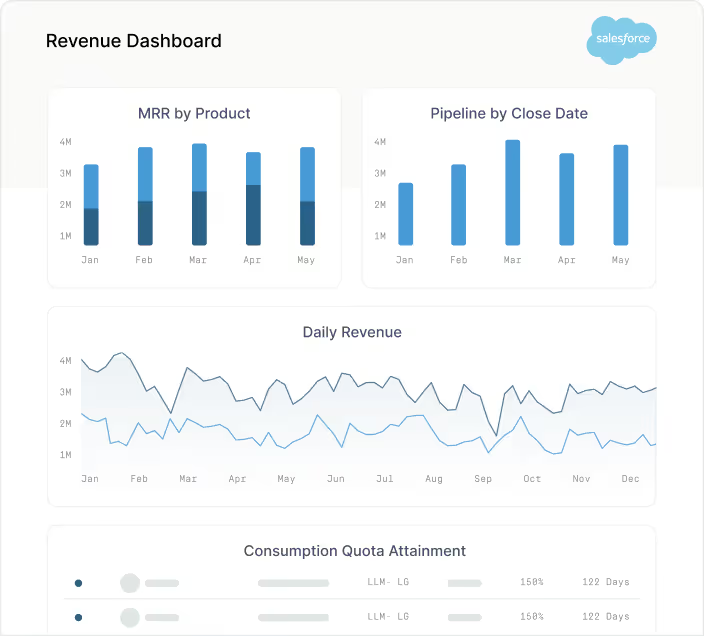
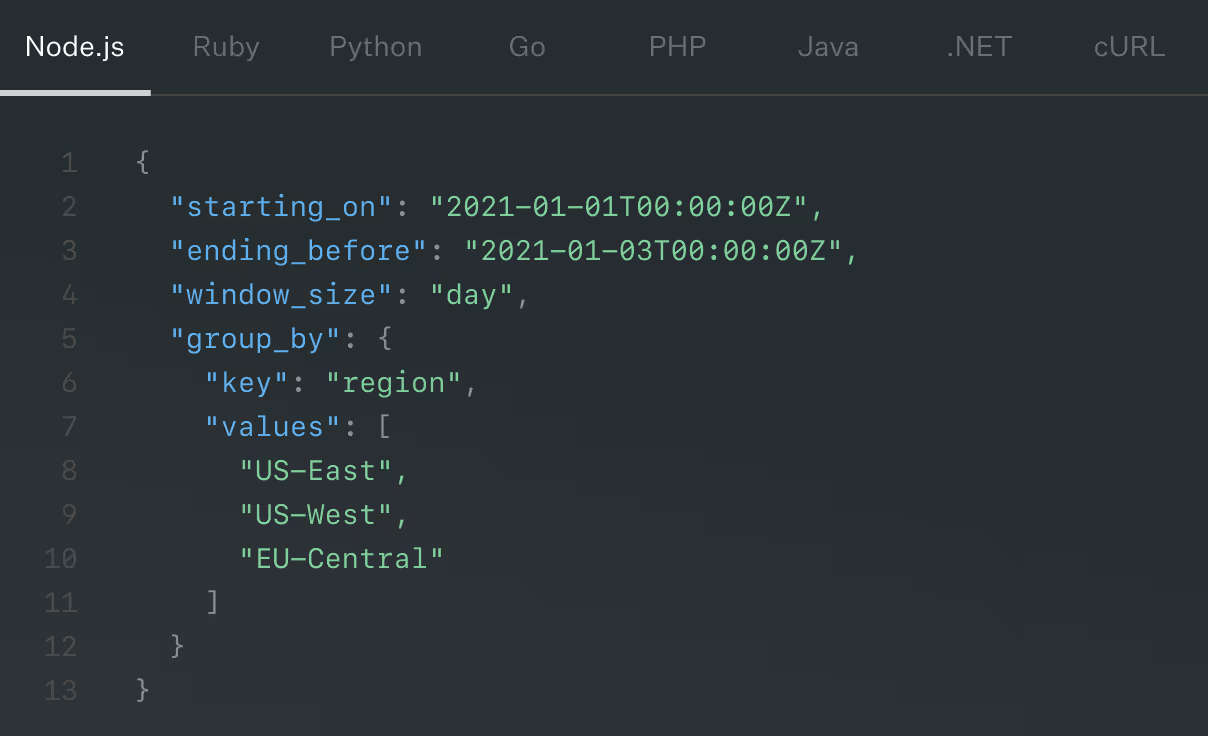
Key features include: Learn how Metronome works with in-depth guides and documentation, Stay up to date on pricing insights and trends, Explore how we connect with your existing stack.
Metronome is commonly used for: Real-time usage tracking for SaaS applications, Automated billing for subscription services, Dynamic pricing adjustments based on usage patterns, Revenue forecasting based on historical data, Integration with CRM systems for customer insights, Custom reporting for financial analysis.
Metronome integrates with: Salesforce, Stripe, Zapier, HubSpot, QuickBooks, Google Analytics, AWS, Microsoft Azure, Slack, Jira.

Scaling Pricing as a Strategic Initiative at Snowflake, with Ryan Campbell | Monetize 2025
Nov 14, 2025