Query in natural language and give your team AI-powered analytics built on your metrics and permissions. Deploy in minutes.
Metabase is praised for its open-source nature and powerful data query capabilities, particularly through the integration with AI tools like Claude, which allows users to interact with data in natural language. Users appreciate the ability to create complex BI systems without the hefty cost, as evidenced by DIY success stories in online discussions. Some complaints mention challenges in setting up and fine-tuning for specific business needs, but these are generally outweighed by its flexibility and cost-effectiveness. Overall, Metabase holds a strong reputation for being a user-friendly and affordable business intelligence solution.
Mentions (30d)
2
1 this week
Reviews
0
Platforms
2
GitHub Stars
47,487
6,485 forks
Metabase is praised for its open-source nature and powerful data query capabilities, particularly through the integration with AI tools like Claude, which allows users to interact with data in natural language. Users appreciate the ability to create complex BI systems without the hefty cost, as evidenced by DIY success stories in online discussions. Some complaints mention challenges in setting up and fine-tuning for specific business needs, but these are generally outweighed by its flexibility and cost-effectiveness. Overall, Metabase holds a strong reputation for being a user-friendly and affordable business intelligence solution.
Features
Use Cases
Industry
information technology & services
Employees
140
Funding Stage
Series B
Total Funding
$51.0M
47,487
GitHub stars
20
npm packages
13
HuggingFace models
Pricing found: $20, $100/mo, $100/mo, $3.75 / 1m, $3.75 / 1m
I built a complete BI SYSTEM for my business with Claude code - opus 4.7 - FULL TUTORIAL
After getting quotes of $15,000 USD from BI experts for creation of analytics dashboards for my startup I decided to try and do it with claude code AND IT WORKED! I am giving all info in the video but here is how I did it - connect claude code via CLI to Google cloud platform connect all data sources via API - Stripe, Google analytics 4, Youtube API (free), google sheets, rewardful and all my other sources. build data tables in big query to serve as the data warehouse installed metabase (opensource sql dashboarding system) for free self hosted talked for hours to Claude about how to plan correctly the buildout We decided the single source of truth (SSOT) should be the revenue of the business. and then around that layer we build everything else. This helped claude stay on point when validating information shown on our dashboards. It all took me 3 days. later I kept iterating on it and it stayed stable till this very day! We use it to gain more clarity on our GTM channels and keep building it and adding more data layers in the same way. Last thing that helped was that I deployed Kartpathis WIKI LLM for obsidian graph on my github repo where I manage a brain system that can keep claude on track when the project keeps growing. I plan on releasing soon an opensource repo of that brain format that other can use. Ask me any question you have about how to build your own BI system. I am sure I can help and you can save the money for your startup and spend it on meaningful things not on Analytics. Claude pro subscription was all it took. Google cloud platform costed 30 USD per month for everything! submitted by /u/mementomori2344323 [link] [comments]
View originalA PM spending half the day in a terminal
Something hit me recently. More than half of my working day now happens in a terminal and VS Code. I'm a Product Manager. That's not supposed to be what my days look like. But I've been using Claude Code for a few months now and things have kind of drifted in that direction, and honestly I don't mind it anymore. What started as me trying to get some data analysis done turned into building an entire work setup: workflows connected to databases, Notion, Slack, Gmail, Granola, Metabase. There's something called MCP servers that lets you plug all of this into one place, and once you set it up it starts to feel like the tools are actually built around how you work rather than the other way around. I've been doing data science work that I genuinely wouldn't have been able to do before this. Simulations, analysis pipelines, crunching operations data across hundreds of thousands of records. I don't have a CS background, never properly learned to code. But I've been close enough to technical work for long enough to understand what needs to happen, and Claude Code became the bridge between understanding something and actually being able to do it. What I think actually makes it useful is what you build around the AI, not just the AI itself. I have a custom memory system now where each session saves what worked, what went wrong, what decisions were made. I created something I call /session-learnings that goes through the whole conversation and stores everything into the project's folder. Each project has its own context and history so the next session picks up where the last one left off. I have hooks that fire when I'm giving feedback or catching something wrong, so corrections actually carry forward instead of getting lost. Git tracks everything. I also have a skill library at this point. Skills for pulling data from our databases, for building dashboards, for writing analysis documents that go to leadership. Some of them run agents in parallel, splitting a problem into pieces and working on each simultaneously, then combining the results. It sounds like a lot to set up but you just need to get started and work with Claude Code to build what works for you. The one I keep thinking about is something I call /akash. It's a skill I've been slowly training on my own way of thinking. My analysis framework, how I structure decisions, how I frame things for different audiences. When I'm about to finalize something, I sometimes run it through /akash first, or just ask it what would I do here. It's a bit of a strange thing to describe but it works out to something like having a second opinion from someone who has read everything you've written and paid attention to all of it. I almost didn't start any of this. I kept convincing myself that Claude Code was too technical, that it was built for engineers and I'd spend more time confused than productive. I was using ChatGPT for most things and it was fine for writing and quick questions, but it had a ceiling. It couldn't connect to anything real, didn't know my context, and every conversation started fresh. I kept running into things I wanted to do that it just couldn't do. Eventually I got over the hesitation and tried Claude Code properly. Once the first real thing worked, a workflow that actually pulled from production data and gave me something I could use, I just kept going. I want to write about what I've built and how it happened, for people in similar roles who are wondering whether any of this is actually worth the time. Not because I have it all figured out, but because I spent a while looking for this kind of writing and mostly couldn't find it. submitted by /u/akashkrr [link] [comments]
View originalOpen-sourced an MCP server for Metabase - query your data in natural language
Built an MCP server that connects Claude to Metabase. You can ask Claude about your dashboards, run SQL queries, create cards, and get automated data insights -- all through conversation. 28 tools across four categories: Read: List/get dashboards, cards, databases, execute queries, search Write: Create/update/delete cards, dashboards, collections NLQ: Natural language to SQL, explain SQL, optimize queries Insights: Ask data questions, generate insights, compare metrics, trend analysis Add it to Claude Desktop config: { "mcpServers": { "metabase": { "command": "npx", "args": ["metabase-mcp"], "env": { "METABASE_URL": "https://your-metabase.example.com", "METABASE_API_KEY": "mb_your_key_here" } } } } GitHub: https://github.com/1luvc0d3/metabase-mcp submitted by /u/plaidr [link] [comments]
View originalRepository Audit Available
Deep analysis of metabase/metabase — architecture, costs, security, dependencies & more
Pricing found: $20, $100/mo, $100/mo, $3.75 / 1m, $3.75 / 1m
Key features include: Analytics dashboard, Query builder, Data segregation, Models, Usage analytics, Metabase AI, Embedded analytics SDK, White-label analytics.
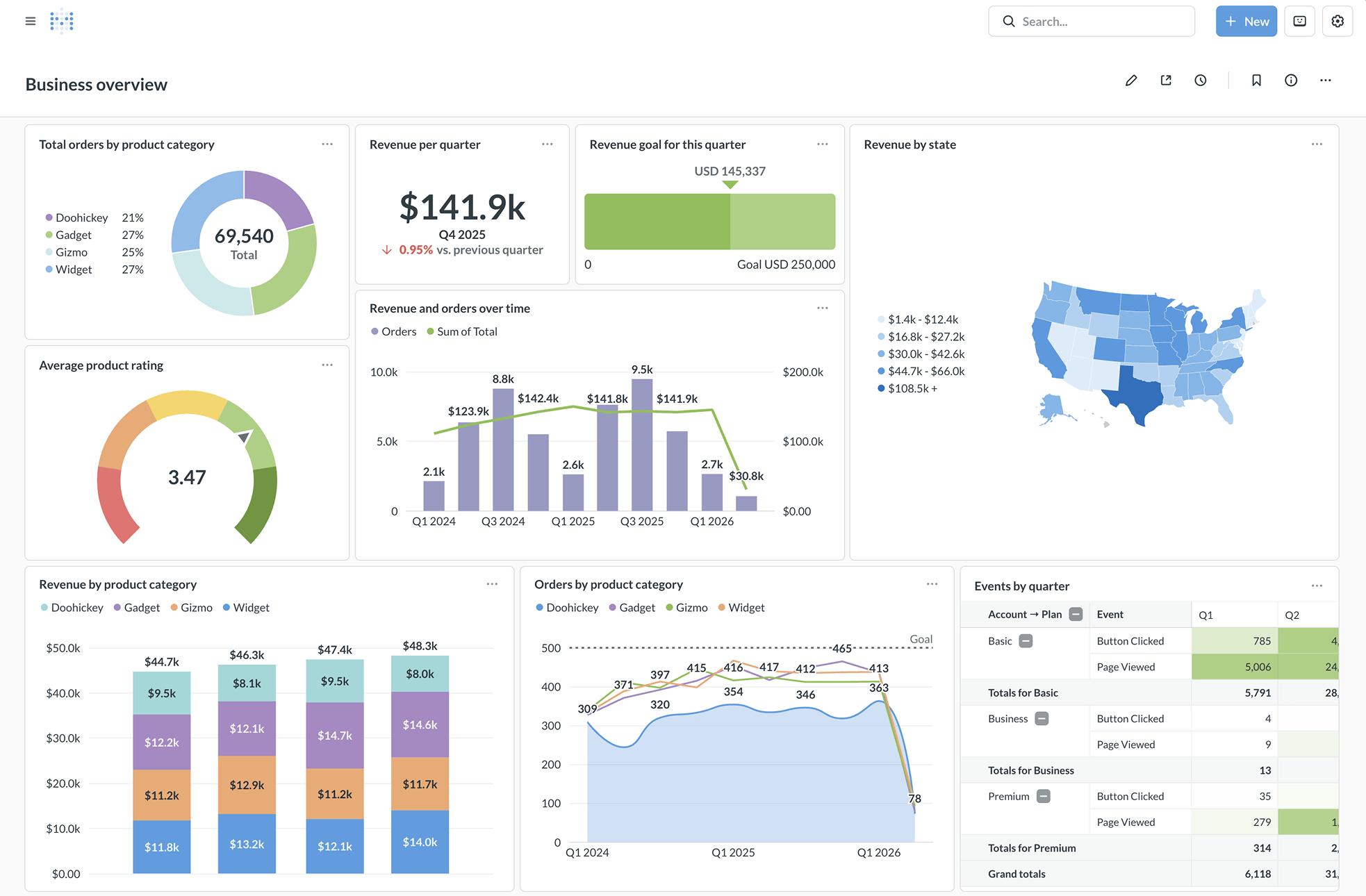
Metabase is commonly used for: Create interactive dashboards for real-time data visualization., Enable non-technical users to generate insights through natural language queries., Facilitate collaborative data exploration among team members., Integrate with existing databases for seamless data access., Automate reporting processes to save time and reduce manual errors., Provide embedded analytics for customer-facing applications..
Metabase integrates with: PostgreSQL, MySQL, MongoDB, Google Analytics, Amazon Redshift, Snowflake, Google BigQuery, Microsoft SQL Server, Stripe, Salesforce.
Metabase has a public GitHub repository with 47,487 stars.