Hopsworks excels in providing a robust feature store and MLOps platform with strong integrations like Apache Kafka and Spark, while OpenPipe stands out for its fine-tuning capabilities and competitive pricing, especially with models like GPT-3.5-0125. Hopsworks has a smaller employee size of ~37 but a larger funding round of $13.5M compared to OpenPipe's ~2 employees and $6.8M funding. OpenPipe boasts 2,787 GitHub stars, reflecting a strong developer interest and vibrant community.
Best for
Hopsworks is the better choice when managing large-scale data workflows and integrating within existing AI tech stacks is a priority for mid-sized teams.
Best for
OpenPipe is the better choice when flexible fine-tuning and cost-effective access to cutting-edge models are crucial for small, agile teams focused on rapid AI model prototyping.
Key Differences
Verdict
Hopsworks is ideal for teams needing a seamless integration of feature store and MLOps capabilities for large-scale data management. On the other hand, OpenPipe is perfect for startups or small teams wanting flexibility in fine-tuning models and cost-effective access to advanced AI models. Both have their strengths and cater to different priorities—choose based on specific needs and team size.
Hopsworks
Build, deploy, and scale production ML systems with Hopsworks. The Feature Store and MLOps platform for real-time AI, trusted by leading teams.
Hopsworks AI is praised for its robust feature set, particularly in managing machine learning models and large-scale data workflows, which is often highlighted in user discussions. However, there are limited explicit user reviews available, making it difficult to identify common complaints or pricing sentiment. Its overall reputation appears positive, especially among users emphasizing its innovative capabilities and ease of integration within existing tech stacks. Given the repetitive nature of social mentions, it's clear the platform generates focused interest, notably within the AI development community.
OpenPipe
OpenPipe is highly praised for its robust fine-tuning capabilities, allowing users to create high-quality, customized models without lock-in limitations, which is a key strength highlighted by users. The tool's ability to export fine-tuned models and its integration of OpenAI and other models like GPT and Llama 2 are particularly appreciated. Users express enthusiasm for its competitive pricing, especially with the support for the newest and affordable models like GPT-3.5-0125. Overall, OpenPipe has a strong reputation for innovation and flexibility in AI model management, with positive anticipation for future updates and features.
Hopsworks
Not enough dataOpenPipe
-67% vs last weekHopsworks
OpenPipe
Hopsworks
OpenPipe
Hopsworks
Pricing found: $0
OpenPipe
Hopsworks (1)
OpenPipe (8)
Only in Hopsworks (10)
Only in OpenPipe (8)
Shared (2)
Only in Hopsworks (13)
Only in OpenPipe (13)
Hopsworks
No complaints found
OpenPipe
Hopsworks
No data
OpenPipe
Hopsworks
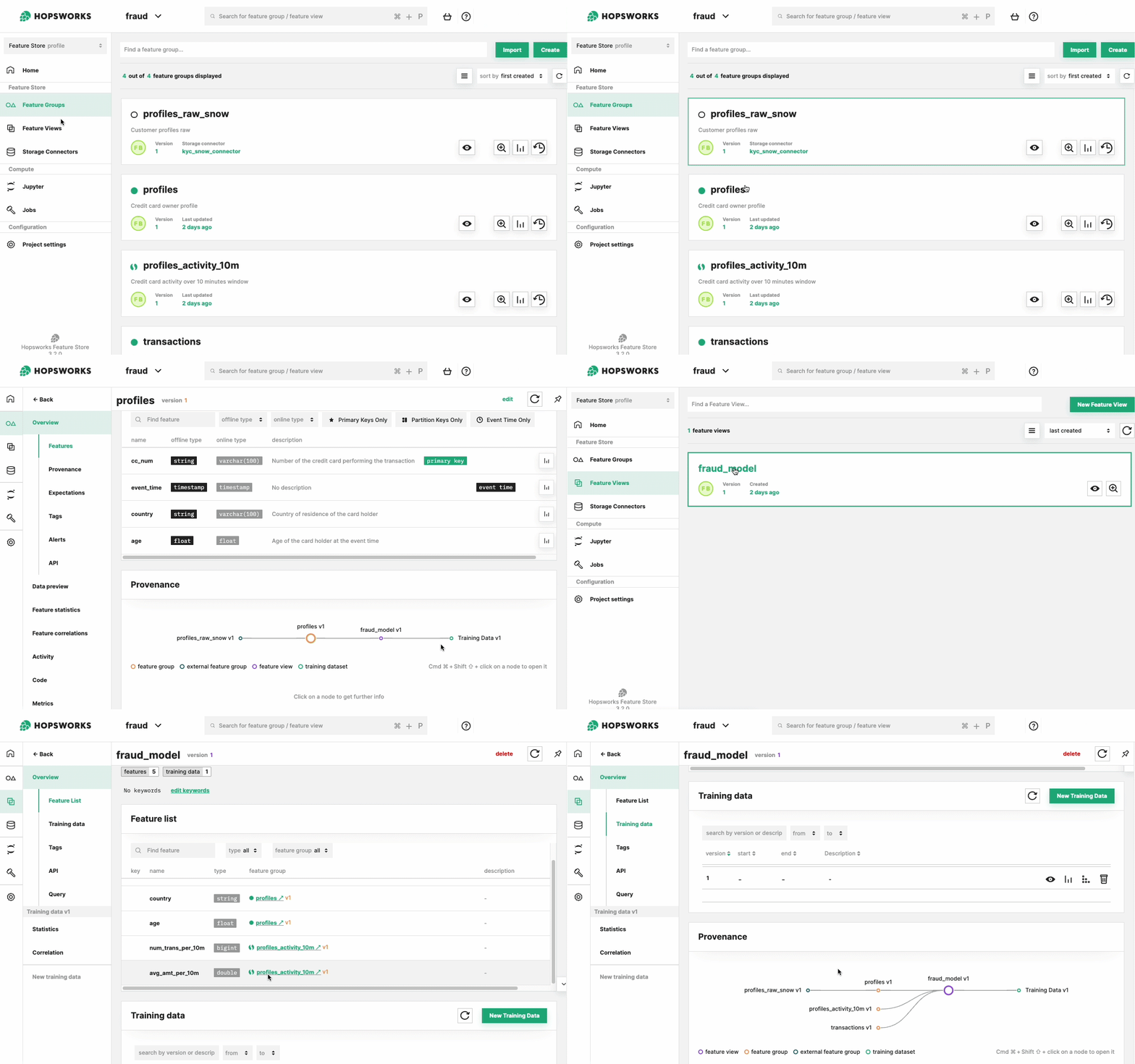
OpenPipe
No screenshots
Hopsworks
OpenPipe
Hopsworks
OpenPipe
My Claude Code morning setup. 8 minutes. Cuts 2 hours of friction. What am I missing?
tutorial-ish but please tell me what I'm doing wrong because I think this is still suboptimal. every morning before I start work I run an 8 minute setup in claude code. it cuts about 2 hours of friction across the day. here's the actual sequence. step 1: cd into the active repo step 2: /resume t
Only in Hopsworks (5)
Hopsworks is better suited for large-scale data workflows due to its comprehensive feature store and robust MLOps platform.
Hopsworks offers a usage-based and tiered pricing model with a free tier option, while OpenPipe is noted for its competitive pricing related to access to advanced models like GPT-3.5-0125.
OpenPipe has better community support, evidenced by its 2,787 GitHub stars, indicating a strong user engagement and developer interest.
Yes, both tools could technically be used together by leveraging Hopsworks for data management and MLOps, and OpenPipe for model fine-tuning, though integration may require customization.
OpenPipe may be easier to get started with due to its user-friendly interface and emphasis on ease of model fine-tuning, though this could vary based on specific project requirements and team expertise.


