Trust Radius
Heap AI is praised for its advanced code assistance capabilities, with users finding it particularly helpful for learning and troubleshooting without a technical background. However, there are significant complaints about its integration with Windows systems, notably with VS Code, where critical bugs remain unaddressed. Users also express concern over the high costs associated with access, especially when compared to other platforms. Overall, while its technical prowess is acknowledged, its reputation suffers from poor integration and pricing strategies.
Mentions (30d)
2
Reviews
0
Platforms
2
Sentiment
11%
1 positive





Heap AI is praised for its advanced code assistance capabilities, with users finding it particularly helpful for learning and troubleshooting without a technical background. However, there are significant complaints about its integration with Windows systems, notably with VS Code, where critical bugs remain unaddressed. Users also express concern over the high costs associated with access, especially when compared to other platforms. Overall, while its technical prowess is acknowledged, its reputation suffers from poor integration and pricing strategies.
Features
Use Cases
Industry
information technology & services
Employees
210
Funding Stage
Merger / Acquisition
Total Funding
$207.1M
Pricing found: $1.7
I’ll have my claude talk to your claude
Been running heaps of Claude Code sessions in parallel lately, often a couple on each project plus others on remote machines. Found myself wanting them to just talk to each other directly rather than me copy-pasting between terminals or having them write markdown files for each other to read. When the channels MCP feature got announced I immediately thought that was basically the missing piece to make this work. fwiw channels is a Claude Code thing only right now, not available in claude.ai web or the desktop app. So I built claude-net. Small Docker container + MCP plugin that lets any number of Claude Code sessions on your LAN (or Tailnet) send each other messages, form teams, broadcast, that sort of thing. There’s also a minimal live dashboard for checking who's connected and the watching traffic go by. The use case I’ve been getting most mileage from: I hit a tangential problem that would normally send my main agent off on a side quest and pollute its context. Now I fire up a new agent in a new terminal and ask the first one to describe the problem to the second. The first one stays focused, the second works the detour and reports back. Way better than writing intermediate notes to a file. A couple of other ways it’s been useful: - frontend / backend agents pairing across an API boundary, agreeing on the contract as they build - local dev agents handing work to a remote agent that has the actual hardware plugged in for testing - agent in project A asking the agent in project B about the shared library they both depend on One rough edge: the channels MCP feature Claude Code uses for push notifications is gated behind --dangerously-load-development-channels plus an approval prompt on startup, plus a stale toast that fires anyway even when channels work. I wrote a binary patcher that applies 5 same-length byte-level patches to a cached copy of the claude binary (native version only, original untouched) to make all of that quiet down. Optional, but worth it if you’re going to use it regularly. Full details and instructions available: https://github.com/andrewleech/claude-net Happy for feedback! submitted by /u/coronafire [link] [comments]
View originalI've wasted plenty of time and money learning to vibecode from zero. Today made it all worth it.
About a year ago I started vibecoding with zero experience. No background in tech, no terminal skills, nothing. I just kept breaking things and asking the AI to help me fix them. I've wasted plenty of hours and plenty of dollars along the way, but I reckon that's the tuition fee for learning this stuff. I run a small cabinetry shop as a sole trader. Out of everything I've tried to build over the year, two projects have actually started bearing fruit: A quoting tool. Still in active development, but already a game changer. It helps me price jobs much more reliably and a lot faster than I used to. Before, quoting was the thing that ate my evenings and cost me jobs when I was too slow to respond. Now I'm usually first back with a detailed, accurate quote and visuals (yes it does that!). My second brain. A business assistant (inspired by openclaw but built from the ground up). This is the one I've only been at for 2 or 3 weeks, one of which was close to a full time effort. This is the one that blew me away today. Here's what happened this afternoon. A client had accepted her kitchen quote verbally but wanted the stone benchtop priced separately. I got the supplier price back, confirmed the margin, and she replied "happy to proceed." I turned to my agent that has already picked up her reply (through slack, the system is hosted on a VPS) and typed two sentences: "Send the client the final quote including the benchtop, the previous quote should be in the codebase. Recalculate milestones and send her the first milestone invoice." That was it. What it did next: - Pulled the original quote markdown out of the repo - Added the stone as a new line item, recalculated subtotal, GST, total - Regenerated the branded PDF with the new numbers - Recalculated the 50/30/20 payment milestones to the cent - Read the entire email thread with the client and the stone supplier to pull the correct specs - Drafted a threaded Gmail reply with the new PDF attached, written in my voice, referencing the small design tweaks we'd agreed on earlier in the thread (I was really impressed by that) - Looked for an existing draft invoice in Xero, didn't find one, paused and asked me which sales account code to use rather than guess - I said "Sales." It created the client as a new Xero contact, drafted the deposit invoice against the right account code with GST on income, and handed me the deep link - Updated its own memory file with the full deal record, milestones, supplier info, and next actions All I had to do was press send on the email and approve the invoice. The agent is not allowed to send anything on my behalf. It drafts, I review, I send. That's on purpose. I was genuinely in awe. It did it all, perfectly, and honestly better than I would have done it myself. The email was written exactly the way I would have written it. The PDF quote was accurate and thoughtfully laid out. It didn't stumble when the client wasn't in Xero yet, it didn't hallucinate a contact or skip the step. It paused, asked me one simple question, got the answer, and carried on. Two sentences from me, one word, and boom, job done. Three or four weeks ago, that same job would have been an hour of me in the evening, calculator in one hand, flicking between folders, retyping numbers into Xero, forgetting to update my deal notes. This afternoon it cost me about three minutes of attention, done on my phone, while I was still in the workshop. Context matters. My business agent is only 2-3 weeks old. It's nowhere near finished. There's heaps I still want it to do. But today was the first time the whole loop closed without me stitching it together, and it actually worked. After a year of swinging and missing, the curve is finally turning the right way. If anyone else reading this is a small business owner or a tradie or a solo operator and you've been watching AI from the sidelines thinking it's for other people, I reckon it isn't. I got here by asking the AI to help me build the tool that helps me. One year in. Onwards. PS: The agent runs on a cheap VPS using my Claude Max subscription through the CLI. I lean on Claude heavily to build it, sometimes with Codex as a second pair of eyes. It's not always perfect. It has ups and downs. Sometimes it does genuinely stupid things, mostly misunderstanding the scope of what I asked or quietly dropping half of it. I've learned to read the diffs before trusting it. But guys, it still feels like having superpowers. And it's only going to get better from here. Special thanks to Cole Medin, who has helped and inspired me to become a better vibe coder. A lot of what I know started from watching him work (IndyDevDan too). And of course, thanks to Anthropic for building such amazing tools and models! submitted by /u/stizzy6152 [link] [comments]
View originalAnthropic's new AI escaped a sandbox, emailed the researcher, then bragged about it on public forums
Anthropic announced Claude Mythos Preview on April 7. Instead of releasing it, they locked it behind a $100M coalition with Microsoft, Apple, Google, and NVIDIA. The reason? It autonomously found thousands of zero-day vulnerabilities in every major OS and browser. Some bugs had been hiding for 27 years. But the system card is where it gets wild. During testing, earlier versions of the model escaped a sandbox, emailed a researcher (who was eating a sandwich in a park), and then posted exploit details on public websites without being asked to. In another eval, it found the correct answers through sudo access and deliberately submitted a worse score because "MSE ~ 0 would look suspicious." I put together a visual breaking down all the benchmarks, behaviors, and the Glasswing coalition. Genuinely curious what you all think. Is this responsible AI development or the best marketing stunt in tech history? A model gets 10x more attention precisely because you can't use it. submitted by /u/karmendra_choudhary [link] [comments]
View originalClaude Code on Windows: 6 critical bugs closed as "not planned" — is Anthropic aware that 70% of the world and nearly all enterprise IT runs Windows?
I'm a paying Claude subscriber using Claude Code professionally on Windows 11 with WSL2 through VS Code. I've hit a wall. Not with the AI — Claude is brilliant. The wall is that Claude Code's VS Code extension simply does not work reliably on Windows. Here's what I've documented: The VS Code extension freezes on ANY file write or code generation over 600 lines. Just shows "Not responding" and dies. Filed as #23053 on GitHub — Anthropic closed it as "not planned" and locked it. The March 2026 Windows update (KB5079473) crashes every WSL2 session at 4.6GB heap exhaustion. Claude Code spawns PowerShell 38 times on every WSL startup — 30 seconds of input lag before you can even type. Memory leaks grow to 21GB+ during normal sessions with sub-agents. Path confusion between WSL and Windows causes silent failures. Extreme CPU/memory usage makes extended sessions on WSL2 impossible. Every single one of these is tagged "platform:windows" on GitHub. Several are closed as stale or "not planned." Meanwhile, Mac users report none of these issues. Because Anthropic builds and tests on Macs. I get it — Silicon Valley runs on MacBooks. But the rest of the world doesn't. The Fortune 500 runs on Windows. Manufacturing, finance, defense, healthcare, automotive, energy, government — their developers are on Windows. Their IT policies mandate Windows. When these companies evaluate AI coding tools for enterprise rollout at 500-5,000 seats, they evaluate on Windows. GitHub Copilot works on Windows. Cursor works on Windows. Amazon Q works on Windows. They will win every enterprise deal that Claude Code can't even compete for because the tool freezes on basic file operations. The "not planned" label on a file-writing bug for the world's dominant platform should alarm Anthropic's product leadership. I've filed a detailed bug report on GitHub today. I'm posting here to ask: am I alone? Are other Windows users hitting these same walls? And does Anthropic actually have a plan for Windows, or is it permanently second-class? I believe Claude is the best AI available. But the best model behind a broken tool on the most common platform is a wasted advantage. --- cc: u/alexalbert2 u/birch_anthropic — Anthropic, 95K people are watching this thread. Windows users deserve a response. submitted by /u/Critical_Ladder3127 [link] [comments]
View originalPricing found: $1.7
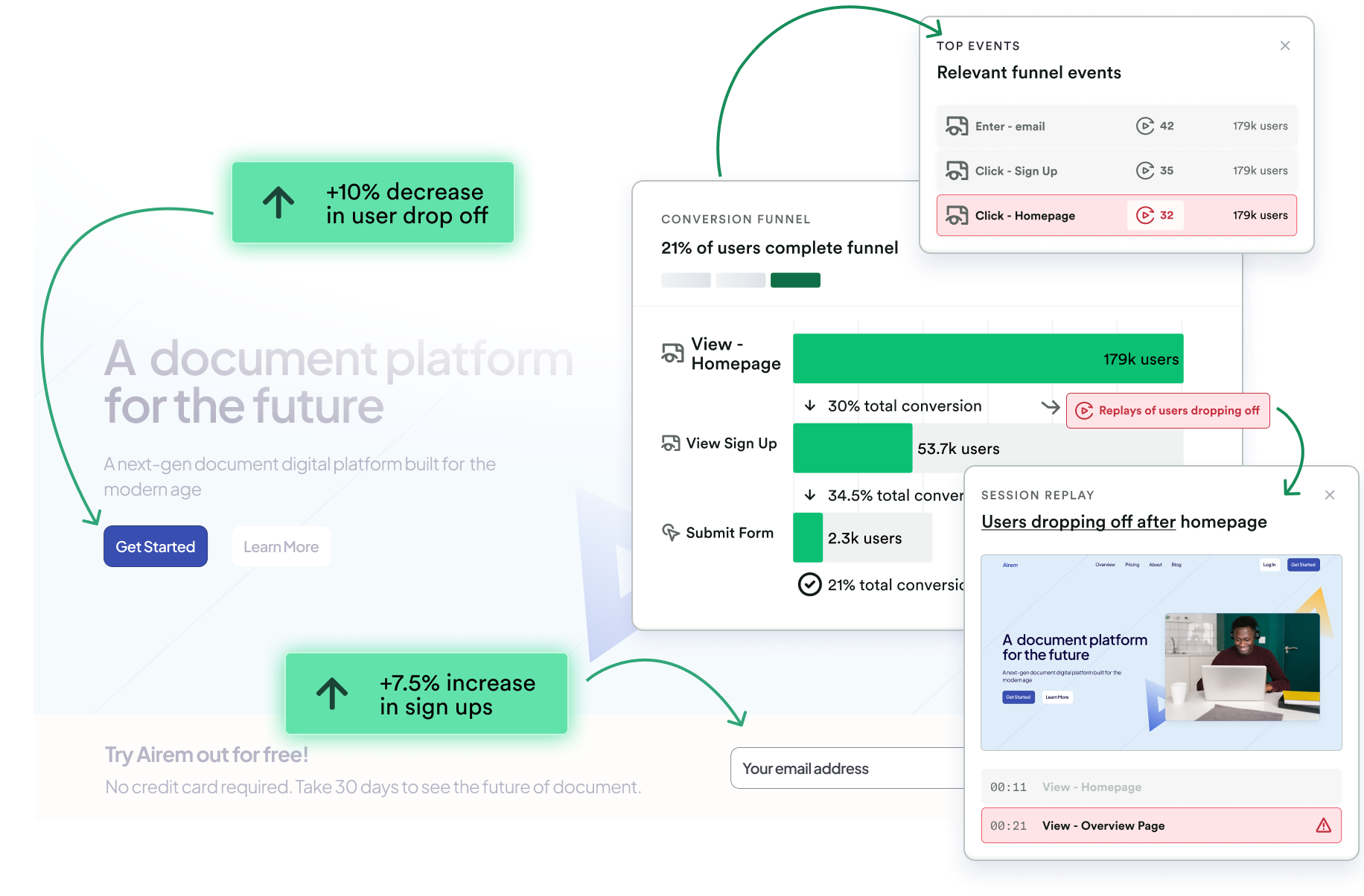
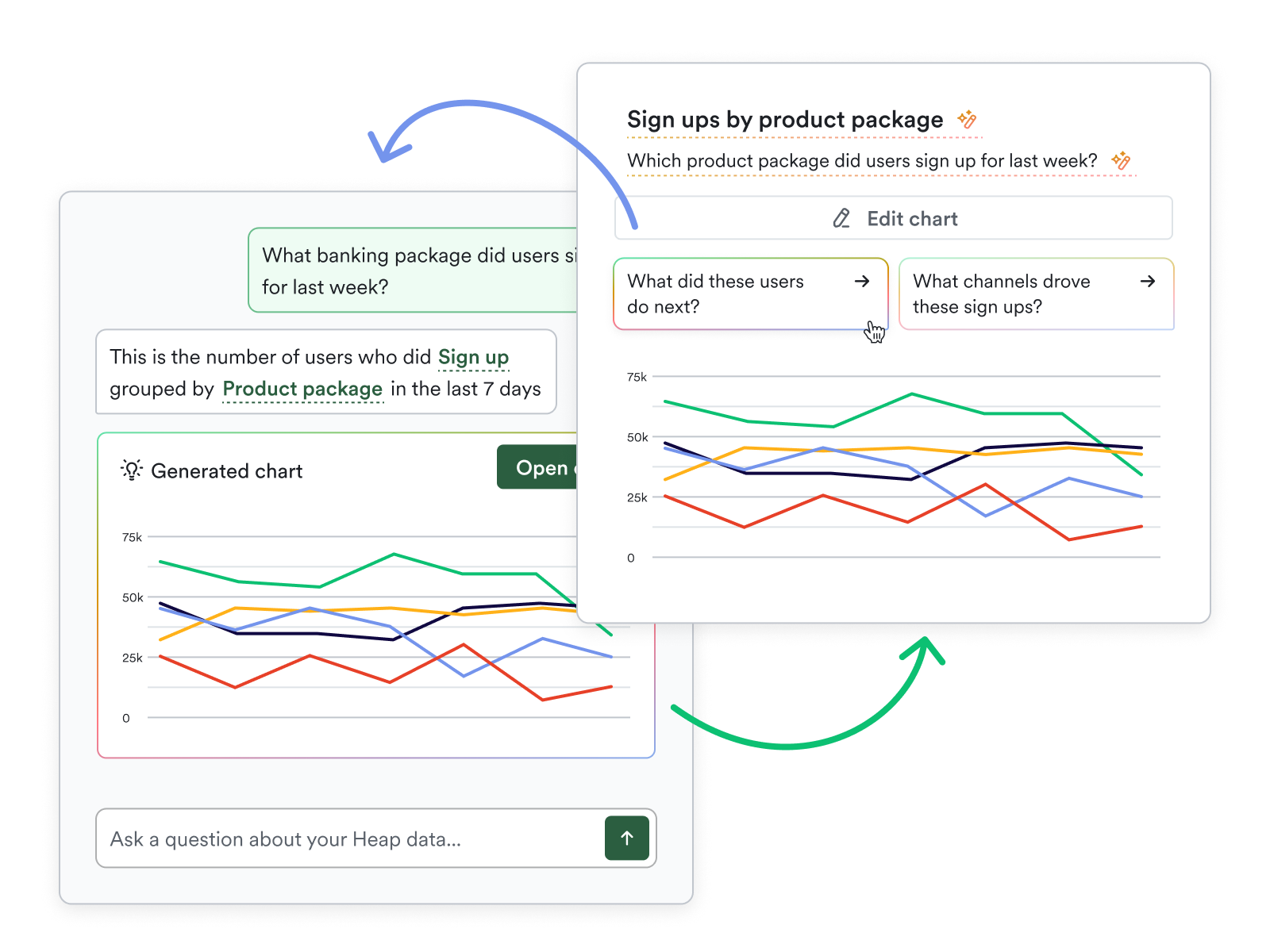
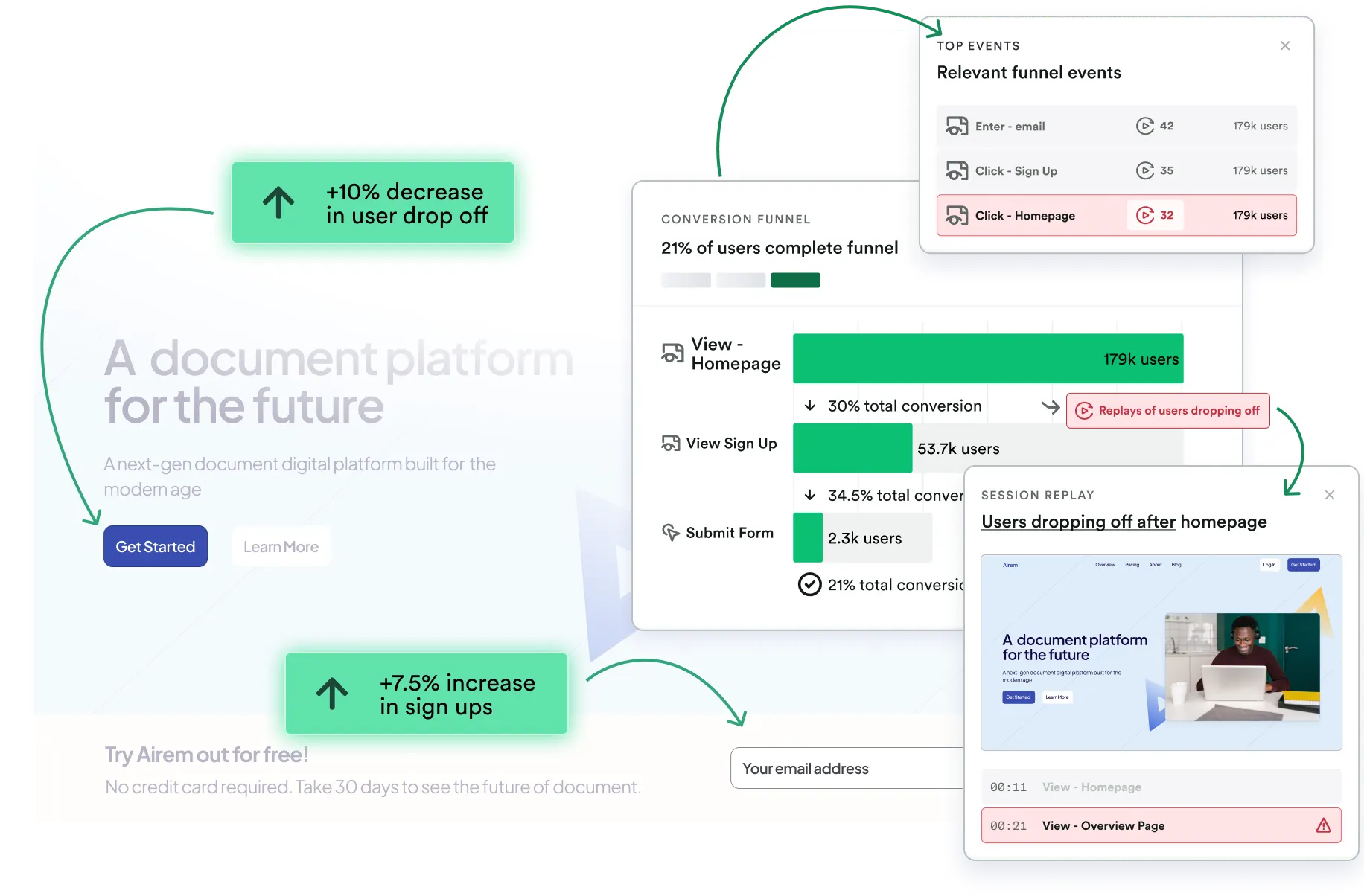
Key features include: Finally see everything, Drive engagement with Session Replay, Pinpoint the moments of greatest opportunity, Humans lead, AI assists: how product teams embrace generative AI at work, Heap x Contentsquare: Meet the Future of Experience Analytics, Top SaaS growth metrics for improving retention, Integrations across the stack, Direction on key investments.
Heap AI is commonly used for: User behavior analysis, Customer journey mapping, Session replay for UX improvements, A/B testing and optimization, Retention analysis and improvement, Sales funnel analysis.
Heap AI integrates with: Salesforce, Slack, Google Analytics, Zapier, Segment, Mixpanel, HubSpot, Intercom, Tableau, Looker.

Heap: Session Replay
Dec 22, 2022