Glean is the Work AI platform connected to your enterprise's data. Find, create, and automate anything. Explore what Work AI can do for you!
Glean is often praised for its AI capabilities and effectiveness in streamlining organizational processes. Users appreciate its user-friendly interface and its ability to enhance productivity. However, some mention concerns about the learning curve and integration challenges with existing systems. Pricing is generally viewed as reasonable, and the tool maintains a positive overall reputation in the market.
Mentions (30d)
2
Reviews
0
Platforms
2
Sentiment
0%
0 positive





Glean is often praised for its AI capabilities and effectiveness in streamlining organizational processes. Users appreciate its user-friendly interface and its ability to enhance productivity. However, some mention concerns about the learning curve and integration challenges with existing systems. Pricing is generally viewed as reasonable, and the tool maintains a positive overall reputation in the market.
Features
Use Cases
Industry
information technology & services
Employees
1,400
Funding Stage
Series F
Total Funding
$780.3M
I am trying to understand persistent memory vs project vs ?
I am a hapless "bean counter". I am retired and do a volunteer work in setting up and fixing the accounting systems of nonprofits. Claude has been outstanding in analyzing the mess of postings I sometimes inherit. I usually do several clients at once and plan for each client to take three weeks to complete. Of course, they never completely go away and often reach out for help later. I have the basic, paid plan and got a warning that I had used 90% of my persistent memory allotment. I know some of that was me directly telling Claude to remember things but much seems to have been data on a couple of clients Claude gleaned from our chats. I find this very interesting. I would love some education on Claude projects and how best to use the persistent memory. Also, how best to purge persistent memory. I know that is pretty broad but I am at the very beginning and those are the kinds of questions you ask at this point. 😄 submitted by /u/JanFromEarth [link] [comments]
View originalArkon: turning Claude from a personal chatbot into a managed organizational resource
Sharing a project I've been building. Not asking for anything in particular - just thought the problem and approach might be interesting to some folks here. The problem Most companies adopting LLMs hit the same wall: every employee uses ChatGPT or Claude individually, copy-pastes confidential docs into random chats, and the org has zero visibility or control. The "AI rollout" is really just a license purchase plus a prayer. On the other end, the heavy enterprise solutions (custom RAG platforms, Glean-style tools) are expensive, complex, and overkill for most mid-sized teams. There's a missing middle: small-to-medium organizations that want their employees to use Claude productively, but with proper access control, shared knowledge, and no manual context-pasting every single time. The approach Arkon sits between the org and Claude. Admins manage knowledge centrally. Employees connect to Arkon via MCP (Model Context Protocol) and automatically get the right context for who they are, without configuring anything. Two realms: Global Knowledge - org-wide docs and wiki, scoped by department. A finance person sees finance docs, an engineer sees engineering docs. Admins decide who sees what. Workspaces - smaller scopes for projects, teams, or cross-functional initiatives. Membership-gated. Your global role doesn't bleed into workspaces - you only see workspaces you're a member of. The MCP integration means employees keep using Claude the way they already do (Claude Desktop, Claude Code, whatever client they prefer). They don't learn a new tool. They just suddenly have org context available when they need it. How wiki generation actually works This is the part I think is interesting and slightly different from typical RAG setups. Arkon isn't a retrieval-augmented chatbot. It's an LLM-generated wiki layer. When you upload a document - say a 300-page handbook - Arkon uses an LLM to analyze the structure and produce a hierarchical wiki. If the source has clear headings, the wiki follows them. If not, the LLM clusters content by topic semantically. The output is a browsable, organized internal reference, not a linear summary. I'm honest with users about the tradeoff: LLM-generated content has no guarantee of accuracy, especially for deep domain material. So there's a human-in-the-loop layer in the roadmap - employees can flag, annotate, and edit wiki content. The LLM does the organizational heavy lifting; humans own final correctness. Permissioning lessons learned The biggest design pivot so far: I initially had roles carry both what you can do and what you can do it on in one bag. This led to a classic bug - give a user "read documents" and suddenly they could read every document in the org, ignoring department scope. Fixed it by splitting cleanly: Permissions are scoped strings: doc:read:own_dept vs doc:read:all Workspaces are pure membership checks - global roles cannot grant workspace access, ever Two realms, fully independent If anyone is building org-level permission systems, that separation is worth getting right early. Retrofitting it is painful. Repo: github.com/nduckmink/arkon Happy to answer questions about architecture, MCP integration, or the permission model. Feedback and criticism welcome - especially from anyone who has built or used internal knowledge systems and seen what works and what doesn't. submitted by /u/Glass-Statistician97 [link] [comments]
View originalOpen AI going the Palantair route?
submitted by /u/Gullible-Angle4206 [link] [comments]
View originalGlean uses a per-seat + tiered pricing model. Visit their website for current pricing details.
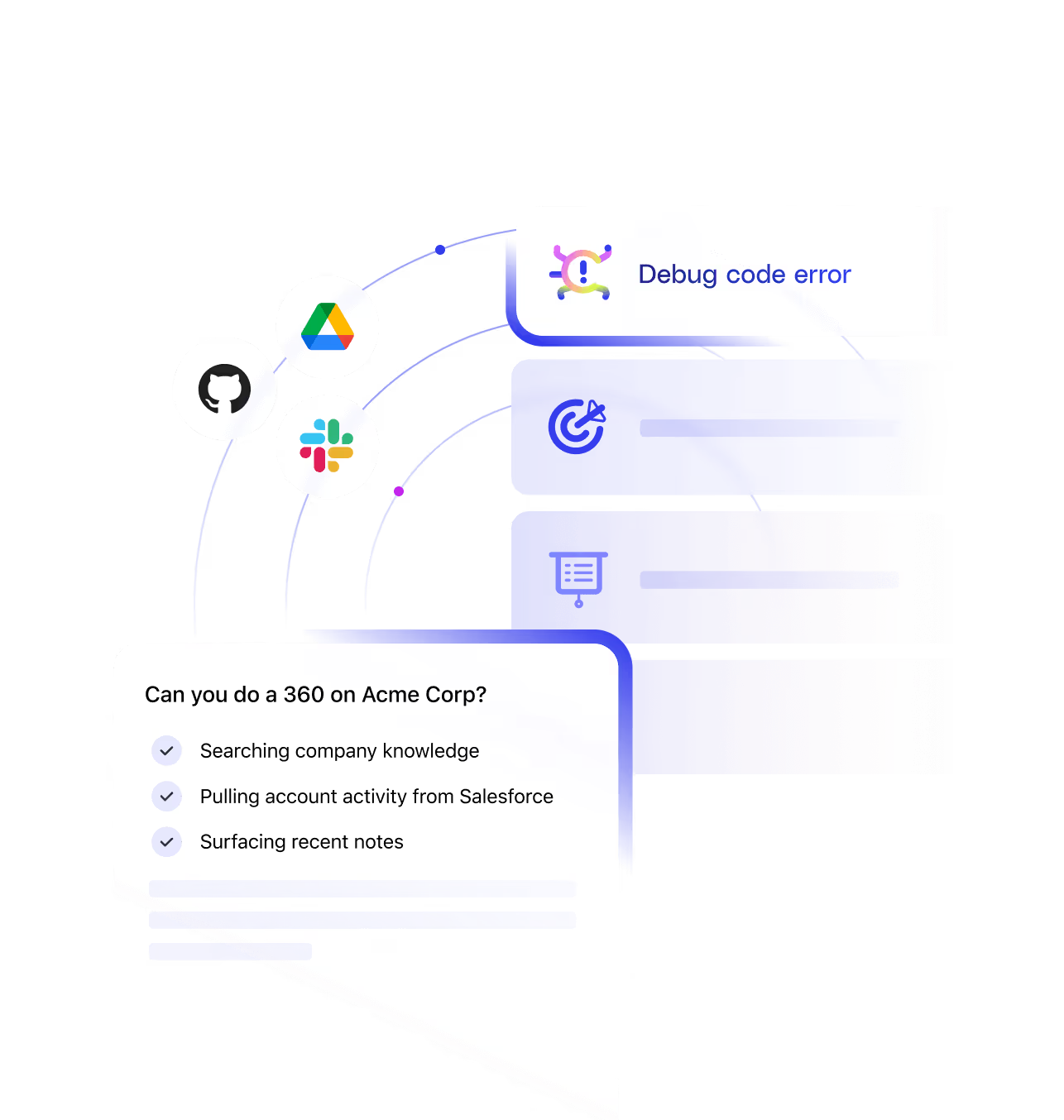
Key features include: Native file types such as Docs, Sheets, and Slides, Merge request descriptions, Merge request conversations and comments, Commit messages for main branch, Directory and file names, Full content of documentation files only (.md and .txt), Repositories, Knowledge articles and attachments.
Glean is commonly used for: Streamlining team collaboration by enabling quick access to project documentation., Enhancing productivity by providing AI-driven insights from various file types., Facilitating knowledge sharing through easy retrieval of knowledge articles and attachments., Automating responses to common queries using AI agents., Improving onboarding processes with easy access to training materials and documentation., Supporting decision-making by aggregating relevant data from multiple sources..
Glean integrates with: Google Workspace (Docs, Sheets, Slides), Slack, Microsoft Teams, GitHub, Jira, Confluence, Asana, Trello, Zapier, Dropbox.

The Verge AI
Publication at The Verge
1 mention

Shipping Better Code, Faster
Apr 9, 2026