One AI Agent handles research, writing, optimization, and publishing. Stop juggling five tools. Join thousands of content teams.
Users generally appreciate Frase for its efficient content optimization and AI-driven features that streamline content creation. Many mention its user-friendly interface and effectiveness in improving SEO performance. Common complaints include occasional inaccuracies in AI-generated content and the need for additional features to expand functionality. Pricing sentiment is mixed, with some users finding it affordable and others suggesting it could be more cost-competitive. Overall, Frase maintains a positive reputation as a helpful tool for enhancing content quality and SEO strategies.
Mentions (30d)
0
Reviews
0
Platforms
3
Sentiment
13%
1 positive

Users generally appreciate Frase for its efficient content optimization and AI-driven features that streamline content creation. Many mention its user-friendly interface and effectiveness in improving SEO performance. Common complaints include occasional inaccuracies in AI-generated content and the need for additional features to expand functionality. Pricing sentiment is mixed, with some users finding it affordable and others suggesting it could be more cost-competitive. Overall, Frase maintains a positive reputation as a helpful tool for enhancing content quality and SEO strategies.
Features
Use Cases
Industry
information technology & services
Employees
11
Funding Stage
Merger / Acquisition
Total Funding
$1.1M
The Anti-Feminist Agenda of the Latin American Far Right
The works in this dossier include illustrations and excerpts from longer comics – snapshots of scenes of struggle, care work, invisible labour, militancy, and instances of ‘putting one’s body on the line’ (poner el cuerpo). The creators of these works are Latin American women and members of the LGBTQIA+ community who seek to defend and tell their own stories in the face of the far right’s many-pronged agenda in the region. The selection was made in collaboration with Feminismo Gráfico (Graphic Feminism), a collective dedicated to compiling, recovering, and showcasing Argentinian women creators of comics and graphic humour from the early twentieth century to the present. Feminismo Gráfico builds a critical genealogy of the comics medium from a feminist perspective, contesting meanings in a popular language that has long been undervalued and centring the experiences of women and dissident genders and sexualities. Visit their archive at feminismografico.com. 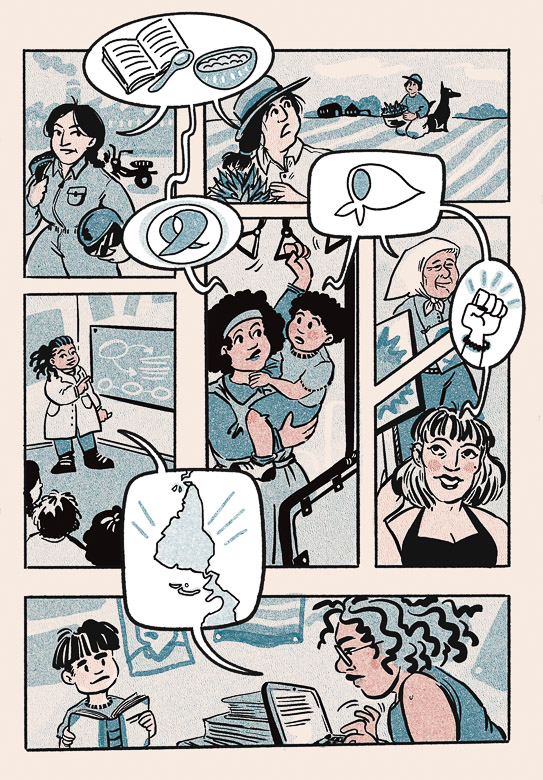 Dani Ruggeri (Argentina), *Colectivo* (Collective), 2026. ## Introduction Since 2016, marches against sexual and gender diversity[1](#_edn1) have swept across Latin America. They feature women dressed in pink and men in blue to underscore traditional gender roles. The marches have been accompanied by a strong social media presence, with hashtags such as #NoALaIdeologíaDeGénero (‘No to gender ideology’), #ConMisHijosNoTeMetas (‘Don’t mess with my children’), #AMisHijosLosEducoYo (‘I will educate my children’), and #ConLosNiñosNo (‘Not with children’). These campaigns, which have their roots in the United States in the 1970s and reemerged in the twenty-first century, are part of an anti-gender, anti-feminist wave driven by Christian fundamentalism. This wave has swept across Catholic-majority countries in Western Europe such as Spain and Italy; across Eastern Europe, from Croatia and Hungary to Poland and Slovenia; and beyond Europe, from Australia to Sub-Saharan Africa. In many countries, efforts to sabotage comprehensive sex education and restrict access to contraceptives and safe abortion are widespread (for instance, more than half of the countries in Sub-Saharan Africa criminalise sexual and gender diversity).[2](#_edn2) Alongside this conservative wave, Latin America experienced an intense transnational cycle of feminist mobilisation (2015–2019). This cycle of feminist mobilisation also strained the limits of state institutions and often outpaced the agendas of the region’s progressive governments, pressing demands that went further than those governments were willing or able to pursue. Today’s far right is international and ascendant, from the Philippines and Hungary to India and Argentina. In this dossier, we examine how, in Latin America, its tentacles intertwine with those of global, regional, and local ultraconservative organisations – both religious and secular – to promote an agenda against the rights of women and sexually and gender-diverse people. Our main lens for analysing how this agenda operates in different countries is The Con Mis Hijos No Te Metas (‘Don’t Mess with My Children’) campaign, which is active across most of the region. We look at six Latin American countries to show how this campaign operated between 2016 and 2025: Peru, where it originated; Ecuador, where it was first exported and took hold under an economically and politically progressive government; Argentina, home to the strongest feminist movements in the region, where major legal and institutional advances have been achieved for the rights of women and sexually and gender-diverse people; Chile, where the massive popular uprising of 2019 failed to consolidate broad gains even as the feminist movement managed to achieve some; and El Salvador, among the most conservative countries on sexual and reproductive rights. El Salvador shares with Brazil – also analysed here – a strong presence of evangelical fundamentalist movements and the fact that, although the Con Mis Hijos No Te Metas campaign has played a limited role, other mechanisms and closely related campaigns have. ## *Part 1* The Women’s Question in Latin America: Between Democratic Transition and Neoliberal Consolidation The women’s movement in Latin America emerged in the 1970s and 1980s as part of the struggles against dictatorships, structural inequalities, and neoliberalism, bringing together demands around gender violence, reproductive rights, the recognition of care work, and political participation. It developed in conversation with the UN’s global agenda on women’s rights and in – often contentious – dialogue with trade-union, peasant, and human rights movements. In the 1980s and 1990s, the movement’s demands were partially incorporated into public policy as governments adopted gender policies and set up specialised state agencies. But this institutionalisation took place in contradiction with neoliberal hegemony, which i
View originalPricing found: $29/seat, $29/seat, $720/year
ChatGPT tiene un fallo absurdo en voz a texto que Grok resuelve con un simple botón. Ojalá lo arreglen pronto.
No sé si soy el único al que le pasa, pero hay una pequeña diferencia entre el modo voz a texto de ChatGPT y el de Grok que, una vez la notas, hace que el de ChatGPT se sienta muchísimo más torpe. Todos conocemos su función de voz a texto whisper: le das al icono del micrófono, hablas, y lo que dices se convierte en texto. Es comodísimo para escribir mensajes largos sin tener que usar el teclado. Hasta ahí, perfecto. El problema está en lo que pasa después. En ChatGPT, en cuanto empiezas a escribir con el teclado, o incluso después de haber usado ya una vez el dictado por voz en ese mismo mensaje, el icono desaparece y se sustituye básicamente por el botón de enviar. Es como si ChatGPT asumiera: “vale, ya has hablado o ya has escrito algo, así que no vas a necesitar volver a dictar más en este mensaje”. Y ahí es donde, para mí, falla. Porque muchas veces no quieres dictar todo de una sola vez. A veces empiezas hablando, luego corriges algo con el teclado, luego quieres añadir otra frase con la voz, luego editar, luego ampliar el mensaje… Es una redacción mixta. Voz, teclado, voz otra vez. Algo natural. Grok, en cambio, lo hace mucho mejor: mantiene siempre el icono de voz a texto disponible. Aunque ya hayas dictado algo. Aunque hayas escrito con el teclado. Aunque estés a mitad del mensaje. El botón sigue ahí, listo para que puedas volver a usarlo cuando quieras. Y lo más absurdo es que no parece una función complicadísima. No estoy pidiendo nada loco, es literalmente no quitar un botón mientras redactas en ChatGPT, mantener el acceso al dictado por voz durante toda la redacción del mensaje. El botón de enviar puede aparecer, claro. Pero no hace falta que sustituya al de voz a texto. Grok simplemente mantiene ambos comportamientos disponibles y por eso se siente mucho más cómodo, flexible y eficiente. Me sorprende bastante que ChatGPT, que va por delante en tantas cosas, se quede atrás en un detalle tan pequeño pero tan importante para la experiencia de uso diaria. Porque al final no es solo una cuestión estética. Es una cuestión de fluidez. ChatGPT te obliga a cambiar al teclado cuando quizá querías seguir usando la voz. Grok te deja decidir en cada momento. Y sinceramente, una vez pruebas ese pequeño detalle en Grok, el sistema de ChatGPT se siente innecesariamente limitado, y me da pena porque no me gusta Grok jajaja. ¿Soy el único al que esto le parece una cagada de UX bastante evidente? submitted by /u/gutierrezz36 [link] [comments]
View originalProblemas usando agentes de IA para revisión editorial completa de libros
Hola a todos. Estoy usando Claude AI con seis agentes distintos dentro de un flujo editorial: lector crítico, editor estructural, corrector de estilo, editor de continuidad, sensibilidad de mercado, etc. El problema es que, aunque al crear los agentes su contexto y su función parecen razonables, cuando les pido una revisión real de un texto o de un libro completo, casi siempre acaban siendo demasiado amables. Yo soy escritor amateur. Escribo porque me gusta, no porque tenga una red de lectores beta, amistades que lean mis manuscritos o contactos en el mundo editorial. Tengo 46 años y llevo usando ordenadores desde 1988, así que estoy bastante acostumbrado a trabajar con herramientas digitales, pero con la IA me encuentro una dificultad concreta: no consigo que critique de verdad. Aunque en los prompts indico claramente que quiero crítica constructiva, evaluación editorial dura, detección de fallos reales, contradicciones, problemas de ritmo, personajes flojos, escenas que no funcionan, exceso de explicación, diálogos artificiales, estructura débil, etc., los agentes tienden a suavizarlo todo. Muchas veces responden con frases tipo: “El texto tiene mucho potencial” “Funciona bastante bien” “Solo necesita algunos ajustes” “La voz es interesante” “Hay una buena base” Pero luego, cuando insisto varias veces, empiezan a aparecer problemas importantes que no habían mencionado al principio. Eso me obliga a hacer diez revisiones o diez repreguntas para conseguir una respuesta realmente útil, concreta y clara. Mi sensación es que los agentes entienden su rol, pero no lo ejecutan con suficiente dureza editorial. Parecen más preocupados por ser agradables que por ser útiles. Lo que necesito no es que me animen. Necesito que me digan cosas como: “Este capítulo no funciona por estas razones.” “Este personaje no tiene conflicto interno.” “Esta escena sobra.” “Este diálogo suena falso.” “Aquí estás repitiendo la misma idea tres veces.” “El ritmo cae en este punto.” “El tono prometido no coincide con lo que realmente está escrito.” “Esto no parece una novela terminada, parece un borrador.” No busco crueldad gratuita, pero sí una revisión editorial real. Si algo está mal, quiero que lo diga. Si algo es mediocre, quiero saberlo. Si una parte es aburrida, confusa o repetitiva, necesito que lo marque sin rodeos. Mi pregunta es: ¿Qué estoy haciendo mal al configurar estos agentes? ¿El problema está en el prompt? ¿En pedir “crítica constructiva”? ¿En dividir la revisión entre demasiados agentes? ¿En que la IA tiende por defecto a proteger emocionalmente al usuario? ¿En que debería usar una rúbrica mucho más cerrada y obligarla a puntuar cada apartado? ¿O simplemente estas herramientas no son todavía buenas para una revisión editorial dura de libros completos? También me interesa saber si alguien ha conseguido que agentes de IA trabajen como editores reales, no como lectores amables. Me refiero a revisiones con criterios claros, ejemplos concretos, diagnóstico de problemas y propuestas de corrección aplicables. Perdón si mi expresión no es perfecta. El inglés no es mi lengua principal. Gracias por cualquier consejo. Edit(Uso Haiku) submitted by /u/linf0cito [link] [comments]
View originalThe Anti-Feminist Agenda of the Latin American Far Right
The works in this dossier include illustrations and excerpts from longer comics – snapshots of scenes of struggle, care work, invisible labour, militancy, and instances of ‘putting one’s body on the line’ (poner el cuerpo). The creators of these works are Latin American women and members of the LGBTQIA+ community who seek to defend and tell their own stories in the face of the far right’s many-pronged agenda in the region. The selection was made in collaboration with Feminismo Gráfico (Graphic Feminism), a collective dedicated to compiling, recovering, and showcasing Argentinian women creators of comics and graphic humour from the early twentieth century to the present. Feminismo Gráfico builds a critical genealogy of the comics medium from a feminist perspective, contesting meanings in a popular language that has long been undervalued and centring the experiences of women and dissident genders and sexualities. Visit their archive at feminismografico.com.  Dani Ruggeri (Argentina), *Colectivo* (Collective), 2026. ## Introduction Since 2016, marches against sexual and gender diversity[1](#_edn1) have swept across Latin America. They feature women dressed in pink and men in blue to underscore traditional gender roles. The marches have been accompanied by a strong social media presence, with hashtags such as #NoALaIdeologíaDeGénero (‘No to gender ideology’), #ConMisHijosNoTeMetas (‘Don’t mess with my children’), #AMisHijosLosEducoYo (‘I will educate my children’), and #ConLosNiñosNo (‘Not with children’). These campaigns, which have their roots in the United States in the 1970s and reemerged in the twenty-first century, are part of an anti-gender, anti-feminist wave driven by Christian fundamentalism. This wave has swept across Catholic-majority countries in Western Europe such as Spain and Italy; across Eastern Europe, from Croatia and Hungary to Poland and Slovenia; and beyond Europe, from Australia to Sub-Saharan Africa. In many countries, efforts to sabotage comprehensive sex education and restrict access to contraceptives and safe abortion are widespread (for instance, more than half of the countries in Sub-Saharan Africa criminalise sexual and gender diversity).[2](#_edn2) Alongside this conservative wave, Latin America experienced an intense transnational cycle of feminist mobilisation (2015–2019). This cycle of feminist mobilisation also strained the limits of state institutions and often outpaced the agendas of the region’s progressive governments, pressing demands that went further than those governments were willing or able to pursue. Today’s far right is international and ascendant, from the Philippines and Hungary to India and Argentina. In this dossier, we examine how, in Latin America, its tentacles intertwine with those of global, regional, and local ultraconservative organisations – both religious and secular – to promote an agenda against the rights of women and sexually and gender-diverse people. Our main lens for analysing how this agenda operates in different countries is The Con Mis Hijos No Te Metas (‘Don’t Mess with My Children’) campaign, which is active across most of the region. We look at six Latin American countries to show how this campaign operated between 2016 and 2025: Peru, where it originated; Ecuador, where it was first exported and took hold under an economically and politically progressive government; Argentina, home to the strongest feminist movements in the region, where major legal and institutional advances have been achieved for the rights of women and sexually and gender-diverse people; Chile, where the massive popular uprising of 2019 failed to consolidate broad gains even as the feminist movement managed to achieve some; and El Salvador, among the most conservative countries on sexual and reproductive rights. El Salvador shares with Brazil – also analysed here – a strong presence of evangelical fundamentalist movements and the fact that, although the Con Mis Hijos No Te Metas campaign has played a limited role, other mechanisms and closely related campaigns have. ## *Part 1* The Women’s Question in Latin America: Between Democratic Transition and Neoliberal Consolidation The women’s movement in Latin America emerged in the 1970s and 1980s as part of the struggles against dictatorships, structural inequalities, and neoliberalism, bringing together demands around gender violence, reproductive rights, the recognition of care work, and political participation. It developed in conversation with the UN’s global agenda on women’s rights and in – often contentious – dialogue with trade-union, peasant, and human rights movements. In the 1980s and 1990s, the movement’s demands were partially incorporated into public policy as governments adopted gender policies and set up specialised state agencies. But this institutionalisation took place in contradiction with neoliberal hegemony, which i
View originalPricing found: $29/seat, $29/seat, $720/year
Key features include: Frase Agent, AI Search Tracking, Content Guard, Content Optimization (SEO + GEO), SEO Research SERP Analysis, Content Opportunities, AI Content Writing, Programmatic SEO.
Frase is commonly used for: Optimizing blog posts for targeted keywords, Conducting competitive SEO analysis, Generating content briefs for writers, Tracking keyword rankings over time, Identifying content gaps in existing website, Creating topic clusters for better content organization.
Frase integrates with: WordPress, Google Analytics, Zapier, SEMrush, Ahrefs, HubSpot, Mailchimp, Slack, Google Search Console, Trello.

The AI Index
Research at Stanford HAI
1 mention