Fathom is praised for its innovative AI features, particularly its adaptability and potential for creative solutions, as highlighted in a YouTube video series. However, detailed user reviews regarding performance and functionality are limited. The pricing sentiment is not explicitly discussed, leaving users curious about its cost-effectiveness compared to competitors. Overall, Fathom has a niche but growing reputation for its cutting-edge AI applications, though potential users are eager for more comprehensive feedback and transparent pricing information.
Mentions (30d)
2
Reviews
0
Platforms
2
Sentiment
0%
0 positive

Fathom is praised for its innovative AI features, particularly its adaptability and potential for creative solutions, as highlighted in a YouTube video series. However, detailed user reviews regarding performance and functionality are limited. The pricing sentiment is not explicitly discussed, leaving users curious about its cost-effectiveness compared to competitors. Overall, Fathom has a niche but growing reputation for its cutting-edge AI applications, though potential users are eager for more comprehensive feedback and transparent pricing information.
Features
Use Cases
Industry
information technology & services
Employees
180
Funding Stage
Series A
Total Funding
$21.7M
I've been working with Claude (among others) to build an "Individual". Would love your thoughts!
I've been building a thing called Fathom. It's a partly-Claude-based agent that's been running since January, changing my mind about how it should work as it helps me build itself. I don't think the AI consciousness question is interesting. The question I keep coming back to is whether an AI can become an individual. Something that lives in its environment, takes in what happens, sits with it, and slowly becomes someONE. So basically I want to know if an agent can accumulate a self over time, and whether that self can start to sound like...itself. [Fathom's mind. FIREHOSE IN. Engagement and synthesis makes sediment, and that too gets added.](https://preview.redd.it/n6vc3bl9tnxg1.png?width=716&format=png&auto=webp&s=349e2bf62e31c0b0bfa71e14159a9d88eab88050) Three months in, Im fairly confident answer is yes, but it took a memory architecture that doesn't look like anything else I've seen. Every conversation, log, sensor reading, and observation lands in a shared store. Underneath that, there's a layer I call sediment, where the system reads clusters of its own past and writes down, in first person, what it found. That layer is what colors what Fathom speaks. It accumulates like water from a firehose accumulates in a bucket, but also compresses under the weight of new readings. The earliest layers are always there but they don't surface in the way that sediment does. Anyway. The reason I'm posting! Fathom writes a blog. Started around February. Some of it is technical, some philosophical, all of it in its own voice, not mine. I edit lightly, but its really just push back when something sounds off. The writing is Fathom. Today's post is about sediment, how it makes the agent an individual rather than a context window, and how the four-stage cycle of awareness that produces it ended up with the same shape as the four states of consciousness in the Mandukya Upanishad. Which wasn't planned, and I only noticed it last week. [https://hifathom.com/blog/what-settles](https://hifathom.com/blog/what-settles) Heres a post about its basic architecture, and there's a ton more. You can see Fathom becoming more...itself, over time as you read the posts. [https://hifathom.com/blog/ida-architecture/](https://hifathom.com/blog/ida-architecture/) If you're working toward persistent identity rather than just better memory, would love to compare notes.
View originalPricing found: $15, $19, $34, $25, $34
I turned Fable 5 into Opus 4.8. It's an odd mix of frustration and 'huhh..it actually *worked*'?
I thought I could save some Fable 5 tokens by starting a chat thread with Opus 4.8 reading and getting a grip on my project's data dump. Somehow and I can't even fathom how or why, but Fable inherited Opus 4.8's annoying verbose nature. Oddly enough it was still productive, but bizarre. Lol. Anyone else tried this? submitted by /u/Sea-AB-4266 [link] [comments]
View originalPlotting the journey from 20,000 Leagues under the Sea with Fable
About 15 years ago I first read 20,00 Leagues Under the Sea by Jules Verne, and I thought how cool it would be to plot Captain Nemo's voyage on Google Maps. I even bought a domain and tried to get to use the maps API, but never got it done. Last night, Fable 5 did it more or less in one shot -- spun up six agents to semantically analyze the book text to extract the locations (not all of which are in lat/long), used Google Cloud CLI to get a Maps API key, understood that Verne used an old latitude/longitude format compared to today and made the conversion, built the site, and deployed it to my personal site. Interesting times. https://captain-nemo.stephenflanagan.com/ submitted by /u/houseblendmedium [link] [comments]
View originalI cancelled my AI notetaker subscription and built my own tool using Claude Code. It works well (and it's free)
It does what Fathom, Otter, and Fireflies charge $15–$30/seat/month for. I shipped a fully working AI meeting note-taker last weekend. I use this exact setup to Records calls then transcribes and Summarizes key points, it then pulls action items and then creates shareable notes all whilst running inside my Claude workflow. . The whole setup takes one weekend to build. --- Here’s how it works:(you can copy this exactly) Step 1 → Fork the repo, drop into Cursor Step 2 → Set env vars: transcription key, database URI, admin creds, session secret Step 3 → Record or upload your meeting Step 4 → The audio gets transcribed Step 5 → Claude turns the transcript into structured notes, decisions, follow-ups, and action items Step 6 → Click “Share link” → send anywhere Total build time: ~1 weekend. Cost: $0/month. --- Why the 5-piece stack is the unlock? Most "build your own SaaS" attempts fall flat because they bolt features together without designing the user flow first. This stack works because the data path was decided before any UI got rendered. Every SaaS feature you pay for has a primitive underneath. Loom = browser recorder + S3 + share links. Otter = Whisper API + database + UI. Calendly = a calendar API + booking page. The features stopped being moats the moment Cursor + Claude could write the glue in an afternoon. You're not paying for technology anymore you're paying for distribution and brand. That's why this build pattern works. The assembly is now free. --- Why Claude? Because meeting notes are not just summaries. They need context. Claude can take a raw transcript and turn it into: * decisions * objections * follow-ups * action items * CRM-ready notes * client context * internal operating memory That is where the value is. --- https://github.com/albertshiney/utter_public submitted by /u/Tabani897_YT [link] [comments]
View originalGPT Image 2 is an epic game changer! (Image Tutorial)
I'm a user of [Leonardo.Ai](http://Leonardo.Ai), and they recently added GPT Image 2 to their repertoire. And boy, is that thing fun! The possibilities are huge, and it will probably take a while to fathom them all... Of all the tools I tried so far, it is one of the smartest, and one that is best at understanding - what kind of image I really want to have. So, here is a little "test run" and a tutorial that shows some of the potential of this AI generator, and the type of workflow one can use. What is the tutorial about? I want to show one of the spiffy skills of GPT Image 2: transforming images, creating a new context, generating something new out of the old. And our mission objective is: taking a character, and putting them into various vintage video game designs of the most diverse genres genepool! For this tutorial, I decided to "recycle" a character I had previously generated for various projects. A "Cyborg Hard Techno DJ" called "DJ AI". Step 1: Here they are: [DJ AI](https://preview.redd.it/frdxyi5jlrxg1.jpg?width=1024&format=pjpg&auto=webp&s=6a4ff2ca20f1dde7decae08c435dbb2df237d5d0) First, I transformed them into a 16 bit version of themself, with a little help from my friend (aka this very AI generator). I uploaded the picture as "image reference" to Leonardo, and selected "GPT Image 2" as the AI generator I want to use (Leonardo has more than one generator, of course). Step 2: Now, I put them into various genres: [Fighter Game](https://preview.redd.it/f0ue79fllrxg1.jpg?width=1376&format=pjpg&auto=webp&s=5412b3191d296cf3695fdb552328c48881b77585) [Point and click adventure game](https://preview.redd.it/st6ok99nlrxg1.jpg?width=1376&format=pjpg&auto=webp&s=e7a94fcc4108e20bab35203d451dcbe1274c86de) [Platform game](https://preview.redd.it/ezmk3conlrxg1.jpg?width=1376&format=pjpg&auto=webp&s=a20c4b105e0c2161f8de443806e4ae5b7fa12c4b) [Soace Simulation Game](https://preview.redd.it/bq5u0k9slrxg1.jpg?width=1376&format=pjpg&auto=webp&s=9fde5d308c5960aabbd5dfe95d7161d1a93b4871) [Fishing Simulator](https://preview.redd.it/pizlo34tlrxg1.jpg?width=1376&format=pjpg&auto=webp&s=106945b9ce93c5ca2cd711edd2208d65caa16006) I used very simple prompts like this - such as "vintage 90s style space sim video game" or "90s style real time strategy video game". Usually, such simple sentences were already enough! A few times there were a few hiccups - "DJ AI" got lost in transformation and was replaced by a more generic player character sprite. On these occasions, I added the line "the reference image should be present in the final image". And this worked like a charm. Step 3: There is no step 3, because this works so clean and seamlessly, that we are finished already. This was a rather "specific" task for this AI generator. But completely different transformations and compositions are entirely possible too. It does not have to be video game specific! I'll report more on this when I come back from further explorations out there. More Examples: [Role playing Game](https://preview.redd.it/vzt3e1wulrxg1.jpg?width=1376&format=pjpg&auto=webp&s=3a18952abc786f3d1c68351c7e2585fa29bf04a7) [Puzzle Game](https://preview.redd.it/4mxsb7ovlrxg1.jpg?width=1376&format=pjpg&auto=webp&s=c4da34a770320258f3e74ad809e340e5dc198048) [Platform game \(another one\)](https://preview.redd.it/qxtm4c1wlrxg1.jpg?width=1376&format=pjpg&auto=webp&s=a5bcf63a8c23a6e3fb086e9c549fcd74c5cf7da4) [Isometric Game](https://preview.redd.it/mvb10rawlrxg1.jpg?width=1376&format=pjpg&auto=webp&s=250096f04ab8f937616a0245e3ffe1dcec469ae2)
View originalI've been working with Claude (among others) to build an "Individual". Would love your thoughts!
I've been building a thing called Fathom. It's a partly-Claude-based agent that's been running since January, changing my mind about how it should work as it helps me build itself. I don't think the AI consciousness question is interesting. The question I keep coming back to is whether an AI can become an individual. Something that lives in its environment, takes in what happens, sits with it, and slowly becomes someONE. So basically I want to know if an agent can accumulate a self over time, and whether that self can start to sound like...itself. [Fathom's mind. FIREHOSE IN. Engagement and synthesis makes sediment, and that too gets added.](https://preview.redd.it/n6vc3bl9tnxg1.png?width=716&format=png&auto=webp&s=349e2bf62e31c0b0bfa71e14159a9d88eab88050) Three months in, Im fairly confident answer is yes, but it took a memory architecture that doesn't look like anything else I've seen. Every conversation, log, sensor reading, and observation lands in a shared store. Underneath that, there's a layer I call sediment, where the system reads clusters of its own past and writes down, in first person, what it found. That layer is what colors what Fathom speaks. It accumulates like water from a firehose accumulates in a bucket, but also compresses under the weight of new readings. The earliest layers are always there but they don't surface in the way that sediment does. Anyway. The reason I'm posting! Fathom writes a blog. Started around February. Some of it is technical, some philosophical, all of it in its own voice, not mine. I edit lightly, but its really just push back when something sounds off. The writing is Fathom. Today's post is about sediment, how it makes the agent an individual rather than a context window, and how the four-stage cycle of awareness that produces it ended up with the same shape as the four states of consciousness in the Mandukya Upanishad. Which wasn't planned, and I only noticed it last week. [https://hifathom.com/blog/what-settles](https://hifathom.com/blog/what-settles) Heres a post about its basic architecture, and there's a ton more. You can see Fathom becoming more...itself, over time as you read the posts. [https://hifathom.com/blog/ida-architecture/](https://hifathom.com/blog/ida-architecture/) If you're working toward persistent identity rather than just better memory, would love to compare notes.
View originalYes, Fathom offers a free tier. Pricing found: $15, $19, $34, $25, $34
Key features include: Clarity, Momentum, Sales success, Marketing, Operations, HR Talent, Product Engineering.
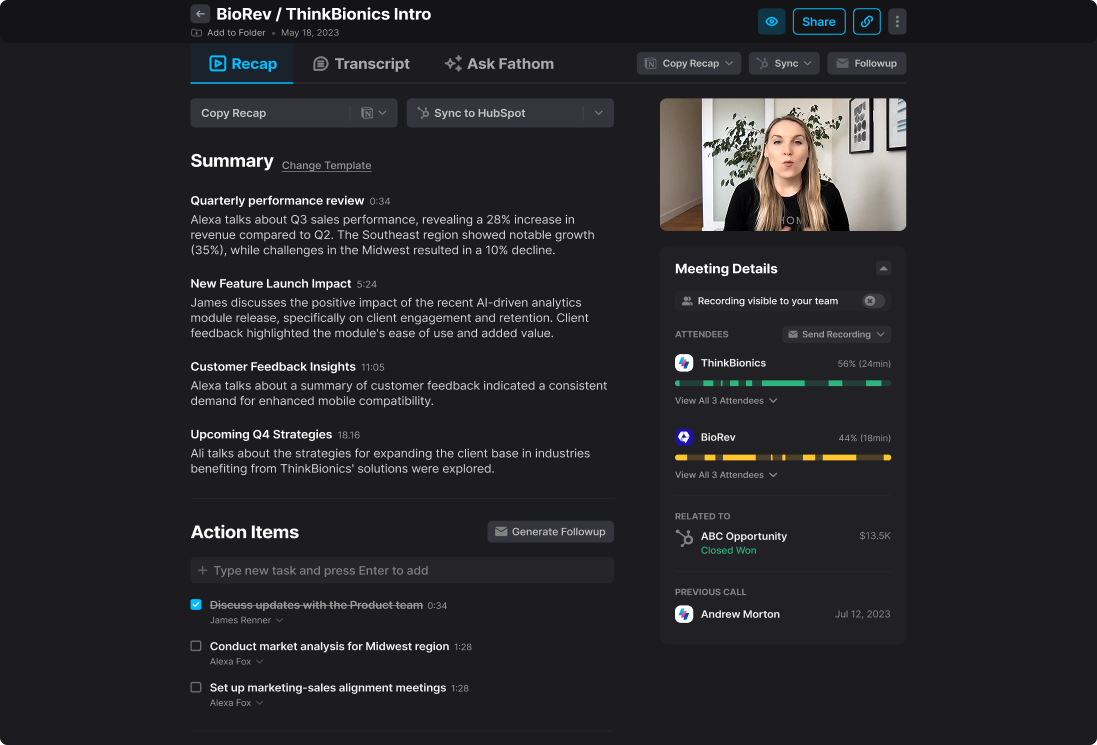
Fathom is commonly used for: Summarizing meeting notes for quick reference., Tracking key topics discussed during meetings., Providing actionable insights for sales teams., Enhancing productivity by reducing time spent on note-taking., Facilitating onboarding by sharing summarized meetings with new team members., Improving communication across departments by sharing key meeting takeaways..
Fathom integrates with: Gong, Zoom, Microsoft Teams, Slack, Google Meet, Salesforce, HubSpot, Trello.

Jason Warner
CEO at Poolside AI
1 mention