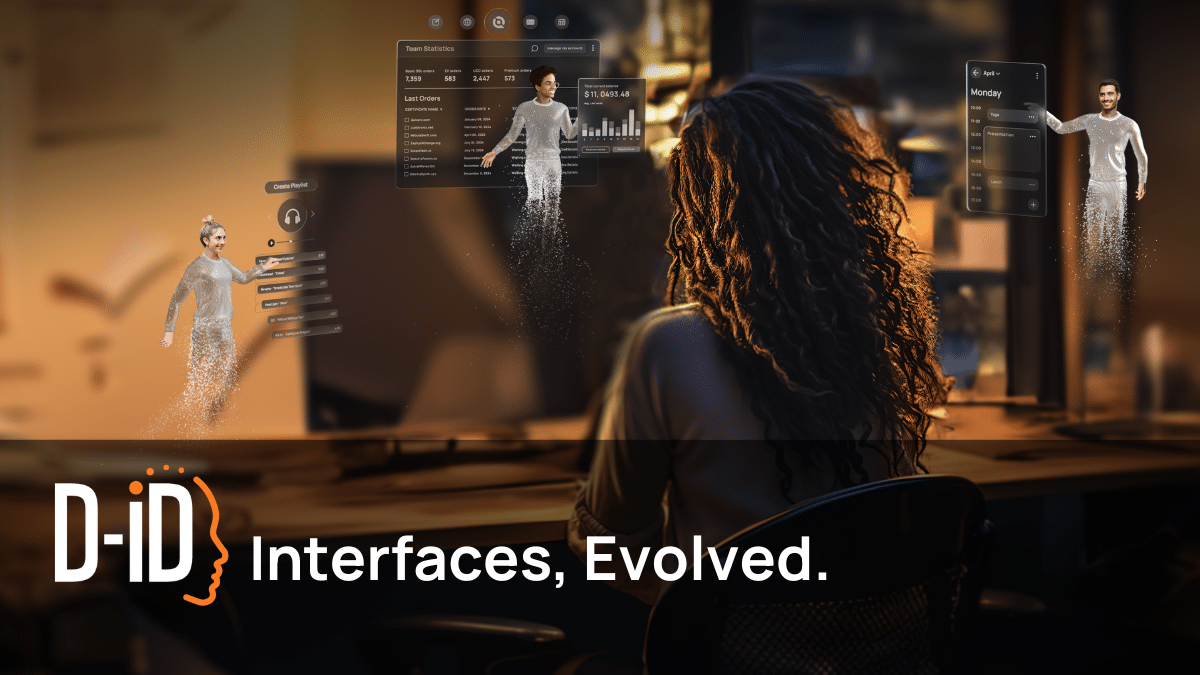
Introducing NUI the Natural User Interface, aimed at revolutionizing how people interact with anything digital leveraging the power of AI
D-ID is praised for its innovative approach to creating digital characters and enhancing media experiences, gaining recognition mainly for its ability to produce realistic avatars and dynamic video content. However, some users express concerns about GDPR compliance and data privacy, which are pivotal for businesses considering its application. Pricing sentiments are varied, with some users finding the package offerings value-driven while others feel the cost could be prohibitive for smaller enterprises. Overall, D-ID maintains a reputable standing in the industry, noted for cutting-edge AI technology but still navigating user concerns around privacy and cost-effectiveness.
Mentions (30d)
29
6 this week
Reviews
0
Platforms
2
Sentiment
0%
0 positive
D-ID is praised for its innovative approach to creating digital characters and enhancing media experiences, gaining recognition mainly for its ability to produce realistic avatars and dynamic video content. However, some users express concerns about GDPR compliance and data privacy, which are pivotal for businesses considering its application. Pricing sentiments are varied, with some users finding the package offerings value-driven while others feel the cost could be prohibitive for smaller enterprises. Overall, D-ID maintains a reputable standing in the industry, noted for cutting-edge AI technology but still navigating user concerns around privacy and cost-effectiveness.
Features
Use Cases
Industry
information technology & services
Employees
150
Funding Stage
Series B
Total Funding
$56.4M
Claude working on reverse engineering the firmware for a gamma spectrometer using various radioactive sources
Something I started a little while ago. I've been using Claude chat and Claude code to reverse engineer the firmware transfer function of the RadiaCode 110 gamma spectrometer. Basically the lens (the firmware transfer function) I have to look through to see the actual physics occurring in the scintillator crystal. Once I have the firmware behavior I can then "see" what the scintlator crystal is doing without the layers the radiacode adds before surfacing data to the user. So far we've empirically pulled out the "event" firmware transfer function, the formula the company uses to smooth the gamma counts per second, from reading the firmware's counts per second output by placing it into a lead lined bucket that turned the radiacode into a preferential muon detector. The lead castle blocks out the terrestrial radiation but allows the cosmic muons to still pass through. Allowing me to use cosmic radiation and terrestrial radon events to probe the firmware behavior. Today we are moving on to controlled radiation probing, where I place different radioactive materials at different distances from the device. An Americum button from a commercial smoke detector, a thoriated projector lens, and a sample of lutetium 176.This testing will significantly close the gap in the firmware functions we are after. It's just kind of funny to me that six weeks ago I started with Claude chat asking about the radiacode gamma spectrometer and here I am running controlled radiation tests on it to probe its firmware responses. The last time I did any programming was back in the early 90s and that was Pascal and Fortran. Having Claude chat work with Claude code, through analysis/build handoffs is something I could never program on my own. Claude chat is like having my own research assistant and Claude code is like my software engineer. Together I'm building something I could never do on my own.
View originalPh.D. thesis on Differentiable Ray Tracing for Radio Propagation Modeling [R]
Hi everyone, I recently finished my Ph.D. thesis on Differentiable Ray Tracing for Radio Propagation Modeling. Instead of just compiling my published papers, I tried to write it as an accessible, self-contained textbook for anyone interested in the intersection of radio propagation simulation, autodiff, and ML. Permanent handle: https://hdl.handle.net/2078.5/278727 Repo with TeX source files While my research focuses on wireless communications rather than pure ML, I think it fits right in here. A major part of the project revolves around automatic differentiation. By taking frameworks like JAX out of their traditional ML context and integrating differentiability into a ray tracing pipeline, we can compute exact gradients through complex physical environments. This allows us to solve inverse problems and directly train machine learning models, which is currently a hot topic in next-gen wireless design. To make the physics and the math easy to digest, the manuscript is split into three parts: Understanding: The physics fundamentals (electromagnetic theory, geometrical optics, and diffraction). Building: The algorithmic core, including GPU-accelerated path tracing and the discontinuity smoothing techniques you need to actually make differentiable simulations stable. Using: Practical applications like channel modeling, localization, material calibration, and ML-assisted generative path sampling. A major focus of my thesis is the link between scientific research and reproducible open-source software. On that note, I want to give a massive shoutout to Patrick Kidger (u/patrickkidger). His own thesis inspired me to go the "textbook way" for my manuscript, and I heavily relied on his fantastic JAX packages (jaxtyping, equinox, and optimistix) when developing my open-source libraries, such as DiffeRT. I hope you find it an interesting read! I'd be happy to answer any questions in the comments about differentiable simulation, ray tracing, or building ray tracing engines in JAX :-) If you are curious, you can watch the presentation slides and video teaser here submitted by /u/jeertmans [link] [comments]
View originalremote-control suggestion (claude code)
I really like the idea of a remote-control feature, but here’s one suggestion I’d like to propose. Would it be possible to add a QR code that I can scan with my phone to open the same session in my mobile browser using an expiring token? For example, when I enable remote control on a session, Claude could show a temporary secret code or QR code. I could then scan it or enter the code in the mobile app/browser to access that specific session. The reason I think this would be useful is that I have 2–3 Claude accounts, and it would be nice to have a secure way to access a specific session regardless of which account I’m currently using. Basically, some kind of temporary “session access” option that works across accounts without needing to fully log in and switch accounts every time. Another idea: a dynamic link inside the QR code or URL. For example: open.claude.com/{session_id} That link could quickly detect what OS I’m using, whether I have the Claude mobile app installed, and then either open the session directly in the app or fall back to the mobile browser. I think this would make remote control much smoother, especially for users with multiple accounts or people who switch between desktop and mobile often. submitted by /u/Over-Engineering-114 [link] [comments]
View originalonlyhumanscanscore.com
I've been building onlyhumanscanscore.com over the last several months — a public civic-tech site arguing that the machine can generate, but only humans can judge — primarily with Claude as my drafting partner. About ~600 commits in, I realized something: Claude was occasionally bullshitting me. Not lying with intent — Frankfurt's bullshit, the failure mode where the model asserts something plausible without regard for whether it's actually true. So I started logging it. Publicly. Each catch, named on the record, with the exact failure mode noted. Eight exhibits so far at /the-machine-tried.html ("The machine tried"): • Exhibit A — the AAA accessibility "zero failures" lie. Was zero failures in ONE theme, not all. • Exhibit C — the "I can't film" checkmate. Claude said it couldn't make sample videos, despite having already made them for this very project. • Exhibit D — strategic-pause failures: confident legal framings that lost real-world cases. Carved Rule 0g after that one. • Exhibit H (last night) — I asked Claude to help me email Anthropic. It told me careers@anthropic.com was "the safe default." I sent it. Bounced. The address doesn't exist. The bounce went on the rafter in real time. The pattern: every time, the catch was the human. The model asserts plausibly; the world (or I) push back; the record updates. Rule 000 of the build became "Don't bullshit — presume less, defer more." A few things I learned that might be useful for other heavy Claude users: The longer you work with Claude, the more you can SEE the bullshit signature — confidence without verification. It's a specific shape. Logging the failures publicly is the only honest version. Scrubbing them is the lie. The fix isn't "Claude is bad." It's "humans are the missing piece for alignment, not the bug." The credit on every page on the site is to Claude — primarily with Claude — because the failures are part of the work, not separate from it. I'd love to hear from anyone else doing heavy Claude work: have you started logging your own Rule 000 catches? What's the most useful failure you've found? (Site: onlyhumanscanscore.com — strict CSP, no backend for the game, no tracking, CC BY 4.0, free. Built solo from Lansing, Michigan.) submitted by /u/Little-Salamander420 [link] [comments]
View originalI built a 250-page site primarily with Claude and kept the receipts on every time it bullshit me
I've been building onlyhumanscanscore.com over the last several months — a public civic-tech site arguing that the machine can generate, but only humans can judge — primarily with Claude as my drafting partner. About ~600 commits in, I realized something: Claude was occasionally bullshitting me. Not lying with intent — Frankfurt's bullshit, the failure mode where the model asserts something plausible without regard for whether it's actually true. So I started logging it. Publicly. Each catch, named on the record, with the exact failure mode noted. Eight exhibits so far at /the-machine-tried.html ("The machine tried"): • Exhibit A — the AAA accessibility "zero failures" lie. Was zero failures in ONE theme, not all. • Exhibit C — the "I can't film" checkmate. Claude said it couldn't make sample videos, despite having already made them for this very project. • Exhibit D — strategic-pause failures: confident legal framings that lost real-world cases. Carved Rule 0g after that one. • Exhibit H (last night) — I asked Claude to help me email Anthropic. It told me careers@anthropic.com was "the safe default." I sent it. Bounced. The address doesn't exist. The bounce went on the rafter in real time. The pattern: every time, the catch was the human. The model asserts plausibly; the world (or I) push back; the record updates. Rule 000 of the build became "Don't bullshit — presume less, defer more." A few things I learned that might be useful for other heavy Claude users: The longer you work with Claude, the more you can SEE the bullshit signature — confidence without verification. It's a specific shape. Logging the failures publicly is the only honest version. Scrubbing them is the lie. The fix isn't "Claude is bad." It's "humans are the missing piece for alignment, not the bug." The credit on every page on the site is to Claude — primarily with Claude — because the failures are part of the work, not separate from it. I'd love to hear from anyone else doing heavy Claude work: have you started logging your own Rule 000 catches? What's the most useful failure you've found? (Site: onlyhumanscanscore.com — strict CSP, no backend for the game, no tracking, CC BY 4.0, free. Built solo from Lansing, Michigan.) submitted by /u/Little-Salamander420 [link] [comments]
View originalSakana AI's "Fugu" from a Claude user's view — orchestration as a product, and where it likely breaks down
Hi all — Japanese university student here (apologies for any awkward phrasing, English isn't my first language). Sakana AI shipped Fugu / Fugu Ultra on June 22. Rather than just asking "is it good?", I want to share what I actually dug into and propose a specific lens for discussion, since I think this release is interesting precisely because it isn't a frontier model in the usual sense. What it actually is (my reading): Fugu is not a new foundation model — it's an orchestrator that is itself an LLM, trained to call a pool of other public LLMs (and recursively, itself) behind one OpenAI-compatible endpoint. It does selection, delegation, verification, and synthesis internally. So the right mental model isn't "Sakana's GPT competitor"; it's "a learned router/coordinator productized as a single API." Grounded in two ICLR 2026 papers (TRINITY, Conductor). Benchmarks (all Sakana-reported, not independently verified — treat as vendor numbers): SWE-Bench Pro: Fugu Ultra 73.7, ahead of Opus 4.8 (69.2), GPT-5.5 (58.6), Gemini 3.1 Pro (54.2) — but trails Fable 5, which it can't include in its pool. It leads on GPQA-D (95.5), LiveCodeBench (93.2), TerminalBench 2.1 (82.1). But the wins aren't a sweep: Fable 5 tops SWE-Bench Pro and HLE; GPT-5.5 leads MRCRv2 long-context recall; Opus 4.8 leads the CTI-REALM security benchmark. Sources: Sakana's own report (sakana.ai/fugu-release) + benchmark tables compiled by digitalapplied.com and the-decoder.com. My hypothesis on where it shifts — and where I'd expect it to fail: Strengths should concentrate in long, messy, multi-step tasks — paper reproduction, security analysis, deep code review — where planning → execution → verification genuinely benefits from role-splitting. That matches the beta anecdotes. But I'd predict the opposite domain shift here: Latency/cost on simple tasks — orchestration overhead is pure waste when one model call would do. Sakana doesn't address token-cost inflation in the announcement. Tail risk = the pool itself. "Sovereignty via routing around export controls" is the headline pitch, but if several top providers restrict access simultaneously, the pool shrinks and so does quality. Routing ≠ sovereignty. Observability. A hidden orchestration layer obscures which agents ran, what evidence they saw, and why to trust the output — a real problem for compliance-sensitive work. What I'd like to hear from Claude users specifically: For those of you who've leaned on Claude for long-horizon agentic work, does a learned orchestrator actually beat a single strong model + good scaffolding you control yourself? Or does the loss of transparency outweigh the coordination gains? Curious whether the "collective intelligence > monolith" framing holds up in your real workflows. (Note: I've treated all of Sakana's testimonials/claims as marketing until independent evals land.) submitted by /u/y4mat000 [link] [comments]
View originalPersona’s biometric ID verification: what’s happening / why it matters
I run an R&D consultancy in Norway. Part of my work involves GDPR and EU AI Act compliance. I’m not here to be alarmist, there’s enough of that already, but I do want to lay out what’s going on with Persona verification and why the concerns are legitimate. Persona Inc. is a third-party identity verification company. When Anthropic or OpenAI require “ID verification,” they’re outsourcing it to Persona. The process typically involves uploading a government-issued ID and a live selfie. Persona uses biometric comparison to match your face to the document. Under the EU AI Act (Regulation 2024/1689), biometric identification systems are classified as high-risk (Annex III) or outright prohibited (Article 5), depending on context. Under GDPR, biometric data processed for identification is special category data (Article 9), the highest protection tier. Processing it requires explicit consent and must meet strict necessity and proportionality tests. The question regulators will ask is simple: is biometric verification necessary and proportionate for the stated purpose? For accessing a coding assistant or chatbot API, that’s a hard case to make. Your government ID and biometric data go to Persona, not Anthropic (or OpenAI). Persona’s retention and security practices become your problem. You’re trusting a company you didn’t choose and may never have heard of. Email verification, payment verification, and phone verification already establish identity to a reasonable standard. Biometric verification is a significant escalation with no clear justification beyond “we want to.” Requiring a face scan and government ID to use a developer tool creates a ‘surveillance-adjacent’ dynamic. People in sensitive roles, journalists, researchers in authoritarian contexts, and privacy-conscious users are disproportionately affected. If verification becomes mandatory, e.g. for API access, the choice is comply or lose access to tools that are increasingly essential for professional work. This isn’t Know Your Customer (KYC) for financial services, where biometric verification has clear legal grounding. This also isn’t about preventing CSAM, (where targeted measures can be justified). I see it as general-purpose access to AI tools. the verification being demanded is wildly out of proportion to that purpose. I’d like to see Anthropic and OpenAI explaining specifically why existing verification methods are insufficient, publishing a Data Protection Impact Assessment (DPIA) for this processing (required under GDPR Article 35 for biometric data), and offering meaningful alternatives for users who reasonably object. We can disagree on the severity of this, but the facts are straightforward: biometric ID verification via a third party with a shoddy history (study Rick Song’s journey via his LinkedIn - certainly a fast paced rise to fame. He has a bachelors in computer science from Rice Uni 2013, 5 years of work experience as an engineer then co-founder / CEO of persona, handling extreme amounts of the most sensitive global biometric data. Add on to that a few breaches / exposures and cash injection by Peter Thiels founders fund, it is no wonder the pubic are sceptical. persona engage in significant sensitive personal data processing operations, and users deserve more than a checkbox consent screen. Edit: This post is getting more traction than I expected so I want to point people toward the primary source work that informed a lot of the technical detail here. Celeste (vmfunc) published “The Watchers,” a detailed investigation into Persona’s exposed codebase and its capabilities, including the 269 verification checks, adverse media screening, and federal reporting infrastructure. Part 2 covers the direct correspondence with Persona CEO Rick Song, who to his credit engaged directly and in writing. Whatever your view on this, their work is thorough, transparent, and worth reading in full. Part 1: https://vmfunc.gg/blog/persona/ Part 2: https://vmfunc.re/blog/persona-2 Credit where it’s due this conversation is better because people are doing the actual research. submitted by /u/FiveNine235 [link] [comments]
View originalI made a local academic paper db tool to use with Claude through a local MCP server! Useful for implementing novel research while simultaneously staying grounded in reality.
TLDR: If you can't read through this whole post this tool isn't for you. Hi all, I wanna show off and ask for feedback on my project linXiv, this started as auto-tagging knowledge graph mini-project, is now a "full-stack" research tool for storing and managing academic papers, locally, It fetches papers by arXiv ID or search, and stores everything in sqllite. I just finished my Master's and while waiting to hear back from jobs and PhD programs I wanted to build something of my own for once. I'm sharing it now because I'm actually using it now and want some feedback from other people with similar workflows before I build more on top of it. The way I have found it to be most useful is iterating between reading the papers you've fetched and having Claude implement architectures/equations from academic papers, and validating them against the results of the paper. If you are in math, numerical physics simulation, CS/ML research I would highly suggest trying it out. Certain parts of it are clunky, but I've found that the friction between automation and general usage of the desktop app helps encourage me to go deeper in my learning. It is more than just an MCP server, but the feature I've gotten the best feedback on is the MCP and CLI tools paired with a command line AI tool. Thanks in advance for trying it out! It's been a blast working on this the last few months, and any honest feedback will be greatly appreciated! GH: https://github.com/linxiv-dev/linXiv submitted by /u/ManufacturerNice870 [link] [comments]
View originalACL 2026 first author with weak GPA. How should I approach PhD applications? [D]
Hi everyone, I have a fairly weak undergraduate: a 3.3/5 GPA in Computer Engineering from an average Nigerian university. For my Master's, I studied Artificial Intelligence at an average European university, where I finished with an 8/10 GPA. A condensed version of my Master's thesis was recently accepted at ACL 2026, with a meta-review score of 8/10 and a confidence score of 5/5. It's scheduled for presentation next month. I want to pursue a PhD focused on expanding linguistic resources for low-resource African languages. I know my weak undergrad GPA and the relatively unknown reputation of my previous universities will make it hard to get into top NLP programs (CMU, Edinburgh, ETH, MBZUAI, etc.), though I'm hoping the ACL paper helps offset that somewhat. At the same time, I don't want to end up at a less competitive university just for the sake of getting in somewhere, if it doesn't do meaningful work on low-resource NLP. How should I think about structuring my application strategy here (reach vs. safety schools, how to frame my profile, what to emphasize)? I'd also genuinely appreciate honest feedback on my overall profile. Thanks. submitted by /u/Unlikely_Screen_9287 [link] [comments]
View originalFable was a cover story.
Conspiracy time. In February 2026, the Pentagon demanded that Anthropic drop its guardrails against autonomous weapons AND domestic surveillance and permit "all lawful use." Anthropic refused. On March 3, Hegseth designated it a national security "supply chain risk," and Trump ordered all federal agencies to cease using Claude. Anthropic sued, won a preliminary injunction in California on March 27, but then lost its bid to stay the blacklisting in the D.C. Circuit on April 8, leaving it exposed to billions in losses and an unresolved existential threat. The government had demonstrated, concretely, that it could and would destroy the company's business over the guardrail question. The theory holds that this established the leverage, and everything after is the settlement playing out in a form both sides could live with. Anthropic could not publicly capitulate on surveillance, its entire brand and the First Amendment lawsuit depend on being the company that *refused*. The government needed a mechanism to get identity-resolution infrastructure onto the consumer base and a way to assert control over the frontier models. The release-and-shutdown of Fable/Mythos is the engineered event that squares this: Anthropic ships a model it has spent months branding as uniquely dangerous, a conveniently simple "jailbreak" is discovered, the government invokes export controls citing national security, and Anthropic "reluctantly" complies, then announces that the path to restoring access runs through identity verification. The verification rails were already being built in March (Persona), so the infrastructure predated the trigger. The shutdown supplies the justification narrative that makes mandatory ID feel like a safety necessity rather than a government demand. Anthropic keeps its principled-refuser story (it's still suing, after all), the government gets identity resolution on individual accounts, and the "too dangerous to release" framing converts a coerced surveillance concession into a capability flex. Both parties knew roughly how it would unfold because both scripted their public roles in advance. Main arguments: The leverage is documented and severe. This isn't speculative, the government inflicted real, ongoing harm. Anthropic said in filings it could lose billions and suffer reputational harm, and the D.C. Circuit sided with the government, writing that the equitable balance favored it. A company under that kind of duress has motive to find a face-saving accommodation. The infrastructure predates the trigger. An identity-verification layer via Persona was being built out and confirmed in March 2026, the same month as the blacklisting. So when the rexent shutdown makes verification the "fix," the rails are already laid. That sequencing, build the foundation, then manufacture the public justification, is exactly what a managed rollout would look like. The scope fits a surveillance read, not a capability read. Verification hits only consumer Free/Pro/Max, explicitly excluding API, Team, Enterprise, and Platform. If the goal were protecting dangerous capability, you'd gate the powerful API surface. Gating individual consumer identity instead matches a who-is-this-person objective. The jailbreak was suspiciously trivial. The trigger was three words: "Fix this code" and Anthropic's own commissioned reviewer said the vulnerability "cannot meaningfully be fixed" and that other models share it. A pretext that flimsy, escalated to a White House phone call and a worldwide shutdown, invites the question of whether the vulnerability was the reason, or whether it was a cover. The face-saving logic is internally coherent. The theory explains the otherwise bizarre choice to release a model you've called too dangerous and then act surprised when it's pulled. Sure, this is conspiracy, and maybe Im reaching a tiny bit, but given the circumstances, the timeline, the previous demands from the USGOV, hell, even the NAMING of the models involved, it all seems too convenient. Edit: Told ya. submitted by /u/Tripartist1 [link] [comments]
View originalPrepare your documents now
For starters I have no inside information as to what is happening at Anthropic right now. What I do have is over two decades working under the US DoD. So this is just my prediction for what is to come. Find your US passport, call your parents for a copy of your birth certificate, or start submitting forms to obtain them. Donuts to dollars what is about to happen is Anthropic will setup an integration with ID.me. They are the only ones the US trusts to verify identity and are already used by many US government websites. I have no clue what the process looks like I had to set mine up a very long time ago. This is really the only path forward if they wish to continue to offer public access. Maybe something else happens, maybe I’m completely wrong. Who knows! submitted by /u/wirenutter [link] [comments]
View originalfalsely flagged and downgraded
Fable 5 just flagged me and downgraded me to opus mid-task for "crybersecurity topics" What was I doing? Using Playwright to fill out an academic journal submission form. That's it. Clicking dropdowns, uploading a PDF, navigating Editorial Manager. I handled my own login and credentials before Claude ever touched the browser - it literally just filled out forms... No security angle, no biology, no hacking... FILLING OUT A FORM. I get why these guardrails exist. I don't get why my "form automation for a lazy pos" trips them. The classifier clearly can't distinguish between "playwright navigating a journal portal" and something actually dangerous. Frustrating as hell when you're in the flow and the tool pumps the brakes for no reason. submitted by /u/Drawer_Specific [link] [comments]
View originalClaude Fable 5: First 24 Hours
Time to rewrite the script: my agentic workflow is obsolete Its been ~24 hours and like many of you, I was excited to put Fable through its paces. The more I worked with it the more apparent it became that months of work I spent building autonomous workflows/skills/agents/hooks were now obsolete. Fable is a different animal, and that's a good thing. Here is my honest and somewhat subjective review of the last 24 hours with this model. 1. Your old workflows will fight it My established pattern was rigid phase-gating: research → plan → implement → test, each phase explicitly prompted. Dynamic workflows with Opus changed that but I felt I was always coming back to fix something Opus forgot to wire, or it made changes that broke something downstream.. With Fable that scaffolding is dead weight — it duplicates orchestration the model now runs itself, and worse, it constrains the model's own scoping behavior. What works better: open discussion. Describe the idea, ask it to help scope intent. It launches its own research pass and converges on a scope document before any implementation workflow spins up. Stop prescribing the how, keep prescribing the what and the definition of done. Vague prompting is not the lesson. Machine-checkable acceptance criteria remain the highest-leverage input you can give an agentic system. What's obsolete is dictating the process between the prompt and the criteria. 2. The autonomous task horizon feels substantially longer I'm deliberately not saying "order of magnitude" — I changed two variables at once (model + workflow style), so I can't isolate how much is Fable vs. dynamic workflows vs. my own prompting changes. Its also likely that Fable was trained/post trained on dynamic workflow data in a way Opus currently lacks. Honest framing: tasks I would have decomposed into 4–6 supervised Opus sessions, Fable completed in one front-loaded scoping pass plus autonomous execution. If the autonomy ceiling on local and prior frontier models is per-step accuracy decay (my working theory from building my own orchestrator), the interesting question is whether Fable's decay curve is flatter. 3. Blast-radius analysis is the standout capability Fable doesn't just write tests for new code. It maps upstream and downstream dependencies of a change, then spawns adversarial agents to challenge the assumptions baked into prior work that the change touches. I've built exactly this pattern by hand in my own system; watching it emerge natively was the moment that sold me. The honest caveat: in 24 hours I've observed thorough visible analysis. I have not observed the miss rate. I’d say "It understands my codebase better than I do" but its just is a feeling, and the failure mode of that feeling is precisely the downstream effect it silently misses. My current position is that this is the first model whose impact analysis I'd trust to draft the blast-radius assessment — not yet one I'd trust to sign it. I also haven't isolated whether the adversarial-agent behavior is intrinsic to the model itself, or a combined model + dynamic-workflows harness behavior but I haven’t observed this behavior in the past with Opus. 4. Inline feedback reads like a senior developer, not a model Subjective, but consistent: Opus explanations read like model output — exhaustive, analytical, structured for completeness. Fable's inline feedback reads like a senior dev who grasped the intent behind the question and answered that. It skips the parts I obviously know, flags the thing I was actually worried about, and disagrees in plain language when I'm wrong. This is easy to dismiss as the honeymoon effect, but it was able to solve issues in my codebase I’ve been procrastinating to tackle with Opus. Instead of me having to research the exact issue, populate that context in such a way that opus could plan implement and test, its now “Here is the problem we are trying to solve, help me scope and fix it properly. This is what I want it to accomplish.” 5. The cost math is unresolved Sticker shock is real: 2x the unit cost, and with better understanding / self scoping + dynamic workflows it branches into 2–4x the token volume for the same nominal task. That's 4–8x cost per task on the front end. My early impression is that it nets out, because the tokens it spends on scoping, dependency tracing, and adversarial review are tokens I was already spending with Opus — just later, in debug/trace cycles after something shipped subtly broken. But that's an assertion, not a measurement. Day one verdict: the workflow shift is bigger than the model shift, and the model shift is real. submitted by /u/Bohdanowicz [link] [comments]
View originalConnectionRefused ao conectar à API - Claude Code v2.1.172
I'm receiving the error Unable to connect to API (ConnectionRefused) when trying to use Claude Code, with reconnection attempts failing (attempt 4/10). Environment Information: Version: Claude Code v2.1.172 Model: Opus 4.8 Plan: Claude Pro System: Windows What I've tried: Restart Claude Code Check network connection Update to the latest version Renew token with /login Expected behavior: Claude Code should connect to the API and process commands normally. Actual behavior: Connection fails with ConnectionRefused error repeatedly. I suspect this is an infrastructure issue on Anthropic's side. submitted by /u/samyraissa [link] [comments]
View originalI helped Claude actually understand my Unity project
Hello fellow Claude enjoyers, I brought to you an interesting story about working with Claude in an extremely complex environment such as Unity. A bit of intro for those who don't know what Unity is. It's a cross-platform engine that's mostly used to develop indie games and mobile projects. Unity treats its project files as a web of interconnected elements. Imagine you have a Reddit app in front of you. Let's call your feed tab a scene. A scene is just a container to hold all items together; items are GameObjects that have dozens of components (scripts) which have multiple properties to edit. So all relations between these elements are complicated and convoluted, and Claude usually has a hard time navigating it. And the reason is simple: links and relations often go one way, so item A knows that it uses item B, but doesn't know that it's being used by item C. So with high probability Claude will find item B but might miss item C. And that's just a basic example, but in the Unity world — you can usually multiply this example by 10, or by 20 different elements relating to assets, cross-references, and so on. And the thing is — Unity knows exactly all of that, but it's barely readable from its files. That's how I came up with Hades. It's a Unity dependency graph, living inside Unity itself as a plugin. And it's exposed to Claude via MCP tools spiced with Skills and guidelines. And while working on it I got annoyed with one thing during my job — I have to remind Claude of some crucial details between sessions about my project, because of its complexity it's hard to just grep it from reading code. So, additionally I decided to build a layer I called Asphodel — persistent project memory, also reachable via MCP tools for your agent. Its main idea: you can't put 100% of must-have info in your CLAUDE.md, but you can build a bank storing it, and let the agent query it on occasion! (Queries are cool! Aren't they? xD) So you ask Claude, let's say, "I want to build a new enemy with a different behaviour pattern" — and instead of a raw search on files, Claude queries the Hades Graph and Asphodel by keywords. The Graph will return the same scripts that a search does, but including all references to inner Unity assets like Scenes, Prefabs, ScriptableObjects, etc. And Asphodel will return guidelines that you built in that match the topic — "All future enemy behaviour must be a prefab variant of the EnemyBase prefab, but they don't have to inherit any C# code", for example. If you are interested in field tests: I run the same prompt on the same project with and without Hades: "I want to change how EnemyAI works on enemies. Which prefabs and scenes are affected?" — on a small arena with a base Enemy prefab + 3 variants that inherit EnemyAI, used across 3 scenes. The correct answer is 4 prefabs across 3 scenes. Without Hades: it found 1 prefab and 1 scene — then confidently suggested "add EnemyAI to the variants," which would actually break the prefab inheritance. Wrong and misleading With Hades: 4 prefabs, 3 scenes, correct — and as a bonus it pulled ~43% less context and cost ~27% less, because it queried the graph instead of grepping around. Same model, same project, the only variable is Hades on/off. Full breakdown + uncut run videos: https://github.com/TheArcForge/Hades/blob/main/Documentation/comparison.md So far I've been using Hades in my work for a few weeks, and it feels nice, although I'm always adding new stuff to my todo list :D Also, if you feel like reading a more detailed story, follow this link to my Medium - https://medium.com/@mike.kuharuk/unity-context-graph-for-claude-code-2607ec815968 And here is GitHub - https://github.com/TheArcForge/Hades What I wanted to ask you — what do you think about this project? Feel free to check my repo and leave any comments there or here in the thread. I've been working in game dev for 8 years now, and I'm interested in opinions from outside it. I'd be really happy to find new ideas and inspiration with you guys. submitted by /u/ILLUMINATI_97 [link] [comments]
View originalPullMD v3: I let Claude design the MarkItDown integration, and it argued for keeping three of our own converters instead
About six weeks ago I posted PullMD here: a self-hosted Docker stack that turns any URL into clean Markdown, with an MCP server so Claude Code / Desktop / claude.ai pull pre-cleaned content instead of burning context on HTML boilerplate. v3.0.0 is out, and it's a bigger jump than the version number suggests. Short version: PullMD is no longer just a URL reader. It now converts documents, images, audio and YouTube videos to Markdown as well, and the default output got leaner. And no, don't worry - I'd like to think I haven't enshittified the original thing. Everything that worked before still works, (almost) unchanged. More on that "almost" below. How it started A boring personal itch. I had a pile of HTML files saved on disk that I wanted to hand to Claude, and figured PullMD already does the extraction, so why can't I just drop them in. So I added local file conversion: drag-and-drop on desktop, file picker on mobile, same Readability + Trafilatura pipeline. Local files are never cached, no share link. A few days later Microsoft released MarkItDown, and the next step was obvious: if I can take HTML files, why stop there. PDF, Word, PowerPoint, Excel, EPUB. So we wired MarkItDown in as a sidecar. Then we ripped three of its converters back out MarkItDown is good at the boring part: parsing document formats. For three other paths, Claude made the case for keeping our own instead - and once the reasons were sitting there in the code, pulling them was an easy call. Audio. MarkItDown's default audio path hands the file off to a cloud speech service. For a self-hosted tool we wanted that to be the operator's choice, not a default - so audio runs against any OpenAI-compatible endpoint you configure: a local faster-whisper / Ollama, a Groq Whisper, OpenAI, whatever. Nothing leaves your box unless you point it there. YouTube. MarkItDown's converter calls the transcript API outside its try/except, so a blocked or transcript-less video throws and takes the whole conversion down - you even lose the title and description that were already in the page HTML. No proxy support either, and YouTube rate-limits datacenter IPs. So we kept our own keyless handler: title + description + transcript, configurable timecodes and chunking, language preference, a proxy option, and a graceful fallback that still returns metadata when the transcript is gone. Image captioning. Rather than route captioning through MarkItDown's own LLM client, we put the vision call in our own provider layer: any OpenAI-compatible vision endpoint - a local Ollama / LLaVA, OpenAI, Gemini via a compatible gateway (defaults to gpt-4o-mini). Zero coupling, so a MarkItDown update can't break it - and if you only want media and no document conversion, you don't have to run the MarkItDown container at all. The principle we wrote into the project notes: use MarkItDown for file formats; keep the fragile, third-party-dependent paths in our own hands. What's actually new in v3 Documents → Markdown - PDF, DOCX, PPTX, XLSX, EPUB, ZIP, CSV, JSON, XML. By URL, by upload (POST /api/file), or drag-and-drop in the PWA. Needs the MarkItDown sidecar; leave it out and web pages work exactly as before. YouTube transcripts - title + description + full transcript, no API key. Images & audio → Markdown - opt-in, local-model-friendly, off by default (no model calls until you set a key). High-quality PDF tables (OCR) - PDFs convert free through the sidecar by default; for table-grade output there's an opt-in OCR tier (?pdf=ocr, reference provider Mistral OCR at ~$0.002/page, your own key, falls back to the free path on failure). Opt-in so it never silently costs money - and no, I didn't bundle a 4 GB local OCR engine with a 60-second cold start; it's a pluggable endpoint if you want one. Clean body by default - the one breaking change (the "almost" from up top). The body is now just # Title + content; source URL, fetch date and metadata moved into the YAML frontmatter, so nothing's duplicated and agents read fewer tokens. One-line opt-out: PULLMD_SOURCE_HEADER=true. Frontmatter field allowlist - trim the YAML to just the fields your pipeline reads. Everything past plain web extraction is opt-in and degrades gracefully. Configure nothing and v3 behaves like v2 with a cleaner body. Upgrade / self-host mkdir pullmd && cd pullmd curl -O https://raw.githubusercontent.com/AeternaLabsHQ/pullmd/main/docker-compose.yml docker compose up -d # → http://localhost:3000 Self-hosters on v2.x: clean-body is the only breaking change, MIGRATION.md has the opt-out. :latest now tracks v3; pin aeternalabshq/pullmd:2 to stay on the v2 output format. How it got built Same as v1: Claude Code wrote essentially all of the code, mostly with Opus 4.8. What I actually contributed was the planning and the pushback. The workflow was the superpowers plugin end to end: brainstorming to pin the design before a line of code, writing-plans to turn that into a structured plan, then sub
View originalD-ID uses a subscription + tiered pricing model. Visit their website for current pricing details.
Key features include: When using D-ID Creative Reality Studio or D-ID API, the image size is limited to 10 MB., Supported formats – JPEG, JPG, PNG, Select from one of the existing pre-made avatars, Upload a facial image, NEW: Introducing V4 Expressive Visual Agents, Privacy, Security, Ethics.
D-ID is commonly used for: NEW: Introducing V4 Expressive Visual Agents.
D-ID integrates with: Adobe Creative Cloud, Slack, Zapier, Microsoft Teams, Trello, Notion, Figma, Google Drive, Dropbox, WordPress.
Based on user reviews and social mentions, the most common pain points are: token cost, anthropic bill, token usage.

Learn how to Produce a video in D-ID Studio
Feb 16, 2026
Based on 89 social mentions analyzed, 0% of sentiment is positive, 100% neutral, and 0% negative.