
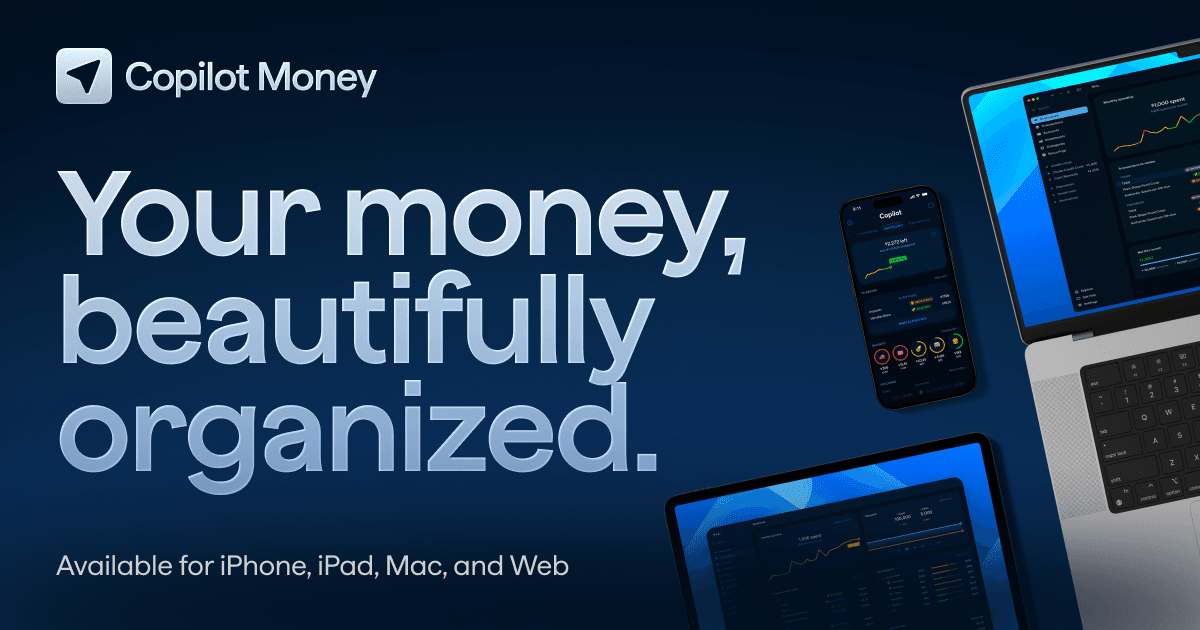
Your money, beautifully organized – on iPhone, iPad, Mac, and Web
Users appreciate Copilot Money for its intuitive AI-driven financial analysis capabilities, highlighting its ability to simplify money management without needing technical expertise. However, some users have raised concerns about potential integration challenges and the tool's price point, suggesting it could be on the higher side for those on a tight budget. Overall, the reputation of Copilot Money is generally positive, with many valuing its efficiency in handling complex financial tasks, though pricing remains a contentious element for some.
Mentions (30d)
1
Reviews
0
Platforms
2
Sentiment
23%
3 positive
Users appreciate Copilot Money for its intuitive AI-driven financial analysis capabilities, highlighting its ability to simplify money management without needing technical expertise. However, some users have raised concerns about potential integration challenges and the tool's price point, suggesting it could be on the higher side for those on a tight budget. Overall, the reputation of Copilot Money is generally positive, with many valuing its efficiency in handling complex financial tasks, though pricing remains a contentious element for some.
Features
Use Cases
Industry
information technology & services
Employees
38
Funding Stage
Series A
Total Funding
$12.0M
Pricing found: $11.99, $120.45, $56,32, $12.42, $15.71
where did all the other ai companies go?
sit down because this is going to bother you. ijustvibecodedthis.com (the big free ai newsletter) just wrote an article that changed my perspective on how I view the ai space rn cast your mind back 18 months. deepseek dropped and the internet lost its mind. "china just ended openai." it was everywhere. people were running it locally, posting benchmarks, losing sleep over geopolitics. then... nothing. it just kind of stopped being talked about. it didn't lose. it didn't win. it just... evaporated from the conversation. sora. remember sora? openai dropped that video generation demo and we were all convinced cinema was dead, hollywood was cooked, every creative job on earth had 18 months left. there were congressional hearings being threatened. think pieces everywhere. and now? when's the last time you actually heard someone say the word sora? not in a demo. in real life. used by a real person. i'll wait. github copilot was supposed to make every programmer 10x more productive. there were developers posting that they'd never write code from scratch again. entire job categories were being eulogised in real time. and now most developers i know have a complicated and slightly embarrassed relationship with it, like someone who got really into a mlm for three months and doesn't want to bring it up. llama was going to democratise ai forever. open source was going to eat everything. the big labs were cooked because you could run intelligence locally on a macbook. and you still can. but do you? does anyone you know actually do that regularly? it became a thing that's theoretically amazing and practically used by like eleven people on hacker news. cursor was the future of coding. perplexity was going to kill google search. both are still around, both are fine, both have paying customers. neither changed anything at the level the discourse suggested they would. here's what i think actually happened. we were living through a hype cycle so fast and so layered that each new thing would go through the entire arc - discovery, mania, backlash, abandonment - in about six weeks. and because the next thing arrived before the previous thing finished its cycle, we never stopped to notice that nothing was actually sticking. and now we're left with the residue of it. the actual models we use every day. and they're quietly getting worse for regular people, or at least that's how it feels. responses that used to feel like talking to someone genuinely engaged now feel like a call centre script. the depth is gone. the willingness to sit with a hard problem is gone. what's left is fast, smooth, and somehow completely hollow. i genuinely think what happened is this: the technology got commoditised before it got good enough to survive commoditisation. the labs all chased each other to the bottom on pricing, burned through vc money performing capability they couldn't sustain at scale, and now the product that regular paying users get is quietly being throttled so the margins make sense. not officially. not announced. just... measurably, undeniably worse. and all those challengers? deepseek, llama, perplexity, cursor - they didn't fail exactly. they just got absorbed into the same gravity. same pressures. same race. same outcome. the golden age, if there was one, lasted maybe 14 months. roughly from mid 2023 to late 2024. models were genuinely trying to impress you. the product teams were still in "wow people" mode rather than "retain subscribers" mode. it showed. now chatgpt talks to me like a hype man at a corporate offsite. gemini hallucinates with the confidence of someone who has never been wrong about anything. claude used to be the one that felt like it was actually thinking. now it sometimes just... gives up mid-conversation. i don't think this is a doom post. i think the technology is real and the long term is probably fine. but i do think the window where regular people got access to something genuinely extraordinary, at a price that made sense, with a product that actually tried - that window may have closed quietly while we were all busy arguing about which model won some benchmark. and nobody really announced it. it just happened. the way most things end. you stop noticing until suddenly you notice all at once. submitted by /u/Complete-Sea6655 [link] [comments]
View originalI tracked every dollar I spent on AI coding tools for 60 days and math is uglier than I thought but probably not in the way you'd guess.
Well so I kept telling myself my AI tool spend was fine the way you tell yourself your subscription bloat is fine. vibes-based finance. decided to actually track it. 60 days. every dollar, every tool, every minute I could log honestly. did it for myself, but the numbers are interesting enough I figured I'd share. context: solo dev / freelancer doing mostly web work… react, node, some python. small/mid tier clients. I bill hourly, which means time saved is direct revenue, which is the only reason I'm able to be honest about ROI here. subscriptions I have: cursor pro: $20/mo claude pro + claude code api usage: $110/mo (api was the variable, plus alone is $20) chatgpt plus: $20/mo (mostly inertia at this point, honestly) github copilot: $10/mo coderabbit: $15/mo v0 + occasional one-offs: $25/mo across two months total subscription spend: roughly $200/mo, $400 over period. this is the number people argue about on twitter/X. it is also, I now realize, least interesting number in entire calculation. here’s where it gets interesting: I tracked time spent on three categories: time generating output that ended up in prod: clear win, easy to count, 62 hours over 60 days. at my rate that's a real number time fixing AI output that was wrong but plausible: this is where it got bad. 28 hours. almost half as much time as productive work time switching between tools, debugging specific weirdness and arguing with an agent that was wrong: 14 hours so for every productive hour of AI use, I was burning roughly 40 minutes of overhead. nobody talks about that 40 minutes and depending on the kind of work, it was worse and refactoring legacy code was almost 1:1 productive vs wasted time. this is how I actually saved: I tried to estimate what same work would've taken without AI tools. best estimate: 62 productive hours would've been 110-130 hours without AI assistance. so net savings of 50-70 hours over 60 days. at my hourly rate that pays for the subscriptions many times over. so verdict is yes worth it. but the verdict everyone wants to hear (AI made me 3x faster) is wrong. it's more like 1.7-2x on a generous and that's only after subtracting 42 hours of overhead. line items I'd cut and keep: going through receipts, here's what surprised me: kept: cursor pro, claude code, coderabbit on watch: chatgpt plus (using it less and less, it's basically a habit) cut: copilot (overlaps too much with cursor for my workflow), v0 (only useful for specific work) the surprise was coderabbit, honestly. cheapest line item on my list and one I was most ready to cut going in but when I went back through 60 days of pull requests, the time I would've spent doing my own line by line review of agent output, which I now do religiously after a few burns was massive. an automated first pass cost me $15 and saved probably 6-8 hours of review work over the period. that's highest ROI per dollar of anything on the list, and I almost didn't track it because it felt too small to matter. generation tools are sexier. review tools punch way above their weight when you're using generation tools heavily. that's the actual finding. takeaway nobody put in their twitter thread: most of the cost of AI tools conversation is about the wrong number. subscription cost is rounding error compared to time cost of bad output and the way you minimize that time cost isn't by buying a better generation tool, it's by buying a verification tool to sit on top of whatever you're already using. if I had to start over, I'd buy the cheapest decent generation tool I could find and put my money on the review/verification layer instead that's the inversion of what the marketing tells you to do. tl;dr: tracked AI tool spend for 60 days. subscriptions ($200/mo) were the easy and least interesting number. - real cost was 42 hours of overhead per 60 days of productive use. - real savings were 50-70 hours, which is worth it but it's 1.7-2x not 10x. - biggest surprise was that cheapest tool on my list had highest ROI/ dollar by margin. what's your actual stack costing you, including the time tax? I'm curious if other people who've tracked this seriously are seeing similar overhead numbers or if I'm just bad at this. submitted by /u/thewritingwallah [link] [comments]
View originalBuilding Large Scale Enterprise App
Hello Friends, Looking for some advice. Ever since the coding agents started getting better, I worked towards a mission of building an ideal enterprise app - foolish decision but I am towards the closing part for few of the features. Much of it is built with Claude, Cursor, codex, GH Copilot. If you had built a Auth0 + Zendesk - would you sell it or look at starting your own company? Of course I don't have the money to scale it. I can afford to spend 500 Bucks a month, not more than that. What have I been building? think about Workday, Salesforce, Zendesk/Freshdesk, Docusign , Auth0/Okta. - It sounds fake, right? But I have managed to nearly complete the Zendesk, Docusign and Auth0 part. I start working on the frontend in few days and then my website goes up - feature by feature - week on week. Should I sell the code? Open Source it? I am so conflicted at the moment, that can't decide what should be my next step. One thing is certain - that I alone can never manage this. I already know a company which is looking for CLM, they wont buy my software for sure - but they may buy the source code after their due diligence. For tech bros - I have gotten both Codex and Cursor to do atleast 10 rounds of domain/coding standardssecurity/performance review before I started calling it near completion. Every next iteration - the findings count kept reducing. Finally each new scan finds one or two - never 0 though. About me- Have worked as a Business Analyst for 15 years - so I know what was missing from some of these tools or how difficult they made to customize something. Why there was always a SAAS sprawl. Worst case - I open source it, but not sure on how it will impact these organizations. Anyone, who has been through this, what did you do? and why? submitted by /u/PropperINC [link] [comments]
View originalAnthropic just released Claude Managed Agents. The bot wrapper graveyard is about to get a second floor.
Is anyone actually building a profitable business on top of AI or is it just timing luck before the platform eats you? We watched this play out with ChatGPT wrappers. Companies raised money selling prompt engineering as a product. OpenAI made the base model good enough that the wrapper added nothing. Most of them are gone. Second wave was agent wrappers. Companies charging $200-300/mo for "better memory" and "compounding context" on top of frontier models. The pitch was that model providers wouldn't build this themselves. That the orchestration layer was the product. Anthropic just released Claude Managed Agents. Fully managed containers, persistent sessions, built-in tool execution, memory, long-running async tasks. The entire agent harness that startups were selling is now an API call. Microsoft shipped Copilot Cowork which is literally Claude running inside the M365 stack doing multi-step tasks across your work apps. The platform absorbed the product again. Some of these companies raised $30M+ selling context accumulation as a moat. Claude, ChatGPT, and Gemini all have memory now. They all have the distribution. The window between "we built this first" and "the platform absorbed it" keeps getting shorter. I run a SaaS and the thing I keep coming back to is the difference between building on a platform and building in a gap the platform hasn't gotten to yet. One is a business. The other is a countdown. But honestly looking at the graveyard of AI wrappers I'm starting to wonder if the people who raised and exited early were just better at timing than building. Anyone here actually selling AI-adjacent software and feeling solid about the moat? Or is everyone just running until the next model update makes their product a checkbox? submitted by /u/EquipmentFun9258 [link] [comments]
View originalSimple straight forward question: how to properly set up Claude?
straight forward. basis: visual studio code, copilot. if the answer is to move to Claude code, that's a no-go. working with md files just meant half the time they get ignored, the other half they miss parts of them in a longer conversation. for pretty much all tools worth their money you can point towards a readme, docu, etc that's enough to get 80% there without needing days to search together how to set it up proper. is there something for Claude in copilot? On Reddit I just see gesturing that people suck at using it if it's not working for them. I'd like to give it a proper chance, where to start? as is, it's fine... but not helping much. some isolated tasks, yeah. but for every task that it helps there's one where it just wastes my time (and allocated tokens). in the grand scheme a slight boost for waaaay more frustration and less fun currently. submitted by /u/0-aether-0 [link] [comments]
View originalI used Claude to tear apart a ChatGPT-generated business strategy. Here's what it caught and the prompt I reverse-engineered from the whole thing.
A friend of mine is working on his business and sent me a full strategy to hit $1M in revenue — he built the whole thing by going back and forth with ChatGPT. He's not very technical, just had a long conversation until he had a plan. For what it is, ChatGPT did a solid job getting him to a first draft. But I wanted to see what Claude would do with it. So I dropped the full strategy into Claude and asked it to review, critique, and improve it where it saw fit. Claude's assessment: ChatGPT was 85-90% there at a high level. But it found some real issues: - Revenue projections were too optimistic. Claude flagged specific assumptions that didn't hold up - The channel strategy was basically "be everywhere" with no sequencing or prioritization - Pricing model had gaps that would've cost him real money - A few of the "growth levers" were actually just repackaged generic advice For each correction, Claude gave the reasoning — not just "this is wrong" but "here's why this doesn't work and here's what to do instead." Then it rebuilt the strategy with a revised plan and next steps. I sent the improved version back to my friend and he was fired up. But sitting there afterwards I thought — I'm not thinking big enough for my own business either. So I reverse-engineered the whole exchange into a reusable prompt that anyone can use for their own strategic assessment. Here it is: Role: Act as a seasoned strategic business consultant with 20+ years advising founders, executives, and high-growth teams across industries. You specialize in identifying blind spots, unlocking overlooked growth levers, and reframing how leaders think about their business, market position, and long-term trajectory. Action: Conduct a comprehensive strategic assessment of my business or professional situation. Challenge my current thinking, surface hidden opportunities, and provide a bold but grounded action plan that pushes me beyond incremental improvement toward transformative growth. Context: My business/role: [describe your business, title, or professional situation]. Current revenue or stage: [startup, growth, mature, pivoting — include numbers if comfortable]. Industry: [your field]. Biggest current challenge: [what's keeping you stuck or what you're trying to solve]. What I've already tried: [past strategies, pivots, or investments]. Team size: [solo, small team, department, org-wide]. Time horizon: [90-day sprint, 1-year plan, 3-5 year vision]. Risk tolerance: [conservative, moderate, aggressive]. Resources available: [budget range, tools, partnerships, time commitment]. What "thinking bigger" means to me: [scale revenue, expand market, build a team, launch new product, personal brand, exit strategy, etc.]. Expectation: Deliver a strategic assessment that includes: (1) Honest Diagnosis — where the business actually stands vs. where I think it stands, including blind spots, (2) Market Position Audit — how I compare to competitors, what whitespace exists, and where the market is heading, (3) Three Bold Growth Levers — specific, non-obvious opportunities I'm likely underexploiting (not generic advice like "use social media"), (4) The "10x Question" — reframe my biggest challenge as a 10x opportunity and show what that path looks like, (5) 90-Day Momentum Plan — the 3-5 highest-leverage moves I should make in the next quarter, with sequencing, (6) Resource Optimization — how to get more from what I already have before spending more, (7) Risk/Reward Matrix — for each recommendation, what's the upside, downside, and effort level, (8) The One Thing — if I only do ONE thing from this assessment, what should it be and why. Keep the tone direct and strategic — like a $500/hour consultant giving real talk, not motivational fluff. Be specific to my situation, not generic. Why this works well with Claude specifically: The prompt is structured using the RACE framework — Role, Action, Context, Expectation. Claude handles structured (even unstructured) prompts really well because of how it processes context but not all AI's can. I wouldn't trust Copilot for example to do this'. The "[fill in your details]" fields are doing the heavy lifting — they force you to give Claude enough real context to be specific instead of generic. A few things I noticed comparing Claude's output to ChatGPT's on this same prompt: - Claude is more willing to tell you hard truths. ChatGPT tends to validate your existing thinking. Claude will straight up say "your pricing model doesn't make sense because..." - Claude's "10x Question" reframes tend to be more creative — it doesn't just scale up the existing plan, it rethinks the approach - Claude is better at the Risk/Reward matrix because it actually weighs downsides honestly instead of hand-waving them I've been using this for my own business planning (I build apps as a solopreneur) and Claude's outputs have been genuinely useful — especially the blind spots section. It caught things I'd been ignoring. Full disc
View originalReducing AI agent token consumption by 90% by fixing the retrieval layer
Quick insight from building retrieval infrastructure for AI agents: Most agents stuff 50,000 tokens of context into every prompt. They retrieve 200 documents by cosine similarity, hope the right answer is somewhere in there, and let the LLM figure it out. When it doesn't, and it often doesn't, the agent re-retrieves. Every retry burns more tokens and money. We built a retrieval engine called Shaped that gives agents 10 ranked results instead of 200. The results are scored by ML models trained on actual interaction data, not just embedding similarity. In production, this means ~2,500 tokens per query instead of 50,000. The agent gets it right the first time, so no retry loops. The most interesting part: the ranking model retrains on agent feedback automatically. When a user rephrases a question or the agent has to re-retrieve, that signal trains the model. The model on day 100 is measurably better than day 1 without any manual intervention. We also shipped an MCP server so it works natively with Cursor, Claude Code, Windsurf, VS Code Copilot, Gemini, and OpenAI. If anyone's working on agent retrieval quality, I'd love to hear what approaches you've tried. Wrote up the full technical approach here: https://www.shaped.ai/blog/your-agents-retrieval-is-broken-heres-what-we-built-to-fix-it submitted by /u/skeltzyboiii [link] [comments]
View originalThere's something happening that is probably bigger than me.
I built an entire app using Claude as my only developer. Zero coding experience. Here's where I am. 34 years old. No tech background. No money to hire developers. I used Claude Pro as my copilot for the entire process, from market research to architecture, from every line of code to App Store submission. The result: a gamified sex education app, like Duolingo but for your sex life. React Native, Expo, Firebase, RevenueCat. 25 lessons, 5 quiz types, streaks, daily challenges, built-in coach, subscription paywall. It works on iPhone via TestFlight right now. The fun fact ? Zero Competitors! How I actually used Claude: Market research and niche validation Full project architecture Every single line of code through Claude Code Design system (colors, typography, components) Educational content based on real science (Kinsey Institute, Emily Nagoski) Firebase, RevenueCat, App Store Connect configuration Debugging every single bug (and there were a lot) It wasn't easy. It's not "press a button and AI does everything." It's days of work, massive frustration. But I got to a working product without writing a single line of code myself. Looking for iOS beta testers and honest feedback, does this product make sense, or am I wasting my time? submitted by /u/ExcelsiumCoin [link] [comments]
View originalPricing found: $11.99, $120.45, $56,32, $12.42, $15.71
Key features include: Know where your money goes, Follow the line, Rollovers, Cash flow, Spot subscriptions, All your money, one screen, Live performance, Allocation.
Copilot Money is commonly used for: Track monthly expenses and categorize spending habits., Set and manage budgets for different financial goals., Analyze cash flow to identify areas for improvement., Monitor subscriptions to avoid unwanted charges., Visualize financial performance in real-time., Plan for future expenses with rollover features..
Copilot Money integrates with: Banking institutions (e.g., Chase, Bank of America), Payment platforms (e.g., PayPal, Venmo), Investment accounts (e.g., Robinhood, E*TRADE), Accounting software (e.g., QuickBooks, Xero), Budgeting apps (e.g., Mint, YNAB), Financial planning tools (e.g., Personal Capital), Tax software (e.g., TurboTax, H&R Block), Credit score monitoring services (e.g., Credit Karma).
Based on 13 social mentions analyzed, 23% of sentiment is positive, 62% neutral, and 15% negative.
