
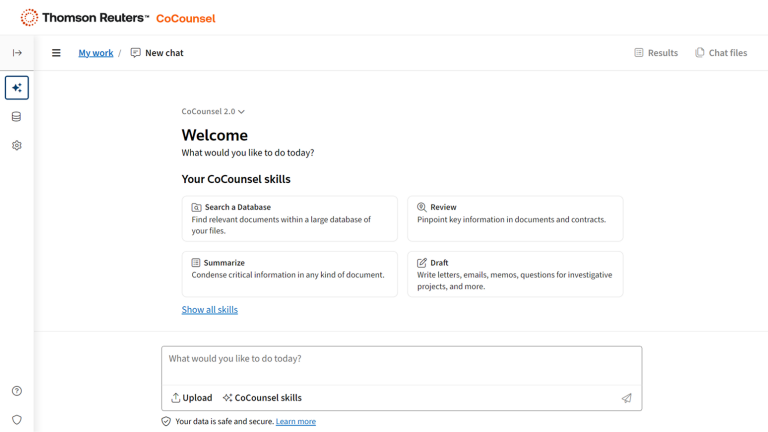
Thomson Reuters CoCounsel is AI technology built by industry experts, backed by authoritative content and equipped with best-in-class security.
CoCounsel receives high praise from users on G2, with ratings frequently reaching 5 stars, indicating strong satisfaction. Users appreciate its robust AI capabilities, though specific complaints are not prominent in the reviews accessed. On social platforms like YouTube and Reddit, it is discussed for its AI features, indicating a focus on technical and practical applications. Sentiment regarding pricing isn't explicitly mentioned, but the overall reputation appears positive, highlighting its effectiveness and user satisfaction.
Mentions (30d)
0
Avg Rating
4.8
20 reviews
Platforms
3
Sentiment
13%
1 positive


CoCounsel receives high praise from users on G2, with ratings frequently reaching 5 stars, indicating strong satisfaction. Users appreciate its robust AI capabilities, though specific complaints are not prominent in the reviews accessed. On social platforms like YouTube and Reddit, it is discussed for its AI features, indicating a focus on technical and practical applications. Sentiment regarding pricing isn't explicitly mentioned, but the overall reputation appears positive, highlighting its effectiveness and user satisfaction.
Features
Use Cases
Industry
internet
Funding Stage
Merger / Acquisition
Total Funding
$714.4M
Pricing found: $0, $501
g2
What do you like best about CoCounsel Legal?CoCounsel Conquers: Our legal team's journey with this AI-powered virtuoso, blending Sherlock's wit and Google's speed, as we waltzed our way to legal mastery and case-crushing confidence. CaseText´s CoCounsel application is a legal ace!" Review collected by and hosted on G2.com.What do you dislike about CoCounsel Legal?Our legal department´s once-beloved manual research, now pales in comparison. We no longer need to hire so many contract attorneys to review discovery documents, which is not good for the country´s GDP. Review collected by and hosted on G2.com.
What do you like best about CoCounsel Legal?The font is easy to read on a desktop and the information loads quickly. Review collected by and hosted on G2.com.What do you dislike about CoCounsel Legal?Not as comprehensive as other big databases Review collected by and hosted on G2.com.
What do you like best about CoCounsel Legal?I like the display of same/ similar cases and 2 column, page printing. Review collected by and hosted on G2.com.What do you dislike about CoCounsel Legal?Some searches need too much detail to get desired results. Review collected by and hosted on G2.com.
What do you like best about CoCounsel Legal?Casetext is extremely easy to use and has all the features of the more expensive legal research options at a cost small firms can afford. Review collected by and hosted on G2.com.What do you dislike about CoCounsel Legal?I am not a fan of the new layout. I would prefer a return to the old one, it was more user friendly and easier to navigate. Review collected by and hosted on G2.com.
What do you like best about CoCounsel Legal?The intuitive search functions, together with the copy and paste features save a lot of time. Review collected by and hosted on G2.com.What do you dislike about CoCounsel Legal?Lack of original pleadings such and Complaints, Answers and other responsive pleadings such as Motions for Summary Judgment, etc. Review collected by and hosted on G2.com.
What do you like best about CoCounsel Legal?Having long been a user of Westlaw, Casetext offers a fast and accurate means of researching cases, with a speed that will shock you if you are used to waiting for the chugging away of prior services. And you are given the option of using to search mechanisms, either key word (bolean) or parallel search. Review collected by and hosted on G2.com.What do you dislike about CoCounsel Legal?I miss having access to certain treatises. Review collected by and hosted on G2.com.
What do you like best about CoCounsel Legal?I love that I can use a statement or a question as my "search" and Casetext provides relevant and accurate results. It's saves me so much time to research particular issues. Review collected by and hosted on G2.com.What do you dislike about CoCounsel Legal?I wish I could narrow my search to specific terms in Black's Law Dictionary in Casetext but I haven't been able to figure this out or it isn't possible yet. I'll keep trying. Review collected by and hosted on G2.com.
What do you like best about CoCounsel Legal?The most useful area is the brightness of the scope. You can research any state. Review collected by and hosted on G2.com.What do you dislike about CoCounsel Legal?I would like to see more explanatory treatises available Review collected by and hosted on G2.com.
What do you like best about CoCounsel Legal?It is compatible with the browser so no extra software to download Review collected by and hosted on G2.com.What do you dislike about CoCounsel Legal?The case history could be easier to use. Review collected by and hosted on G2.com.
What do you like best about CoCounsel Legal?Easy to use. Also, I really like the assistance from the staff. Review collected by and hosted on G2.com.What do you dislike about CoCounsel Legal?Casetext does not have unreported cases. Review collected by and hosted on G2.com.
Legal: Claude + CoCounsel MCP Released
So this just happened today. All Anthropic needs now is the regional datacentres for both information at rest and inference, and we're off to the races. https://www.thomsonreuters.com/en/press-releases/2026/may/thomson-reuters-and-anthropic-expand-partnership-to-connect-claude-with-cocounsel-legal We all knew this was eventually going to happen but didn't think it would be so soon. My strategies just shifted for sure. submitted by /u/helraiser [link] [comments]
View originalUsing Claude Desktop + Code CLI as the core of a multi-model ER practice setup — curious who else has gone this deep
Background: I'm a former L&E management-side labor and employment defense attorney, turned in-house ER practitioner. Got frustrated with the limitations of any single AI tool for the kind of work we do — fact-gathering, documentation review, policy analysis, drafting PIPs and separation agreements, thinking through investigation strategy, etc. Over the past year, I've built a setup I think of as an "AI Council" — several models running in parallel, each assigned based on what it's actually good at. Perplexity handles real-time research, citation verification, and pre-decision fact checks. Grown to really love it over the past few months, and even started using Comet browser. Gemini and (more so) ChatGPT Plus are my strategy, analysis, and validation layer — long-context analysis, feasibility pressure-testing, and a check on whether my reasoning would survive scrutiny. Grok runs adversarial: it's my least favorite, but sometimes catches edge cases, hostile readings, and the arguments the other side will make. Anthropic's products are the hub — primary drafting, synthesis, and the final pass on anything that might end up in a file or a courtroom. That breaks into two surfaces: Claude Desktop for interactive work and Claude Code CLI for heavier, tool-driven execution — file operations, multi-step workflows, and anything that benefits from running against the actual repository rather than a pasted excerpt. Codex handles Windows-native scripting and automation on the back end, and cross-checks Claude's work. The whole stack is wired together through over a dozen MCP servers/Connectors/Extensions— Desktop Commander for controlled file writes, Filesystem for direct repository access, Google Drive and Gmail for organizational documents and correspondence, and Google Calendar for timeline reconstruction on investigations. NotebookLM sits on top of the document repository for source-grounded synthesis when I need to stay anchored to the record. Obsidian is the connective tissue, tied mostly to Claude's products — the knowledge base everything feeds into and draws from. I treat them less like individual tools and more like a panel of advisors running in parallel, with different members on point at different phases of the matter. One thing that's made a real difference: I've built out a local repository the AI can reference — org charts, reporting structures, personnel titles and manager relationships, employee characteristics relevant to ER patterns, investigation templates, policy libraries. So instead of re-explaining context every time, the models are working from a shared, structured picture of the organization. It's closer to how I'd brief a co-counsel than how most people describe using AI. For ER specifically, the biggest wins have been: Comparator and consistency pulls — before recommending discipline, having the AI surface similar past cases from the repository to flag disparate treatment risk before I'm standing in front of a plaintiff's attorney explaining it Pretext-proofing the record — checking whether the documented performance history actually supports the stated reason for action, not just whether the decision feels right Credibility framework structuring — in he-said/she-said investigations, using it to stress-test my witness weighting and surface what a hostile reviewer would attack in my findings Manager coaching in real time — drafting the actual words for difficult conversations (PIPs, termination, accommodation denials) so managers stop improvising their way into liability Intake triage and scope-setting — determining early whether a complaint warrants a formal investigation or a managed resolution, and what that decision's downstream exposure looks like Drafting that litigation-proofs itself — one AI drafts, another redlines for ambiguity, passive voice, and weasel language that wouldn't survive discovery Chilling effect and retaliation risk flags — identifying when a situation's timeline creates a proximity problem before the next adverse action goes through Hasn't replaced judgment — still very much human-in-the-loop, and the attorney background makes me *very* paranoid about accuracy in ways that probably help here. But it's fundamentally changed how I work. Curious if anyone else has built something similar, or is using AI in ER at all. submitted by /u/TheLawIsSacred [link] [comments]
View originalhttps://t.co/ha9aNCSnhU From #SerbiaFloods
https://t.co/ha9aNCSnhU From #SerbiaFloods
View originalYes, CoCounsel offers a free tier. Pricing found: $0, $501
CoCounsel has an average rating of 4.8 out of 5 stars based on 20 reviews from G2, Capterra, and TrustRadius.
Key features include: A fluid connection to the solutions you work in every day; it understands context and nuance across products and workflows, allowing you to derive more in-depth insights faster than ever., Access to the most innovative large-language models (LLMs) backed by the industry's most trusted and reliable content., Integration with industry-leading platforms such as Westlaw, Practical Law, Checkpoint, Microsoft 365, and document management system partners..
CoCounsel is commonly used for: Small firms.
CoCounsel integrates with: Westlaw, Practical Law, Checkpoint, Microsoft 365, Clio, DocuSign, Everlaw, iManage, LexisNexis, Zola Suite.
