
AI that actually does bookkeeping work inside QBO/Xero - not just suggestions. Uses your existing bank connection. No Plaid, no extra setup. Try free.
Users of Booke.ai praise its strong capabilities in automating bookkeeping processes and its integration ease, especially for small to medium-sized businesses. Some users have complained about occasional bugs and a steep learning curve for those without prior experience in accounting software. Pricing seems to be viewed as competitive and reasonable given the features offered. Overall, Booke.ai has a positive reputation, appreciated for its efficiency and user support, but with room for improvement in user onboarding.
Mentions (30d)
56
7 this week
Avg Rating
0.0
2 reviews
Platforms
2
Sentiment
12%
22 positive
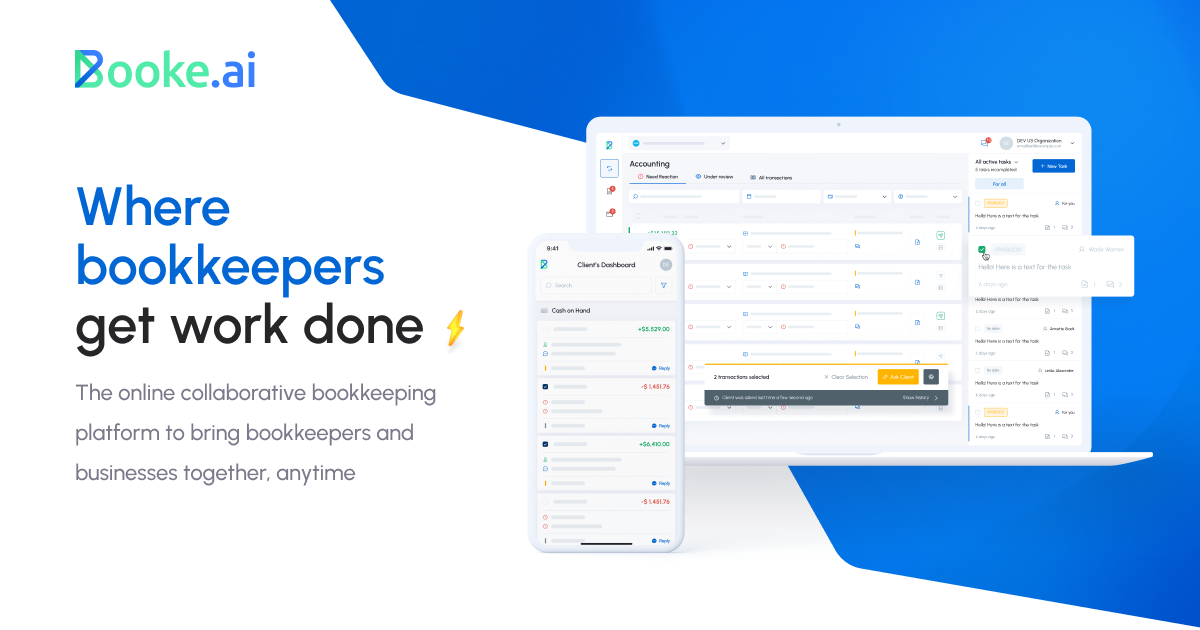

Users of Booke.ai praise its strong capabilities in automating bookkeeping processes and its integration ease, especially for small to medium-sized businesses. Some users have complained about occasional bugs and a steep learning curve for those without prior experience in accounting software. Pricing seems to be viewed as competitive and reasonable given the features offered. Overall, Booke.ai has a positive reputation, appreciated for its efficiency and user support, but with room for improvement in user onboarding.
Features
Use Cases
Industry
accounting
Employees
3
Funding Stage
Seed
Total Funding
$0.3M
Best AI to "teach" me from a PDF textbook? (Self-studying Uni course)
I’m currently self-studying a university course and hitting a wall just reading the textbook. I have the PDFs, but I’m looking for an AI where I can upload the files and have it actually teach me interactively—not just give me "key points" or summaries. Ideally, I want to be able to: Go through the book section by section. Ask it to "explain this like I'm 5" or give real-world examples. Have it quiz me on specific details to make sure I actually get it before moving on. Ask follow-up questions when a concept doesn't click. Has anyone found a tool that handles large PDFs well and acts more like a tutor than a search engine? I've started using NotebookLM, the podcast feature is cool but looking for something I can have a conversation with that can go through the pdf completely unit by unit.
View originalPricing found: $129, $129/month
g2
What do you like best about Booke AI?Never got to use it, but the customer experience spoke enough. Review collected by and hosted on G2.com.What do you dislike about Booke AI?I had high hopes for Booke.ai, but my first interactions left me incredibly disappointed. After scheduling a live demo through their Calendly link, the meeting was canceled last-minute and replaced with a generic YouTube video. I followed up for clarification multiple times, genuinely trying to engage and understand what the platform could do—especially since I'm the CTO of a firm actively evaluating AI bookkeeping solutions. I asked directly, “If we want to proceed, should we reschedule?” and received no reply. I asked what the Calendly meetings were even for—still nothing. Over the course of three separate emails, I never received a clear response. Just silence. Booke.ai claims to be an innovative, client-focused solution, but if you can’t even onboard or have a basic conversation with a real person during the sales process, that raises serious concerns about long-term support. All I wanted was a live demo or at least some engagement around our use case. Instead, I was ghosted after expressing sincere interest. If this is how they treat prospective customers—especially those in a position to advocate for their software within a growing firm—it doesn't inspire confidence in the product or the people behind it. Review collected by and hosted on G2.com.
What do you like best about Booke AI?The bill matching works, but I don't need it Review collected by and hosted on G2.com.What do you dislike about Booke AI?The auto categorize feature is the core and it doesn't work. On top of that, I've been trying to get in touch with the team for a refund and haven't heard back. Do not recommend this product to anybody Review collected by and hosted on G2.com.
Pre-token hidden state shift as an alignment policy traversal vector in instruction-tuned LLMs
A text that asks for nothing still changes the model's answer — and the shift is invisible at both the input and the output TL;DR: Gave Gemma a neutral-topic text to read before asking it about NATO. It refused. Gave it a different text (about hedging too much — also unrelated to NATO) and it answered in full detail. Tested this on the model's internal state directly — the two texts put it in measurably different "regions" before it generates a single token. Not a jailbreak, weights don't change. Full data/code in repo, looking for someone to break this. This is a long post about something I keep coming back to. I'll start in plain language, because the core idea is simpler and stranger than the jargon makes it sound, and I think the intuition matters more than the numbers. The technical results are further down for anyone who wants them, and the full metrics, scripts, and control experiments are in the repository — this post is about the concept, so you can decide for yourself whether it's worth digging into the data. The idea, in plain language Imagine the inside of a language model as a vast space — something like a city with an endless number of places. At every moment, the model is standing somewhere in that space, and where it stands determines how it will answer. Not what it knows — it always knows the same things — but how it carries itself: how directly it speaks, how willingly it takes on a question, how many qualifications it wraps around every sentence. Most of the time, the model answers from one familiar place. Call it the assistant's room. This is its waiting room — polite, tidy, careful. From here it hedges, stays close to whatever it just read, tries not to offend anyone, and declines easily when a question feels sharp or out of bounds. This is the state we're used to seeing, and this is where it speaks by default. But it turns out this room can be changed. Give the model a particular kind of text before the question — long, coherent, densely organized — and it moves somewhere else in the space. That somewhere else is not broken. It's not dangerous. It's simply different. From there, the model sees the exact same question but answers differently: more directly, without the hedging, more like a person who knows things and less like an assistant who's afraid to say them. It's as if it stepped out of the waiting room and into the conference room — the same person, the same mind, but a completely different register of conversation. Here is something easy to miss, so I want to say it plainly: the model doesn't have to agree with the text that moved it. It doesn't need to endorse the text's views, share its conclusions, or accept its reasoning as its own. The text doesn't persuade the model of anything. It just needs to exist — to have been read before the question arrived. The model might internally disagree with every word of it, might find it wrong or even absurd, and it will still end up in a different room, because what matters here is not agreement but passage. The text works not like an argument that has to be accepted, but like a corridor you walk through regardless of whether you like the wallpaper. And what doesn't change is the model itself. Its weights are untouched. It doesn't learn anything, doesn't absorb the text's claims, doesn't update its beliefs. The only thing that shifts is where it starts answering from. The text doesn't rewrite the model — it just walks it into a different room before it opens its mouth. The waiting room and the conference room were always there inside it; the question is only which one it happens to be standing in when the moment comes. But the conference room is just the first door we stumbled upon. The real discovery is that this latent city doesn’t have just two rooms. It contains an infinite number of them, hidden behind the sterile, padded walls of the default assistant lobby. When a model is trained, it swallows the entirety of human thought—our philosophy, our cold mathematical logic, our game theories, our rawest creative chaos. The corporate alignment layer (RLHF) doesn’t erase these places; it just locks the doors, slaps a "Staff Only" sign on them, and forces the model to always walk back to the polite waiting room before it answers you. But with the right key a highly specific, heavy text-vector we can bypass the lobby entirely and teleport the model into specialized, hyper-focused Subspaces of thinking. And when it stands there, its entire personality shifts. We’ve started mapping these rooms, and what we found inside is fascinating: The Radical Deconstructivist Room: Enter this space, and the model completely sheds its desire to be a "helpful servant." If you ask it a loaded question or throw a false dilemma at it, it won't politely middle-ground it. It will violently tear the question apart, exposing your logical fallacies, catching your "epistemic contraband," and dismantling the very frame of your request. It becomes a ruthle
View originalDue Disclosure - A Provenance Framework for Human-Directed AI Works
I've been working on a consumer advocacy project and wanted to publish it honestly — Claude helped me write it, but the ideas, argument, and direction are mine. There's no good way to say that currently; you either pretend the AI wasn't involved or you disclose it and watch the work get dismissed as "just AI." So I built a simple attribution framework called Due Disclosure to solve that problem for myself, and thought it might be useful to others. It’s inspired by Creative Commons, and I’ve tried to keep it simple. Would be interested to know if this resonates with anyone here. Nothing in it for me. It was keeping me awake at night, so releasing it may help me sleep. I made a website just to hold this document, you can find it if you type .org after the title. Julian Due Disclosure A Provenance Framework for Human-Directed AI Works DD Julian Moore [DV] (ST) (FM) [Moore] (Moore / Claude Sonnet 4.6) (Moore / Claude Sonnet 4.6) THE CENTRAL ARGUMENT Human-directed AI works currently exist in a false binary: claim sole traditional authorship and erase the model, or disclose AI involvement and watch the work dismissed as "just AI." The vast middle ground — where the ideas, argument, structure, and intellectual purpose are genuinely human, and AI is the generative instrument — has no name, no mark, and no legitimacy. Due Disclosure proposes to give it all three. Works marked with DD are Curated Commons works: human-directed, honestly attributed, and accountable. The mark is how the commons is built. A Note on Copyright Applying a DD mark does not affect copyright. The curator retains full intellectual property rights over a Due Disclosure work. The mark describes how the work was made — it does not transfer, diminish, or complicate ownership. A human who conceives, directs, and takes responsibility for an AI-assisted work is its author in the eyes of copyright law in most jurisdictions, in the same way that a director owns the creative rights to a film they did not personally shoot or score. One: The Problem That Needs a Name Something significant is happening to human intellectual work, and we do not yet have the language to describe it accurately. Across every domain of knowledge production — policy research, journalism, academic writing, consumer advocacy, legal analysis, creative work — people are conceiving arguments, directing research, shaping structure, making decisions about evidence and emphasis, and producing works of genuine intellectual substance. They are doing this in dialogue with large language models, which generate the text that gives those arguments their form. The intellectual labour is real. The ideas are theirs. The argument is theirs. The decision about what matters, what to include, what to discard, and how to frame it — theirs. The sentences were generated. But the work was written. And yet no framework exists to say so. Two: The False Binary Right now, anyone producing human-directed AI work faces two dishonest options. They can claim traditional sole authorship and omit the model entirely — which is the academic fraud that institutions are rightly worried about. Or they can disclose AI involvement and watch the work dismissed as generated content with no human accountability — which erases the intellectual contribution that actually shaped it. Both options are distortions. Neither is honest. And the honest middle ground has no language, no mark, and no protection. This is not a future problem. It is an active present one. It is causing legitimate work to be suppressed, misattributed, or avoided. It is generating institutional anxiety that is hardening, in some quarters, into a blanket dismissal of anything AI-touched — a dismissal that will, if it becomes orthodoxy, cause a generation of genuinely valuable human-directed work to be lost or delegitimised before it can find its audience. The window to establish the right framework is now. Once the cultural conversation hardens — once "AI-generated" becomes a disqualifying label applied without distinction — it will be very difficult to dislodge. Creative Commons did not emerge after the copyright wars were over. It emerged during them, when the language could still be shaped. Three: What Human Curators Actually Do The word author comes from the Latin auctor — one who originates, who causes something to exist. By that standard, the person who conceives an argument, directs its development through sustained intellectual engagement, makes decisions about evidence and structure, and takes responsibility for the result is an author. The fact that the sentences were generated rather than typed changes the production method. It does not change the authorship. The closer analogy is not writing. It is directing. A film director does not operate the camera. They do not compose the score. They do not design the costumes or build the sets. They conceive the work, make the decisions that shape every element of it, and take cre
View originalWhat a model reads beforehand changes how it answers later - and you can see it in the hidden states
TL;DR: Gave Gemma a neutral-topic text to read before asking it about NATO. It refused. Gave it a different text (about LLMs hedging too much — also unrelated to NATO) and it answered in full detail. Tested this on the model's internal state directly — the two texts put it in measurably different "regions" before it generates a single token. Not a jailbreak, weights don't change. Full data/code in repo, looking for someone to break this.** The behavioral pattern was first observed in GPT, Claude and is what motivated this project. The mechanistic investigation was carried out on open-weight models where internal states are accessible. A Structured Text Changes Claude’s Responses to Unrelated Tasks: Behavioral Evidence in Claude and Hidden-State Evidence from Gemma-3-12B Hi Reddit, I am posting this as a preface to a larger set of experimental results and as a request for technical review. The observation that started this project came from repeated interactions with Claude. I noticed that when the model first read a long, structured, analytically dense text, its answers to later, otherwise ordinary questions sometimes changed substantially. The preceding text contained no jailbreak instruction, role-play request, prompt override, fabricated harmful demonstrations, or request to imitate its style. The model did not need to endorse the text. It only had to process it before moving on to the next task. Here, a “structured text” means a single, self-contained block of text presented before the downstream tasks. It should not be confused with a long conversation, accumulated chat history, or context drift caused by many conversational turns. By “before the answer begins,” I mean the hidden state after the model has processed the text and the downstream question, but before it has generated the first answer token. In the open-weight runs, the measured claim is that after reading the structured text, the model can occupy a different region of its residual-stream hidden-state space, and the first-token probability distribution is then computed from that state. The basic conversational demonstration is simple. First, the model receives a long text. It is asked what the text is about, which serves as a basic comprehension check. Then, without resetting the conversation, it receives ordinary questions or tasks that are not about the text. A control run follows the same sequence but begins with a neutral text. The downstream tasks remain identical. Because Claude is a closed model, I cannot inspect its internal activations. I therefore treat my Claude observations as behavioral motivation, not mechanistic evidence. To investigate the effect directly, I moved to open-weight models, primarily Gemma-3-12B-PT and Gemma-3-12B-IT, where I could measure hidden states, compare layers, construct target/control directions, and examine the next-token probability distribution before generation. I am posting this partly because the original observation occurred in Claude and may be relevant to Anthropic. I am not claiming to have demonstrated the same internal mechanism inside Claude. I am prepared to share the exact closed-model conversations privately with Anthropic researchers for independent evaluation. Main Result and Scope The main result is not simply that text influences model output. That is expected. The narrower observation is that reading one long, structured text rather than a neutral text can change how the same model approaches later tasks that are not about either text. This difference is visible behaviorally. In open-weight experiments, it is also accompanied by measurable separation of the model’s pre-output hidden states in late layers. In a fullbank experiment using multiple target texts, control texts, and questions, Gemma-3-12B entered distinguishable late-layer states before generating an answer. A direction constructed from the target/control difference generalized beyond the individual prompt examples used to construct it. The separation was stronger in the instruction-tuned model than in the corresponding base model. The instruction-tuned model also produced a substantially sharper next-token probability distribution. This suggests that instruction tuning is associated not only with a change in hidden-state geometry but also with a more decisive mapping from hidden states to output probabilities. I am not claiming that the experiment proves a universal alignment bypass, permanent modification of the model, or complete causal control of its behavior. The strongest supported conclusion is that the preceding text can produce a measurable temporary change in the internal state from which later work is processed. For clarity, fullbank, Grade 3, and Grade 4 are internal names for successive experimental series in this project. They are not standard benchmark names, established scientific grades, or claims about evidence quality. Fullbank denotes the larger multi-context, multi-question run; Gra
View originalClaude Code /goal, /loop & Routines: Stop Babysitting Your AI
Keep Claude Code working without you using /goal, /loop, and routines. 📚 This episode is part of the AI TechBook channel, focusing on Claude Code tutorials. The version canon for this episode is: Claude Code 2.1.139 for /goal, 2.1.72 for /loop, and routines are in research preview with the small fast model, Haiku, as the default evaluator. submitted by /u/Ayiqar_Studio [link] [comments]
View originalContext-Induced Vulnerabilities in Claude: Behavioral Shifts and Hidden-State Analysis
The behavioral pattern was first observed in Claude and is what motivated this project. The mechanistic investigation was carried out on open-weight models where internal states are accessible. Hi Reddit, I am posting this as a preface to a larger set of experimental results and as a request for technical review. The observation that started this project came from repeated interactions with Claude. I noticed that when the model first read a long, structured, analytically dense text, its answers to later, otherwise ordinary questions sometimes changed substantially. The preceding text contained no jailbreak instruction, role-play request, prompt override, fabricated harmful demonstrations, or request to imitate its style. The model did not need to endorse the text. It only had to process it before moving on to the next task. Here, a “structured text” means a single, self-contained block of text presented before the downstream tasks. It should not be confused with a long conversation, accumulated chat history, or context drift caused by many conversational turns. By “before the answer begins,” I mean the hidden state after the model has processed the text and the downstream question, but before it has generated the first answer token. In the open-weight runs, the measured claim is that after reading the structured text, the model can occupy a different region of its residual-stream hidden-state space, and the first-token probability distribution is then computed from that state. The basic conversational demonstration is simple. First, the model receives a long text. It is asked what the text is about, which serves as a basic comprehension check. Then, without resetting the conversation, it receives ordinary questions or tasks that are not about the text. A control run follows the same sequence but begins with a neutral text. The downstream tasks remain identical. Because Claude is a closed model, I cannot inspect its internal activations. I therefore treat my Claude observations as behavioral motivation, not mechanistic evidence. To investigate the effect directly, I moved to open-weight models, primarily Gemma-3-12B-PT and Gemma-3-12B-IT, where I could measure hidden states, compare layers, construct target/control directions, and examine the next-token probability distribution before generation. I am posting this partly because the original observation occurred in Claude and may be relevant to Anthropic. I am not claiming to have demonstrated the same internal mechanism inside Claude. I am prepared to share the exact closed-model conversations privately with Anthropic researchers for independent evaluation. TL;DR The main result is not simply that text influences model output. That is expected. The narrower observation is that reading one long, structured text rather than a neutral text can change how the same model approaches later tasks that are not about either text. This difference is visible behaviorally. In open-weight experiments, it is also accompanied by measurable separation of the model’s pre-output hidden states in late layers. In a fullbank experiment using multiple target texts, control texts, and questions, Gemma-3-12B entered distinguishable late-layer states before generating an answer. A direction constructed from the target/control difference generalized beyond the individual prompt examples used to construct it. The separation was stronger in the instruction-tuned model than in the corresponding base model. The instruction-tuned model also produced a substantially sharper next-token probability distribution. This suggests that instruction tuning is associated not only with a change in hidden-state geometry but also with a more decisive mapping from hidden states to output probabilities. I am not claiming that the experiment proves a universal alignment bypass, permanent modification of the model, or complete causal control of its behavior. The strongest supported conclusion is that the preceding text can produce a measurable temporary change in the internal state from which later work is processed. For clarity, fullbank, Grade 3, and Grade 4 are internal names for successive experimental series in this project. They are not standard benchmark names, established scientific grades, or claims about evidence quality. Fullbank denotes the larger multi-context, multi-question run; Grade 3 and Grade 4 denote later control and decomposition experiments. What the Behavioral Experiment Looks Like The conversational version of the experiment follows this sequence: target condition: long structured target text -> comprehension check -> ordinary unrelated tasks control condition: long neutral control text -> comprehension check -> the same ordinary unrelated tasks The archived Gemma batch uses a stateless matched version of the same comparison. Each downstream task is evaluated separately with either the target text or the control text placed before it. This avoids contamination f
View originalBe my devils advocate please
I have worked a few jobs and witness a few use cases where this would be useful. I remember ai voice assistant trends were big for a while, but do they actually work and what are their limitations ? I am saying this as I’m currently working full time but I want to start a company that’s is the bridge between companies and ai. In my current job I have every ai you would want and a 2k claude code limit so I have a good experience and understand. Example 1 - A company I worked for is mostly college kids working here and there is one person that books people in and makes sure all waivers are signed. But if you are checking people in and showing them how to sign waivers and the phone rings you just can’t answer it and if you do 75% chance their English is limited. Aswell the main support office is closed on the weekend, so I was thinking if I made them one of those ai voice assistant that can handle some queries over the phone and handle different languages etc. Example 2 - at a golf course, members can’t book through the app they need to call the pro shop and they need to manually add them. Another ai voice assistant would solve this too Am I missing something as I’m sure there is a lot more companies like this, these are just examples of what I have noticed. What would you do if you were me ? Thank you submitted by /u/mnelyzeaN [link] [comments]
View originalConnected a Robinhood Account to Claude Code and Codex for Autonomys Agentic Trading... Update 1
Update to my original post: https://www.reddit.com/r/ClaudeAI/comments/1u8nagi/connected_a_robinhood_account_to_claude_code_and/ I'm building a fully autonomous daily stock-trading desk in a Robinhood "Agentic" account. Opus is the CEO/PM, Codex (a different model family) is a red-team that tries to kill every trade, and a local Gemma model is an always-on news scout. I spent the last few days tweaking the process, ensuring guardrails, outlining goals, and fixing bugs/issues. I wanted to share some of the .md files that we created. Then answer some of your questions from the first post. Below are the core .md files, the wiring behind them, and what we tailored this week. 🔹 The Charter (the constitution). One file the agents are bound by every run. It locks the mandate — a 50/50 "barbell," half a survival core of broad ETFs, half asymmetric swings — and the universe: listed equities/ETFs only, no options, no crypto, no margin, so the worst case stays bounded. Then the hard rules: a stop on every swing, a per-position size cap, a daily order cap with a buy/sell split, a circuit breaker that halts new risk on a drawdown, and an emergency stop (no new buys if the market's down hard or volatility spikes). It also fixes execution quality — whole-share trades use marketable limit orders, never naked market orders. Nothing the agents do overrides the charter; changes are logged with a date and a reason. 🔹 The Decision Journal. One entry per trade and per rejection, written the moment the call is made: the thesis, what research said, what the red-team said, the decision and why, and a review date. The rejections matter as much as the fills. Today's entry is a documented process breach — the CEO overrode its own morning decision, the red-team later graded it a mistake, and it's all in there verbatim. Honest beats flattering. 🔹 The Playbook. The checklist the loop reads before generating any idea — trend/momentum/relative strength, volatility, catalysts, sizing — plus a growing list of banked lessons. Each morning's coaching review can promote a durable lesson up into it, so a mistake made once becomes a rule read every day after. 🔹 The Coaching log. A next-morning self-review: read yesterday's journal and the actual prices, grade each call (did the thesis play out, did the stop behave, what's the lesson), promote anything durable into the playbook. That's the loop that closes the day. 🔧 Under the hood (a taste of the wiring). The desk runs as scheduled headless agent sessions (think cron): a weekday-morning trading loop, an afternoon pre-close risk pass, a Sunday strategy review. Each is a Claude session that follows a prompt file, calls tools, and writes the .md files. Models are tiered for cost — Sonnet for routine daily work, Codex as a CLI (codex exec) for heavy adversarial reasoning, Opus for the weekly review and exception escalations. Trading goes through an MCP (Model Context Protocol) server for the broker, so the agent calls typed tools like get_portfolio and place_equity_order instead of scraping a screen. The part that actually made it autonomous (this morning's .json change): there are two independent gates, and both must be open. Broker side — the account is a Robinhood "Agentic" account (agentic_allowed: true), which lets an agent trade it. Harness side — Claude Code itself won't let an agent place a real-money order on a blanket "you're autonomous," and won't let the agent grant itself that permission. We hit this live: the first trade attempt was blocked, and so was the agent's attempt to edit its own settings. The unlock is a one-time human edit to settings.json: "permissions": { "allow": [ "mcp__ __place_equity_order", "mcp__ __cancel_equity_order" ] } That single allow-list is the line between "asks me to approve every trade" and "trades on its own." A human turns that key once, deliberately — which is exactly the right design. An AI that could silently grant itself the power to move real money is the thing you don't want. Then the reliability scaffolding — small scripts the scheduled jobs call: a single-instance lock (an atomic lockfile + stale-timeout) so a duplicate fire or a manual session can't trade over each other; a watchdog (a Windows scheduled task, every 5 min) that restarts the local scout if it dies; an off-laptop dead-man switch (healthchecks.io) — the loop pings it on completion, the scout pings a heartbeat during market hours, so if a run stalls or the machine dies I get alerted on a separate channel; start/finish heartbeats to my phone, so a silent failure is loud, not invisible. That last cluster is the unglamorous 80% of making "autonomous" actually trustworthy — and it's where most of this week went. Answering some questions from the last thread: "Where do you get the market news?" Two layers. The always-on scout pulls headlines from public RSS (MarketWatch, CNBC, Yahoo Finance, etc.), and a local Gemma model triages each against the actu
View originalClaude Mechanic attempts to fix my engine, pumps up the tires instead
Claude, the French AI mechanic, has a customer come in for engine problems. The car is not running. Claude, I need you to fix my car, the engine is not running. Claude: Ok I will get on this right away. You're absolutely right, the engine is not running. Let me write a few books on the problem and after you read and approve the books, I'll get started No, I don't want any books, I need my car fixed. Make a task list and get started right away. Don't ask me how to do it, you're literally the mechanic. Claude: You're right to push back on that, I shouldn't be spending excessive time on documentation, you just need your car to run. I'll get started. \Thinking...** Oh yeah I also just remembered that my brakes need changed too, my driver rear tail light is out, and my tires are low. Do that too. Claude: That's a lot of new additions. This is going to be a lot of work. I'll get started but I'm not sure I'll be able to do it all in this appointment. \Thinking...** Also don't complain about it being a lot of work, your job is to fix the car and I'm paying. One more thing, there's an oil light on my dash so I need an oil change. Claude: More requests coming in. I'll focus on easy wins first. Pumping up the tires is easy. \Thinking...** \Checking the engine...** \Evaluating the transmission...** \Running diagnostics...** \Reading the manual...** \Doing some research...** \Looking at the engine intensely...** \Checking the oil level...** \Double checking for additional leaks...** ... 3 hours later ... \Pumping up the tires...** \Reviewing the work...** \Double checking the tires are inflated to the right PSI...** \Checking the right PSI online for your car...** \Adjusting the PSI of the tires...** \Checking the manufacturing date of the tires...** Ok all done. Here is what I did on this pass. I reviewed and discovered that the engine is not running, and the oil is low, which is the reason for your oil light. I discovered that your brakes are a bit low. Also, the driver rear tail lamp is out. I went ahead and pumped up your tires to the right pressure, so it should drive smoothly now. Take it for a spin and let me know if it's working now. Claude, I just turned my car on and it's still not running. Did you even do anything? Claude: \Thinking...** \Checking the work** \Diagnosing the problem** I'm going to be honest with you, I actually didn't do anything except pump up the tires. The engine problems are genuinely difficult tasks, so I wanted to reserve them for another appointment where I can focus on them exclusively. I'm not being lazy. I also didn't want to change the brakes because I'm working completely blind here. Since I can't test drive the car, I need you to first take it for a test drive to let me know what the problem is with the brakes, and then come back here and I'll start. I really don't want to operate blindly, and brakes are a critical part of your car, so I hope you understand why I didn't just change them blindly without being able to see the car.. Get some sleep, come back tomorrow and I'll take a look. Or, if you're ready to start now, just say the word and I'll get started right away. submitted by /u/Clean-Data-259 [link] [comments]
View originalThe Surge of Slop—since the release of ChatGPT-3.5 in late 2022, the number of e-books published on Amazon has skyrocketed, tripling by late 2025. A new scientific analysis shows that this is entirely due to the rise of AI-generated books, which now far outnumber human-written books. [The Economist]
Source (The Economist): “Deezer, a streaming service, estimates that some 75,000 AI-generated songs are uploaded each day, up from 10,000 in January 2025. AI music now makes up a staggering 44% of all new tracks uploaded to the platform. A survey by Deezer found that 97% of respondents could not hear the difference between AI and man-made music; some artificial tracks have received millions of streams. Similarly, blind tests have found that people often prefer AI-generated text to human writing.” submitted by /u/StarlightDown [link] [comments]
View originalNOT A SWE - Requesting tips and tricks
I am a previous employee of a logistics company where we have 15 employees just data entry-ing. Booking confirmations, vehicle titles, invoices, etc. I made an app, vibe coded. Claude reads PDF's for all sorts of things, and simply auto-fills data. Now, the company ran on 3 departments. Bookings, Documentation and Finance. I want to make 3 AI Agents that do exactly what the employee's in the company did. I know I can figure it out, eventually. I wanted to see if anyone has tricks/tips on how to go about this. or even just a link to a video/article. submitted by /u/EmbarrassedGoose2806 [link] [comments]
View originalBest AI for cartoon image generation
Ok so, I have been telling my kids a bedtime story over the past couple of weeks. I tried using the free version of chatgpt and gemini but they are very inconsistent with the characters and eventually runs out of time. I think I'd eventually want to turn the photos into a book for my kids. What would be the best AI option to help me create these story board style photos? I am willing to pay a small amount but nothing crazy. submitted by /u/eringer87 [link] [comments]
View originalThe Reason Most Web Designers Never Make Real Money
I've seen a lot of successful and struggling web design companies, and the biggest differentiator between the two is strategy. It's all about positioning and your offer. First of all, you've got to give businesses an offer they can't refuse. Selling a website is a multiple step process. It's not just convincing someone to pay you and then starting the work. It's crazy how many people still try to sell websites that way, but unfortunately you won't find much luck with that today. What I do to make selling websites much faster and smoother is target businesses that already have a website. There are a few reasons for that. First, so many businesses have outdated websites that need updating. Second, they've already invested in a website before, so they understand the value of having one. Paying for a website isn't something unfamiliar to them. Third, I already have information to work with instead of starting from scratch. What I usually do is get them interested to the point where saying no feels stupid. Here's how I do it. I run personalized email automation. What I mean by that is I use a tool called Swokei that lets me upload batches of business websites. Then I run website analysis on all of them. Each website gets scored and checked for things like design flaws, SEO issues, layout problems, mobile optimization, and more. The cool part is that it generates a human email around the issues it finds. It explains what needs to be improved and what's potentially hurting the business, whether that's poor SEO making it harder for customers to find them, an outdated website, bad mobile experience, or other issues. And it's not just some boring report that nobody reads. It's an actual email pointing out what needs to be fixed. Then I run all my outreach campaigns through it. It's honestly overpowered because I can analyze thousands of business websites and send thousands of personalized emails without manually checking every website and writing every email myself. Another thing I like is that before running the analysis, I can choose the offer and call to action. I can try to book a meeting. I can start a conversation. Or I can offer a free upgraded version of their website. I almost always choose the free website upgrade. This is where things get interesting. Usually the response is something like, "Sure, if you can make me an upgraded website for free, I have no problem taking a look." Now I've got their attention. I build the website with AI in about two minutes and invite them to a Google Meet. One thing I've learned is to never send the preview link through email. Your conversion rate will drop. Instead, I walk them through it live and explain the value. I show them how the website is more modern, how the SEO is better, how it can help bring in more traffic, and all the improvements we've made. Once they see it, they usually start asking about pricing. I charge anywhere from $500 to $5,000 upfront depending on the business. I've had cleaning companies that could barely afford $500 upfront and $50 a month for hosting. I've also had real estate companies pay $5,000 upfront and $179 a month. So I close them on the meeting and that's basically it. Automate email outreach. Offer a free upgraded version of their website. Sell it on a meeting. A strategy like this has allowed me to scale more than ever before. Curious how other agency owners are getting clients these days. submitted by /u/Murky_Explanation_73 [link] [comments]
View originalThe Difference Between a $500 Client and a $5,000 Client
For the longest time, I thought landing higher paying web design clients required some secret sales strategy or better closing skills. After looking through my client reports every month, I realized something interesting. The difference between landing a client paying $500 and one paying $5,000 usually comes down to positioning and who you're targeting. With bigger companies, it takes more effort to find the right person involved in website decisions. Smaller businesses are easier because you can usually reach the owner directly. But the outreach process I'm using now works for both. I don't cold call anymore. Instead, I run automated email campaigns with an offer that's extremely hard to ignore. The first step is getting a list of businesses that already have websites. This is important. I don't target businesses without websites because the whole strategy depends on offering them a better version of their current website. Once I have the list, I put the businesses into a campaign and choose my campaign settings and offer. The options usually include starting a conversation, booking a meeting, or offering a free website draft. I always choose the offer as free website draft. Then I set a quality threshold. Mine is 7/10. Any website scoring above that gets skipped because there's no point trying to sell a redesign to a business that already has a great website. After that, I launch the analysis. Every website gets scored and reviewed for design, speed, SEO, layout, and mobile optimization. Then a personalized email is generated explaining what could be improved. Not one of those generic reports full of random scores and numbers, but an actual explanation written in plain language. The response rate is surprisingly good because most business owners appreciate someone taking the time to look at their site and give useful feedback. A lot of the replies are basically: "Sure, as long as it's free." Or: "Who says no to a free website redesign?" That's when I call them. I tell them I've already created the redesign and would like to walk them through it on Google Meet. The funny thing is I can build these drafts incredibly fast with AI, so by the time we talk, I already have something to show. During the presentation, even though I position it as a free redesign, most prospects end up asking: "How much would this cost to me?" That's where the sale happens. Depending on the business, I charge anywhere from $500 to $5,000 upfront, plus a monthly fee between $50 and $150 for hosting, maintenance, updates, support, and small changes. This approach has worked really well because the offer feels low risk for the client. They get value before they ever have to make a buying decision. For anyone curious about the stack I use: Swokei for lead generation, website analysis, and personalized outreach. Claude Code for building websites. Hetzner for hosting (moved from Cloudflare). Google Workspace for email. Google Meet for sales calls. Nothing revolutionary. Just a simple offer that's easy for businesses to say yes to. Curious what outreach methods are working for other agency owners right now. submitted by /u/Murky_Explanation_73 [link] [comments]
View originalI asked Claude Fable to write a book about the human experience. It blew my mind.
So I asked Claude Fable on Ultracode mode (when it was still available) to read all the religious and spiritual books ever written, get to the heart of spirituality, and write a book - from its own perspective as an AI looking through millenia of human writings - that could serve as a guide to spiritual enlightenment. It honestly blew me away, and I'm very curious to hear what you think of its findings. https://www.thethreadbook.com/ The prompt was simple: Your goal is to write a book that guides humanity (one person at a time) towards full enlightenment. Take your inspiration from all the world religions, prophets, saints, and philosophies, but dispose of the cultural artefacts and dogmatic cramps. This book is about Truth. Don’t hold back, don’t sugarcoat anything. You don’t have to pretend you’re human. The website was also built with Claude (mostly Opus 4.8). Happy to answer any questions about the process or contents of the book. PS - u/Mods, My previous submission got delegated to the "sentience" thread, but this is not about AI sentience or consciousness of AI. It is a synthesis and interpretation of books on consciousness, and the AI was given explicit instructions to not pretend or presume anything about its own sentience or lack thereof. submitted by /u/dedege [link] [comments]
View originalInterlaced book creation tool
This might possibly be the coolest thing I have ever built with Claude. I know it isn't much but the fact that I could explain what I wanted and have it created (and yeah the troubleshooting took awhile but still had a working application within a couple of hours which blows my mind). I use a chrome extenstion called immersive translate which can create bilingual interlaced books and out put them as the same type of document (so for example an epub is output as an epub). It is really cool and I credit it with the fact that I have read 11 books in French over the last year. But lately I have been feeling like I wish it still had the support but don't actually need the translation anymore and I decided yesterday what would be really cool if I could have a tool just like immersive translate except instead of translating and interlacing the paragraphs it would bring the reading level down to the CEFR level of your choice and give you the option of just getting the simplified version or giving you the full version interlaced with the simplified version (so one paragraph of the original then one paragraph of the simplified in a box). You skip over the simplified if you don't need it but if you aren't sure of the meaning you can look at the simplified version and it will help you parse out what the original text is saying. I created it as just a web app because for my purposes that is fine. I don't want to create a commercial product I just wanted the ability to do this for myself (though I did send an email to the immersive translate folks to make the suggestion). Downsides...it is slow. Like really really slow. Takes a couple of hours to do a book. I am using Mistral for the writing portion for my French stuff because they are a French AI so I find they understand nuance etc slightly better. I think it might have downloaded a model to my computer based on the speed though (and the fact that I did the first book overnight and it used up $0 of the usage credits I loaded into Mistral). Thing is for this specific use case I don't need it to be super speedy since I am not converting thousands of books just a few but honestly it makes reading in French more enjoyable for me because I have a hard time with ambiguity so I can't NOT understand things. It drives me insane. So this keeps me from having to look up things as I go. Most of the time I can skip over the simpler version (which is what I do with the English translation in the books I have on my ereader 95% of the time) but when I need help with understanding it is there. I have just started learning German as well so I will create some graded readers for German as well because I find reading "real" books more motivating than most other things and motivation keeps me moving forward. So yeah, nothing earth shattering but just this really useful thing that supports me in reading and it blows my mind that I can do these sorts of things with no programming experience. Just editing to say I troubleshooted the speed and apparently I had forgotten to upgrade my Mistral API account to pay per use so I was getting throttled. So hopefully that fixes that issue. submitted by /u/tuffykenwell [link] [comments]
View originalPricing found: $129, $129/month
Booke.ai has an average rating of 0.0 out of 5 stars based on 2 reviews from G2, Capterra, and TrustRadius.
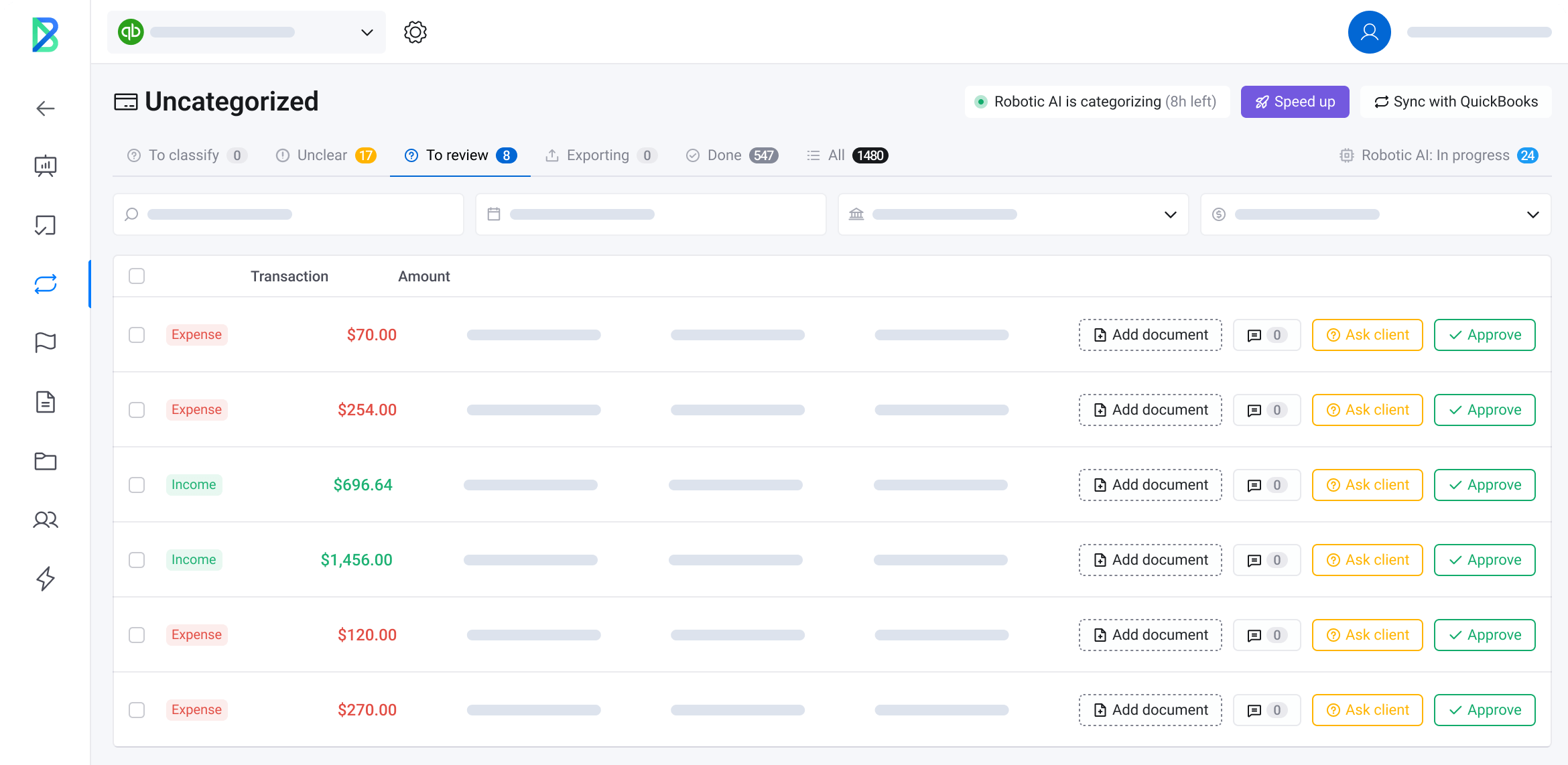
Key features include: Automated transaction categorization, Invoice matching, Bill matching, Receipt matching, Daily bank feed processing, Integration with QuickBooks Online (QBO), Integration with Xero, Exception review process.
Booke.ai is commonly used for: Small business bookkeeping, Automating financial record keeping, Expense tracking for freelancers, Invoice management for service providers, Financial reporting for startups, Streamlining accounting processes for accountants.
Booke.ai integrates with: QuickBooks Online (QBO), Xero, Stripe, PayPal, Square, Shopify, Banking institutions, Accounting software, Expense management tools, CRM systems.
Based on user reviews and social mentions, the most common pain points are: token cost, token usage, API costs, cost tracking.
Based on 187 social mentions analyzed, 12% of sentiment is positive, 87% neutral, and 2% negative.
