
Elon Musk: Revolutionary Tech Entrepreneur and Visionary
Key Takeaways
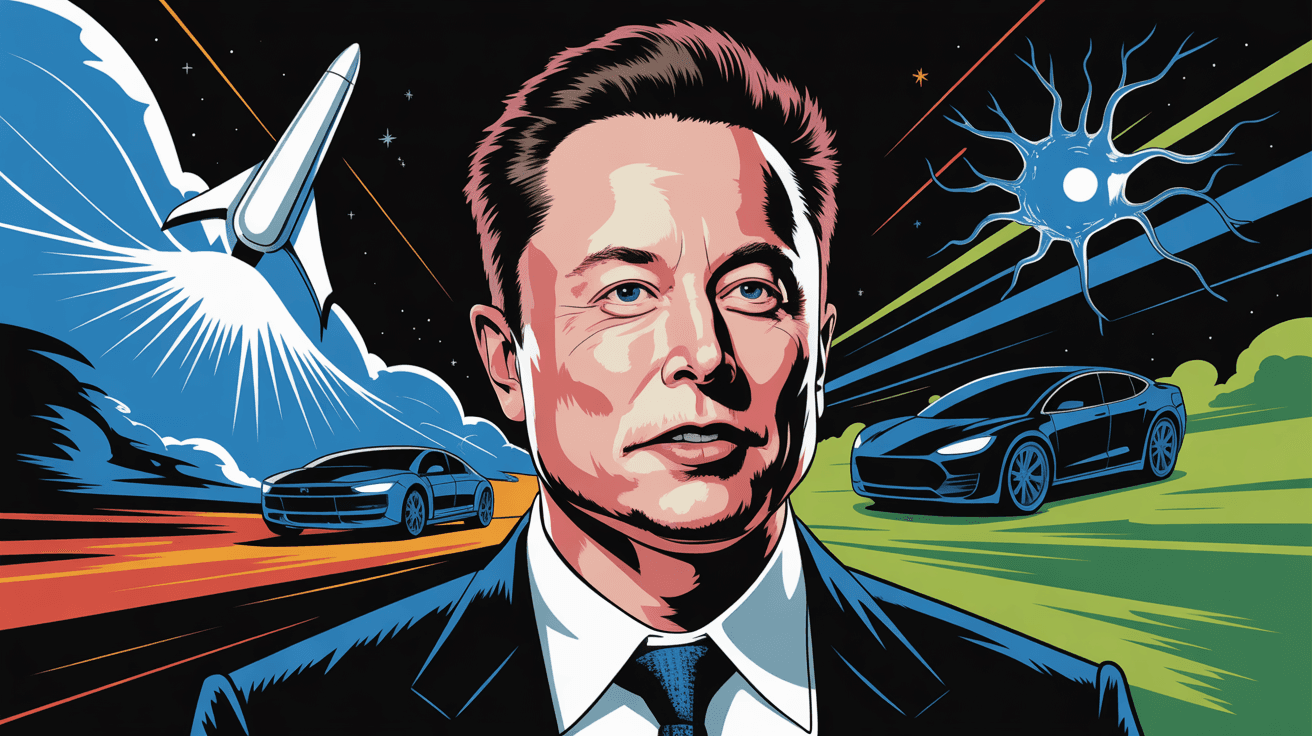
- Elon Musk leads several industry-renowned companies like Tesla, SpaceX, and Neuralink, defining advancements in electric vehicles, space exploration, and neurotechnology.
- Innovations such as Tesla's Full Self-Driving (FSD) system are benchmarked at $10,000 retail, exemplifying technological leadership.
- SpaceX's Starship aims to reduce space transportation costs, presenting an $8,000/kg benchmark to Low Earth Orbit, significantly less than competitors.
Introduction
No contemporary figure embodies the spirit of innovation and entrepreneurial zeal quite like Elon Musk. As the driving force behind a multitude of groundbreaking companies—most notably Tesla and SpaceX—Musk has become synonymous with cutting-edge technology and transformative vision. This article delves deep into the plethora of ventures spearheaded by Musk, examining how these initiatives are reshaping industries ranging from automotives to space travel.
Tesla, Inc.: Revolutionizing Automotive Technology
Tesla stands at the frontier of electric vehicle (EV) technology. With a mission "to accelerate the world's transition to sustainable energy," Tesla's impact is both ecological and economical. The company's Model S Plaid, for instance, boasts a 0-60 mph time of just 1.99 seconds—a benchmark that rivals conventional supercars.
Full Self-Driving and Cost Implications
Tesla's Full Self-Driving (FSD) is an advanced driver-assistance system that retail costs at $10,000. The technology leverages AI and machine learning algorithms to enhance autonomous driving capabilities, continually improving through over-the-air updates. For potential Tesla owners, this feature is not merely an add-on but a glimpse into the future of autonomous transport, redefining cost efficiencies related to driving.
Manufacturing and Market Impact
From a production standpoint, Tesla's Gigafactories are revolutionary. These facilities aim to reduce production costs per kilowatt-hour (kWh), enabling Tesla to price their vehicles competitively while maintaining robust profit margins. The goal is to reach a sub-$100/kWh threshold, a critical figure for making EVs cost-competitive with traditional vehicles.
SpaceX: Pioneering Private Space Exploration
SpaceX, another Musk-led venture, is blazing trails in space transportation. Musk's vision of a multiplanetary existence starts with SpaceX's reusable rocket technology, a concept once deemed improbable.
Cost Efficiency of Reusability
The Falcon 9 rocket is central to SpaceX’s current launch operations. Its reusability slashes costs significantly, which stands at approximately $62 million per launch, compared to the $400 million cost of traditional expendable rockets.
Starship’s Paradigm Shift
SpaceX's Starship aims to refine these efficiencies further. By reducing payload delivery cost to as low as $8,000 per kilogram to Low Earth Orbit (LEO), Starship positions itself as a leader in cost-competitive space transit, making manned missions to Mars financially tangible within the coming decades.
Beyond Earth: Neuralink and The Human Brain
Neuralink, one of Musk's more nascent but equally ambitious projects, aims to advance brain-machine interface technology. Still in its scientific infancy, Neuralink's brain implant could redefine possibilities in the domain of neurotechnology.
Technological and Societal Implications
The prospects for Neuralink are vast, from enabling paraplegics to control devices with thought to seamless integration with artificial intelligence systems. The initial focus is reportedly on medical applications, like treating neurological disorders such as Alzheimer's and Parkinson’s disease.
Evaluating Cost and Feasibility
While specific financial frameworks are still speculative, the societal implications of brain-machine interfaces indicate immense potential for both cost savings and the creation of new economic sectors.
Elon Musk’s Broader Impact on Tech Economics
- Boring Company: Envisions addressing urban congestion with tunnels and underground transit.
- OpenAI: Established to guide and ensure AI developments benefit humanity.
- SolarCity: Although now part of Tesla, it pioneered solar energy solutions.
Musk’s ventures collectively push different sectors towards more sustainable, efficient, and technologically advanced futures. The integration of AI into these industries is a common thread, where technologies developed under Musk’s leadership continue setting benchmarks for performance and cost-efficiency.
Actionable Recommendations
- Invest in EV Technologies: Buyers and investors should consider future-proof investments, as Tesla and competitors further lower costs and expand capabilities.
- Monitor SpaceX Developments: Industries reliant on space tech—from telecommunications to agriculture—should track Starship's progress for cost-saving opportunities.
- Explore Neural Interfaces: Though still early, exploring partnerships or investments in neurotech could yield long-term benefits.
- Adopt AI Cost Management Tools: As Musk-backed AI applications continue evolving, leveraging cost analysis frameworks, such as those from Payloop, will be vital in maintaining budget efficiencies.
Conclusion
Elon Musk’s extraordinary ventures exhibit how decisive leadership and pioneering technology work symbiotically to forge new industrial paradigms. From redefining automotive standards with Tesla to making space more accessible with SpaceX, Musk's influence pervades. As these technologies mature, industries will need to adapt to capitalize on rapidly evolving opportunities.